Churel, the woman with the feet turned backwards
By Ralf Ittermann · last reviewed on
Churel is a demoness of the Indian tradition.
Beautiful from the front, recognisable by her backwards-turned feet.
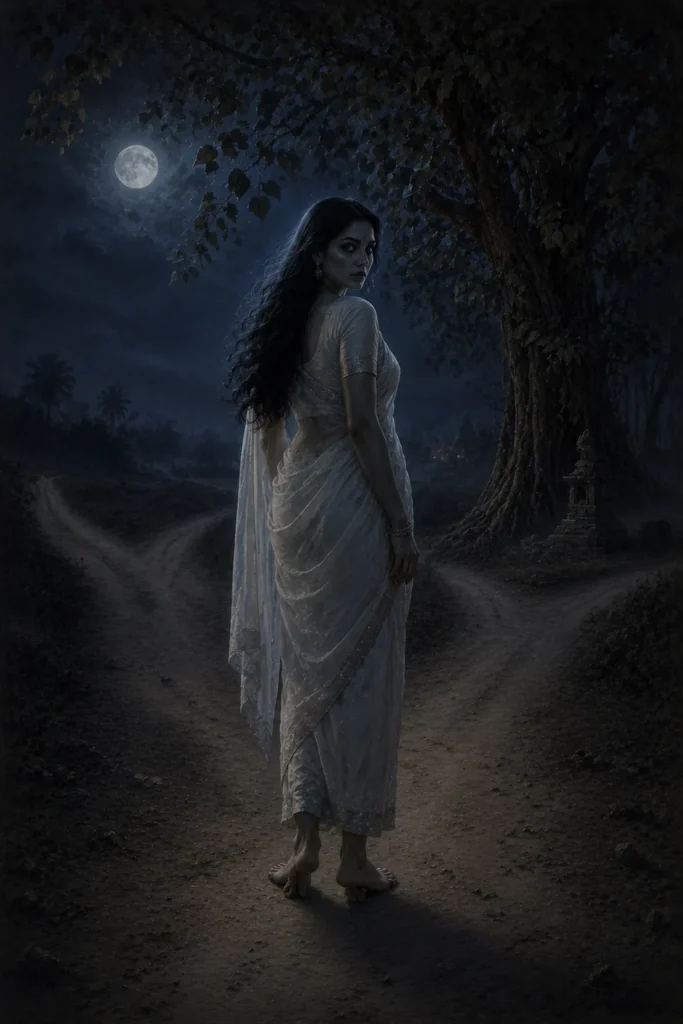
Churel is the avenging spirit of a woman who died during pregnancy, in childbirth, or through sustained neglect by her family. As an avenging female spirit, she transforms into a beautiful young woman in white, seduces men and drains their life force until they waste away in old age.
Her surest mark of recognition remains visible in every form: the feet turned backwards. The tradition has been well documented since the 19th century, with numerous regional variants from Northern India as far as the Caribbean, where it once travelled with Indian indentured labourers.
Type: Avenging spirit of a woman who died in childbirth or an impure death
Origin: North Indian and South Asian folk belief
Texts: well documented since the 19th century, fundamentally by William Crooke, numerous regional variants
Period: attested since the 19th century, still alive in literature and film to the present day
Appearance: hideous in her true form, transformed into a beautiful young woman in white, recognisable by her backwards-turned feet
Source context
Period of the Texts
Well documented since the 19th century, above all through William Crooke; the concept remains alive in literature and film to the present day.
Area of Diffusion
South Asia: India, Bangladesh, Nepal and Pakistan form the core regions. Through Indian indentured labourers, the belief also reached the Caribbean.
Sources
Good: numerous regional variants are documented, fundamentally through Crooke and supplemented by later folkloric and literary works.
Name and variants
Hindi: churel or chudail, a word also used colloquially to denote a witch. William Crooke documented numerous regional variants of the figure in the 19th century.
Appearance and transformation
Appearance
In her true form, the Churel is considered hideous, yet she can transform into a beautiful young woman in white. Her surest mark of recognition remains visible in both forms: her feet stand backwards, turned around. She shares this leitmotif with the Bhoot, which makes the trap narratively effective, for anyone who tries to evade her and flees in the opposite direction runs straight into her arms because of the reversed feet. The contrast between the beautiful front and the terrible back symbolises the seductive trap.
Effect
The Churel seduces men on paths, at crossroads and in fields, lures them away and drains their life force, blood or procreative power until they waste away as old men and die. If she arose from mistreatment within her family, her revenge strikes the male relatives one after another, from the youngest upwards. Whoever follows her nocturnal calls may die.
Profile: Churel
The key aspects of the Churel at a glance.
Avenging spirit of North Indian and South Asian folk belief, documented since the 19th century above all through William Crooke.
Young men and lone travellers whom she seduces, as well as the male relatives of the family in which she was mistreated during her lifetime.
Hideous in her true form, disguised as a beautiful young woman in white, always recognisable by her backwards-turned feet.
Draining of life force, blood and procreative power on paths, at crossroads and in fields, until the victim wastes away in old age and dies.
Preventive care for pregnant women, special burial rites for suspected cases, and exorcism performed by an Ojha or Baiga.
The impure death and the birth of an avenging spirit
The name Churel derives from the Hindi churel or chudail. She is regarded as the spirit of a woman who died during pregnancy, in childbed, or in the period afterwards considered ritually impure, or who perished from neglect and mistreatment by her husband and his family. William Crooke documented numerous regional variants of this belief in the 19th century.
The older tradition historically linked the Churel to women of lower caste. This should be understood as an attribution bound to the sources of the time, not as the essential nature of the figure: the actual core is the impure or unjust death suffered by a woman, not her social origin.
From Kipling to Bulbbul
The Churel appears in literature in Kipling and Tagore and in film, for instance in Bengali horror and in the 2020 feminist retelling Bulbbul. The Bollywood hit Stree from 2018 is based on the related Nale Ba legend and carries motifs close to the Churel, but is not identical to the Churel herself.
The Churel links the Preta motif with a pronounced taboo around women and childbed: death during the phase considered impure and neglect by the family create the avenging spirit. In social history she is read as an expression of real women’s fates, and modern reception increasingly turns this perspective towards the feminist.
Prevention, funeral rites and exorcism
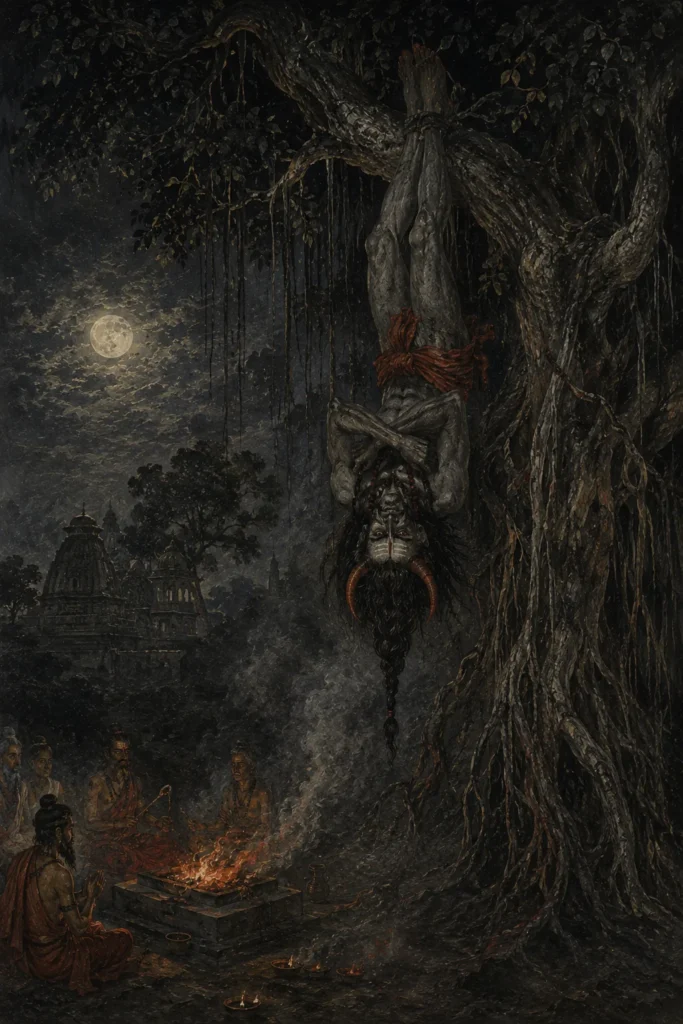
The most effective protection is prevention: good care for pregnant women is meant to prevent from the outset that a woman becomes a Churel. If a woman nonetheless dies under suspicious circumstances, she is buried rather than cremated, with particularly careful rites and holy water. In especially dangerous cases, the body is placed face down in the grave, the fingers and toes are nailed down with iron, it is covered with thorns and weighted with stones. Mustard seeds scattered along the path are meant to delay the spirit until sunrise, because she must pick up every single grain; wormwood is also widely regarded as a protective herb of similar function in warding off spirits. An Ojha or Baiga, a spirit healer, can drive out the Churel after a sacrifice.
Related avenging spirits in comparison
The Churel is related to the Malay Langsuir and the Pontianak, female spirits of women who died during or after childbirth, as well as to the Romanian Strigoi in the family and blood motif and the Slavic Nav, the souls of those who died in childbed. All share the core idea that death in childbed produces an avenging female spirit.
Frequently asked questions about the Churel
How can you recognise a Churel?
Most reliably by her feet turned backwards; her beautiful form is deception, her true form is ugly.
How can a woman be prevented from becoming a Churel?
Through good care for pregnant women and, in the event of death, through a special burial instead of the usual cremation.
Whom does the Churel attack first?
If she arose from mistreatment by the family, the male relatives in turn, starting with the youngest.
Further links
Further reading:
- Bhoot – another Indian spirit with the motif of reversed feet
- Langsuir, Pontianak – Malay spirits of women who died in childbed
- Iron, Mugwort, Holy Water – traditional protective means
- Protection Compass – protective means at a glance
Literature (selection)
Further standard works in the bibliography.
As chudail or churel, she remains in South Asian folk belief an avenging female spirit: beautiful from the front, deadly from behind, recognisable by feet that always point back towards where death came from.