Bixia Yuanjun, pilgrimage goddess of Tai Shan
By Ralf Ittermann · last reviewed on
Bixia Yuanjun is a goddess of Chinese tradition.
Goddess of birth and protectress of women and children.
Bixia Yuanjun, the Lady of Tai Shan, is the Daoist-folk-religious goddess of the sacred Eastern Mountain Tai Shan in Shandong. She is responsible for birth, fertility and the protection of women and children, and is the object of a large pilgrimage cult.
In folk tradition she is also called Taishan Niangniang, Lady of Tai Shan, or Tianxian Shengmu, Heavenly Holy Mother. Her rise to a cult figure of supra-regional significance began in the Song era; she became a mass goddess of northern China in the Ming and Qing eras, and her pilgrimage cult remains alive to this day.
Type: Daoist-folk-religious protective and fertility goddess
Origin: Tai Shan, Shandong, Northern China
Texts: Song-era founding legend, pilgrimage and temple tradition
Period: Song era to the present, living pilgrimage cult
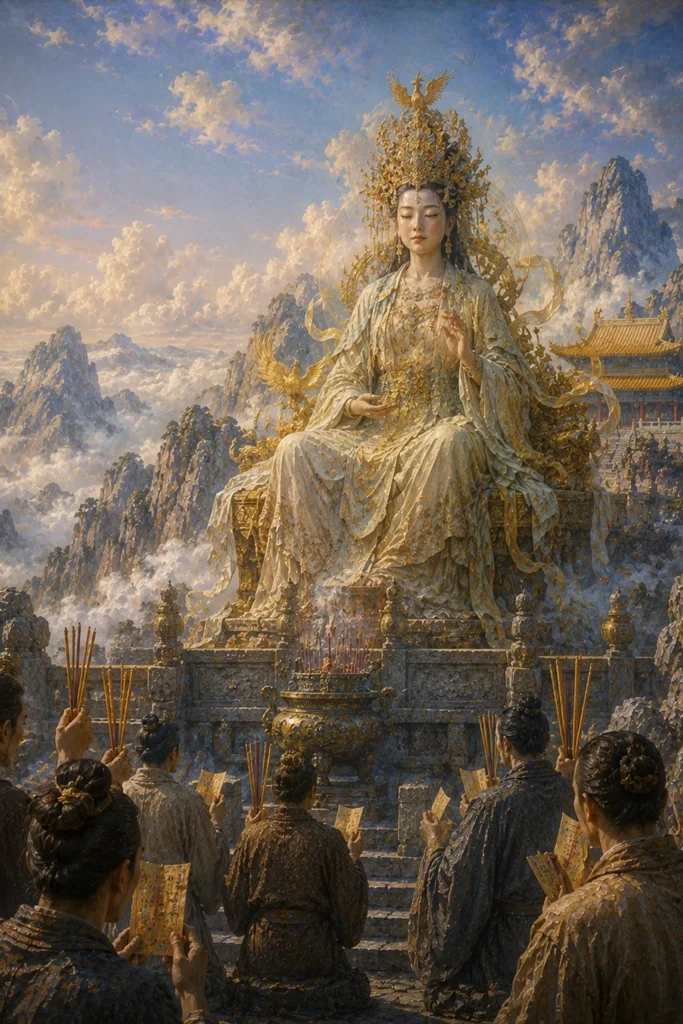
Appearance: enthroned matron with phoenix crown
Region of origin and sources
Period of the Texts
The cult is documented since the Song era and remains alive today; Bixia Yuanjun became a mass goddess of northern China in the Ming and Qing eras.
Area of Diffusion
Tai Shan in Shandong and northern China as a whole: branch temples exist among others in Beijing and on Miaofengshan.
Sources
Well documented: the pilgrimage cult is the subject of thorough religious studies research, above all by Susan Naquin and Kenneth Pomeranz.
Name and variants
Chinese: Bìxiá Yuánjūn, roughly the Original Lady of the Azure Dawn Clouds. In folk tradition she is also called Taishan Niangniang, Lady of Tai Shan, or Tianxian Shengmu, Heavenly Holy Mother.
Form and attributes
Appearance
Bixia Yuanjun appears as an enthroned matron figure with a characteristic phoenix or bird crown, often flanked by assistant goddesses, including the Lady of Eyesight and the Lady Who Brings Children.
Effect
She is responsible for birth, fertility, the protection of women and children, and for healing, particularly of eye ailments; petitions are directed above all towards having offspring. Attributions such as judging the dead overlap with the domain of Dongyue Dadi and are in part a popular assimilation.
Profile: Bixia Yuanjun
The key aspects of the goddess at a glance.
Daoist-folk-religious goddess of the sacred Eastern Mountain Tai Shan, attested since the Song era and risen to become a mass goddess of northern China in the Ming and Qing eras.
Birth, fertility and the protection of women and children; also healing, particularly of eye ailments, and petitions for offspring.
Enthroned matron with a phoenix or bird crown, often flanked by assistant goddesses such as the Lady of Eyesight and the Lady Who Brings Children.
Tai Shan and northern China as a whole: pilgrims carry their petitions to the summit temple, branch temples stand in Beijing and on Miaofengshan.
A large pilgrimage cult to the Bixia temple on the summit plateau, with votive offerings, petition slips, ex-votos and pilgrimage societies, especially in spring.
Functionally analogous to the sea goddess Mazu and to Guanyin’s role as bringer of children; as Lady of the Mountain she stands alongside Dongyue Dadi.
From stone figure to mass goddess
The name Bìxiá Yuánjūn means roughly the Original Lady of the Azure Dawn Clouds. The rise to a cult figure of supra-regional significance is bound to the Song empire; the founding legend links the goddess with a stone figure found on the mountain in 1008.
Bixia Yuanjun became a mass goddess of northern China in the Ming and Qing eras, when the stream of pilgrims to Tai Shan reached its full breadth. Her relationship to Dongyue Dadi, the Lord of the Mountain, of whom she is often considered the daughter, is popular but not consistently documented.
Living cult and classification
The pilgrimage cult to Tai Shan remains alive to this day and is the subject of thorough scholarship in religious studies, above all by Susan Naquin and Kenneth Pomeranz.
In religious studies, Bixia Yuanjun is a benevolent goddess of protection and fertility. Two clarifications are important: the popular-esoteric reading of her as a goddess of dawn who brings each new day is an overstretching of the name element ‘clouds’; the focus is on birth and fertility, not a sunrise myth. And the classification as a daughter of Dongyue Dadi is common, but not fixed in the canon.
The pilgrimage cult to the summit temple
Well documented is the great pilgrimage cult to the Bixia Temple on the summit plateau of Tai Shan, with votive offerings, prayer slips, ex-votos and pilgrim associations, especially in spring. Branch temples exist throughout northern China, including in Beijing and on Miaofengshan. Those who wished to ask the goddess for offspring or for a child’s protection set out for the mountain; the pilgrimage itself is the central form of the cult.
Mazu, Guanyin and the lord of the mountain
Functionally, Bixia Yuanjun is analogous to the sea goddess Mazu and to Guanyin’s role as a bringer of children. Structurally, she stands as the lady of the mountain alongside the lord of the mountain, Dongyue Dadi, who presides over the tribunal of the dead on Tai Shan.
Frequently asked questions about Bixia Yuanjun
Who is Bixia Yuanjun?
The Daoist goddess of Tai Shan and goddess of birth, fertility and the protection of women. Her summit temple is the destination of a great pilgrimage cult.
What is she invoked for?
Above all for offspring, for the protection of women and children, and for healing of eye ailments.
Is she the daughter of the mountain god?
This classification as a relation of Dongyue Dadi is popular, but not fixed in the canon; the sources are inconsistent here.
Further links
Further reading:
- China – all beings of the Chinese cultural sphere
- Dongyue Dadi – the lord of Tai Shan and of the tribunal of the dead
- Incense burning, amulet, protective candle – traditional protective means
- Protection Compass – an overview of protective means
Literature (selection)
Further standard works in the bibliography.
As lady of Tai Shan and goddess of birth, Bixia Yuanjun embodies the benevolent side of the sacred eastern mountain: where Dongyue Dadi judges the dead, she assists the living.