Pairika, from demoness to Peri
By Ralf Ittermann · last reviewed on
The Pairika is a demoness of the Persian tradition.
The beautiful but malicious seductress who became the Peri.
The Pairika, in New Persian Pari or Peri, was originally a beautiful but malicious demoness of the Avesta. Over time she transformed into the beautiful, winged Peri of Persian poetry, the symbol of otherworldly beauty.
In the early period she brings drought and calamity: she brings comets and darkness, prevents rain, causes crop failures and seduces men. The figure is found from India to Turkey.
Type: Seductive demoness, later the beautiful Peri
Origin: Avesta; the Iranian region and Central Asia
Texts: Avesta (Vendidad), Islamic-era poetry by Ferdowsi and Attar
Period: Avesta to Islamic-era poetry
Appearance: beautiful but malicious woman, later winged
Historical Classification
Period of the Texts
From the Avesta to Islamic-era Persian poetry: her origin lies in the Avesta as a demoness, continued by Ferdowsi and Attar.
Area of Diffusion
The Iranian region and Central Asia; the figure is found from India to Turkey.
Sources
Well documented: the Avesta, Persian poetry and the Encyclopaedia Iranica.
Name and variants
Avestan: pairika, Middle Persian parig, New Persian pari or peri, possibly related to the root par, wing; there is no consensus on the derivation.
Appearance
Appearance
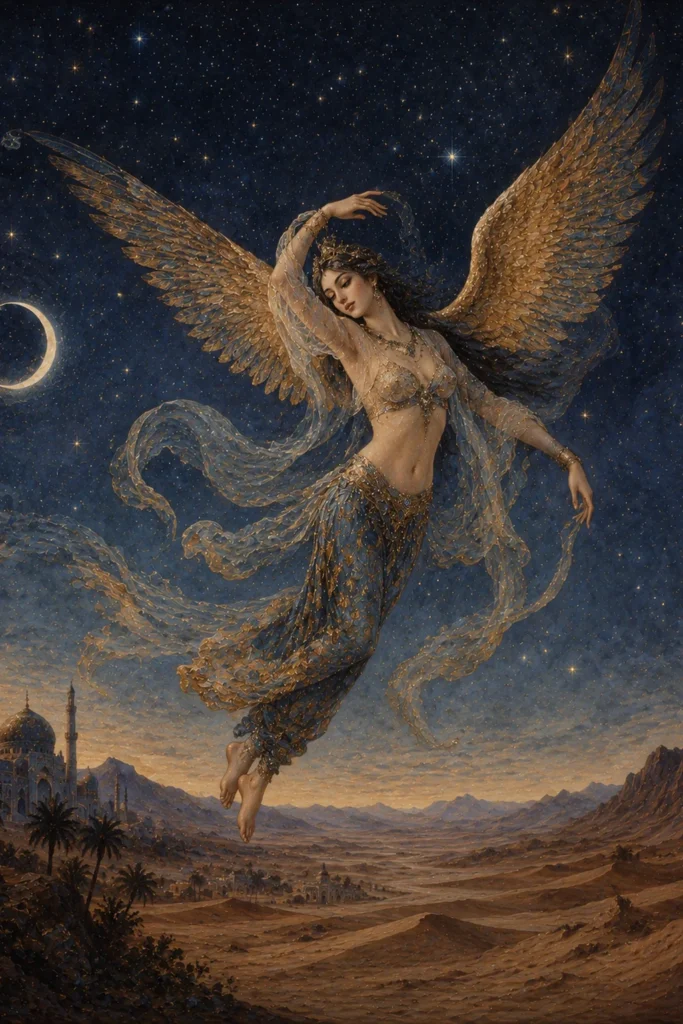
In Avestan sources the Pairika is a beautiful but malicious demoness, listed in the Vendidad alongside sorcerers, often a sorceress or witch and agent of Ahriman. From the 10th century onwards, in the Islamic era, she transforms into a beautiful, winged being resembling an angel or nymph.
Effect
In the early period the Pairika brings drought and calamity: she brings comets and darkness, prevents rain, causes crop failures and seduces men. Later she is associated with beauty and love, and in the folk belief of Central Asia she is sometimes even helpful, as shamans consult the Pari.
Profile: Pairika
The key aspects of the seductress at a glance.
Demoness of the Avesta with a long afterlife: from the Vendidad through Persian poetry to the folk belief of Central Asia.
Men, rain and harvest: the early Pairika seduces, prevents rain and causes crop failures.
A beautiful but malicious woman, listed in the Vendidad alongside sorcerers; from the 10th century onwards winged, resembling an angel or nymph.
Agent of Ahriman in the early period; later a symbol of otherworldly beauty in Persian poetry.
In the early Zoroastrian phase, the general defence against the Daeva; there is no defence for the later, positive Peri.
The fixed counterpart pairing with the ugly Divs; the equation of Peri with fairy is disputed and mostly rejected.
From the Vendidad to poetry: a shift in meaning
In Avestan the figure is called pairika, in Middle Persian parig, in New Persian pari or peri, possibly related to the root par, wing, without consensus on the derivation. Her origin lies in the Avesta as a demoness: in the Vendidad she stands alongside sorcerers, often as a sorceress or witch and agent of Ahriman.
From the 10th century onwards she transforms into a beautiful, winged being resembling an angel or nymph, and enters Islamic-era Persian poetry with Ferdowsi and Attar. The figure is found from India to Turkey; in the folk belief of Central Asia the Pari is sometimes even helpful, as shamans consult her.
The Peri in Romanticism and folk belief
Thomas Moore made the Peri popular in Paradise and the Peri, set to music by Robert Schumann as Das Paradies und die Peri; thus the Peri entered European Romanticism. Added to this is the story of Ahmad and Peri Banu from the Thousand and One Nights.
From a religious-studies perspective, the Pairika is a demoness who became the beautiful Peri. Three clarifications: the shift from malicious demoness to beautiful Peri is well documented and the scholarly consensus. The shortcut of equating Peri with fairy is a popular misconception without consensus. And the thesis of pre-Zoroastrian goddesses is a hypothesis, not directly readable from the Avesta.
Defence against the Daeva and its end
In the early Zoroastrian phase, the Pairika falls under the general defence against the Daeva: veneration of Ahura Mazda and the code of purity in the Vendidad. There is no defence for the later, positive Peri; a being who has become a symbol of otherworldly beauty is no longer warded off, but sung about.
Peri versus Div: contrast and kinship
The Pairika forms a fixed pair of opposites with the ugly Div, Peri against Div. Functionally she resembles the Arabian Djinn and was integrated into the Houri tradition from the 10th century onwards. The kinship of Peri and English fairy, however, is disputed and mostly denied. Belonging to the same demonic world is the wrath demon Aeshma; as a seductress, Umm al-Duwais of the Arabian tradition is close to her.
Frequently asked questions about the Pairika
What is a Pairika?
Originally a beautiful but malevolent demoness of the Avesta, an agent of Ahriman. Later she became the beautiful Peri of Persian poetry.
How did her meaning change?
From the calamitous demoness who prevents rain and seduces men, she transformed from the 10th century onwards into a beautiful, winged being, resembling an angel or a nymph.
Is the Peri the same as a fairy?
The equation of Peri with fairy is a popular misconception without scholarly consensus; the kinship is mostly denied.
Further links
Further reading:
- Div – the ugly counterparts to the beautiful Peri
- Aeshma – the wrath demon of Persian tradition
- Umm al-Duwais – the seductive demoness of Arabian tradition
- Holy Water, Amulet, Iron – traditional protective means
- Protection Compass – an overview of protective means
Literature (selection)
Further standard works in the bibliography.
Few Persian demonesses have undergone such a transformation as the Pairika: from an agent of Ahriman in the Avesta to the beautiful Peri of poetry, whose name still stands for otherworldly beauty today.