Tupilak: Artificially Made Revenge Spirit of the Greenlandic Tradition
By Ralf Ittermann · last reviewed on
In the Greenlandic Inuit tradition, the Tupilak is an artificially made being, deliberately deployed, assembled from animal and human remains, with which a shaman sought to harm or kill an enemy.
Today the term is known internationally above all as a carved figure made of bone or stone. In religious studies it belongs to the rare class of manufactured aggression spirits.
Classification and Brief Profile
In religious-studies classification, the Tupilak belongs to the rare group of manufactured spirit beings.
Unlike Sedna, Sila or Tornarssuk, which are regarded as given cosmic or helping powers, the Tupilak is a deliberately produced construct that serves a concrete purpose: harming an enemy. This constructive dimension fundamentally distinguishes it from all other entries of the Inuit pantheon.
The sources for the Tupilak concentrate on Greenland, in particular the east coast and the Disko Bay, and range from the 18th century with Hans Egede through Henrik Rink in the 19th to William Thalbitzer and Robert Petersen in the 20th century.
Related terms such as tupilaq or tuurngaq qungasiq are also attested in the central Canadian Arctic, though there with a partly divergent meaning. This regional specificity is instructive from a religious-studies perspective.
Today the Tupilak exists in two layers in parallel: as the historical concept of a being of harm actually manufactured and magically animated, and as the term for the carved figures made of whale tooth, reindeer antler and bone that have been developed as a Greenlandic craft form since the 1880s. This dual layering makes any discussion of the Tupilak methodologically demanding and requires careful differentiation.
With the Tupilak, more recent research has expanded its methodological tools and combines ethnographic precision, linguistic source criticism and a comparative perspective.
This refinement is especially necessary here, because older Western accounts often sensationalized the artificially produced being of harm; the Inuit community of knowledge, which today is itself involved in the research, corrects such partly colonially shaped attributions.
Etymology and Word History
Etymologically, tupilak or tupilaq derives from the stem tupi-, which in several Inuit languages means ancestor or soul of a dead person. Tupilak would thus literally mean something like ancestral form or spirit creature.
In his studies of linguistic history, Robert Petersen worked out the kinship with terms for the spirit of a deceased person, thereby establishing a linguistic bridge to the world of the dead among the Inuit.
In the Greenlandic language the plural tupilait also exists, denoting the collective of these beings. In modern usage the meaning has broadened and is often translated as bogey figure or evil spirit, which shortens the original meaning and loses the specific dimension of construction. In religious studies this reduction must be treated critically.
It is notable that the Tupilak is not negatively connoted in its etymology. The negative valuation arises from its function, not from the word itself. A Tupilak is not evil by nature but is deployed for aggression.
This ethical neutrality of the word itself is of interest in religious studies because it shows that the moral assessment arises only through the intentional use.
In addition, the religious-sociological view of the role that the Tupilak played in the social order of the traditional Inuit community is worthwhile.
Since such a being was directed deliberately against an enemy, it shows particularly clearly that the religious structure was not separated from social practice but closely interwoven with it. This entanglement forms its own field of religious anthropology, which Frédéric Laugrand and Jarich Oosten in particular have studied systematically.
Manufacture in Traditional Practice
The ethnographic sources, especially in Henrik Rink and William Thalbitzer, describe the manufacture of a Tupilak in detail.
A shaman who wished to harm an enemy secretly gathered components: bones of various animals, hair, sinews, sometimes pieces of corpses or of the enemy’s own clothing. These components were assembled into a figure at a secluded place, often at a rock cleft or cave.
Over this figure, chants and incantations were performed. The shaman suckled the being from his armpit or his lap and transferred vital force to it. The figure was then released into the water or the snow to seek out and kill the enemy.
If the enemy was himself a powerful shaman, he could ward off the Tupilak or even turn it back against its creator, which lent the practice a considerable risk.
In religious studies this practice is interesting because it rests on a theory of the animation of inorganic and organic remains that is interlocked with the shamanic doctrine of helping spirits.
The Tupilak is a form of constructive magic that in the Inuit cosmos is at once permitted and ethically burdened. In terms of the phenomenology of religion, it is a hybrid form combining construction magic and spirit animation.
The manufacture itself was a dangerous act. Whoever was discovered risked social ostracism, retaliation by the enemy’s family or death by his own Tupilak.
This structure of risk stabilized the social order and made the use of Tupilaks the exception rather than the rule, even though the narratives give the impression of a more frequent practice.
Compared with other shamanic practices of the Inuit, the manufacture of a Tupilak is described in exceptional detail, because it was regarded as a dangerous anomaly and thereby aroused particular interest among the ethnographers’ informants.
This distortion of the source situation must be reflected upon in religious studies, because it may make the Tupilak practice appear larger in perception than it actually was.
In comparative religious studies, the Tupilak is read as a component of that circumpolar religious topography that recurs across thousands of kilometers in a remarkably consistent structure. This structural stability is regarded, in the phenomenology of religion, as one of the most remarkable findings of the field and is still discussed controversially today.
Apotropaic Counter-Practices
Against the Tupilak there was an established repertoire of apotropaic practices. Anyone who suspected that a Tupilak was on its way against him sought out a shaman who, with the help of his Tornait, that is, his helping spirits, could intercept, identify and send the Tupilak back.
If the Tupilak had returned against its creator, it brought him the intended death. This reciprocity is, in the phenomenology of religion, a pattern of its own.
Other protective practices consisted in wearing apotropaic amulets, sealing the igloo entrances with certain rites and observing the general taboo rules, whose observance was meant to weaken the Tupilak.
The effectiveness of these means was a central theme of belief and experience that is treated extensively in Greenlandic narrative literature and makes up a considerable share of the oral corpus.
In religious studies it is notable that the Tupilak practice generated both discourses of threat and of protection.
The possibility of an aggressive use heightened the social significance of the shamans as an instance of protection and at the same time stabilized the social order, because overt conflicts tended to be avoided. This socio-political function of the Tupilak threat is, in the sociology of religion, an independent object of research.
Mythological and Legendary Tupilak Narratives
The East Greenlandic narrative literature knows numerous Tupilak stories in which a Tupilak returns against its creator because the chosen enemy was too strong.
A well-known narrative reports of a shaman who directed a Tupilak against a rival who, however, recognized its power, warded it off and sent it back to the sender. The creator thereupon died in his own igloo.
Other narratives concern Tupilaks that strike the innocent by mistake, or Tupilaks that no longer come under the control of their creator and roam through the tundra as wandering spirits of harm.
These narratives are not merely entertaining but function as ethical warnings: whoever makes Tupilaks risks his own life. The didactic dimension of the narratives is, in religious pedagogy, a topos of its own.
The Tupilak narratives are attested many times over in the major Greenlandic collections, for instance in Henrik Rink and Mathias Storch. They form an independent genre within Inuit folklore and are an important source corpus for the religious-studies reconstruction of traditional shamanic practice and its ethical discourse.
A specific subgroup of the narratives deals with Tupilaks described as animal hybrids that act at the boundary between animal and spirit.
This hybrid character of the Tupilaks is, in the phenomenology of religion, a phenomenon of its own and connects the Tupilak conception with the general transformation theology of the Inuit, in which the boundaries between human, animal and spirit are permeable. Here lies a research question of its own concerning the construction of hybrid beings.
From Spirit of Harm to Carved Figure
A significant transformation of the Tupilak concept began in the 1880s in East Greenland. European visitors asked shamans about the appearance of the Tupilaks.
Since the real Tupilaks were invisible or amorphous and disintegrated immediately after their task, the shamans carved models from whale tooth, reindeer horn and later stone. These models were objects of demonstration, not magically effective Tupilaks.
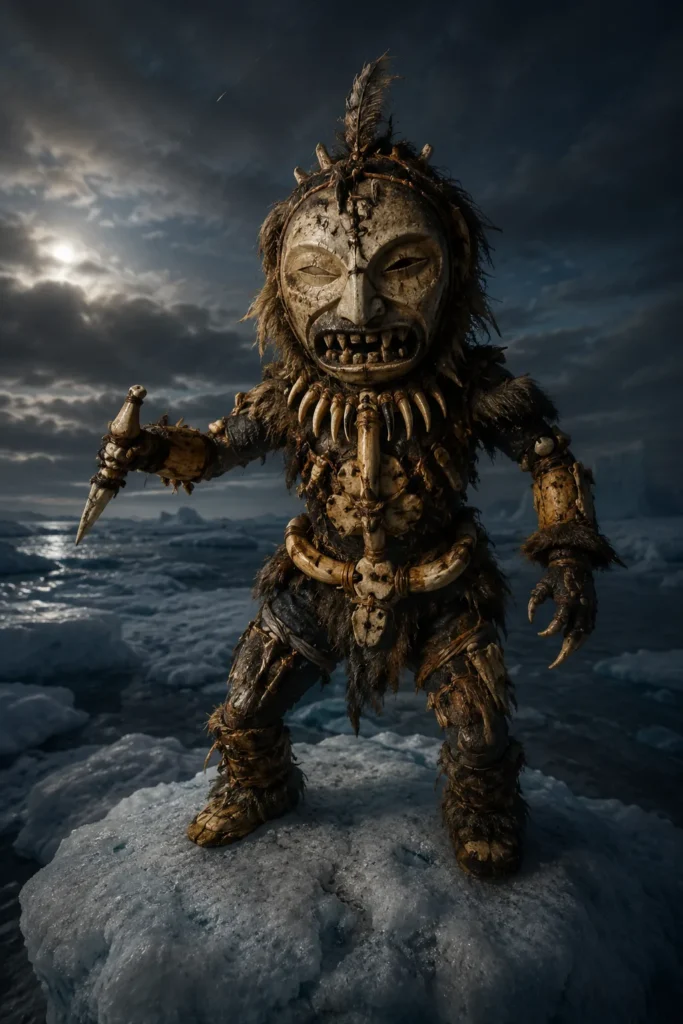
From these models an independent craft tradition arose. Today’s Greenlandic Tupilak carvings show distorted, hybrid beings with human, animal and fantastic features. They are a significant economic factor for Greenland and are present in every tourist trade. The aesthetic variety is great and reflects the individual creativity of the respective carvers.
In religious studies this transformation is a textbook example of the secularization of a religious category. The Tupilak as a spirit being has largely vanished from the imagination, while the Tupilak as a carved figure is world-famous.
Both layers must be kept cleanly apart if one wishes to understand the religion of the Inuit. This distinction is also explicitly conveyed in today’s Greenlandic schools and museums.
The Tupilak in Comparison with Other Beings of Harm
In religious-studies comparison, the Tupilak belongs to the category of constructed aggression spirits attested in many cultures. Structurally related are the Hebrew golem, the Javanese tuju, the Haitian zonbi complex and, in a certain sense, the ancient katadesmos curse tablet. Common to all is the deliberate material construction of an effective being.
Within the circumpolar region there are parallels in the Chukchi and Yupik traditions, which know manufactured aggression spirits, though with other material and ritual specifics. Among the Sami, the Tupilak corresponds structurally to the carved spirit beings that played a role in Sami shamanism, without a direct historical kinship being assumable.
The Tupilak practice stands out from Western notions of black magic in that it is not primarily ethically condemned. It is risky, but within the Inuit framework of values it is a legitimate, if dangerous, option in the event of conflict.
This ethical position makes the Tupilak practice interesting from the philosophy of religion and clearly distinguishes it from Christian, morally shaped notions of harmful magic.
In addition, the parallel to the Mesopotamian Lamashtu incantations should be noted, in which a combination of construction of harm and apotropaic practice likewise becomes tangible, without a historical connection having to be assumed.
These structural analogies are, in the religious-studies discussion of the universal patterns of harmful magic, a field of research of their own and evidence of the structural constancy of such practices across cultures.
Mission, Prohibition and Memory
With the mission that Hans Egede began in 1721 in West Greenland and that the Moravian and Danish-Lutheran churches continued, the Tupilak practice came under strong pressure.
It was regarded as devilish, was forbidden by the church and was socially ostracized. In East Greenland, which was intensively missionized only at the end of the 19th century, the practice persisted longest.
In religious studies it is difficult to date the precise extinction of the genuine manufacture of Tupilaks.
As late as 1923, William Thalbitzer reports of persons who had made Tupilaks in their youth or at least claimed to have done so. In the second half of the 20th century the Tupilak survives only in the carving art and in the narrative literature.
In Greenland’s schoolbooks and museums the Tupilak tradition is conveyed today with didactic care. The difference between historical magic and contemporary art is expressly marked in order to forestall misunderstandings.
This pedagogical practice is, in the didactics of religion, a field of research of its own and an example of conveying a colonially transformed history of religion.
Present-Day Research and Reception
Current research on the Tupilak takes place above all in Greenland itself, for instance at the Greenland National Museum and Archives in Nuuk and in the ethnological institutes of the Danish universities.
Robert Petersen, Birgitte Sonne and Jens Rosing have presented fundamental studies on the Tupilak practice and its pictorial history, which are recognized in the international research discourse.
The international reception is divided. While the religious-studies literature treats the Tupilak as a historical-ritual category, in popular culture the use as an esoteric or decorative motif dominates. This discrepancy is the subject of its own scholarly reflection on the colonial appropriation of indigenous religions and the ethical problems of such appropriations.
Within the Inuit diaspora, the Tupilak has remained a symbol of identity, without being revitalized as a magical practice. This dual stance, preserving the symbol while deliberately leaving the practice behind, is instructive in religious studies and shows the selective appropriation of traditional concepts in modern indigenous identity formation.
Lexicon Cross-References
Related are the entries Tornarssuk, Sedna, Sila, Anguta, Nanook, Pinga, Igaluk, Malina and Qailertetang. The cultural hub Inuit tradition frames the history of religion. Structurally similar construction spirits are found in the Sami series of entries and in numerous other traditions worldwide.
The Manufacture of the Tupilak in the Tradition
In the Greenlandic Inuit tradition, the Tupilak is not a born being but a manufactured one. According to the descriptions that derive, among others, from the records of the Fifth Thule Expedition under Knud Rasmussen and from older travel reports, a person who wished to harm another secretly fashioned the creature from various materials.
Bones, animal parts, pieces of pelts, sinews and occasionally also something from the body of a child or of the deceased were used.
These components were assembled into a small, often formless figure. Through songs, invocations and, according to some reports, through contact with the maker’s own body, life was breathed into the figure. The Tupilak was thereby a tool of harmful sorcery: it was sent into the sea to seek out and kill a particular victim.
The tradition emphasizes, however, that the Tupilak was dangerous to its own creator. If the targeted victim commanded stronger supernatural powers or was himself a shaman, he could ward off the Tupilak and send it back.
The returning Tupilak then killed the one who had fashioned it. The manufacture was therefore regarded as a highly risky and socially condemned act.
The sources for these conceptions are throughout records from outside, gathered by expedition members, pastors and travelers, and they relate above all to East and West Greenland. A uniform practice for the entire Inuit world cannot be derived from them.
The Carved Tupilak Figures and the Colonial Art Market
The best-known Tupilak objects today are small carved figures of tooth, bone, antler or wood that depict grotesque mixed and grimacing forms.
These figures are, however, not identical with the creatures of harmful sorcery described in the tradition. The original Tupilaks were concealed, secretly fashioned objects that no one was to see and that were not kept after use.
The carved figures arose only in contact with Europeans. Travelers, missionaries and later tourists wanted to know what a Tupilak looked like, and Greenlanders thereupon created visible images of what had until then existed only as a conception.
Out of this encounter, an independent carving art developed from the late 19th and above all in the 20th century, especially in East Greenland around Ammassalik. The Tupilak figures became a fixed component of Greenlandic craft and are still made today.
For research, this development is an instructive case of colonially shaped object history. What lies in museums and collections as a Tupilak is usually a product of the contact period, not a testimony of pre-colonial ritual practice.
Ethnologists such as William Thalbitzer, who studied East Greenland in the early 20th century, early identified the difference between the handed-down concept and the visible figure.
The carved Tupilaks are nevertheless not mere forgeries but an independent artistic tradition that has transferred the old concept into a new, material form. With every statement about Tupilak objects it must therefore be distinguished whether the handed-down conception or the carving art is being referred to.
Literature (Selection)
- Henrik Rink: Tales and Traditions of the Eskimo (Edinburgh 1875)
- William Thalbitzer: The Ammassalik Eskimo (Copenhagen 1914-1923)
- Robert Petersen: Carved Greenlandic Figures (Nuuk 1991)
- Birgitte Sonne: Worldviews of the Greenlanders (Fairbanks 2017)
- Jens Rosing: Sagn og saga fra Angmagssalik (Copenhagen 1963)
- Hans Egede: Det gamle Grønlands nye Perlustration (Copenhagen 1741)
In the Greenlandic tradition, the Tupilak is regarded as an artificially made revenge spirit that a shaman or angakkoq formed from bones, animal remains and skin in order to strike a particular opponent.
As a deliberately produced revenge spirit, the Tupilak differs from the freely roaming spirit beings of the Inuit tradition, because it is directed at a concrete person and can, according to the sources, turn against its own originator as soon as the attacked target is more strongly protected than expected.
Related key terms: Tupilak Tupilaq Tupilait spirit of harm carved figure East Greenland whale tooth Thalbitzer.
iWell Guard and Traditions of Protection
iWell Guard ties in with the cultural-historical tradition of portable protective objects, in the tradition of the Inuit and many other cultures worldwide. 41 layers, solid gold, platinum, silver, made in Germany. 30-day right of return.
Personal experiences may vary. Not a medical device. No promise of healing.