Atum, Egyptian creator god of Heliopolis
By Ralf Ittermann · last reviewed on
Atum is an Egyptian creator god whose cult was based in Heliopolis and who stands at the beginning of the Ennead there.
In the ancient Egyptian pantheon Atum is regarded as the creator god of Heliopolis, who emerged from the primeval waters of Nun and brought forth through himself the first two gods, Shu and Tefnut.
His name is usually translated as “the Complete One”, “the Whole One” or “the All”, yet it can also mean “the Non-Existent One”, since the verb “tem” can express both completion and negation.
This semantic ambivalence captures Atum’s theological position: he is that which existed before creation and that which will exist after creation, the beginning and the end of the cosmic cycle.
While Amun-Ra takes over the leading theological position in the Middle and New Kingdoms, Atum retains his cosmogonic function and his peculiar profile as a creator through self-masturbation or self-utterance, one of the oldest and most differentiated concepts in the history of religion.

Profile: Atum
Atum: the most important aspects at a glance. The following fields summarise origin, function, appearance, veneration, symbols and parallels.
Atum is the Egyptian creator god of Heliopolis and stands at the beginning of the Ennead there. He emerged from the primeval waters of Nun and brought forth Shu and Tefnut from himself. His name is translated as “the complete one” or “the all-become”, but can also mean “the non-existent”.
Atum creates the world out of himself, without partner and without pre-existing matter; in the Pyramid Texts he brings forth Shu and Tefnut through his semen or by sneezing and spitting. As the evening sun he forms the conclusion of the solar cycle, and at the coronation the pharaoh is identified with him.
Atum is usually depicted as a beardless, youthful man with the double crown (pschent), which symbolises the union of Upper and Lower Egypt. He can also wear a scarab, sun disc or atef crown on his head; as the evening sun he appears as an old man with a staff and a stooped back.
The main cult centre was Heliopolis with the temple of Atum-Re, the Benben stone, the sacred persea tree and the solar barque. In the morning the divine image was awakened with incense, libation and hymn, and in the evening put to rest. The most important festival was Wepet-Renpet, the New Year, which marked the beginning of the Nile flood.
His sacred animal is the snake; in addition the ichneumon is regarded as sacred because it kills snakes. The main cult symbol is the Benben stone in Heliopolis, a pyramid-shaped or conical stone that embodies the primeval mound; the pyramid form and the obelisks are said to have emerged from it.
Atum forms with Re the double form Atum-Re, merges in Thebes into Amun-Atum and stands in Memphis in relation to Ptah, who, according to the Memphite Theology, thinks what Atum carries out. With Khnum he shares the function of the primeval god. The return of the world to the primeval waters is structurally close to the Hindu pralaya.
Myth and Genealogy
The Heliopolitan cosmogony places Atum at the beginning of the Ennead (the group of nine gods). From the primeval waters of Nun, which existed before all time and form, Atum emerges onto the primeval mound (Tatenen), the first fixed point in chaos.
On this mound Atum carries out creation: in the Pyramid Texts (Spell 527) he creates Shu and Tefnut through his semen, which he either emits with his hand or receives in the form of the hand-goddess “Iusaas” or “Nebet-hetepet”.
In another variant (Pyramid Texts Spell 600) Atum creates the first gods by spitting them out: he sneezed out Shu (air) and spat out Tefnut (moisture). Both versions stand side by side, without Egyptian theology having attempted to harmonize them.
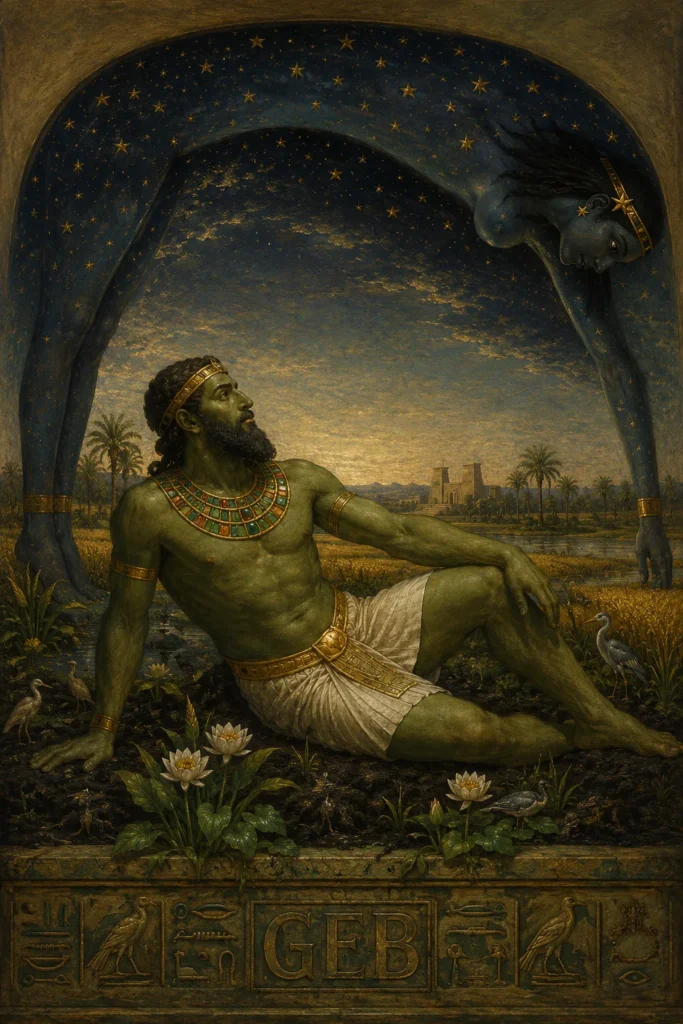
From Shu and Tefnut come Geb (earth) and Nut (sky), and from their union come Osiris, Isis, Seth, Nephthys and, in some lists, also Horus the Elder. Atum is thus the genealogical ancestor of almost all the important Egyptian gods.
The Ennead of Heliopolis (the group of nine gods) gathers Atum, Shu, Tefnut, Geb, Nut, Osiris, Isis, Seth and Nephthys; it forms the theological framework of Heliopolitan theology.
The sequence of gods is to be read not only genealogically but also cosmically: it unfolds creation from the pure selfhood of Atum, through the elemental forces of nature, to the divine figures that shape the human world.
The self-sufficiency of Atum in the oldest tradition is remarkable. Unlike other creator gods, Atum needs no partner and no pre-given matter; he creates the world out of himself.
This idea is developed philosophically in later theology: the Atum hymns of the New Kingdom describe him as the one who “made himself”, who “came into being out of himself” (kheper-djesef). This reading shapes the theological speculations of the Late Period and also influences Christian-Gnostic conceptions of the self-generator.
In the combined divine form Atum-Ra, Atum appears as an aspect of the sun god, specifically as the setting evening sun (in contrast to Khepri as the rising and Ra as the midday sun).
This threefold division of the solar cycle, treated at length in the sun litanies of the New Kingdom, makes Atum the god of the end of the cosmic cycle, who at the same time holds within himself the new beginning.
The pharaohs identified themselves with Atum especially in death, because he embodied the transition from the earthly sunset to the otherworldly rebirth.
Symbols, Iconography and Attributes
Atum is usually depicted as a man wearing the double crown (pschent), which symbolizes the union of Upper and Lower Egypt. This crown is a royal attribute and underlines Atum’s function as the primeval king and ancestor of pharaonic dignity.
He can also appear with the scarab on his head, with the sun disk or with the atef crown. In anthropomorphic form his face is usually beardless and youthful, which stands in contrast to the idea of the “old” Atum who embodies the evening sun.
His sacred animal is the snake. In the Book of the Dead (Spell 175) Atum declares: “I will send the world back again into the primeval waters, and only I and Osiris will remain, as two snakes that no human and no god knows”.
This eschatological vision lets the snake appear as a symbol of the undifferentiated primeval state. Alongside it, the ichneumon (Egyptian mongoose) is a sacred animal of Atum, because it kills the snakes that embody Apophis-like threats.
Atum’s main cult symbol is the Benben stone in Heliopolis, a pyramid-shaped or conical stone that embodied the primeval mound.
From the Benben came the later pyramid form of the royal tombs and the obelisks; every pyramidion (pyramid tip) is symbolically a Benben stone, embodying the ascent to heaven and the encounter with Atum-Ra. Heliopolis itself was marked in hieroglyphic writing with the sign of the Benben.
Sculptural images of Atum survive from all epochs of Egyptian religion. From the New Kingdom comes a famous quartzite statue of Tutankhamun, in which the youthful king is depicted with the Atum crown; from the Late Period numerous smaller bronze statues with Atum survive.
On the temple walls of the Ramesside period, especially in Karnak and Abydos, Atum is regularly depicted among the rows of gods who crown the king or hand him the sign of life “ankh”. In Deir el-Bahari, Hatshepsut equipped the Atum-Ra cult with impressive pictorial programs that legitimize her own creation through Amun-Atum.
Cult and Veneration
Heliopolis (Egyptian Iunu, meaning the “City of Columns” or “City of Pillars”) was the main cult center of Atum. The city lay about ten kilometers northeast of present-day Cairo and, since the unification of Egypt, was among the theologically most important cities of the land.
Here stood the great Atum-Ra temple with the Benben stone, the sacred Persea tree and the solar barque, which re-enacted the daily appearance and disappearance of the sun.
The Heliopolitan priesthood, with the High Priest at its head (called “Greatest of Seers”), was the most learned of Egyptian religion; its theological speculations had an effect on the entire land.
In the daily ritual of the Atum temple, the morning brought the “awakening” of the divine image through censing, libation and hymn recitation. During the course of the day the daily food offerings were presented; in the evening the divine image was ritually laid to rest and the sanctuary was sealed.
On special festivals, such as the royal jubilee (Sed festival) and the New Year festival, the image of Atum was taken from the sanctuary and carried in a procession through the temple courts. These processions were public and gave the urban population a share in the otherwise priestly cult.
The most important Atum festival was the festival of “Wepet-Renpet”, the New Year, which marked the beginning of the Nile flood. Atum received the first-fruit offerings on the eve of the new year, because as creator he was also the one who renewed the annual cycle.
Inscriptions in the temple of Karnak and in the Ramesside mortuary temples document these rites in detail. In the “ritual of the king from the hand of Atum” the liturgical sequence is rendered in full; it served the pharaoh as a model of his own daily temple ritual.
Outside Heliopolis the Atum cult was present in many places, but almost always as an aspect of other principal gods.
In Thebes, Amun-Atum was venerated; in Karnak the entire Ennead, including Atum, was taken into the festival calendar. In Memphis, Ptah-Atum was an important theological connection that combined the concept of Ptah-as-intellect with the concept of Atum-as-self-sufficiency.
The famous “Memphite theology” text (on the Shabaka Stone, today in London) articulates the theological reflection that Ptah accomplished through intellect and word all that Atum had accomplished through his semen; a philosophically high-ranking variant of creation theology.
Important Sanctuaries and Temples
The Atum-Ra temple of Heliopolis was one of the largest sacred buildings of Egypt, yet almost nothing of it survives.
The city was abandoned in Roman times and used in the Middle Ages as a quarry for the construction of nearby Cairo; only individual obelisks (Senusret I in Matariya) and remnants of the temple walls have endured.
Strabo (XVII, 1, 27 to 30) describes his visit to Heliopolis in the first century BC and gives a brief account of the temple; at that time the sanctuary was already neglected, but still visible.
Important Atum chapels are found in Karnak (in the court of the Temple of Amun), in the mortuary temple of Hatshepsut in Deir el-Bahari, in the temple of Ramesses II in Abydos and in the Sed festival temple of Amenhotep III in Malqata.
Most of the Ramesside mortuary temples on the west bank of Thebes (Ramesseum, Medinet Habu, the Seti I temple) have Atum chapels in which the deceased king was united with Atum-Ra.
In Abu Simbel, Atum is not among the four cult images in the sanctuary of the great temple (Amun-Ra, Ra-Horakhty, Ptah, and Ramesses II himself); Atum appears here as part of the royal apotheosis.
In Deir el-Medina, the village of the royal tomb workers, there are small private shrines at which Atum-Ra received invocations alongside Amun and Ptah.
Atum sanctuaries in the Libyan Desert (Bahariya, Kharga, Dakhla) are documented in the Late Period. In the Hibis temple of the Kharga Oasis, Atum is prominently represented as part of the theological pictorial programs.
Mythic Narratives
The central myth of Atum is his self-creation. In the Pyramid Texts (Spell 527 and 600) the story is told in two variants.
In the first, Atum, alone on the primeval mound, emits his semen into his hand, which is personified as the goddess Iusaas or Nebet-hetepet; from this seed Shu and Tefnut come into being.
In the second, Atum spits out the two gods, with the Egyptian wordplay between “spit” (techech) and Tefnut, and “sneeze” (ischesch) and Shu, becoming audible; the gods are thus brought forth from the verbs through onomatopoeia. Both variants stand for the Egyptian idea that creation is a bodily act, not an abstract, mental process.
Another narrative describes Atum’s search for his lost children Shu and Tefnut. In a mythical primeval time the two gods vanished into the primeval waters of Nun; Atum sent out his eye (the Eye-eye or the Ureh eye) to search for them.
While the eye was away, Atum made himself a new eye. When the old eye returned with the children it had found, it found the new eye in its place and grew furious.
Atum appeased the eye by setting it as a uraeus snake on his forehead; from the tears of the eye the first humans came into being.
This mythical narrative, handed down in several late texts, establishes the connection between the divine eye and the uraeus snake and at the same time explains the origin of the human race.
In the Book of the Dead (Spell 175) there is an eschatological vision: Atum announces that after long ages the created world will return once more into the primeval waters of Nun; only Atum himself and Osiris will remain, in serpent form.
This idea of a cyclical, eschatological return of the world into chaos is significant in the history of religion and stands in structural kinship with the Hindu Pralaya concept and with later apocalyptic ideas.
In the daily solar cycle, Atum takes on the role of the evening sun. With his entry into the underworld the nocturnal journey of the solar barque begins, which traverses the realm of the dead in twelve hourly sections.
This journey is described in detail in the “Books of Gates” and in the “Amduat” (the “Book of What Is in the Underworld”). Atum, as an old man with a staff and a bent back, climbs into the barque and is led through the night to the morning resurrection as Khepri.
Relationships within the Pantheon
Atum is, genealogically and theologically, the ancestor of the Heliopolitan pantheon. With Shu and Tefnut he has the father-child relationship; in one variant they appear as his hands, which attain their own existence.
With Ra he forms the double form Atum-Ra, in which the evening sun and the daily sun are theologically brought together. With Khepri and Ra arises the threefold figure of the solar cycle: Khepri (morning sun), Ra (midday sun), Atum (evening sun).
With Amun in Thebes, Atum merges into Amun-Atum, a form that became theologically effective in the Ramesside period.
With Ptah in Memphis there is, in the “Memphite theology“, a philosophical relationship: Ptah thinks and speaks that which Atum then creatively carries out; this reading makes Atum the executing aspect of a creation conceived by Ptah.
With Khnum in Esna there is a similar complementarity; Khnum forms the living beings, Atum brings them into existence.
With Osiris, Atum has an eschatological relationship that is articulated in the Book of the Dead: both are imagined as the only remaining gods at the end of the world, in serpent form. This constellation makes Atum the god of the cosmic beginning and end, Osiris the god of the rule over the underworld.
With the king (pharaoh) there is a special relationship: at his coronation the pharaoh is identified with Atum, and at his death he is received as Atum-Ra into the solar cycle. This ritual identification is the core of Egyptian royal theology.
Reception
In Greco-Roman antiquity, Atum was usually equated with Helios or Apollo, sometimes also with Saturn, because Atum is “the Old One”. Plutarch (“De Iside et Osiride” 12 and 73) treats Heliopolitan theology.
Hellenistic Hermeticism used Atum concepts in its speculations about the “autogenes theos”, the “self-generated god”. This reading shapes the “Corpus Hermeticum” and, through it, the Christian-Gnostic theology of late antiquity.
With the end of the pagan temple cult in the fifth and sixth centuries of the Christian era, the practical Atum cult disappeared. The Coptic tradition, however, preserved some theological concepts, such as the idea of the self-generated god, which becomes visible in Coptic-Christian Christology.
In the Middle Ages, Arab travelers reported on the abandoned temple remains of Heliopolis; most of the obelisks were transported over time to Rome (today the Lateran, Piazza del Popolo) or to Constantinople.
The modern rediscovery of the Atum cult begins with the Napoleonic scholars and with Champollion’s decipherment of the hieroglyphs. In the nineteenth century, Lepsius documented the Atum pictorial programs; in the twentieth century, James Henry Breasted, Henri Frankfort and Erik Hornung systematically presented the theological depth of the Heliopolitan cosmogony.
In the more recent research of Jan Assmann (“Theology and Piety“, 1984) and James P. Allen (“Genesis in Egypt”, 1988), Atum has been treated as the central figure of Egyptian “pre-creation theology”.
In modern esotericism and in New Age literature, Atum appears as the archetype of “self-born consciousness”, a reading that draws on the Hermetic-Gnostic tradition.
Religious-Studies Classification
Atum belongs to the category of creator gods who create through self-generation. This idea is striking in the history of religion: while most polytheistic religions describe creation through battle, union or workshop labor, Egyptian Heliopolitan theology knows the creator who comes into being out of himself.
Comparable are only a few other ideas: the Hindu Prajāpati, the Vedic Hiraṇyagarbha (the “Golden Egg”) and, in a limited way, the Gnostic Autogenes.
The theological reflection on Atum reached high points especially in the Late Period.
The Esna hymns, the Memphite theology and the hymns from the temples of Edfu and Dendera treat the paradoxical aspects of the creator: he is in the primeval waters and yet distinct from them, he is alone and yet father of an Ennead, he is old and eternal at the same time.
This philosophical depth makes the Egyptian discourse on creation one of the most differentiated in ancient religious history and places Egyptian thought on a level with Greek and Indian philosophy.
Henri Frankfort saw in Atum the “high god” of Egyptian religion, a reading that was later qualified by Hornung: Atum is not the only or highest god, but a manifestation of the divine principle that appears under many names and forms. Jan Assmann, in “Egypt.
Theology and Piety” (1984), analyzed the “New Solar Theology” of the New Kingdom, in which Atum, Ra and Khepri are united into three aspects of a single solar being; this reading prepares the way for the monolatrous piety of the Amarna period under Akhenaten and stands in structural kinship with the later biblical monotheism.
Sources
Pyramid Texts, Spell 527 (self-creation), Spell 600 (Shu and Tefnut), Spell 587. Coffin Texts and Book of the Dead, especially Spell 17, 78 and 175. Memphite theology (Shabaka Stone, British Museum EA 498), edition by James H. Breasted.
Esna temple inscriptions, edition by Sauneron. “Book of Gates” and “Amduat” from the royal tombs in the Valley of the Kings, edition by Hornung.
Strabo, “Geographica” XVII, 1, 27 to 30; Plutarch, “De Iside et Osiride” 12, 73. Henri Frankfort, “Kingship and the Gods”, Chicago 1948. Erik Hornung, “Der Eine und die Vielen”, Darmstadt 1971. James P. Allen, “Genesis in Egypt.
The Philosophy of Ancient Egyptian Creation Accounts”, New Haven 1988. Jan Assmann, “Ägypten. Theology and Piety of an Early Civilization”, Stuttgart 1984.