Turms: Etruscan Messenger of the Gods, Counterpart of the Greek Hermes
By Ralf Ittermann · last reviewed on
In Etruscan religion, Turms is the messenger of the gods and the companion of the dead on their way to the underworld. Functionally he corresponds to the Greek Hermes and the Roman Mercurius. This account describes his standing within religious studies, his iconographic features, and his role in the Etruscan eschatological system.
Profile: Turms
Turms: the most important aspects at a glance. The following fields summarise origin, function, appearance, veneration, symbols and parallels.
Turms is among the prominent gods of the Etruscan pantheon. His name is attested on numerous mirrors and inscriptions; a secure etymology has not been reconstructed. The epithet Turms Aitas (“Turms of Aita”) marks him as companion of the underworld god Aita.
As messenger of the gods, Turms carries messages between the Olympians, between gods and humans and between the living and the dead. His most important eschatological function is the escort of the dead into the underworld. On mirrors he stands as mediator between communicating gods.
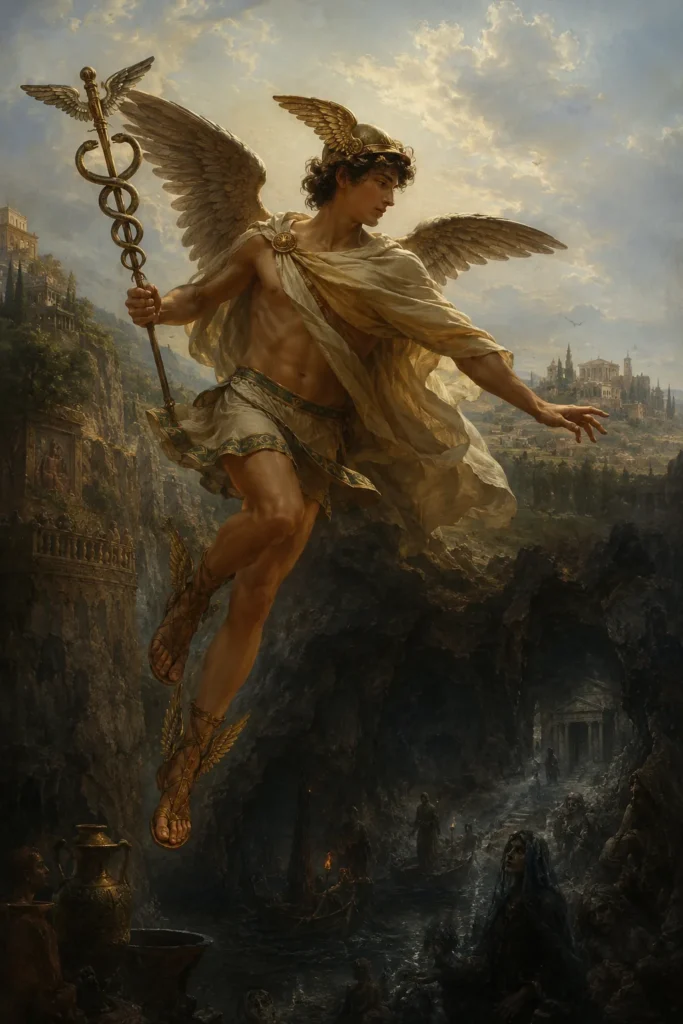
Turms is depicted as a youthful man with travelling hat (petasos), winged shoes and caduceus (herald’s staff). On mirrors (4th/3rd century BCE) he often appears as companion of dying heroes; small bronze figures are also preserved. On sarcophagi and in tomb paintings he stands together with Charun and Vanth.
Turms was venerated in temples of his own, though less prominently than Tinia, Uni or Menrva. Travellers, merchants and envoys appealed to him; at burials he was invoked to guide the dead safely into the underworld.
Belonging to Turms are travelling hat (petasos), winged shoes and caduceus (herald’s staff). As protective signs served figurines of Turms, which one wore or laid in the grave with the dead, as well as herms at house and city entrances.
Turms corresponds functionally to the Greek Hermes and the Roman Mercury; the Etruscan tradition goes back directly to the Greek one of Hermes, but sets its own accents in eschatology. As divine messengers, Anubis (Egyptian, escort of the dead) and Wotan/Odin as guide of the dead (Germanic) are also compared.
Classification within the Etruscan Pantheon
Turms belongs among the prominent gods of the Etruscan pantheon. He is a messenger between the gods and between the worlds, those of the living and of the dead. In this function he corresponds broadly to the Greek Hermes Psychopompos.
Larissa Bonfante and Nancy Thomson de Grummond have treated Turms in their works on Etruscan religion. He is a frequent figure in Etruscan visual art, often depicted on mirrors with an inscription.
The messenger god Turms belongs to a religion that is so informative for religious studies precisely because it mediates between the Greek-Mediterranean and the Italic-Roman worlds of tradition. Essential research contributions come from Massimo Pallottino, Jacques Heurgon, Sybille Haynes, Mauro Cristofani and Giovanni Colonna, whose works have sharpened the picture of an independent religious tradition.
Etruscan theology knew a clearly structured pantheon with graded ranks and precisely distributed tasks; within it, Turms was firmly anchored as a messenger between the gods and between the worlds. Where older studies presented this system as enigmatic or alien, today one recognizes an independent variant of Mediterranean religion.
In the religious history of Italy, the Etruscans held a mediating position between Greek influences and the emerging Roman religion. This intermediary role, which is mirrored as it were in the messenger function of Turms, is of particular interest to religious studies.
The religious-ethnological research of recent decades regards Etruscan religion as a self-contained system that is independent in its religious phenomenology. The older reading, which understood it as a mere derivative of Greek religion, has given way to a markedly more differentiated view, from which the understanding of Turms also benefits.
Name and Etymology
The name Turms is attested on numerous Etruscan mirrors and inscriptions. A secure etymological meaning has not been reconstructed. Helmut Rix’s Editio Minor documents the epigraphic evidence.
Turms also appears under the epithet Turms Aitas (‘Turms of Aita’), which explicitly identifies him as the companion of the underworld god Aita. This connection is important for religious studies: it shows his dual function as messenger of the gods and guide of the dead.
Etruscan stands linguistically on its own; it is regarded as isolated or is hypothetically assigned to a Tyrsenian family, to which Lemnian and Raetic may also belong. Scholars have been working on deciphering the texts since the nineteenth century; the work is not complete, which also concerns the interpretation of the name Turms.
The authoritative epigraphic collection of the Etruscan language corpus is Helmut Rix’s Editio Minor; in it the evidence for the name Turms is also documented. Today it is supplemented by the Thesaurus Linguae Etruscae and the online database ETP, the Etruscan Texts Project.
Already in antiquity, views on the origin of the Etruscans diverged: Herodotus derived them from Lydia, while Dionysius of Halicarnassus saw in them a native Italic people. From the standpoint of religious history the question is relevant, because on it depends whether Etruscan religion shows connections to Asia Minor cults.
Linguistics and epigraphy today work closely together. The digital edition of Etruscan texts, the Etruscan Texts Project (ETP), considerably facilitates comparative investigations, for example of theonyms such as Turms. Pioneering contributions to this have been made by Marie-Laurence Haack and Vincent Jolivet.
Description and Iconography
In Etruscan art Turms is depicted as a youthful man, often with a traveling hat (petasos), winged sandals and a caduceus (herald’s staff). This iconography is adopted from the Greek Hermes tradition. Famous are Etruscan bronze figurines of Turms, preserved in several collections worldwide.
On Etruscan mirrors (4th/3rd century BCE) Turms appears in numerous mythological scenes, often as companion of dying or transferred heroes, sometimes also as a messenger between gods.
In terms of religious phenomenology, the visual art of the Etruscans is exceptionally rich and at the same time the principal source of our knowledge, not least for the many depictions of Turms.
Mirrors, vases, tomb paintings and bronzes carry the greater part of the material. In her studies, Larissa Bonfante has emphasized that this visual language is an independent tradition and not merely derivative.
A first-rate source on the religion and eschatology of the Etruscans is tomb painting, preserved above all at Tarquinia, Cerveteri and Vulci. Its images show banquets, mythological episodes, as well as dance and music; the afterlife, into which Turms leads as guide of the dead, appears here as a continuation of earthly life.
Etruscan iconography favors compositions with many figures, narrative allusions and symbolically condensed pictorial statements; Turms too appears frequently in such scenes. Unlocking this pictorial language is the task of Etruscan religious iconography.
Characteristic of Etruscan visual art is a dense narrative layering. Even a single mirror or a vase can contain several mythological references at once, for instance when Turms appears alongside further figures. This condensation requires of scholars a careful analysis of the pictorial context.
Turms as Messenger of the Gods
In his function as messenger of the gods, Turms conveys messages between the Olympians, between gods and human beings, and between the living and the dead. On Etruscan mirrors he is frequently depicted in scenes in which gods communicate with one another, with Turms standing between them as mediator.
This function is well known in the Hermes tradition and was probably adapted by the Etruscans from the Greek body of myth. The Etruscans, however, set their own emphases, in particular through the connection with the underworld.
The mythology of the Etruscans, unlike the Greek or Roman, is not transmitted in fully formulated narrative texts. Myths surrounding Turms must be reconstructed from pictorial depictions, inscriptions and the Greco-Roman secondary tradition. This indirect source situation calls for particular methodological caution.
The relationship between Etruscan and Greek mythology is complex. On the one hand the Etruscans took over numerous Greek subjects, for example concerning Achilles, Odysseus and Oedipus; on the other hand they gave them their own interpretations and emphases.
Scholars investigate intensively how this appropriation proceeded in detail, for instance in the transfer of the Hermes traits onto Turms.
A typical feature of Etruscan theology is the council of the gods, the consensus deorum. The high god Tinia does not act alone but consults with the other gods, and Turms mediates between them as messenger. In terms of religious phenomenology, this body represents a distinctive feature.
Etruscan mythology has left no self-contained narrative tradition; it must be pieced together from pictorial scenes, inscriptions and secondary sources, which calls for careful interpretation.
Since Turms appears above all on mirrors, what proves especially fruitful here is the combining of the Etruscan inscription, the Greek pictorial model and a contextual reading of the respective scene.
Turms as Guide of the Dead
Turms’s most important eschatological function is the accompanying of the dead into the underworld. On Etruscan sarcophagi and tomb paintings (Tarquinia, Vulci) he is frequently depicted together with other guides of the dead such as Charun and Vanth.
Etruscan eschatology is of particular interest to religious studies because it offers a pronounced conception of the underworld (in Etruscan partly calusna). Turms is part of this conception. Jean-Rene Jannot treated eschatology systematically in Religion in Ancient Etruria.
The religious background of Turms is formed by the Disciplina Etrusca, that divinatory system of the Etruscans which knows three branches: the inspection of entrails (haruspicina), the interpretation of lightning (fulguratio) and the observation of birds (auspicia).
The Etruscans passed it on to the Romans, where it remained a living practice into the fourth century CE. Cicero and Seneca described it in detail.
The transmitted knowledge in which a figure like Turms is also anchored was borne by specialized priestly schools, in which the Disciplina Etrusca was handed down from generation to generation.
Its important writings are held to be the Libri Rituales, the Libri Haruspicini and the Libri Fulgurales. These texts are not preserved; from quotations in Cicero, Festus and Macrobius, however, they can be partly reconstructed.
The Etruscan cultic system was strongly bound to the respective city. Each of the great centers, that is Tarquinia, Caere, Vulci, Veii, Clusium, Volsinii, Cortona, Perugia, Arezzo, Volterra, Populonia and Roselle, had its own principal cults and religious particularities.
The rank of the religiosity in which Turms has his place is evident from the Disciplina Etrusca: as a coherent religious and divinatory system it ranks among the most highly developed divinatory practices of the ancient world.
The Romans adopted it systematically, and its practice reached into late antiquity. From the standpoint of religious history, this continuity deserves attention.
Cult and Rituals
Turms was venerated in his own temples, though not with the same prominence as Tinia, Uni or Menrva. His cult was oriented rather toward the practical and pragmatic: travelers, merchants and envoys appealed to him, and at burials he was invoked to guide the dead safely into the underworld.
A pronounced practice is the placing of small Turms figurines in graves. They are meant to show the dead the way. Such figurines have been found in numerous Etruscan graves.
The buildings too, in which deities such as Turms were venerated, bear their own signature. The Etruscan temple is characterized by the Tuscan style with an independent order of columns, which Vitruvius describes in De Architectura.
In the ground plan the cella and a broad frontal hall stand out strongly, in which these buildings differ markedly from Greek models.
Frequently the temples of the cultic world to which Turms also belongs were laid out on a monumental scale. One example is the Jupiter temple on the Capitolium in Rome, which Etruscan architects and artists erected, above all Vulca of Veii. It is regarded as an architectural testimony to Etruscan religiosity in early Rome.
For Turms as messenger of the gods, the supra-regional cultic framework in which he was venerated is informative: at the Fanum Voltumnae near Volsinii, the Etruscan league of the twelve cities gathered each year for a religious and at the same time political assembly.
Voltumna there functioned as the federal god of the confederation and possessed a religious significance that reached beyond the individual city cults.
Traditions of Protection
In protective contexts Turms was invoked primarily by travelers, merchants, messengers and diviners. Whoever set out on a journey spoke prayers to Turms; merchants included him as a patron in their business practices. In divinatory contexts too, in particular in bird observation and dream interpretation, Turms had a role.
Apotropaic practices in the sphere of Turms included the carrying of Turms figurines, the setting up of Turms herms at the entrances of houses and cities, and the invocation before important negotiations. This practice is adopted from the Greek Hermes tradition.
Etruscan protective custom has at its disposal numerous warding signs: phallus amulets, gorgoneion images, eye symbols, bullae and certain formulas.
Like other figures of the Etruscan pantheon, Turms too stands in a setting that was permeated by warding signs.
The eye of Tinia, phallus amulets and gorgoneia were found on temples and graves as well as on house shrines and personal implements. Beyond Etruscan culture, this practice lived on in Roman and in the wider Mediterranean popular belief.
Whoever approaches the sphere of influence of Turms encounters a religiosity whose protective conduct was closely bound to the Disciplina Etrusca. The founding of a city, a military campaign or the building of a house was not begun without a prior divinatory inquiry into the will of the gods.
Parallels in Other Cultures
Turms corresponds functionally to the Greek Hermes and the Roman Mercurius. The connection is close both typologically and historically: the Etruscan Turms tradition goes back directly to the Greek Hermes tradition. The Etruscans, however, set independent emphases, in particular in eschatology.
In comparative religious terms, Turms can be linked with other messengers of the gods: Anubis (Egyptian, guide of the dead), Hermes (Greek), Mercurius (Roman), Wotan/Odin in his function as leader of the dead (Germanic). The idea of the messenger of the gods as mediator between worlds is universal in religious phenomenology.
Through the interpretatio Romana, Etruscan deities received Roman names: Tinia became Jupiter, Uni Juno, Menrva Minerva. Such equations usually grasped only selected traits, not the whole figure.
The research of the last fifty years works out which Etruscan particularities were thereby preserved, for instance in the case of the messenger god Turms in relation to Hermes and Mercurius.
That Turms as messenger of the gods stands close to the Greek Hermes and the Roman Mercurius points to a wide-ranging interconnection: Etruscan religion shows numerous points of contact with Anatolian, Phoenician and Near Eastern traditions.
The Phoenician mediation is attested by the Pyrgi Tablets. This trans-Mediterranean networking has for some decades belonged to the important fields of research.
From a comparative religious viewpoint, the Etruscan cult belongs to the wider Mediterranean family of religions and stands in relation to Greece, Phoenicia, Egypt, Anatolia and Latium. This embedding, to which the messenger figure of Turms also belongs, forms a significant field of research.
Current Research
Research on Turms has advanced considerably over the last 30 years through the systematic evaluation of Etruscan mirrors (Corpus Speculorum Etruscorum, CSE).
Scholars investigate intensively the relationship between the Greek Hermes tradition and the Etruscan independence of Turms. Where are there direct adaptations, where Etruscan particular features? This question is the subject of current discussion.
Figures like Turms too are today treated within the framework of an internationally conducted research on Etruscan religion. Important centers are held to be the universities of Florence, Rome Sapienza, Pisa, Tubingen and Princeton. Each year several international congresses deal with individual aspects of this field.
International projects on Etruscan religion today draw on digital methods: three-dimensional scans of temples and graves, databases for inscriptions and pictorial sources, as well as GIS analyses of the settlement structure. Such methods open up new insights, including into the mirrors on which Turms is depicted.
What research works out about Etruscan religion and its deities, among them Turms, reaches the public through exhibitions, for example at the Vatican Museum, the Museo Nazionale Etrusco di Villa Giulia and the Boston Museum of Fine Arts, and besides through numerous publications.
Sources and State of Research
The most important sources for research on Turms are the Etruscan mirrors (in particular those with an inscription), the tomb paintings, the sarcophagi and the inscriptions. The Corpus Speculorum Etruscorum (several volumes) is the most important collection of the mirror images.
A deeper classification within Etruscan religious history as a whole shows how Turms is to be understood within the web of relations with the Olympians and with the underworld gods Aita, Charun and Vanth. This networking is essential for religious studies.
The source base for Etruscan religion is heterogeneous: epigraphic testimonies, collected in Helmut Rix’s Editio Minor, archaeological finds, pictorial sources and secondary literature. Whoever wishes to grasp Turms adequately must evaluate this diversity across disciplines; recent research combines for this purpose philology, archaeology, religious studies and anthropology systematically.
An appropriate source criticism requires that one know both the original Etruscan testimonies and the Greco-Roman secondary tradition. This twofold access is demanding, but indispensable for a sound religious-historical reconstruction of Turms.
A thorough religious-historical classification of Turms presupposes that one surveys the epigraphic, archaeological and literary sources as well as the approaches of modern religious studies. This many-layered engagement is regarded as the standard in research.
Turms on the Bronze Liver of Piacenza and in the Etruscan Discipline
A central document on the Etruscan order of the gods is the so-called Bronze Liver of Piacenza, a bronze model of a sheep’s liver found in northern Italy in 1877, which is divided into fields and inscribed with the names of gods in Etruscan script.
It probably served as a teaching or demonstration aid of Etruscan entrail inspection, the haruspicina. On the edge of the model sixteen fields are arranged, with further ones in the interior.
On this object Turms also appears. His placement allows conclusions about which region of the Etruscan sky the priests located him in and with which other deities he was thought to be neighboring.
The Bronze Liver is thus a rare source that does not stem from Roman or Greek secondary tradition but directly from Etruscan cult practice, the so-called etrusca disciplina.
The reading and interpretation of the liver is, however, difficult. Etruscan is indeed legible, but only partly intelligible, because there is no closely related language. Researchers such as Massimo Pallottino, Ambros Josef Pfiffig and later Nancy de Grummond have contributed to its classification, without all the fields and their theological logic having been clarified. Turms thus stands exemplary for a fundamental problem of Etruscology: we know his name and his position in the ritual system, but the doctrine surrounding him remains fragmentary.
The Guide of Souls: Turms in Etruscan Tomb Painting
Unlike the Greek Hermes, whose broad literary tradition shows him as messenger of the gods, trickster and inventor, Turms is for us almost exclusively image.
One of his clearest roles is that of the guide of souls, the psychopompos, who leads the deceased into the underworld. This function emerges above all in Etruscan tomb painting and on ash chests of the later Etruscan period.
In wall paintings of Etruscan chamber tombs, for example in the surroundings of Tarquinia and in the great necropolises, a figure appears with a traveling hat and staff who takes a dead person by the hand or goes before him.
Frequently this figure is identified with Turms, partly by an inscription, partly only through the iconography. Sometimes he bears the epithet that explicitly identifies him as guide to the underworld, in research often read as Turms Aitas, that is Turms in the circle of the underworld god Aita.
This strong emphasis on the guide-of-the-dead function is a good example of how the interpretatio can lead astray. Were one simply to dismiss Turms as the “Etruscan Hermes,” one would overlook that Etruscan art brings precisely the afterlife-related aspect into the foreground, while the thieving, cunning side of the Greek Hermes is scarcely tangible. Whether this is due to the source situation, which in Etruria is strongly determined by graves, or to a really different weighting of the deity, is an open research question. On the methodology of Etruscan religion, see also the entry on Etruscan mythology.
Literature (Selection)
- Jean-Rene Jannot: Religion in Ancient Etruria (2005)
- Massimo Pallottino: Die Etrusker (1942, German 1965)
- Corpus Speculorum Etruscorum (several volumes)
Further standard works in the literature index.
Turms is the Etruscan messenger of the gods and is regularly treated in the ancient sources as well as in research as an interpretatio figure: he appears as the direct counterpart of the Greek Hermes and the Roman Mercurius.
On bronze mirrors of the fourth and third centuries before our era he wears winged sandals and a herald’s staff and takes on comparable functions, such as the guidance of the deceased. The assignment as counterpart shows how closely the Etruscan world of the gods was interwoven with the Greco-Roman conceptions.
The Etruscan myth identifies Turms as messenger of the gods and guide of souls, whose function coincides closely with that of the Greek Hermes; he becomes pictorially tangible on bronze mirrors of the fourth and third centuries before the common era.
Related key terms: Turms Etruscan messenger of the gods caduceus Hermes Mercurius guide of the dead Aita.
iWell Guard and Traditions of Protection
iWell Guard ties in with the cultural-historical tradition of portable protective objects, in the tradition of Etruscan and many other cultures worldwide. 41 layers, solid gold, platinum, silver, made in Germany. 30-day right of return.
Personal experiences may vary. Not a medical product. Not a healing promise.