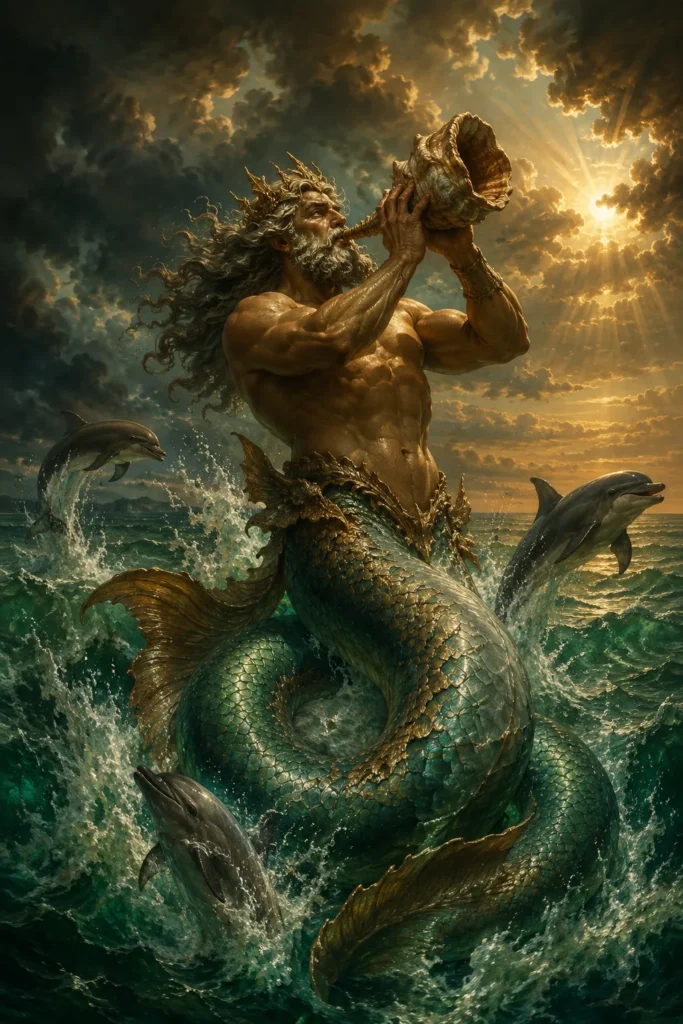
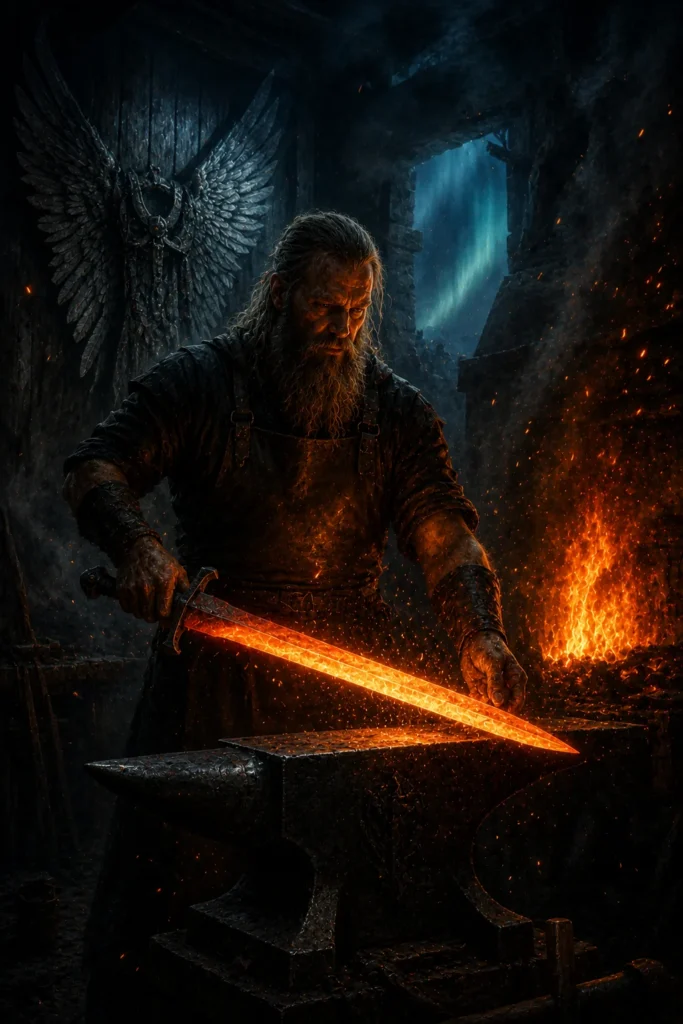
Tu Matauenga, known in short as Tu, is regarded in Maori religion as the Atua of war, conflict, and humanity. He stands in sharp opposition to his brother Tane Mahuta in the central creation myth and is the only son of Ranginui and Papatuanuku who remains inside after the dispute among the siblings.
This entry explores his role in the pantheon, his rituals, and his enduring presence in the Maori warrior ethos up to the present day.
Tu Matauenga is the Maori god of war and human aggression.
Tu Matauenga, the Maori war god, embodies human aggression, war, and the spoils of the hunt.
Tu Matauenga is one of the great Atua of the Maori. He is the son of Ranginui and Papatuanuku, and brother of Tane Mahuta, Tangaroa, Rongo, Haumia-tiketike (god of wild food plants), and Tawhirimatea (god of the winds).
His special position derives from the creation narrative: as the only brother, Tu wished to kill the parents rather than separate them.
Margaret Orbell describes Tu as a figure who holds a dual role within Maori theology: god of war and Atua of humanity. From a religious-studies perspective, this connection is not coincidental.
In many cultures, the god of male strength is also conceived as the “primal father of humanity” — for example Mars in Rome, Tyr in Scandinavia, Indra in Vedic India. The Maori variant, however, has a specific quality: Tu is not merely a warrior but also a bearer of knowledge (“Matauenga” means “knowledge, insight”).
This combination of war and knowledge is of interest to religious studies. It presupposes that the human engagement with the world — whether warlike, intellectual, or pragmatic — has a single root. Anne Salmond and Hirini Mead have elaborated this aspect in their more recent work.
The name Tu means “to stand” or “to stand upright” in Maori.
The full epithet Matauenga can be translated as “knowledge” or “insight.” Tu Matauenga thus means “the one who stands with knowledge” or “the upright knower.” Other epithets include Tu-ka-riri (“Tu the wrathful”), Tu-kai-taua (“Tu who devours armies”), Tu-mata-uenga (“Tu with the face of knowledge”), and Tu-mata-rehurehu (“Tu in the twilight”). Each variant accentuates a specific function.
Linguistically, Tu is attested across all of Polynesia: Ku in Hawaii (with the sound shift k from *t due to regular change), Tuu in Tahiti, Tu in Mangaia.
In Hawaii, Ku is one of the four great high gods, canonized in official temple liturgies (Valeri, Kingship and Sacrifice, 1985). In Aotearoa, Tu has not been elevated to a high deity but remains one among several great Atua.
The difference between the Hawaiian Ku cult and the Maori Tu cult is instructive from the history of religion: in the stratified Hawaiian kingship, war was an institutionalized state practice with its own temples and rites; in the more decentralized Maori society, war remained an iwi matter with a less centralized cult.
Tu Matauenga is often depicted in Maori woodcarving (whakairo) in a warlike posture: protruding tongue (whakapohane), legs apart, fingers spread, emphasized muscles. These iconographic elements appear on the prow of meeting houses, on gate and post columns, and they structure the choreography of the haka, the well-known war and combat dance.
Tu is never represented as a single canonical statue. Instead, every warrior in the moment of combat embodies Tu in his own body. Anne Salmond describes this performativity as a central aspect of Maori theology: the divine is not fixed in an image but becomes present through body, dance, and karakia.
The weapons — in particular the mere (club of pounamu), the taiaha (staff), and the patu — are not mere tools but extensions of the Tu body. They carry the mana of their bearers and are passed down as heirloom objects.
They are not amulets in the Western sense, but condensations of collective history. Hirini Mead describes the iconographic layers of such objects in detail in Maori Art on the World Scene (2002).
In the central myth of the separation of heaven and earth, Tu wishes to kill his parents while Tane advocates separation and Rongo advocates reconciliation.
Tane prevails, but after the separation Tawhirimatea, the storm god, attacks the other brothers in anger over the loss of his father. Tane, Tangaroa, and Rongo flee to their respective domains. Tu, however, stands firm and ultimately defeats Tawhirimatea.
Tu then punishes his brothers who fled. For this reason, the Maori are permitted to hunt fish (the domain of Tangaroa), catch birds (the domain of Tane), plant sweet potatoes (the domain of Rongo), and gather wild plants (the domain of Haumia).
From a religious-studies perspective, this myth legitimizes humanity’s claim to natural resources — not as arbitrary appropriation, but as the consequence of a cosmic event.
Tu is therefore also the ancestor of humanity as a whole: the Maori often call themselves “Nga uri o Tu” (“descendants of Tu”). This genealogical attribution does not mean biological descent in the Western sense, but a ritual-mythological lineage that structures the relationship between human beings and the Atua.
Margaret Orbell points out that the Tu narrative distinguishes Maori theology from gnostic or dualistic frameworks: there is no “evil” in the moral sense, but rather different, sometimes conflicting forces that must be brought into a dynamic equilibrium.
In traditional Maori warfare, Tu was the central point of reference. Before every battle (taua), Tu was invoked through karakia, tapu prescriptions were observed, and purification rituals were performed. Warriors fasted, avoided contact with women, and recited specific formulas. The tohunga (priestly specialist) determined the timing based on astronomical and divinatory signs.
Elsdon Best describes the ritual system in detail in The Maori as He Was (1924) and Maori Warfare (1903). After the battle, a lengthy process of tapu removal followed before warriors were permitted to return to their families. The trophies (the heads of enemies, weapons) were treated in rituals assigned to Tu.
This ritual embedding is remarkable from a religious-studies perspective: war in Maori culture was not profane, but a highly ritualized, religiously tapu-related event. Preparation could last months; a raid without Tu-karakia was considered illegitimate and dangerous to one’s own warriors.
Also noteworthy is the concept of “utu” (retribution or rebalancing), which is closely connected to Tu. Utu is not primarily revenge in the morally negative sense, but the restoration of cosmic and social equilibrium after a violation.
One who practices utu acts in the spirit of Tu by restoring the disrupted order. This concept is deeply embedded in Maori ethics and is drawn upon today in court proceedings and mediation contexts.
There is also an important gender dimension: Tu practices were primarily male, but not exclusively so. Women could bear Tu-related references in certain functions (intermediaries in vision, guardians of kotahitanga). Mira Szaszy and other Maori women elders have elaborated this dimension.
The haka is today known worldwide through the national rugby team. From a religious-studies perspective it is not a mere sports dance, but a choreographed manifestation of Tu energy.
Tribal hakas such as “Ka Mate” (composed by Te Rauparaha in the 19th century) or “Ko Niu Tireni” each have their own histories and honor specific ancestors.
The movements — pukana (rolling of the eyes), whakapohane (tongue protrusion), tunga ringa (arm movements) — are ritualized gestures of Tu manifestation. Salmond and Mead discuss haka as “embodied theology.” In Maori schools, haka is today taught systematically, as a cultural practice and as a spiritual-physical form.
It is important to distinguish between war haka (peruperu, with weapons), peace haka (haka taparahi, without weapons), and welcoming haka (haka powhiri). Each form has its own function and occasion. At the Te Matatini Festival, the largest haka competition in Aotearoa, all forms are represented.
The haka “Ka Mate” deserves special attention. It was composed in the early 19th century by Te Rauparaha, leader of the Ngati Toa, after he had escaped a deadly pursuit. The text celebrates survival and is today the property of the Ngati Toa tribe, which regulates its use by third parties through legal means.
This legal anchoring of cultural tradition — cultural property law — is a young area of law in which Aotearoa is doing internationally pioneering work. From a religious-studies perspective, this shows that haka is not “general Polynesian cultural heritage” but remains tied to specific iwi and their whakapapa stories.
From the perspective of religious ethnology, haka is a “collective trance practice” in the sense of Bourguignon (Possession, 1976), in which the group as a whole transitions into the Tu state. This collective dimension distinguishes haka from individual shamanic practices and makes it a phenomenologically distinct phenomenon in the study of religion.
Protective practices in the Tu context are primarily collective and ritualized. Before a confrontation — today also understood metaphorically, for example before an important negotiation, a legal proceeding, or a competition — a karakia to Tu may be spoken.
This does not serve to magically influence the outcome, but rather to achieve inner focus and ritual affirmation of the task.
Protective objects in this domain are symbolic weapons: mere (club of pounamu), taiaha (staff), and patu. They are often passed down as heirloom objects (taonga tuku iho) and carry the mana of their previous bearers. They are not amulets in the Western sense, but condensations of collective history.
In modern encounters with Tu tradition — such as in the Maori Battalion during the Second World War, in the Vietnam War experience of Maori soldiers, or in current police and military careers — Tu-related rituals are employed to prepare soldiers spiritually and to reintegrate them into the community after deployment.
Mason Durie has documented this practice in Whaiora (1994) as an element of Maori mental health practice.
Mason Durie’s research on Maori mental health shows that Tu karakia serve as an effective cultural resource in the treatment of post-traumatic stress disorders among Maori veterans (Vietnam, Afghanistan). They are not used as a magical remedy, but as a ritual framework that facilitates reintegration.
Tu Matauenga can be compared with Ares and Mars (Greco-Roman), Tyr (Germanic), Indra (Vedic), and Ogun (Yoruba). The common thread is the personification of male, warlike energy.
It is important, however, to note the difference: in Maori theology, Tu is not a “war god” in the Western sense of a bloodthirsty aggressor, but rather a mediator of ethical practice. The ritual stringency before and after battle shows that war in Maori culture was deeply embedded in tapu and mana.
Within Polynesia, the parallel to the Hawaiian Ku is particularly interesting. Valeri shows that in Hawaii, Ku was venerated within a highly institutionalized temple system, with human sacrifice in certain rites. In Aotearoa, this institutionalization is absent; human sacrifice is not documented in comparable systematization.
From the phenomenology of religion, the Tu complex also shows a connection to shamanic cultures of Siberia and North America: there too one finds ritualized warrior initiations and reintegration practices following combat. Eliade documents such parallels in Shamanism (1951), albeit without direct reference to the Maori.
Further important parallels are found in the samurai Bushido of Japan, in the Christian tradition of holy war, and in the Vedic Kshatriya ethic. In all cases, the concern is not with the glorification of violence, but with its ritualized embedding in an ethical context.
Comparative religious studies has systematically examined such warrior ethics as “sacred warriorship,” proceeding from the presumed assumption that the human tendency toward violence, without ritual framing, falls into destructive channels.
Tu Matauenga is present today in sport, in military tradition (Maori Battalion, 28th Battalion in the Second World War), and in political representation.
Maori activism since the 1970s — Bastion Point, the marches for land and language — frequently invokes Tu as a symbolic reference point for self-assertion. The tikanga of “standing firm” (tu tonu) is a direct application of the Tu concept.
In education, Tu is not conveyed as a promotion of aggression, but as a cultural anchoring of dignity, discipline, and steadfastness. The Polynesian-Maori religion as a whole understands Tu as an ethically framed force, not as a raw war demon.
Current discussions around Maori prisoner statistics, police violence, and culturally grounded reintegration of soldiers traumatized by war draw on Tu-related concepts. The concept of “mana tane” (male mana, healthy masculinity) is part of current Maori men’s health programs.
The most important research contributions on Tu Matauenga come from Elsdon Best, Te Rangihiroa (Peter Buck), Margaret Orbell, and Hirini Mead.
From more recent times, the works of Anne Salmond, Judith Binney, and Mason Durie (Whaiora, 1994) are central. For comparison with the Hawaiian Ku tradition, Valeri’s Kingship and Sacrifice is a standard work.
Maori-internal knowledge traditions preserve Tu karakia and haka as living practice. This dual perspective — scholarly research and tradition-internal cultivation — characterizes the field. Wananga such as Te Wananga o Aotearoa and Te Wananga o Raukawa teach Tu-related tikanga in academic form, creating an institutional bridge between tradition-internal knowledge and university research.
A deeper contextualization of Tu within the Polynesian-Maori religion shows how he is to be understood not in isolation, but within the relational web of the other Atua. Only this relational reading opens up the theological depth.
In the tribal traditions of the Maori, Tumatauenga is not only the war god, but also the Atua from whom the people received their tools against the other gods. A narrative attested in several iwi versions follows directly on from the separation of the sky father Ranginui and the earth mother Papatuanuku.
After this separation, the brothers turn against one another. Tumatauenga, who alone had voted for the violent separation, comes into conflict with his siblings, who rule over the various domains of the world.
The decisive point of the narrative is that Tumatauenga defeats his brothers not through brute force, but through cunning and implements. Against Tangaroa, lord of the sea, he invents nets and fishhooks.
Against Tane, lord of the forest, and against the sons of Haumiatiketike and Rongo, who represent the wild and cultivated plants, he brings forth the digging stick, the snare, and the methods of gathering and harvesting.
By subjugating his brothers through technology, he makes their domains usable for humanity. The other gods thus become food, and the ritual language of many Maori communities still refers to fish, birds, and crops today with expressions that allude to this subjugation.
This episode also explains why, according to Maori understanding, humanity is permitted to eat what it eats. Because Tumatauenga subjugated the other Atua, access to their spheres is not a transgression, but a right legitimized by the primal ancestor — a right that must, however, be secured through karakia, that is, through ritual invocations.
Only Tane, the human being, retains in this logic an Atua kinsman who is not eaten, because he is himself the father of humanity.
From a source-critical perspective, it should be noted that the most detailed written version of these myths goes back to recordings of the 19th century, in particular those of George Grey and texts by the tohunga Te Matorohanga.
These sources are selective, often oriented toward a single tradition, and in part colored by Christian expectations of an ordered creation narrative. The basic figure of Tumatauenga as the founder of hunting, fishing, and agricultural technology is, however, attested across many iwi and belongs to the established stock of tradition.

Related key terms: Tu Matauenga Maori war god haka pukana taua tapu Tu-ka-riri.
iWell Guard draws on the cultural-historical tradition of wearable protective objects, in the tradition of Polynesia / Maori and many other cultures worldwide. 41 levels, real gold, platinum, silver, crafted in Germany. 30-day right of return.
Personal experiences may vary. Not a medical device. No healing promises.
Against its influence, cross-cultural tradition names these protective means:
Compare in the Protection Compass →Recommended protective means
The simplest protective means in this collection: 41 layers of fine gold 999, platinum, silver and silicon, manufactured in Ruhla, Thuringia. It requires no activation, is bound to no person, and is effective within a radius of around 50 meters, even without being worn.
Related Beings

Longwang, the Chinese Dragon King: ruler of the four seas, giver of rain, temple cult and appeara...

The Buddhist and Daoist embodiment of cosmic justice in Korean mythology.

Aita is the Etruscan god of the underworld, counterpart to the Greek Hades. Religious-studies ove...

Telipinu is the Hittite vegetation god whose disappearance brings famine. A religious-studies ove...

Szélanya, the wind mother of Hungarian folk belief. Origin, role in incantations and religious-st...

God of writing, scribe of fate, his temple in Borsippa and the secret knowledge of the word in Me...