Israfil, Archangel of the Islamic Tradition
By Ralf Ittermann · last reviewed on
Israfil is the archangel figure of the Islamic tradition, the trumpet angel of the resurrection and the herald of the Last Judgment. His significance in religious studies lies in the embodiment of eschatological turning points, in the cosmic transformation from the earthly to the eternal, and in mysticism as the herald of the Hour (As-Sa’ah).
Israfil
Israfil acts as the trumpet angel and herald of the resurrection. His attributes include strength, cosmic awareness, and immediate closeness to the cosmic moment.
Central myths are: Israfil’s two trumpet blasts (the first bringing death, the second the resurrection), the slowing of time during the blast (all life pauses, all souls rise), the encounter with the Prophet Muhammad during the Ascension (Isra and Mi’raj), and mystical traditions of Sufi eschatology.
Brief Profile: Israfil
Israfil is mentioned indirectly in the Quran (39:68, on the day when the trumpet is blown) and is elaborated in hadith collections (Tirmidhi, Ibn Majah, Arabic, 8th and 9th century).
The framing assignment took place in the early Islamic period. The state of research (Schimmel, Hughes, Wild) documents Israfil as central to Islamic eschatology and temporal cosmology.
Classification
The continuity of the tradition across these long spans of time is remarkable and shows a deep, stable cultural rootedness. Even in modern times the memory and sometimes also active veneration is alive, at times transformed, but still recognizable in its essential features.
Israfil was not confined to a particular region or locality, but was known and venerated, or respectfully feared, universally throughout the entire Islamic world.
Israfil was known across all levels of Muslim society, because his role rested on texts that everyone shared. Scholars treated him in Quran commentary, hadith collections, and cosmographies, while preachers brought the image of the angel waiting with the trumpet at his lips into Friday sermons and admonitory literature. For ordinary believers he belonged to the basic furnishings of eschatology: whoever heard about the Last Day heard about Israfil. His reception thus ran along the established channels of religious instruction, from the scholar’s desk through the mosque to household piety.
This clearly points to a central role in the self-understanding of the whole people. Trade, migration, and cultural exchange contributed to the geographic spread and to the stable uniformity of the veneration.
Primary sources are the Quran (39:68, trumpet verse, 69:13-14, resurrection scenario, Arabic, 7th century), hadith collections (Jami at-Tirmidhi, Sunan Ibn Majah, Arabic), tafsir works (Tabari on surah 39:68, Ibn Kathir), and Sufi eschatology (Al-Ghazali, Ihya, Ibn Arabi, Futuhat al-Makkiyya, Arabic, 11th to 13th century). On the secondary level, Schimmel (Mystical Dimensions, 1975), Hughes (Dictionary of Islam), Wild (Eschatology in Islamic Tradition), and McLeod (Judeo-Islamic Angelology) analyzed Israfil’s cosmic role as the central archangel of the resurrection.
Name
Israfil is depicted in the various sources and artistic traditions with certain recurring iconographic elements that remain relatively constant across decades and across different geographic areas. These elements are not purely decorative or chosen at random, but are deeply symbolically coded and carry great meaning.
They convey, in a central way, the functions, sources of power, sphere of responsibility, and cosmic role of the being.
The overall system is like a sacred script or a coded image: it allows initiates or the culturally educated to grasp and correctly understand the essential, deeper meaning. Colors, sacred objects or weapons, bodily attributes, specific accessories, all are significant and traditionally handed down.
Characteristics
Israfil was central to the religious practice, the everyday rituals, and the everyday understanding of Islam. People turned to this entity in critical or particular life situations or at certain ritual times of the year.
What was said about Israfil followed the rules of Islamic scholarship: the Quranic passages on the trumpet blast at the Last Day were interpreted by Quran commentators, the traditions concerning the angel were collected and examined by hadith scholars, and cosmographers such as al-Qazwini placed him within their descriptions of the world. Talk of the trumpet angel was thus part of an ordered science, not of free speculation.
The continuity of these practices across many generations clearly shows that the practice was regarded as effective and necessary. The functions were manifold: some were preventive (warding off potential misfortune), some healing (relief of illness or suffering), some transformative (accompaniment through transitions between stages of life).
Profile: Israfil
The Profile captures Israfil across six dimensions: his origin in Quranic eschatological scenes, his target audience among believing Muslims and mystical contemplatives, iconographic trumpet attributes, his functional role as cosmic herald of transformation, comparisons with Christian and Jewish powers of resurrection, and his mystical role in Sufi eschatologies.
The trumpet angel, whom later tradition calls Israfil, is mentioned without a name in Quranic texts of the 7th century, with roots in Judeo-Christian resurrection traditions (Gabriel’s annunciations, Uriel’s eschatological role). The geographic origin lies in the Arabian Peninsula and the Near East.
The dating of the first mention is Quran 39:68 (Meccan period, 610 to 622 CE). The theological framing as the chief trumpet angel took place in hadith commentaries and Sufi works (9th to 13th century).
Israfil addressed himself primarily to believing Muslims with an interest in hope for the hereafter and in the Judgment. The target audience comprises the pious (hope for resurrection), believers of all social strata, and Sufis (mystical contemplation).
The occasions are Friday prayers (khutba on the Last Day), thoughts of death, discussions of the signs of the end (Allamah), and mystical night prayers (Tahajjud). The invocation takes place in prayers for readiness (Isti’dad) for the Last Day.
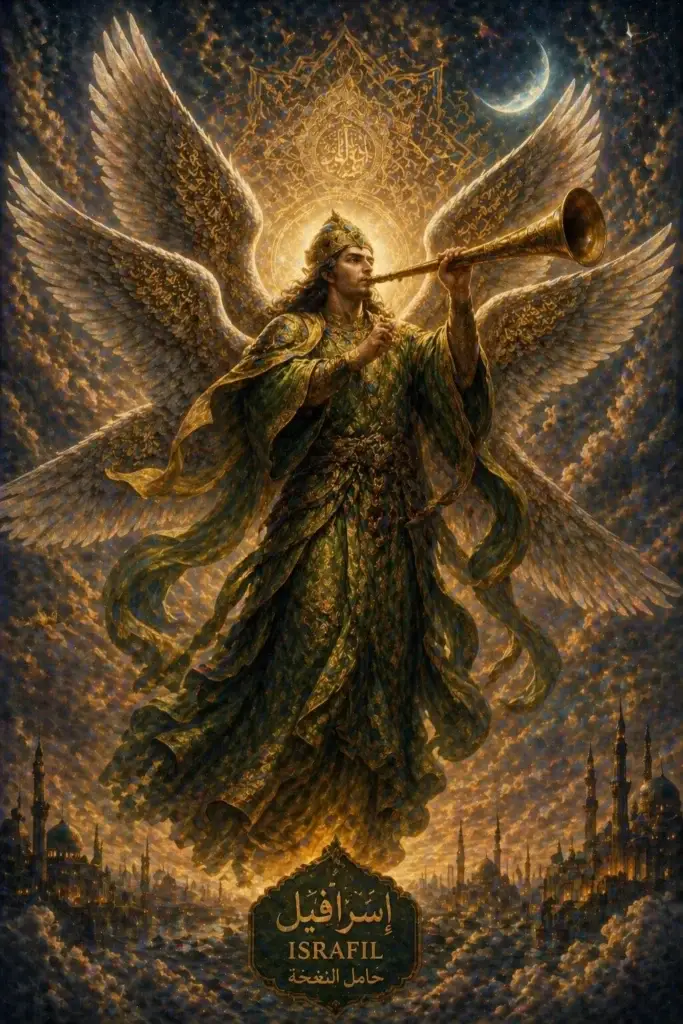
Israfil iconographically: a male figure with enormous silver or golden wings, a serious, focused gaze. His attributes are a trumpet or horn (Soor, Arabic), sometimes the book of deeds (Amal), light or a halo.
In Sufi miniature painting: a tense posture, as if ready to blow. The iconographic connection to the trumpet and cosmic tension is unique to Israfil.
Israfil (Isrāfīl, Urāfīl) is, in Islamic popular belief and in the canonical sources, the archangel who blows the trumpet (Sūr) at the Last Judgment (Yawm al-Qiyāma).
Israfil was regarded as neutrally authoritative and infallible in eschatological execution. The invocation practices included prayers for readiness (Isti’dad) for the Last Day, for reconciliation (Muhasaba), and inner purification (Takhalli).
In Sufi traditions, meditations on Israfil’s blast were practiced (Muraqaba ala-s-soor), in order to cultivate fear of Allah’s Judgment (Khawf) and hope for mercy (Raja). Reverence for Israfil expressed itself as eschatological vigilance.
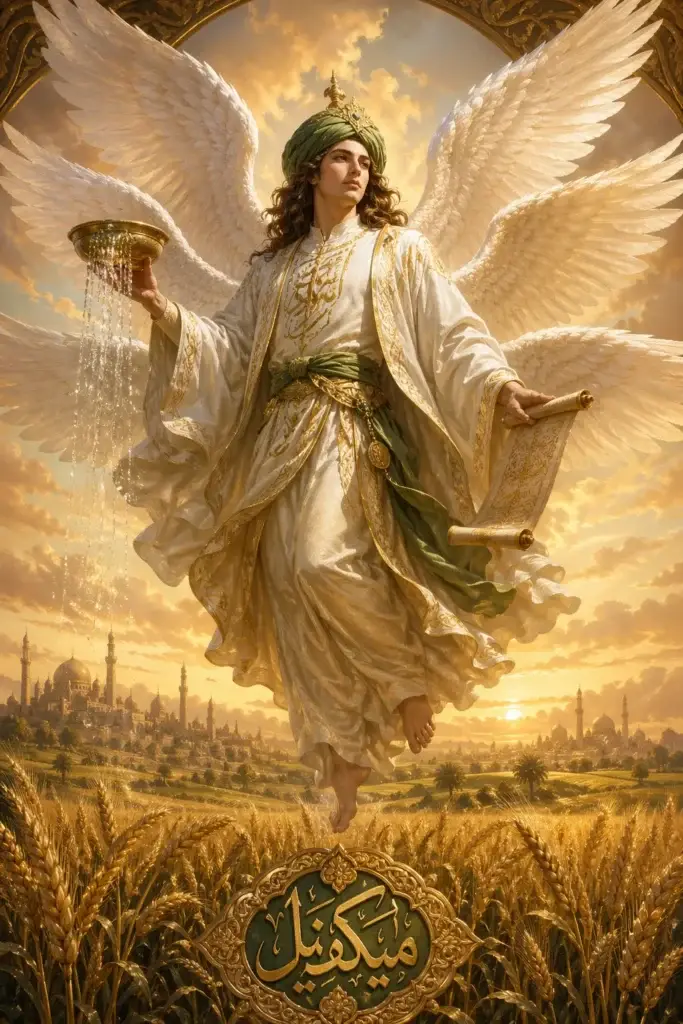
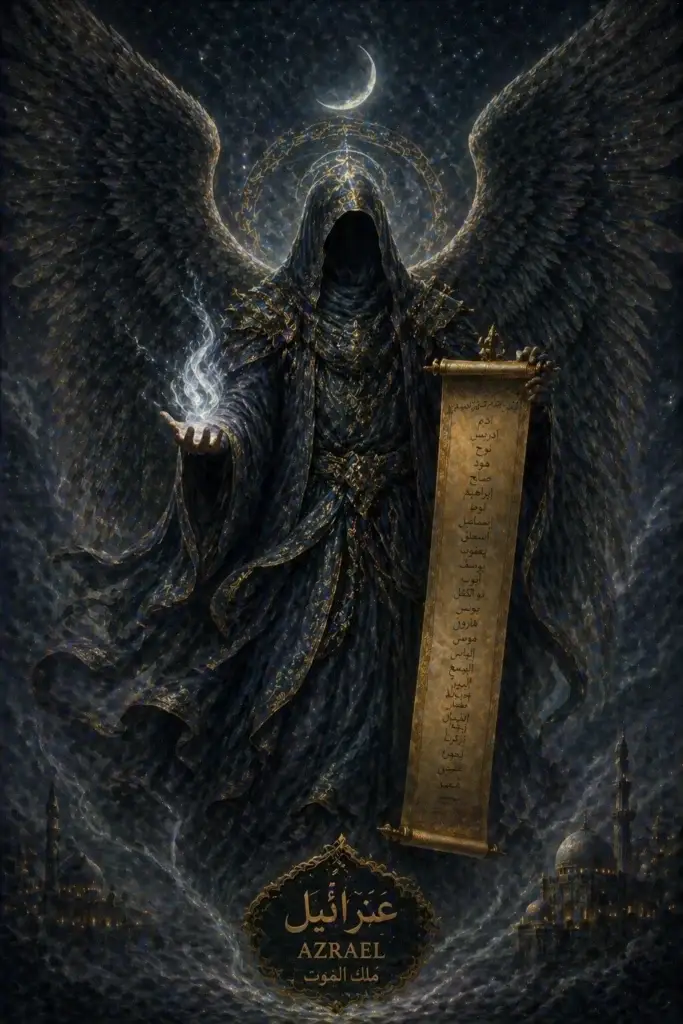
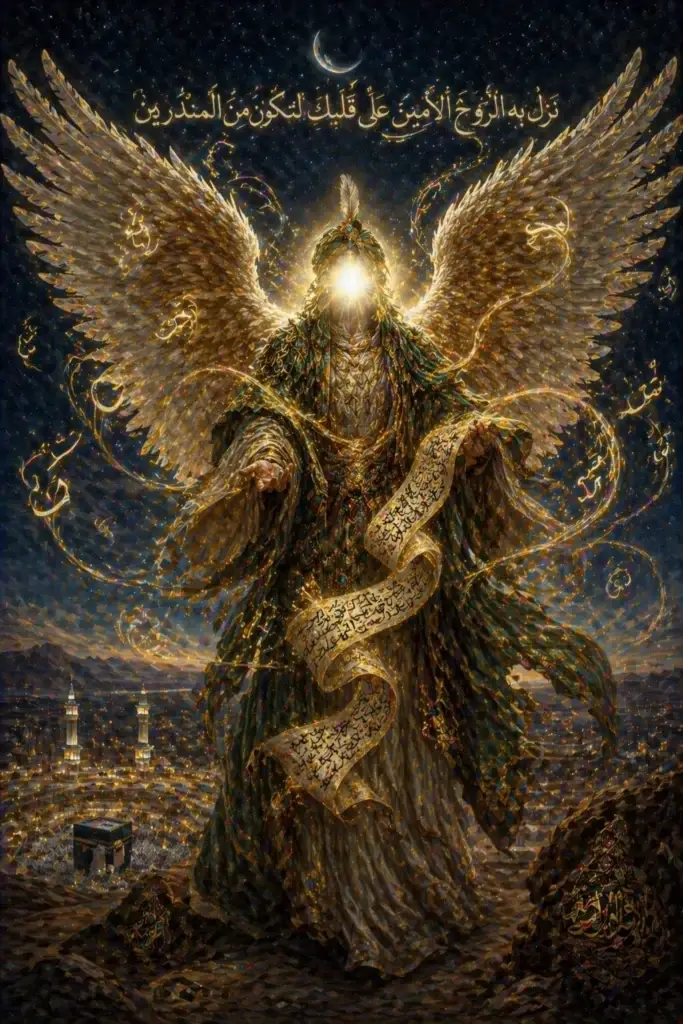
Comparable figures in Islam: Jibril (herald of revelation), Mikail (guardian angel), Azrael (angel of death). Outside Islam: the Christian Gabriel (annunciations), the Jewish Uriel (angel of judgment, angel), the Christian Michael (angel of war, angel). The specific cosmic function of transformation makes Israfil unique.
Defense in Everyday Life
Invocations and Commemorative Practice
Israfil is not an object of direct invocation in the sense of petitionary prayers (Du’a).
The Sound of the Trumpet and Mystical Audition
Surah 39:68 describes two trumpet blasts (Naffkha).
Protective Amulets and Apocalyptic Preparation
There are no direct amulet practices for Israfil. Instead, the commemorative practice (Zikr, Salawat upon the Prophet) is the preventive protective measure.
Israfil, Parallels in Other Cultures
Jewish tradition: Jewish parallel: Uriel (angel of judgment, angel, the trumpets of annihilation implied in apocalyptic). The difference: Uriel is more a herald of punishment; Israfil is a pure announcement of transformation. Raguel too (cosmic justice) carries eschatological features.
The Greco-Roman world: Greek counterpart: Hermes (herald of the messengers of death), Apollo (oracle, but not eschatological). Closer: the Moirai/Parcae (messengers of fate, temporal transformation). The absence of a resurrection mythology in Greece makes direct parallels weak.
Mesopotamia: Mesopotamian counterpart: the Enuma Elish scenario (cosmic transformation through battle). Closer: Namtar (messenger demon of transformation). The absence of an explicit resurrection tradition in Mesopotamia makes Israfil specifically Islamic.
India/Asia: Indian counterpart: Indra’s horn or trumpet at the transition of the world (Hindu eschatology). Closer: Samvarta (god of cosmic dissolution). Buddhist parallel: Dharmakaya transformation (revelation of the Buddha nature). They share the function of transformation.
The Trumpet Angel and the End of the World
In Islamic belief, Israfil is above all the angel of the trumpet. His task is to blow a horn or trumpet at the end of time, called in Arabic sources mostly as-sur. According to the widespread teaching, this blast occurs twice.
The first trumpet blast causes all the living to die of terror and the order of the world to collapse. The second trumpet blast calls the dead to resurrection and gathers them for the Judgment.
It is notable that the name Israfil does not appear in the Quran itself. The Quran speaks in several places of the trumpet blast and of the one who blows the trumpet, without naming him.
The identification of this angel with the name Israfil derives from the extra-Quranic tradition, above all from the hadith, the transmitted sayings and reports about the Prophet, and from the later narrative literature.
Israfil thus belongs to the four or, depending on the count, several distinguished angels whose names and functions the Islamic tradition has elaborated beyond the Quranic text.
In popular Islamic piety, Israfil is regarded as one of the highest-ranking angels, often named alongside Jibril, Mikail, and the angel of death. The notion that he always stands ready at the trumpet, waiting for the divine command, has a strong eschatological effect.
It keeps alive the thought of the inevitability of the Judgment. From the standpoint of religious studies, Israfil is a good example of how a being that appears in the sacred text only as a function receives a name, biography, and profile in the subsequent tradition.
Israfil in Hadith and Narrative Literature
The more detailed descriptions of Israfil are found in the hadith literature and in the narrative works of the so-called Qisas al-anbiya, the stories of the prophets.
There Israfil is portrayed as an angel of enormous size, with several pairs of wings, whose form spans the creation. Some traditions say he has four wings and that his head reaches up beneath the Throne of God.
One notion widespread in pious literature concerns his constant readiness. Israfil is said to hold the trumpet already set to his mouth, his gaze fixed on the divine Throne, waiting only for the command to blow.
These images underscore that the moment of the end lies with God alone and that the mightiest angel is only an executor. In some traditions, Israfil is also assigned a role as an angel who passes on the divine decrees or the contents of the heavenly tablet to other angels.
Some narrative traditions connect Israfil with the Prophet Muhammad, for instance by reporting that Israfil appeared to the Prophet at the beginning of his calling, before Jibril conveyed the regular revelation. Such reports are, however, assessed differently and are not recognized in all collections.
Islamic scholarship here distinguishes carefully between well-attested and weaker traditions. For consideration in religious studies, it is decisive that Israfil’s profile is composed of a multitude of texts of differing weight and not of a single authoritative source.
Israfil in the Comparison of Religions
The figure of the trumpet angel stands within a larger context of the history of religions. The image of an angel who, with a blast of the horn, ushers in the end of the world and the resurrection of the dead has clear parallels in the Jewish and Christian tradition.
In Judaism, the shofar, the ram’s horn, is connected with the notion of the great horn blast at the end of days, and Christian apocalyptic too, for instance in the First Letter to the Corinthians and in the Revelation of John, knows the trumpet as the signal of the resurrection.
Research therefore sees in Israfil a figure that takes up older Near Eastern eschatological imagery and reorders it within the Islamic framework.
Unlike in the Christian Revelation, where several angels blow trumpets one after another, the Islamic tradition concentrates this function in a single, named figure. At this point, this gives Islamic eschatology a clear focus.
Within Islamic angelology, Israfil stands beside the other great angels in an ordered structure. Jibril delivers the revelation, Mikail is connected with provision and rain, the angel of death takes the souls, and Israfil is assigned to the end and the resurrection (see Gabriel for the Jewish-Christian parallel to Jibril).
It is consistently important in the Islamic understanding that all these angels are pure executors of the divine will. They have no power of their own over the moment or the outcome of events. Israfil is mighty, but he is a servant, and his horn blast occurs only when God commands it.
Sources and Literature
Further standard works in the literature index.