Shedim, demons of the Jewish tradition
By Ralf Ittermann · last reviewed on
Shedim are demons of the Jewish tradition.
The classic demon concept of Judaism, between the Talmud and the incantation bowl.
Shedim
Shedim is the most widely used collective term for demons in the Jewish tradition. Unlike Lilith, Asmodai or Azazel, the word does not denote a single figure but a class of invisible, often dangerous beings that stand between angels and humans.
Attested only twice in Biblical Hebrew (Deut 32:17; Ps 106:37), shedim becomes the standard term for demons in general in rabbinic literature.
The body of evidence is vast. The Talmud contains numerous narratives and legal rulings that presuppose shedim; the Aramaic incantation bowls bind them by name; medieval Kabbalists place them in hierarchies of the “other side”.
The term remains in use into modern Hasidic folk religion. Its etymology links it to the Mesopotamian shedu (a protective genius, partly threatening), one of the densest linguistic and religious bridges between Mesopotamia and Judaism.
At a Glance: Shedim
Type: Collective term for demons and invisible harmful beings
Origin: Probably Mesopotamian (shedu), adopted into Biblical Hebrew
Texts: Deut 32:17; Ps 106:37; Talmud (among others Pesachim 110, 112); Aramaic incantation bowls; Kabbalah
Period: Pre-exilic to the present
Distribution: Babylonia, Palestine, the worldwide diaspora
Defense: Prayer, name magic, amulets, mezuzah, rabbinically regulated protective practices
Classification
The two biblical passages appear in the context of polemic against idol worship; here the shedim are the “foreign powers” to whom Israel unlawfully brings offerings.
The elaboration takes place in the rabbinic literature of the 3rd to 6th centuries CE, especially in the Babylonian Talmud. The Aramaic incantation bowls (4th to 7th centuries) provide rich practical insights. Medieval Kabbalah and folk magic carry the tradition forward.
The center is Babylonia (the Sasanian Empire), where the incantation bowls originate. Alongside it stand Palestine and the entire later diaspora. The shedim remain present in modern Jewish communities worldwide, especially in Orthodox and Hasidic circles.
Individual biblical passages, rabbinic literature (Mishnah, Tosefta, Talmud), midrashic texts, Aramaic incantation bowls in hundreds of examples, medieval Kabbalah (Sefer Raziel, Zohar), amulets, and modern folk-religious handbooks. One of the best-attested classes of demons in the entire Mediterranean region.
Designation and Spellings
Hebrew: shed (שֵׁד, singular), shedim (שֵׁדִים, plural).
Aramaic: shīdā, plural shīdē.
Related terms: mazzikim (harmers), ruchot ra’ot (evil spirits), lilin (night figures). All denote overlapping but not identical categories.
The probable derivation from the Mesopotamian shedu (the protective bull genius at temple and palace gates) is linguistically interesting: what was a protective force in Mesopotamia becomes a threat in Israel. This reflects the religious-historical position of biblical monotheism: what others venerated as protective gods can only be a demon within the Israelite system.
Description
Appearance
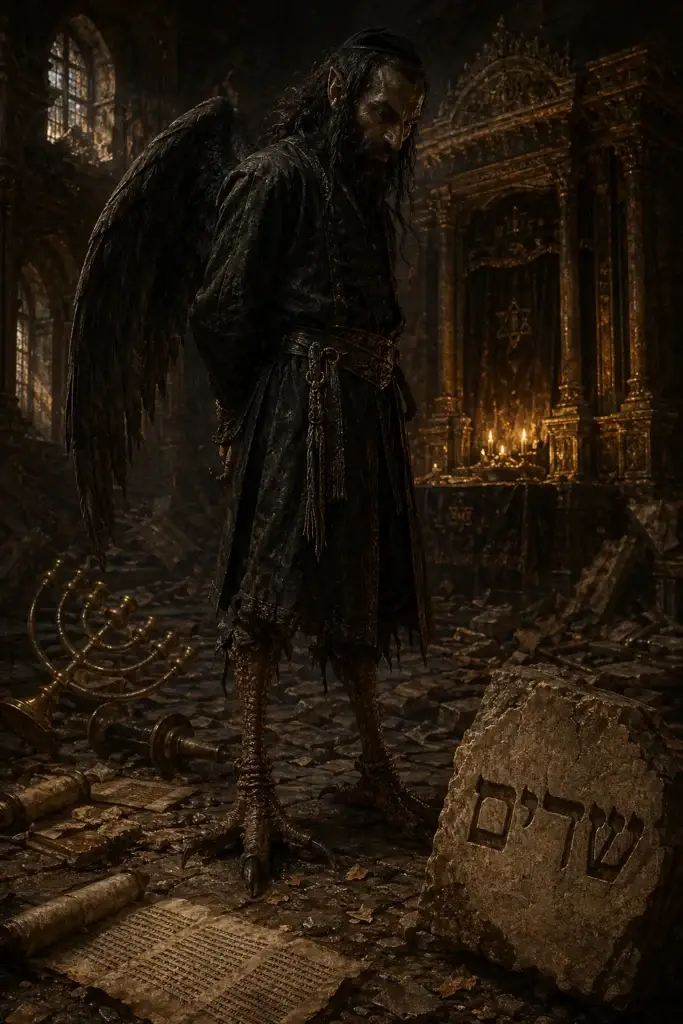
Largely invisible. The Talmud describes them with humor: “Whoever wishes to see their tracks should scatter ashes around his bed, and in the morning he will see the marks of rooster feet.” Individual texts give them wings, a basically human form, and non-human feet. The iconography of the incantation bowls shows them bound, mostly anthropomorphic.
Behavior
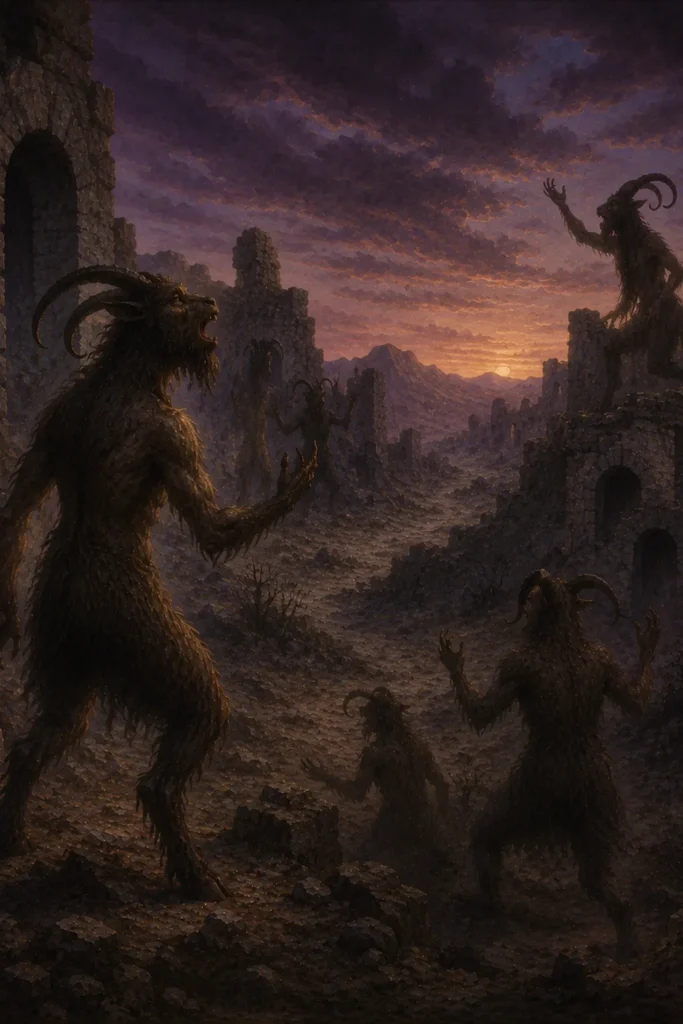
Shedim inhabit unclean places (ruins, latrines, cemeteries), boundaries and places of transition. They cause illness, disturb sleep, stir up conflict, and seduce. Unlike Lilith, they have no specific area of responsibility; they are the “general” demonic threat of everyday life.
Sphere of Influence
Unclean places, transitions, nocturnal situations, travel. The Talmud names specific danger zones: edges, doorsills, wells, privies, and paths at dusk.
Mythological Origin
Midrashic traditions know various origins: as the last beings of the week of creation, as the offspring of Adam with Lilith, as beings formed from dust that remained unfinished before the completion of creation. The diversity of these narratives is itself an expression of the openness of the category.
Profile: Shedim
The most important aspects of the shedim at a glance. You will find the detailed treatment of their name, description, defense and parallels in the following sections.
A collective term, not a single being. Etymologically probably adopted from the Mesopotamian shedu, turned to the negative in Biblical and rabbinic Hebrew.
A general threat. People who stay at unclean places or at thresholds; travelers at dusk; sleepers without a protective formula.
Largely invisible. Occasionally described with rooster feet, wings, and a human upper form. On incantation bowls they are depicted as anthropomorphic and bound.
Illness, nocturnal disturbances, conflict, sudden fright. Harmful effect without any sharpened thematic specialization.
Prayer, name magic, amulets, a mezuzah on the door, protective formulas when entering unclean places. The Talmud gives detailed rules of conduct (for example when going to the latrine).
Mesopotamian shedu/lamassu (etymologically related), Greek daimones (a comparable collective category), Christian demons in general, and Arabic jinn.
Practical Defense
Rituals of Defense
The Talmud gives detailed instructions: protective formulas when entering a latrine, spitting three times at certain encounters, and washing the hands after waking. These small everyday rituals keep shedim at a distance without negotiating with them directly.
Incantations
The Aramaic incantation bowls are the richest source. Their texts conjure individual shedim by name, bind them with divine names and angelic names, and send them back to unclean places. The central logic: whoever knows the name of a shed has power over it.
Amulets and Protective Symbols
A mezuzah on every doorpost, with the divine name Shaddai upon it, is regarded as a guardian. Kimpetzettel (childbed notes) for the lying-in period and the infant. Amulets with verses from the Psalms and angelic names. The hamsa hand against the evil eye.
Parallels and Afterlife
Mesopotamia
The name probably goes back to shedu, a protective bull there and a demon here. This reevaluation is a model case of religious-historical change.
Islamic Tradition
The Arabic jinn structurally take over many features of the shedim: a class of invisible intermediary beings, ambivalent, between human and angel. The parallels are close, without any direct dependence being demonstrable.
Modern Jewish Folklore
In Eastern European Hasidic traditions the idea of the shedim remains alive. Modern literature (I. B. Singer, dybbuk tales) draws on them. In contemporary Israeli speech, shed is used colloquially for “rascal” or “imp”, an ambivalently mischievous softening.
The Few Biblical References and the Problem of Translation
The Hebrew word shedim occurs only twice in the entire Tanakh, both times in the plural. In the Book of Deuteronomy, Israel is reproached for having sacrificed to the shedim, who are no deity, new gods whom the fathers did not know.
In a Psalm it says that the people sacrificed their sons and daughters to the shedim and thereby shed innocent blood. Both passages closely connect the word with forbidden sacrificial worship, especially with child sacrifices offered to foreign powers.
Even this slim evidentiary basis makes clear that the biblical record says almost nothing about the nature of these beings. The texts are polemical; they aim to devalue foreign cults, not to develop a demonology.
Shedim appears here as a collective designation for the recipients of a cult that the biblical authors brand as idolatrous and bloody.
Scholarship connects the word with great probability to the Akkadian shedu. In the Mesopotamian region this designated a protective spirit, often in the form of a winged bull-man, who guarded the gates of palaces and temples.
What in Mesopotamia was a benevolent protective genius was reinterpreted in the Hebrew Bible as a foreign, unlawful power to which one must not sacrifice.
This reinterpretation is a good example of a widespread pattern. The gods and spirits of the neighboring peoples are not denied in biblical monotheism but devalued; they are not true deities but mere shedim, to whom no lawful cult may be directed.
Later Jewish demonology thus had hardly any biblical foundation on which to build, and had to develop the picture of these beings largely anew.
The Elaboration of the Shedim in Rabbinic Writings
Only the rabbinic literature, above all the Babylonian Talmud and the associated works of interpretation, turned the bare biblical word into an elaborated class of demons. Here the shedim appear as a numerous, ever-present kind of being.
An often-cited passage in the Talmudic tractate Berakhot describes how the shedim surround people in immense numbers, how each person has thousands of them on the left and on the right, and how the crowding in the study house or the weariness of the knees stems from their activity.
The rabbis placed the shedim in an intermediate position.
A well-known text lists three properties in which they resemble the ministering angels: they have wings, they fly from one end of the world to the other, and they know what is to come; and three in which they resemble humans: they eat and drink, they reproduce, and they die.
The shedim thus stand between angel and human; they are corporeal enough to die and spiritual enough to possess hidden knowledge.
Various conceptions circulated about their origin. A widespread tradition connects them with the twilight of the sixth day of creation, when God created their souls but, because of the approaching Sabbath, no longer completed their bodies, so that they remained unfinished between the spheres. Other texts trace certain demons back to Adam.
The rabbinic literature also developed the names of individual leaders, gives hints about their preferred dwelling places, such as ruins, latrines, the shadows of trees and lonely paths at night, and names times of particular danger. In this way the biblical collective term became a detailed body of teaching that pervaded everyday life.
Protection and Defense in Jewish Everyday Life
If, according to rabbinic conception, the world is densely populated with shedim, then everyday life requires protective measures. Over the centuries the Jewish tradition developed a rich repertoire of defense and precaution, drawn from the Talmud, from the subsequent legal works, and from folk practice.
At the center stands the word. The pronouncement of blessings, the study of the Torah, and especially the recitation of certain Psalms, above all the so-called Psalm against the plagues, were regarded as effective protection.
The Shema, the Jewish confession of faith spoken at bedtime, was also understood as a defense against the terrors of the night. The mezuzah on the doorpost, which contains verses from the Torah, also protects the house from harmful powers according to widespread belief.
Alongside these stood concrete rules of conduct. The Talmud advises avoiding certain endangered places, not walking through ruins alone and at night, not drinking water that has stood uncovered through the night, and not passing between two persons or between two trees at dangerous spots.
Performing certain actions in pairs, and avoiding even numbers in certain contexts, also belonged to these prescriptions.
In folk piety, especially in the milieu of Lurianic Kabbalah and of Eastern European Judaism, amulets were added, inscribed parchments with divine names, angelic names and biblical verses, worn on the body or affixed in the house.
Their use was especially widespread in protecting women in childbed and newborns, who were regarded as particularly at risk. These practices show that the shedim were no mere doctrinal opinion but a reality with which lived religion reckoned daily.
Solomon, the Mastery of Demons, and the Later Formation of Legend
A distinct line of tradition connects the shedim with King Solomon. It proceeds from the biblical depiction, which ascribes to Solomon superior wisdom and dominion over all creation, and develops from it the idea that the king also ruled the spirits and demons.
The Babylonian Talmud already contains a detailed narrative in which Solomon captures the leader of the demons with the help of a signet ring engraved with the divine name and forces him to serve in the building of the Temple.
In the course of the story, Solomon temporarily loses power over the demon through his own arrogance.
This Talmudic narrative became the nucleus of a sprawling post-biblical legendary tradition. In later texts, some arising outside rabbinic Judaism, Solomon becomes the great master over the demons, who knows their names, their domains and the means of subduing them.
Part of the Jewish magical literature of the Middle Ages, and the literature influenced by it, builds on this conception.
From the standpoint of religious studies this line is instructive, because it shows how an entire genre grows out of terse biblical allusions and isolated Talmudic narratives. The signet ring, the list of demons with their peculiarities, and the idea that knowledge of the name grants power over the being all became fixed building blocks.
At the same time, normative rabbinic Judaism remained reticent to disapproving toward the practical incantation of demons.
The Solomon tradition therefore often moved at the edge of official religion or beyond it. Yet it shows that the shedim were conceived not only as a threat but also as masterable powers whose forces a sufficiently wise and pious person could press into service.
This tension between defense and mastery runs through the entire Jewish engagement with the shedim.
Further Links
Further reading:
- Judaism
- Lilith (a concrete representative of the class)
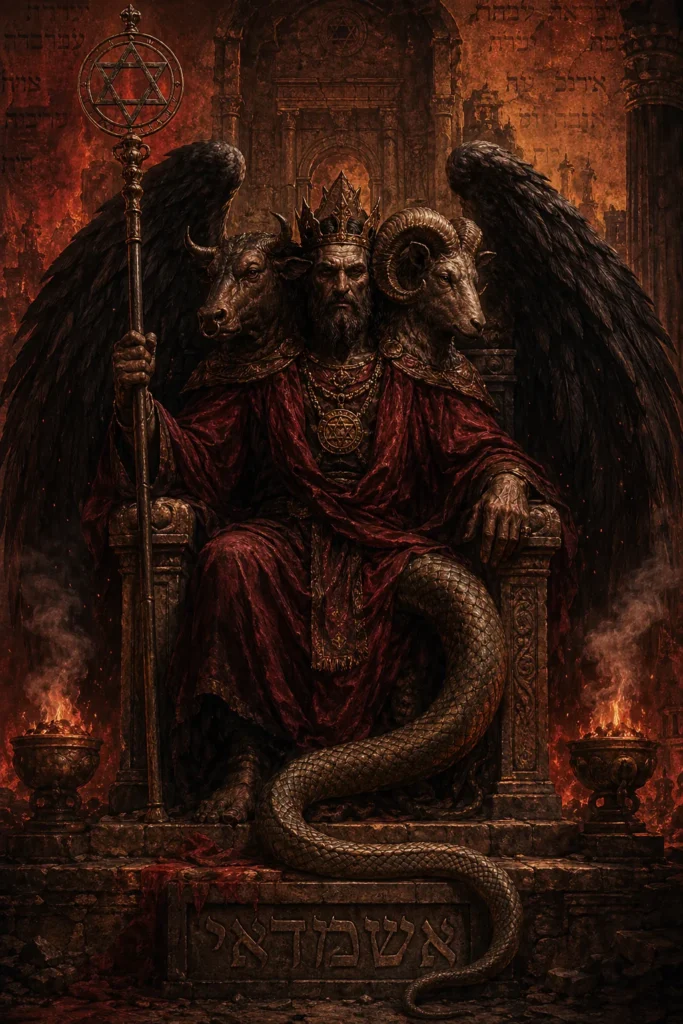
- Asmodai (king of the shedim hierarchy)
- Mesopotamia (the shedu etymology)
- The mezuzah and Jewish protective amulets
Research Literature
Further standard works in the literature index.
The protective practice described here is a religious-studies classification of historical traditions. iWell Guard ties in with this cultural-historical line of wearable protective objects and represents a contemporary form of it. More about the iWell Guard →
Frequently Asked Questions about Shedim
What are shedim in the Jewish tradition?
Shedim (plural of shed, Hebrew שדים) are, in the Jewish tradition, a class of spirit beings, mostly characterized as destructive or at least morally ambivalent.
In the Tanakh the term appears rarely (Deut 32:17; Ps 106:37), where it is used as a designation for the pagan gods to whom the Israelites sacrificed their sons. In the Talmud (especially Pesachim 110a-112b), shedim are treated as real, supernatural beings that live in toilets, at crossroads, in villages and in bramble hedges.
How do shedim differ from mazzikim and lilin?
Jewish demonology knows several classes: shedim are the most general class, body-like, intelligent beings with free will. Mazzikim (harmers) are specifically oriented toward harm. Lilin are the offspring of Lilith, night demons.
Ruchot are pure spirit beings, sometimes departed souls. The Talmud (Chagigah 16a) records that shedim share three properties with humans (eating, reproduction, mortality) and three with angels (wings, flight from one end of the world to the other, knowledge of what is to come); they are intermediary beings.