Nephthys, goddess of the Egyptian tradition
By Ralf Ittermann · last reviewed on
Nephthys is a goddess of the Egyptian tradition.
Sister of Isis and Osiris, protective goddess of the dead, goddess of boundary zones. Nephthys stands in the shadow of her more famous sister Isis, yet she is no less powerful, only essential in a different way.
She protects the deceased on their journey into the afterlife, she knows the dark paths and the secret names. With glowing hieroglyphic signs on her brow, more distant than near, Nephthys is the goddess of transformation and of necessary solitude.
Quick Overview: Nephthys
Type: Major Egyptian deity, sister of Isis, deity of the dead and of lamentation
Pantheon: Egypt (all dynasties)
Function: Mourning for Osiris, escort of the dead, protection of mummies, aid in childbirth
Main attributes: Hieroglyphic house sign with a basket on the head, outspread wings
Main cult site: Hut-Sechem (Greek Diospolis Parva, in Upper Egypt), shared sanctuaries with Isis
Siblings: Isis, Osiris, Seth
Context
Nephthys is attested from the Pyramid Texts onward (Spell 218, ca. 24th century BCE). The main flourishing of her theology: the Middle and New Kingdoms, central within Osiris mythology as the mourning sister.
Unlike Isis, Nephthys has only a few temples of her own, but she is present as a protective figure in every sarcophagus, every temple and every funerary stele.
In the Ptolemaic period she was increasingly merged with Isis or understood as her elder sister. The Lamentations of Isis and Nephthys (several transmitted hymn versions) are among the most famous texts of Egyptian liturgy.
Main cult site: Hut-Sechem (Greek Diospolis Parva, in Upper Egypt). More common than temples of her own: shared sanctuaries with Isis, the pair of sisters being iconographically often inseparable.
In every temple of Osiris (Abydos, Philae) Nephthys had her own cella or niche. In the Late Period (1st millennium BCE) she was central as a mourning figure in every funerary ritual.
Central sources: Pyramid Texts (Spells 218, 535, 670), Coffin Texts, Book of the Dead (Spells 17, 151), the Lamentations of Isis and Nephthys (Bremner-Rhind Papyrus, P. Berlin 3008), Plutarch’s De Iside et Osiride.
Secondary literature: Münster, Untersuchungen zur Göttin Isis (Nephthys aspects); Bonnet, Reallexikon; Wilkinson, Complete Gods and Goddesses; Pinch, Egyptian Mythology.
Name and Spellings
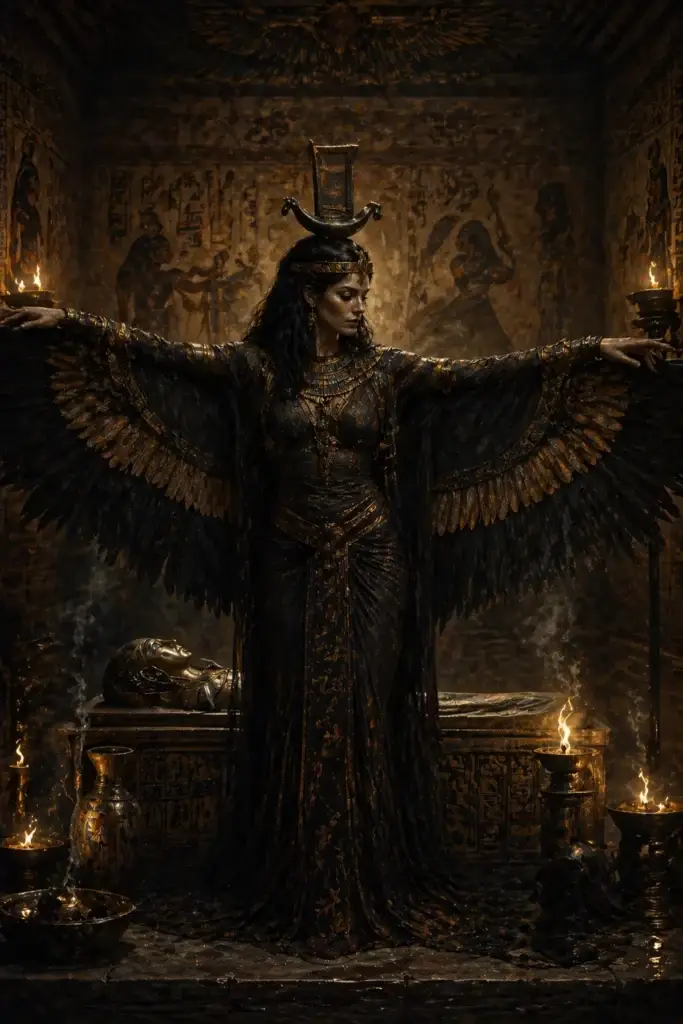
Nephthys is shown with the house hieroglyph on her brow (her name means “Mistress of the House”), or with two feathers. She often wears black or dark garments, not as a sign of evil but of mourning and of nocturnal protection.
Sometimes she has falcon wings. Her depiction is less decorative than that of Isis, more sombre, but not without dignity. The uraeus (serpent) sometimes adorns her brow. In tomb scenes she is shown beside Isis, both bent over the corpse.
Characteristics
Nephthys protects the deceased on their journey into the afterlife. She sings lamentation hymns that strengthen the dead. In the Book of the Dead she is invoked to overcome obstacles and to recognise the names of secret guardians.
Priestesses played the role of Nephthys in funerary rites, wearing dark garments and singing songs of lamentation. Nephthys is also understood as a goddess of barrenness and of misfortune, not evil but necessary. She is the goddess of boundaries, of the passage between life and death. Mummies were entrusted to her protection.
Appearance and Symbolism
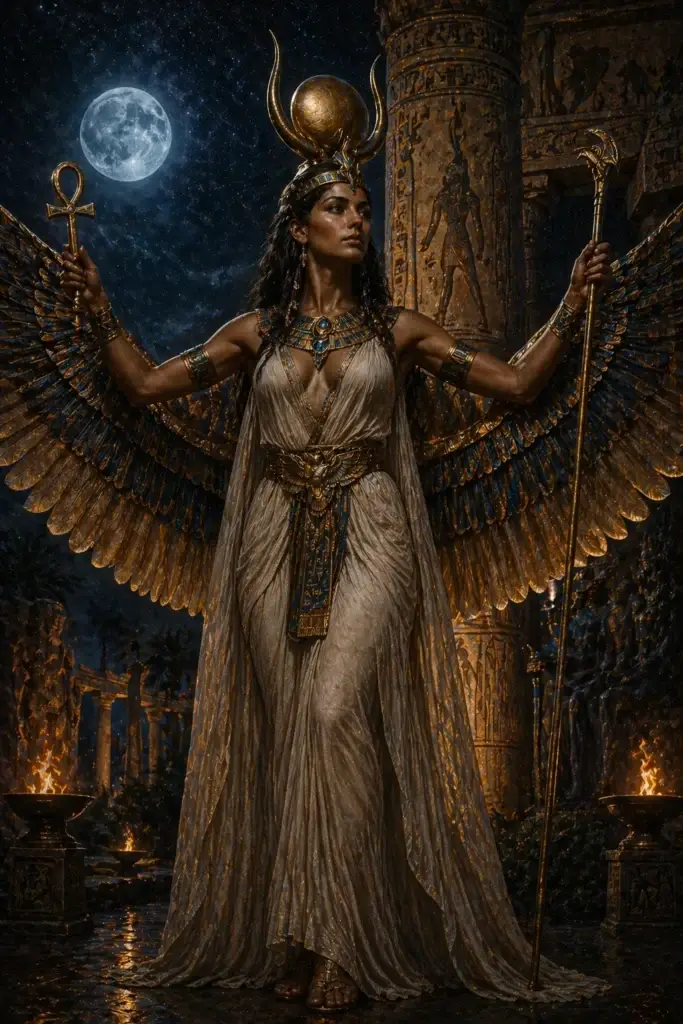
Nephthys is depicted as a woman with a crown of two feathers and an inlay of the sign of her name, or with wings, resembling a falcon. She wears a long dress and is often painted with dark brown or dark blue skin colour, to symbolise her connection to the western darkness.
She is frequently shown beside her sister Isis, striding or mourning. Her attribute is the burning house or the burning lamp, symbols of the fiery transformation in death.
The most important aspects of Nephthys at a glance. The following fields summarise origin, function, appearance, veneration, symbols and cultural parallels.
Nephthys (Egyptian Nebet-Hut, “Mistress of the House”) is the daughter of Geb (earth god) and Nut (sky goddess), sister of Osiris, Isis and Seth. Consort of Seth, but in one tradition the mother of Anubis (from an affair with Osiris; out of fear of Seth, Nephthys gives the child up, and Isis raises it).
In the Osiris myth she has a central mediating function: unlike her violent husband Seth, Nephthys sides with her sister Isis and helps to search for and mourn the murdered Osiris.
Sisterly mourning for the murdered Osiris; in the Egyptian tradition of the dead she is invoked together with Isis as a mourning pair. Protection of mummies: her outspread wings enfold the deceased, frequently as a sarcophagus symbol.
Escort of the dead: she stands (often with Isis) at the deathbed and protects the soul on its way into the afterlife. Helper in childbirth: in some traditions a patroness of midwives. In popular cult also protection against demonic powers.
Anthropomorphic as a beautiful woman, often with outspread wings (gesture of protection). On her head the hieroglyphic house sign with a basket; her name Nebet-Hut literally means “Mistress of the House” (= of the temple).
A long, multi-layered garment, frequently in a gesture of mourning with the hand before the face. On sarcophagi she is often depicted as a winged protective figure at the foot end (Isis at the head end). Frequently in the company of the escort gods of the dead (Anubis, Thoth).
Sphere of influence: Nephthys was invoked in every Egyptian funerary ritual; the mourning pair Isis-Nephthys was a central component. In the Lamentations of Isis and Nephthys, each of the sisters speaks in turn, mourning the murdered Osiris or the deceased.
In personal cult, an invocation for the protection of the deceased’s mummy, for aid in labour pains. In the Ptolemaic period she was also venerated within the Isis mysteries.
Hieroglyphic house sign with a basket (on the head), outspread wings (gesture of protection), was-sceptre, ankh, mourning gesture with the hand before the face. Sacred plant: sycamore tree. Sacred animals: falcon (in some traditions), dragon-tree plant.
Isis (Egypt, sister, often inseparable as a mourning pair), Hecate (Greece, crossroads, death, partial parallel), Persephone (Greece, queen of the dead), Hel (Germanic, half-sister and half a dead being), Maman Brigitte (Vodou, cemetery loa, mourning function), Yamuna (Hinduism, sister of Yama, companion of the dead).
Functionally: every mourning figure who weeps for the dead together with her sister shares aspects of Nephthys (especially the Marys at the tomb in the Christian tradition).
Protective Practice
Rituals of Veneration
Nephthys (Egyptian Nebet-Het, “Mistress of the House”) is the sister of Isis, Osiris and Seth, and the consort of Seth. Together with Isis she appears as a mourning woman for the dead Osiris, the central Egyptian figure of lamentation for the dead.
Her main cult sites are Sepermeru (12th Upper Egyptian nome) and Diospolis Parva. In the funerary ritual, two priestesses represented the mourning women Isis and Nephthys (Lamentations of Isis and Nephthys, Ptolemaic ritual text, cf. Wilkinson).
Invocations
The “Lamentations of Isis and Nephthys,” hymns preserved in Hieratic from the Ptolemaic temple ritual, are the central liturgical invocation. The Pyramid Texts (Spell 532) and Coffin Texts (CT 38) integrate Nephthys into the liturgy of the dead. She is the protectress of the canopic jar for the lungs.
Amulets and Protective Symbols
Nephthys amulets of faience or semi-precious stones were placed in the tomb as grave goods for the dead. She bears the Nebet-Het symbol on her head.
Her temple images show her with outspread wings as a protective goddess (cf. images in the Tutankhamun shrine, Cairo). Apotropaic wedjat eyes bearing her name for protection of the dead.
Nephthys, Parallels in Other Cultures
Nephthys resembles Persephone (Greece), a goddess of the underworld and of transition. She shares traits with Hecate (Greece), goddess of nocturnal boundaries. She recalls Skadi (Scandinavia), a goddess of wilderness and solitude. The motif of the boundary goddess is universal; Nephthys is a melancholic yet powerful expression of it.
Nephthys and Isis as Mourning Women in the Osiris Myth
The most important mythological role of Nephthys lies in her connection to the Osiris myth. After the murder of Osiris by his brother Seth, who is at the same time Nephthys’ consort, Nephthys joins her sister Isis to search for the dead god, to mourn him and to make his revival possible.
In the Pyramid Texts, the oldest religious texts of Egypt from the Old Kingdom, the two sisters repeatedly appear at the head and at the feet of the deceased, as the two kites or female falcons watching over the corpse.
This position was transferred to the burial of every deceased person, who was identified with Osiris. On coffins and in burial chambers, Isis is depicted at the head end and Nephthys at the foot end.
From the Egyptian temple liturgy the so-called Lamentations of Isis and Nephthys are preserved, texts of the Late Period in which the two goddesses alternately call upon the dead Osiris and move him to return.
In the ritual performance, two priestesses took on the roles of the sisters. Religious studies sees in this pair of goddesses the mythic archetype of Egyptian funerary lamentation, in which female mourning has the power to preserve the dead and to enable his transformation.
Her Position in the Ennead of Heliopolis
Nephthys belongs to the so-called Great Ennead of Heliopolis, a theological system that arranges the most important gods into a genealogical order.
At its head stands the creator god Atum, from whom the air pair Shu and Tefnut proceeds, from these the sibling pair Geb (earth) and Nut (sky), and from these in turn the four siblings Osiris, Isis, Seth and Nephthys.
Nephthys is accordingly the daughter of Geb and Nut, sister of Osiris, Isis and Seth, and at the same time consort of her brother Seth.
Her Egyptian name Nebet-hut means Mistress of the House, which is traditionally taken to refer to the temple precinct or the palace, not to the dwelling house in the everyday sense. The meaning continues to be debated in Egyptology.
Within the Ennead, Nephthys is a particular figure in that her own mythological activity remains almost entirely confined to her function in the Osiris events. She rarely appears alone, but almost always in relation to others: as sister of Isis, as consort of Seth, as protectress of Osiris.
Some traditions make her the mother of Anubis, the god of embalming, with Osiris as the father in some versions, which binds her still more closely to the cult of the dead. Scholarship therefore often describes Nephthys as a complementary deity, whose profile emerges from her relationship to the other members of the Ennead.
Nephthys in the Cult of the Dead and on the Canopic Jars
In the Egyptian burial ritual Nephthys had a fixed and concrete function. She was one of the four protective goddesses connected with the Sons of Horus, who watched over the inner organs of the deceased. During mummification, the lungs, liver, stomach and intestines were removed and interred in four vessels, the canopic jars.
Each of the four Sons of Horus was responsible for one organ and stood in turn under the protection of a goddess. Nephthys protected Hapy, the Son of Horus with the baboon head, to whom the lungs were entrusted.
Isis protected Imsety, Neith protected Duamutef, Selket protected Qebehsenuef. On the sides of sarcophagi and shrines these four goddesses appear in the corners, with outspread winged arms enfolding the dead.
In the famous burial treasure of Tutankhamun this constellation is impressively preserved: the gilded canopic shrine is surrounded on its four sides by the protective goddesses, Nephthys among them, with protectively outstretched arms.
Her headdress, a basket on a stylised house sign, also forms the script sign of her name and makes her easily identifiable in depictions.
The connection of Nephthys with the preservation of the body and protection in the afterlife runs through the entire history of Egyptian religion and makes her one of the most present goddesses of material grave culture, even though her own temple cult remained comparatively modest.
Further Links
Literature (Selection)
Further standard works in the literature index.
Frequently Asked Questions about Nephthys
Who is Nephthys in Egyptian mythology?
Nephthys (Egyptian Nebt-Het, Mistress of the House) is the younger sister of Isis and Osiris and at the same time the consort of Seth, one of the four great mother goddesses of Egypt. In the Osiris myth she helps her sister Isis to gather the dismembered limbs of Osiris.
Nephthys is a protective goddess of the dead, especially of the canopic jars; together with her sister Isis she protects the sarcophagus and stands with her at the foot of the deathbed as a mourner. At every Egyptian burial two mourning women appear as Isis and Nephthys.
What is the relationship between Nephthys and Seth?
Although Nephthys is formally the consort of Seth, her relationship to him is ambivalent. In the myth she clearly turns against him, allying herself with Isis against her own husband.
In some sources Anubis (the dog god) is her son, fathered not by Seth but by Osiris (a liaison that Isis first forgives and then accepts). This constellation makes Nephthys a complex figure standing between the worlds: sister of the bright gods, consort of the god of chaos, mother of the god of the dead.