Bastet, goddess of the Egyptian tradition
By Ralf Ittermann · last reviewed on
Bastet is a goddess of the Egyptian tradition.
Cat goddess, protectress of the home and of motherhood. Bastet is the wild grace that dwells within the house: protector, huntress, gentle mother.
Shown with a cat’s head or with a human body in feline form, she is tender as well as dangerous: the dual nature of the cat itself. Her sanctuary at Bubastis drew pilgrims from across Egypt, and her popular veneration was perhaps greater than that of many more significant gods.
Type: Egyptian principal goddess, cat and protective goddess
Pantheon: Egypt (all dynasties)
Function: protection of the home, motherhood, fertility, the warding off of illness and evil powers
Principal attributes: cat, sistrum, aegis (lion-headed collar), basket with kittens
Principal cult sites: Bubastis (Per-Bastet, Nile delta), Memphis, Speos Artemidos
Greek counterpart: Artemis Bubastia Roman counterpart: Diana Bubastis
Historical classification
Bastet is attested from the Early Dynastic Period (ca. 2900 BC), at first in lioness form as a wild protectress of kingship, and increasingly as a gentle house cat from the first millennium BC onward.
The principal flowering of the Bastet cult falls in the 22nd Dynasty (the Bubastites, ca. 945:715 BC), when Bubastis was briefly the Egyptian capital. In the 5th century BC, Herodotus describes the Bubastite festivities as one of the largest pilgrimage festivals of Egypt. In the Greco-Roman period she underwent syncretism with Artemis and Diana.
The principal cult site was Bubastis (Tell Basta) in the eastern Nile delta, one of the most important Egyptian pilgrimage sites of the Late Period. Alongside it stood Memphis, Thebes and almost all the larger temple cities.
In the Late Period, monumental cat cemeteries arose at Bubastis, Saqqara and at the Speos Artemidos (Beni Hassan), attesting to the enormous popularity of the cult. Bastet bronzes are today among the most frequently preserved votive objects of the Late Period.
The central sources include the Pyramid Texts (Spell 1111), the Coffin Texts, the Book of the Dead (Spells 17 and 145), temple reliefs from Bubastis and Edfu, as well as Herodotus’s Histories II 59:60 on the Bubastite festival.
Archaeologically, the animal mummy cemeteries of Bubastis, Saqqara and the Speos Artemidos document the reach of the cult. The most important secondary literature: Bonnet, Reallexikon der ägyptischen Religionsgeschichte; Wilkinson, Complete Gods and Goddesses of Ancient Egypt; Malek, The Cat in Ancient Egypt.
Name
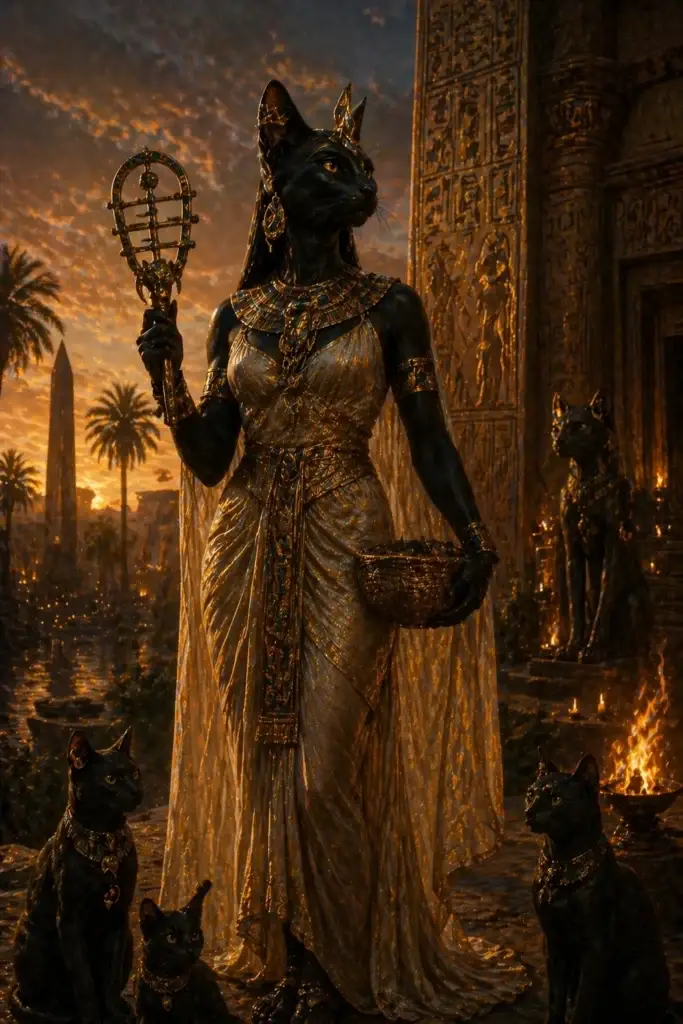
Bastet is depicted as a woman with a cat’s head, often holding a sistrum (a rattle instrument) in one hand and a basket of kittens in the other. Sometimes she is purely feline, a large cat upon a human body.
Her colour is gold or brown. The sistrum was her sacred musical instrument, symbolising joy and fertility. The uraeus (serpent) sometimes adorns her brow. Cat mummies were made in her honour, thousands of them interred in crypts.
Description
Bastet protects the home against plague, fire and evil spirits. She is the patroness of women, especially in pregnancy and childbirth; her fertility is gentle and productive, unlike the warlike Sekhmet. In the Bubastis temple, pilgrims offered her milk, fish and flowers.
The festival in Bastet’s honour was one of the largest Egyptian religious festivals, accompanied by music, dance and wine. Priestesses kept living cats in the temples; the veneration of the cat itself was part of the cult. To sacrifice or drown kittens was an act of piety, not cruelty.
Appearance and symbolism
Bastet is depicted almost exclusively as an elegant black cat or as a cat-headed woman, often with the Aten, the solar disc, upon her brow. In her hand she carries the sistrum, a sacred percussion instrument played in dances and rituals.
The girdle around her hips is adorned with beads and amulets. Her eyes are often depicted kohl-blackened with the characteristic Egyptian Wadjet eye. The black cat was sacred and was endowed with divine protection.
The most important aspects of Bastet at a glance. The following fields summarise origin, function, appearance, veneration, symbols and cultural parallels.
Bastet is one of the oldest Egyptian goddesses, with origins in the Early Dynastic Period.
She is regarded as the daughter of the sun god Ra (in some traditions of Atum) and the sister of the lion-headed Sekhmet, with whom she forms two aspects of a double goddess: the raging destroyer (Sekhmet) and the peaceful protectress (Bastet).
She is the wife of Ptah and the mother of the lion-headed protective god Mahes (Mihos).
Protectress of the home, of pregnant women, of mothers and of children. A goddess who wards off illness, snakes, scorpions and evil spirits.
In her solar aspect she is also the daughter and Eye of Ra, frequently depicted with a solar disc above her head. In her early lioness form she was a wild protectress of kingship.
Early form: a lion-headed woman (above all in the Old Kingdom). Later form: a cat-headed woman in a long sheath dress, holding in her right hand a sistrum (a ritual rattle instrument) and in her left an aegis (a ceremonial collar with a lion’s head).
Frequently with a basket of kittens on her arm. Full-cat statuettes were extremely widespread as votive offerings. Most often seated (a cultic pose), more rarely striding.
Sphere of influence: Bastet protects house and hearth against visible and invisible threats. Women called upon her before and during childbirth, and mothers wore Bastet amulets for their children. Snakes, rats and scorpions were regarded as her particular adversaries.
In the temple of Bubastis, the sacred cat was venerated as the living image of the goddess; deceased cats were mummified and laid to rest in the great animal cemeteries. The Bubastite festival was regarded as the most exuberant Egyptian popular festival.
Sistrum, aegis (a collar with a lion’s head), the cat (especially the tabby house cat), the solar disc, the menat collar. Plants: reed, lotus. Of lesser importance are objects such as incense bowls and offering baskets. In pictorial depiction she is frequently accompanied by the household protective god Bes.
Sekhmet (Egypt, sister and wild double aspect), Tefnut (lioness daughter of Ra), Hathor (in the Sekhmet-Hathor tradition), Artemis Bubastia (Greece, syncretistic adoption), Diana (Rome). In a broader comparison: Freyja (Germanic, the cat as a sacred animal), Lakshmi (Hinduism, goddess of the home and prosperity).
Protection in everyday life
Veneration in everyday life
Rituals and invocations
According to Herodotus’s account, the great festival of Bubastis drew crowds of people and was marked by music, especially the sistrum, and by processions. Bastet was regarded as a protective and at the same time joyful deity of domestic life.
Conjurations and invocations
Textual transmission and formulae
Bastet already appears in the Pyramid Texts and the Coffin Texts. Her principal cult site was Bubastis in the Nile delta; in the second book of his “Histories”, Herodotus describes the festival there in detail.
Amulets and protective symbols
Material apotropaia and archaeological evidence
Cat amulets and faience cat figurines are among the most frequent Egyptian protective signs and were intended to preserve house and family. Added to these are the aegis of Bastet as well as the extensive cat necropolises with animal mummies.
Bastet, parallels in other cultures
Bastet resembles Diana/Artemis (Greece): huntress, virgin and mother at once. She shares traits with Freyja (Scandinavia), goddess of love and fertility.
The motif of the protective household goddess is found in numerous cultures: the Penates (Rome), the household gods (Slavic). Yet Bastet is singular in her bond to a single animal and in her popular popular piety.
Bubastis: city, temple and the great festival
The centre of the Bastet cult was the city of Bubastis in the eastern Nile delta, in Egyptian Per-Bastet, the House of Bastet. The Greek historian Herodotus visited Egypt in the fifth century before our era and has left one of the most detailed descriptions of the sanctuary there.
He describes the temple as surrounded by canals, so that it lay on a kind of island, and describes it as one of the most impressive he had seen in Egypt.
His account of the Bastet festival is particularly well known. Herodotus reports of great numbers of pilgrims who came to Bubastis by water, of music, dance and exuberant activity, and of a considerable consumption of wine. He names the festival of Bubastis as the largest and most heavily attended among several Egyptian festivals.
Even if Herodotus’s statements are to be read with caution in detail, since as an outside observer he may have abridged or embellished some things, their broad outlines accord with what archaeological and Egyptian sources suggest about the significance of Bubastis.
Archaeological investigations at Bubastis have uncovered remains of the temple and the associated structures, among them building elements from various epochs, which show that the sanctuary was maintained and extended over a long period.
In the Late Period, when rulers from the delta held power in Egypt, Bubastis gained in political as well as religious weight. The city was thus not only a cult site but at times also a centre of power, which reflects the close connection of kingship and the cult of the gods in ancient Egypt.
Cat mummies and animal cemeteries
Among the most striking archaeological remains of the Bastet cult are the animal cemeteries with large quantities of mummified cats. Such burials are known not only from Bubastis but also from other sites. The mummies were in part carefully wrapped in bandages and shaped, some placed in specially made containers.
Scholarship understands this practice above all in connection with the votive culture of the Egyptian Late Period and the Greco-Roman epoch. Pilgrims acquired animal mummies in order to present them to the deity as a gift, comparable to a votive offering. The cat, as the animal associated with Bastet, was especially suited to this.
Investigations of individual mummy assemblages with modern imaging techniques have shown that the contents differ: some contain complete animals, others only parts or almost nothing but bandages. This points to an extensive, in part routinised production, in which the ritual function of the gift was more important than the completeness of the individual animal.
These finds attest how deeply the animal cult was anchored in religious practice. At the same time they reveal an economic dimension: in order to meet the demand for votive mummies, cats were evidently kept and reared on a larger scale.
In the nineteenth century, large quantities of Egyptian animal mummies were even shipped to Europe, in part for use as fertiliser, a little-known chapter that shows how the treatment of these finds in later times was far removed from their original religious meaning.
Bastet and Sekhmet: the two faces of the lioness
Bastet stands in close relation to a group of goddesses regarded as dangerous, lion-shaped powers, foremost among them Sekhmet.
Both belong to the daughters of the sun god Ra and embody aspects of the so-called Eye of the Sun, a conception that grasps the protective but also destructive power of the sun god as a female deity.
In Egyptian religious history a shift becomes apparent. In early times Bastet herself was depicted as a lioness and possessed thoroughly menacing traits.
Over the course of time, above all from the first millennium before our era onward, her appearance as a cat or as a cat-headed woman came to the fore, while the wild, destructive side remained more strongly with Sekhmet.
Some texts present the two goddesses as the two sides of a single power: Sekhmet when she rages, Bastet when she is appeased.
This polarity is no contradiction but corresponds to the Egyptian conception that the same divine power can act threateningly or protectively according to its state.
The so-called myth of the Distant Goddess, in which the raging daughter of the sun god travels to Nubia and must be appeased and brought back, belongs to this circle of ideas.
Bastet appears in it as the pacified figure in whom danger has turned into protection. For an understanding of the goddess it is therefore important not to see her in isolation as a friendly cat goddess, but as one pole within a spectrum of leonine sun goddesses.
Further links
Literature (selection)
Further standard works in the literature index.
Frequently asked questions about Bastet
Who was Bastet in Egyptian mythology?
Bastet (Egyptian Bȝstt) was the Egyptian cat goddess, one of the most popular folk deities of Egypt. In early times she was depicted lion-headed (like Sekhmet, with whom she was originally identical), and from the first millennium BC onward cat-headed or as a seated cat.
Bastet was the goddess of the home, of birth and of fertility, and a protectress against evil spirits. Her principal cult site was Bubastis (Egyptian Per-Bastet) in the eastern Nile delta. Herodotus describes the Bastet festival there as the largest festival of Egypt, with boat processions, music and exuberance.
Why were cats sacred in ancient Egypt?
Cats came to Egypt as domesticated animals from around 2000 BC and developed a unique religious significance there. They kept the storehouses free of mice and snakes, which was vital precisely in a grain-based high culture. From this practical esteem grew religious veneration.
The killing of a cat was severely punished (according to Diodorus, even with death). In house fires the cat was rescued first. Mummified cats were dedicated by the hundreds of thousands as votive offerings in Bastet temples; modern excavations find entire cat necropolises.