iWell Guard

Shinatobe, breath of the wind shrines of Ise

Shinatobe is a goddess of Japanese tradition.

The wind that dispels the morning mist from Izanagi’s breath.

GoddessJapan

Table of Contents

Shinatobe, the wind god of Shinto
Shinatobe

Shinatobe, female, and Shinatsuhiko, male, are the wind deity of Shinto. They appear partly as a pair and partly as two names for the same wind principle, and are venerated for good harvests and protection against storms, especially at the wind shrines of Ise.

They are canonically attested in the Kojiki of 712 as a child of Izanagi and Izanami, and in the Nihon Shoki of 720, where the wind god arises from Izanagi’s breath, which blows away the morning mist. They have no fixed iconography: this is a textual god who lives on in shrine worship.

At a glance: Shinatobe

Type: Wind and harvest deity of Shinto, female and male form of a single principle
Origin: Japan, chronicles and shrine cult
Texts: Kojiki 712, Nihon Shoki 720
Period: eighth-century chronicles, living cult
Appearance: textual god without canonical iconography

Region of origin and sources

Period of the Texts

The canonical sources are the Kojiki of 712 and the Nihon Shoki of 720; the cult remains alive to this day, especially in Ise and Tatsuta.

Area of Diffusion

Japan, especially the wind shrines of Ise and the Tatsuta Shrine in Nara, which, according to the Nihon Shoki, repeatedly received delegations to the wind gods.

Sources

Well attested: the chronicles Kojiki and Nihon Shoki, as well as the documented shrine cult of Ise and Tatsuta.

Name and variants

Japanese: Shinatsuhiko is traditionally interpreted as the long-blowing man of long breath; shina is disputed, tsu an old genitive particle, hiko meaning man or prince. The female form Shinatobe carries an old female suffix. Older names for the same principle are Ame-no-mihashira and Kuni-no-mihashira, pillar of heaven and pillar of the land.

Beings and effect

Appearance

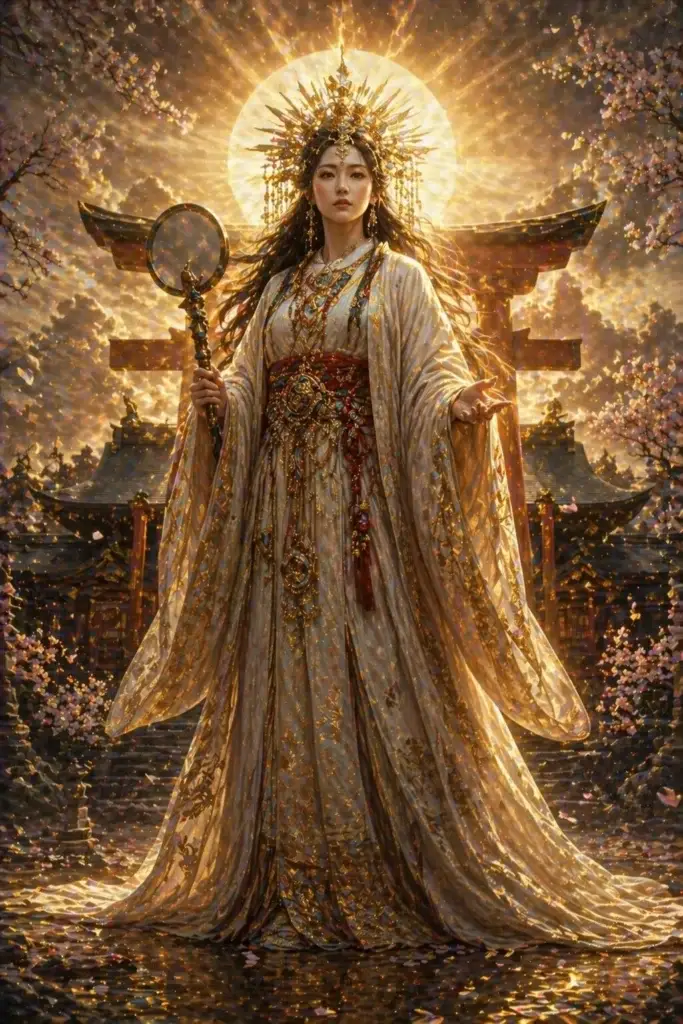
No canonical iconography exists; Shinatobe and Shinatsuhiko are textual gods of the chronicles who live on in ritual and shrine worship, not in imagery.

Effect

They are the wind and breath of the world and act for good harvests and protection against storms. According to the Nihon Shoki, the Tatsuta Shrine in Nara repeatedly received delegations to the wind gods to request a good harvest.

Profile: Shinatobe

The key aspects of the wind deity at a glance.

Tradition

Wind deity of the Shinto chronicles: in the Kojiki a child of Izanagi and Izanami, in the Nihon Shoki arisen from Izanagi’s breath.

Domain

Farmers, seafarers and shrine communities: invoked for good harvests and protection against storms.

Depiction

No canonical iconography: a textual god, accessible only through chronicle and shrine cult, also known under older names as pillar of heaven and pillar of the land.

Function

Wind and breath of the world: blessing of the harvest and protection against storms, in Ise also linked to the kamikaze legend of the Mongol invasions.

Cult

Two wind shrines in Ise, Kaze-no-miya and Kazahinomi-no-miya, along with the Tatsuta Shrine in Nara with delegations for the harvest.

Distinctions

To be distinguished from the iconic wind god Fujin, who, with his wind bag, derives from the Buddhist visual tradition of the Indian Vayu.

From Izanagi's breath: the chronicle evidence

In the Kojiki of 712, the wind deity appears as a child of Izanagi and Izanami. The Nihon Shoki of 720 tells a different origin: there, the wind god arises from Izanagi’s breath, which blows away the morning mist. The name Shinatsuhiko is traditionally interpreted as the long-blowing man of long breath, though this interpretation is folk etymology; the female form Shinatobe carries an old female suffix.

The two names stand partly for a pair and partly for two forms of the same wind principle; male or female is therefore a false alternative. The cult remained alive: according to the Nihon Shoki, the Tatsuta Shrine in Nara repeatedly received delegations to the wind gods for a good harvest.

Present-day cult and classification

Shinatobe and Shinatsuhiko remain to this day a fixed part of the Ise wind cult, though far less present in popular culture than Fujin.

From a religious-studies perspective, Shinatobe is a purely benevolent wind and harvest god, invoked in the cult solely as a protective and blessing power. Three clarifications are important: the interpretation of shina as long breath is folk etymology. Shinatsuhiko is not Fujin. And male or female is a false alternative, since both forms exist side by side as a pair.

The wind shrines of Ise

In Ise there are two wind shrines, Kaze-no-miya and Kazahinomi-no-miya. The Ise wind shrine was elevated in status because it was believed that its deity had sent the divine wind, the kamikaze, during the Mongol invasions of 1274 and 1281; this should be identified as religious interpretation and legend, not as meteorology. Alongside it stands the Tatsuta Shrine in Nara, which, according to the Nihon Shoki, repeatedly received delegations for a good harvest.

Shinatobe, Fujin and the Wind Gods of Asia

Shinatsuhiko is to be distinguished from the iconic wind god Fujin, who, with his wind bag, derives from the Buddhist visual tradition of the Indian Vayu; the two are often mistakenly equated in popular usage. Within Shinto, Shinatobe stands alongside the sun goddess Amaterasu, with whom she shares her origin in the Izanagi myth cycle.

Frequently asked questions about Shinatobe

Is Shinatobe male or female?

Both: Shinatobe is the female, Shinatsuhiko the male form of the same wind principle, often thought of as a pair.

What does the wind god have to do with the kamikaze?

It was believed that the Ise wind deity had sent the divine wind during the Mongol invasions of 1274 and 1281; this is religious interpretation and legend.

Is Shinatsuhiko the same as Fujin?

No. Fujin is the Buddhist iconographic wind god with a wind bag, while Shinatsuhiko is the Shinto chronicle god without a canonical image.

Further links

Recommended internal links:

Literature (selection)

A selection of key sources and studies:
  • Kojiki. Aufzeichnungen alter Begebenheiten. 712.
  • Nihon Shoki. Chroniken Japans. 720.
  • Ponsonby-Fane, R. A. B.: Studies in Shinto and Shrines. Kyoto 1953.

Further standard works in the bibliography.

Shinatsuhiko is regarded in the chronicles as the Japanese wind god, Shinatobe as his female counterpart; together they embody the Shinto wind of breath, which arose from Izanagi’s breath and is still venerated today at the wind shrines of Ise.

Classification & Protection

ILEVEL
The Protection Compass assigns this being to influence level I, Minor influence.

Against its influence, cross-cultural tradition names these protective means:

Compare in the Protection Compass →

Recommended protective means

iWell Guard

The simplest protective means in this collection: 41 layers of fine gold 999, platinum, silver and silicon, manufactured in Ruhla, Thuringia. It requires no activation, is bound to no person, and is effective within a radius of around 50 meters, even without being worn.

All protective means at a glance →