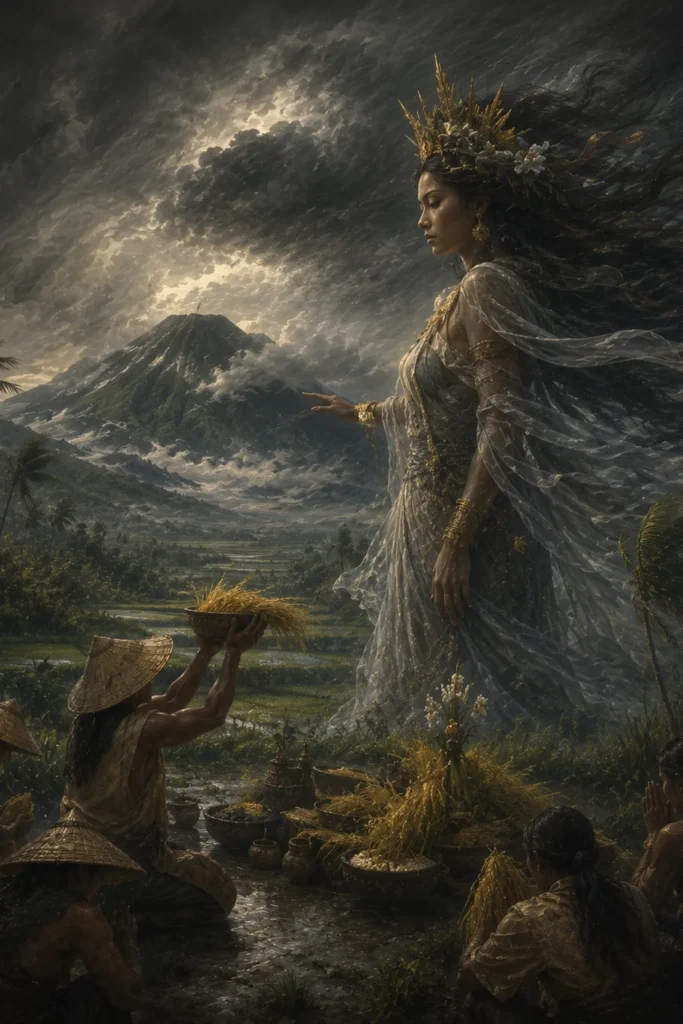
Anitun Tabu is a goddess of the Philippine tradition.
Capricious mistress of wind and rain, appeased with harvest offerings.
Anitun Tabu is a Philippine goddess of wind and rain. She is considered capricious and can send storms, but needs to be appeased rather than being demonic.
Important for classification: documented in early colonial times is the Zambales form Aniton Tauo, the Anito of wind and rain, attested by Domingo Perez in 1680. The Tagalog form with a genealogy, by contrast, is a modern compilation.
Type: Capricious goddess of wind and rain
Origin: Zambales and Tagalog region, Philippines
Texts: Perez, Relation of the Zambals 1680; modern compilations
Period: Zambales form early colonial, Tagalog genealogy modern
Appearance: no early colonial iconography
The Zambales form is attested in early colonial times by Perez in 1680; the Tagalog form with a genealogy, by contrast, is a modern compilation.
Zambales and the Tagalog region in the Philippines; the confirmed centre lies in the pantheon around Mount Pinatubo.
Divided source situation: the Zambales form Aniton Tauo is documented; the Tagalog genealogy as daughter of Idianale and Dumangan is modern.
Philippine: The root anito means ancestor or nature spirit; the second part is uncertain. The Zambales form Aniton Tauo suggests tawo, meaning human; the Tagalog form Tabu is likely a secondary contraction. The variants Tabu, Tabo and Tauo denote the same figure.
Appearance
Early colonial iconography is lacking; modern artistic depictions are recent. What is handed down is the role, not the image: the mistress of wind and rain.
Effect
Anitun Tabu, or Aniton Tauo, rules over wind and rain and is considered capricious. In the weakly documented Tagalog folk belief, she is credited with the drizzle Ambon; rain during a wedding was considered good fortune.
The key aspects of the weather goddess at a glance.
Early colonial documented weather figure of the Zambales in the pantheon around the chief god Malayari at Mount Pinatubo.
Wind and rain over the fields; those addressed were farmers, who offered her the best roasted rice grain at harvest thanksgiving.
No early colonial iconography; all images of the goddess are modern artistic depictions of the mythology renaissance.
Mistress of wind and rain, capricious and capable of storms; in Tagalog folk belief associated with the drizzle Ambon.
For the Zambales form, a harvest thanksgiving is documented: the best Pinipig in the Mamiarag ritual, according to Perez in 1680; for the Tagalog form, no distinct rites are recorded.
Documented in early colonial times is Aniton Tauo, the Anito of wind and rain, by Domingo Perez in 1680, in the pantheon around the chief god Malayari at Mount Pinatubo. This includes the motif that she was demoted in rank for arrogance: the chief god demoted the haughty weather figure.
The Tagalog form Anitun Tabu with a genealogy as daughter of Idianale and Dumangan does not appear in Plasencia 1589 and is a modern compilation. Anyone wishing to grasp the goddess historically must therefore look to Zambales, not to the popular Tagalog genealogies.
Anitun Tabu is one of the most popular goddesses of today’s Philippine mythology renaissance.
In religious studies, she is a capricious weather goddess who can send storms but needs appeasement rather than being actively demonic. Important clarifications: the Zambales form Aniton Tauo is documented in primary sources by Perez in 1680, not the old Tagalogs; the family genealogy is a modern construction; and the name variants Tabu, Tabo and Tauo denote the same figure.
For the Zambales form, a harvest thanksgiving is documented: the best Pinipig, roasted young rice grain, offered in the Mamiarag ritual, according to Perez in 1680. The capricious mistress of wind and rain was thus not warded off, but appeased with the best gifts of the harvest. For the Tagalog form, by contrast, no independently documented rites have survived.
Within the Philippines, she is the same figure as the Sambal Aniton Tauo. The pattern of arrogance leading to demotion is widespread and also found among other weather deities. Among the wind figures of the islands, she is joined by the Ilocano lord of wind Apo Angin and the southwest monsoon Habagat; from the broader Philippine spirit world, the mountain mistress Maria Makiling should be mentioned.
Who is Anitun Tabu?
A Philippine goddess of wind and rain; documented in early colonial times as the Zambales Aniton Tauo.
Is the family genealogy old?
No. The Tagalog form with a genealogy is a modern compilation; what is documented is the Zambales form.
Why was she demoted?
Because of her arrogance, the chief god Malayari demoted her in rank.
Recommended internal links:
Further standard works in the bibliography.
As the Philippine goddess of wind and rain, Anitun Tabu today stands at the centre of the mythology renaissance; historically, she remains identifiable as the Zambales Aniton Tauo, who was demoted in rank for her arrogance and appeased with harvest thanksgiving.
Against its influence, cross-cultural tradition names these protective means:
Compare in the Protection Compass →Recommended protective means
The simplest protective means in this collection: 41 layers of fine gold 999, platinum, silver and silicon, manufactured in Ruhla, Thuringia. It requires no activation, is bound to no person, and is effective within a radius of around 50 meters, even without being worn.
Related Beings

The Each-uisge, the most dangerous water horse of the Scottish lochs. Origin, legends, its sticky...

Aed, the Irish name and the figure of fire in Celtic mythology. Origin, the closeness to Brigid a...

Lakshmi is the Hindu goddess of wealth, fortune and beauty, consort of Vishnu. Lotus, gold coins,...

The Boto Encantado, the enchanted pink river dolphin of the Amazon. Origin, the man in the white ...

Ankou, the personified death of Brittany. Origin, the creaking death cart, the last person to die...

The Shiqq, the lengthwise-split desert demon of Arabia. Origin, its distinction from the soothsay...