Tengri, sky god of the Turks, Mongols, and Siberian steppe peoples
By Ralf Ittermann · last reviewed on
Tengri is the central supreme deity of Eurasian steppe Tengrism. As the eternal blue sky (Mongolian Möngke Köke Tengri), he embodies order, law, and power simultaneously, forming the backdrop against which shamans, khans, and tribal elders derived their political and ritual legitimacy.

Profile: Tengri
Tengri: the most important aspects at a glance. The following fields summarise origin, function, appearance, veneration, symbols and parallels.
Tengri is the highest-ranking deity of Tengrism, which extends from Inner Mongolia across the Central Asian steppes to southern Siberia. His name is attested since the earliest Chinese reports on the Xiongnu (3rd century BC); the worship of heaven can also be demonstrated among the Göktürks, Mongols and Siberian peoples.
As the eternal blue sky, Tengri embodies order and law and forms the background against which shamans, khans and tribal elders legitimise themselves politically and ritually. In the Secret History, Genghis Khan is presented as chosen by Tengri. As a distant high god, Tengri is called a deus otiosus.
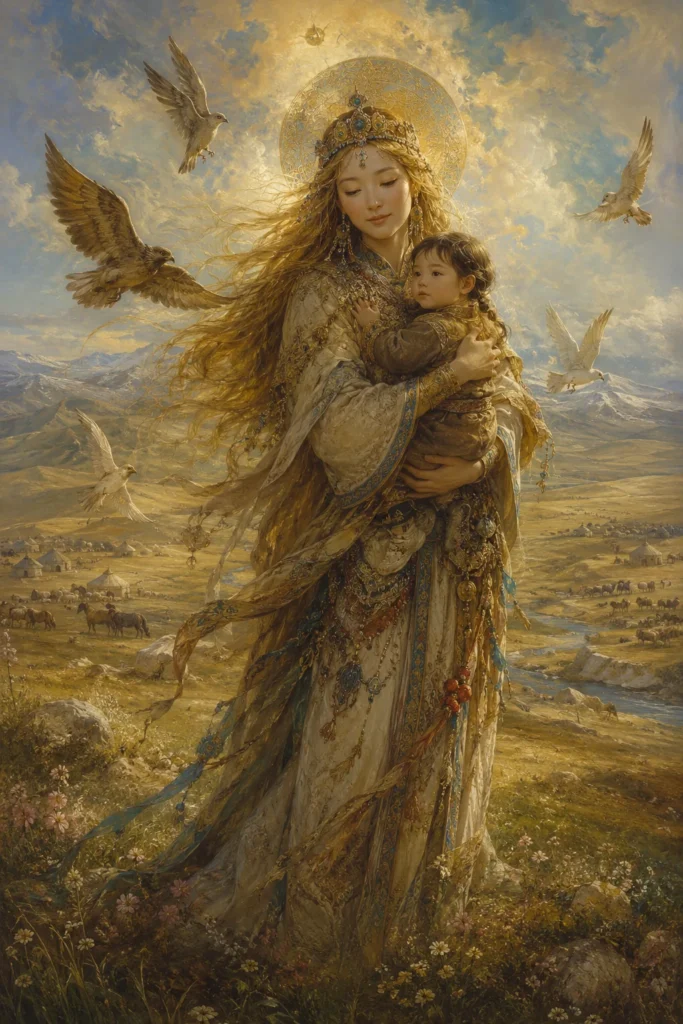
Tengri never developed an iconography of his own and remains aniconic. His place is the firmament. Modern attempts at depiction, for example in Kazakhstan and Kyrgyzstan, fall back on motifs of sun, eagle and wolf, which do not continue a pre-Islamic pictorial tradition.
The cult was a state cult without temples: worship took place under the open sky, on mountain passes, at stone heaps (obo) or with sacrifices of horses and sheep, which were burnt. The khan acted as mediator. Shamans mostly turned to supporting deities such as Umai, since Tengri was considered too remote.
Symbols that appear are the white eagle as messenger of heaven, the white horse as the shaman’s mount, the nine-fold stepped form for the nine heavens and the golden stake as the Pole Star, the “nail of heaven”. His sound is thunder, his sign the blue daylight.
Structurally comparable are the Vedic Dyaus Pitar, the Greek concept of Zeus Pater, the Chinese Tian, the Ugric Num and the Finnish Ukko. The closest relation is to Tian: both merge heaven and deity, legitimise rule and remain aniconic. In Siberia the Yakut Ürün Aar Tojon is regarded as a specialisation of the high god.
Classification and Brief Profile
Tengri is the highest-ranking deity of a far-reaching religious complex extending from Inner Mongolia across the Central Asian steppes to southern Siberia, designated in scholarship as Tengrism.
The term in the study of religion is a relatively recent construction of the 19th and 20th centuries, yet the underlying phenomenon, the veneration of an impersonal, boundless sky as the supreme power, can be documented continuously among the Turks (Gokturks), the Xiongnu, the Mongols of Genghis Khan, and numerous Siberian peoples such as the Yakuts, Buryats, and Altaians.
Tengri is neither an anthropomorphic god nor a capricious weather-maker; he rather coincides with the visible and invisible sky alike.
In more recent ethnographic sources he appears as one of several layers within a multi-tiered pantheon, in which Ülgen also figures as an upper sky-dweller and Erlik Khan as ruler of the underworld. The entire complex belongs to what scholarship groups under Siberian-Tengrist religion.
The name Tengri is attested since the earliest Chinese reports on the Xiongnu (3rd century BCE), where the word is rendered as cheng-li. This early attestation marks Tengri as one of the oldest historically traceable supreme deities of Inner Asia and provides the field with a rare fixed point spanning more than two millennia of continuous attestation.
It is rare in the history of religion for a term to be traced uninterruptedly across such a long period.
Name and Etymology
The name Tengri is transmitted in virtually all Altaic linguistic strata: Old Turkic teŋri, Mongolian tngri and tenger, Yakut tangara, Chuvash tură. The etymology is disputed; a derivation widespread in Turkology connects the word with an Altaicized root meaning “high, wide, luminous.” Gerard Clauson, in his Etymological Dictionary of Pre-Thirteenth Century Turkish (1972), proposes that the word originally meant “vast boundless space” and only condensed into a designation for the supreme deity through religious usage.
It is instructive that the word in many languages carries the dual meaning of sky and deity, a classic case of linguistically merged numinosity such as the phenomenology of religion describes, for instance, with dyaus (Vedic) or Zeus.
This fusion is described by Gerardus van der Leeuw as the “epitome of the numinous” and represents a characteristic of many Indo-European and Altaic supreme deities. It distinguishes Tengri fundamentally from later personalized gods such as Khormusta.
The Gokturk inscriptions of Orkhon and Yenisei (8th century) speak of Köktürk Tengri, the “heavenly one of the Gokturks,” and employ the formula Tengri yarlığı, “command of the sky.” In Mongolian, the famous phrase Möngke Köke Tengri, “eternal blue sky,” appears later in the edicts of the great khans.
In 19th-century tsarist ethnography, Tengri was introduced into German scholarship by researchers such as Wilhelm Radloff as “the supreme god of the Turks”; later scholars such as Jean-Paul Roux elaborated the distinctions within the concept.
Description and Iconography
Tengri never developed an independent iconography. In contrast to the personally conceived gods of Inner Asia (such as the Buddhist Mahakala figures), Tengri remains imageless.
Where he is depicted nonetheless, for example in modern attempts at a “re-Tengristization” in Kazakhstan and Kyrgyzstan, recourse is taken to sun, eagle, and wolf motifs, which however do not continue any pre-Islamic pictorial tradition.
This “absence of imagery” is significant from a phenomenological standpoint: it links Tengri typologically with other invisible supreme deities such as the Old Testament YHWH or the Chinese Tian.
His “place” is the firmament; his acoustic signature is thunder, his sign the blue daylight. In the shamanic songs of the Altaians and Yakuts he is invoked as Aar Tojon or Ürün Aar Tojon (“White High Lord”).
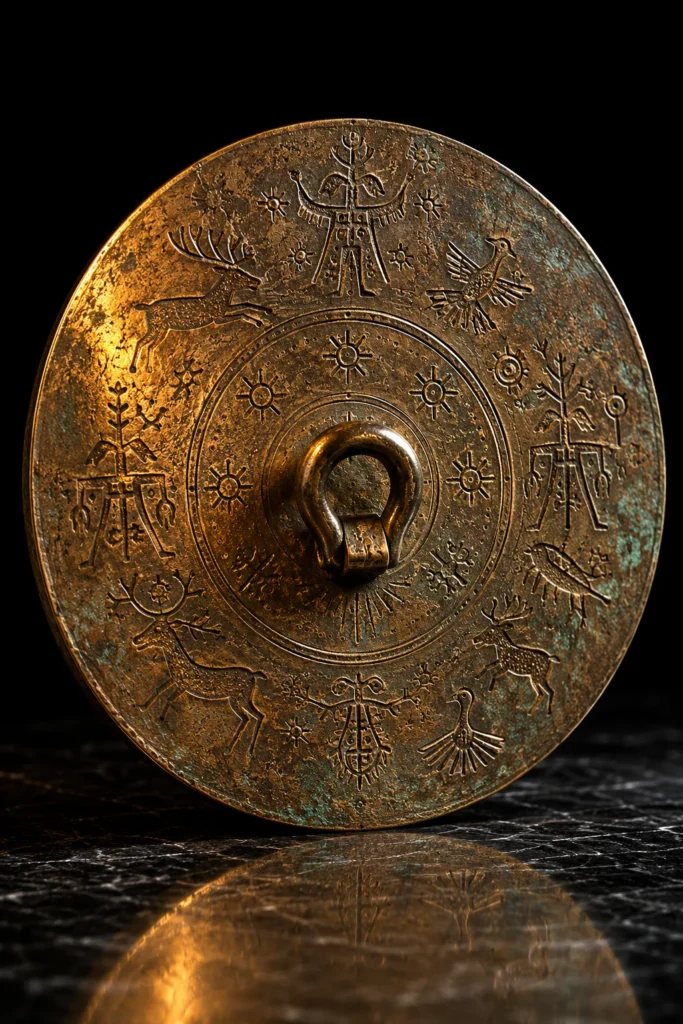
The shaman‘s drum, whose painting in many tribes depicts a three-layered world picture, invariably assigns Tengri to the uppermost level; the drumhead itself is regarded by many researchers (including Mircea Eliade in Le chamanisme et les techniques archaïques de l’Ekstase, 1951) as a symbolic horse that carries the shaman into the upper world, “to Tengri.”
Secondary symbols appearing in Tengri contexts include: the white eagle (messenger of the sky), the white horse (mount of the shaman), the ninefold stepped form (nine heavens), the golden peg (Pole Star, “sky nail”).
In the modern Kazakh coat of arms the Pole Star is deliberately interpreted as a Tengrist reference, which illustrates well the tension between historical religion and identity-political construction. This observation belongs, according to Marlene Laruelle (2007), to the characteristic features of Neo-Tengrism.
Mythological Narratives
Tengri rarely appears as an active figure in a narrative mythology. His agency is more a background order than a story. Where narratives do place him on stage, this occurs in creation and legitimation myths.
In the Mongolian Secret History (1240), Genghis Khan is legitimized as the one chosen by Tengri; his rise is repeatedly justified with the formula Möngke Tengri-yin küchün-tür, “by the power of the eternal sky.” Igor de Rachewiltz, in his monumental Brill edition (2004), elaborated the precise usage and theological weight of this formula: it transfers not only success but also political responsibility.
If the khan fails, Tengri has turned away from him.
An Altaic creation narrative recorded by Wilhelm Radloff in the 19th century has Tengri (here in his split form as Ülgen) together with Erlik Khan raise the earth from the primordial sea, whereupon Erlik out of arrogance disturbs the order and is banished to the underworld.
This narrative form, the dive-creation myth, connects Central Asian mythology with broad Paleo-Siberian and North American traditions, which Mircea Eliade interpreted as evidence of a circumpolar primordial stratum.
In the Orkhon texts of the Gokturk period (Bilge Kagan inscription) one hears the lament: “The Turks were a united people when Tengri above and the sacred earth below had given them a realm,” a founding topos that derives political legitimacy directly from the sky.
Talat Tekin, in his standard edition (1968), analyzed the language of this inscription and pointed to the theological character of its formulaic language.
Cult and Veneration
The cult of Tengri was historically a state cult, not a temple cult. There were no sanctuaries in the strict sense; veneration took place in the open air, often on mountain passes, at obo stone cairns, or over burning horse and sheep sacrifices.
The khan acted as intermediary, a function analogous to that of the Chinese tianzi, the “Son of Heaven.” Caroline Humphrey drew particular attention to this parallel in Shamans and Elders (1996).
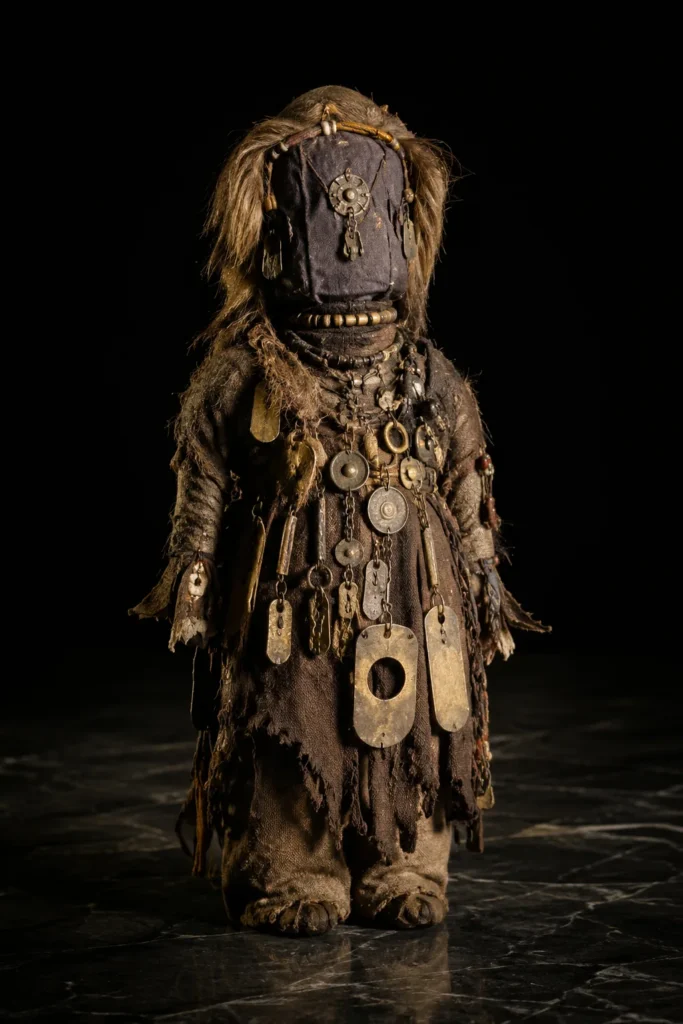
At the popular level, belief in Tengri merged with a broad helping-spirit religion centered on the Kam (Turkic) or Böö (Mongolian): the shaman. Shamans mostly did not invoke Tengri directly, since he was considered too distant, but turned instead to supporting deities such as Umai, to ancestors, or to power-animal spirits.
Tengri remained the invisible guarantor of world order. This “remoteness of the supreme deity” has been designated in the phenomenology of religion as deus otiosus, a concept elaborated at length by Mircea Eliade and after him by Raffaele Pettazzoni.
With the Islamization of the Turkic world from the 10th century onward, the term Tengri was partly transferred to Allah (cf. the Tatar Tängre), partly displaced as a pagan remnant.
In the Siberian periphery and among the Mongols the cult persisted longer; in the Buddhistically shaped Mongolia from the 17th century onward, Tengri was gradually overlaid by personalized Buddhist supreme deities without disappearing entirely. Walther Heissig described this stratification in detail in Die Religionen der Mongolei (1970).
Protective Practices and the Apotropaic
As described in the study of religion, protective practice within the Tengri complex was less a petition for healing than an act of confirming world order: whoever honored Tengri remained within the order, whoever violated it fell outside.
Apotropaic actions included preserving the “purity” of sacred mountains (Bogdo mountains), avoiding the pollution of water or fire, and performing ritual greeting formulas toward the sun and sky.
In the domestic sphere, Umai as mother and child goddess assumed many concretely protective functions that in other religions are attributed to the supreme deity itself.
Tengri remained the distant background against which all these smaller protective acts derived their meaning. This functional division is significant from a sociology-of-religion standpoint and was systematically described by Vladimir Basilov in Izbranniki dukhov (1984).
A special form of Tengri veneration with apotropaic character is the ovoo ritual: on mountain passes, cairns are piled up, decorated with blue cloth strips (khadag), and circumambulated three times while riding past.
Within the tradition this action is interpreted as a petition for the protection of Tengri and the locally bound spirits; from a scholarly perspective it remains a practice, not a verified effect. The observation belongs to the classical descriptive work of Mongolian studies.
Parallels in Other Cultures
From a phenomenological standpoint, Tengri takes his place in the spectrum of so-called “supreme beings” that Wilhelm Schmidt systematically surveyed in his twelve-volume Ursprung der Gottesidee (1912, 1955).
Structurally comparable are: the Vedic Dyaus Pitar, the Greek Zeus-Pater concept, the North Germanic Tyr substrate, the Chinese Tian, and, in Siberia itself, the Yakut Ürün Aar Tojon as a specialization of the supreme deity. The Ugric Num and the Finnish Ukko also show typological similarities.
Unlike the Semitic creator god, however, Tengri does not remain narratable as a person; he is rather what Eliade calls a deus otiosus: an “idle god” to whom concrete intervention is more foreign than mere existence.
The discussion of the deus otiosus runs through the entire phenomenology of religion and was defended against Wilhelm Schmidt by Raffaele Pettazzoni in L’essere supremo nelle religioni primitive (1957).
Particularly close from a history-of-religion perspective is the relationship to the Chinese Tian: both terms fuse sky and deity, both legitimize rule (“Son of Heaven” vs. “Chosen of Tengri”), both remain imageless.
Whether there were historical contacts between these two currents, and in which direction they flowed, is a subject of ongoing discussion in Sinology and Turkology.
Contemporary Reception and Research
Since the 1990s, Tengrism has experienced a revival, above all in Kazakhstan, Kyrgyzstan, and Inner Mongolia.
Authors such as Olzhas Suleimenov and Nurmagambet Ayupov have positioned it as a “spiritual alternative” to Islam and Christianity; in Mongolia it stands in open coexistence with Tibetan Buddhism. This revival has been critically documented by scholars of religion such as Marlene Laruelle (2007).
Academic Tengrism research is today interdisciplinary. Classic names include Wilhelm Radloff, Vladimir Basilov, Jean-Paul Roux, Andrei Znamenski, and for the Mongols Igor de Rachewiltz with his annotated edition of the Secret History.
Mircea Eliade anchored Tengri in his work on shamanism as an example of a supreme being lacking active shamanic engagement; Roberte Hamayon later critically revised this view in La chasse à l’âme (1990).
From the perspective of religious studies, it should be noted that contemporary Neo-Tengrism is a modern reformulation and should not be equated with historical steppe Tengrism. Research cautions against a naive identification and advocates careful stratification of the sources.
Research Debates and Open Questions
Several research debates continue to shape the study of Tengri today.
First: was Tengri originally a single supreme deity or a collective term for an entire celestial stratum? The Mongolian conception of the “99 Tengri” (55 western white, 44 eastern black) suggests a plural concept, while the Old Turkic inscriptions point more toward a singular.
Walther Heissig discussed this question at length in Die Religionen der Mongolei (1970).
Second: how should the relationship between Tengri and shamanism be understood? Roberte Hamayon argued against Eliade’s thesis that shamanism is not an independent “archaic technique of ecstasy” but part of a broad hunting and kinship economy; in this model Tengri is less a goal than a background order.
Third: what role did Iranian influences play? Khotanese and Sogdian mediation allowed concepts such as that of Ahura Mazda to merge with Tengri, which becomes visible in the later Khormusta complex.
This shows how difficult the separation between “autochthonous” and “syncretistic” Tengri is, a methodological question that ultimately applies to every religious history of Inner Asia.
The Sky as Source of Political Legitimacy: Tengri in the Old Turkic Inscriptions
The oldest and most reliable written testimonies for Tengri come from the Old Turkic runic inscriptions of the Orkhon Valley in present-day Mongolia, dated to the 8th century. The best known are the inscriptions in honor of Prince Kul Tigin and the ruler Bilge Kagan.
They are written in a script deciphered in the late 19th century by the Danish linguist Vilhelm Thomsen, which for the first time made Old Turkic history accessible from native sources.
In these inscriptions Tengri appears above all as the founder and guarantor of rule. A recurring formula states, in essence, that the sky installed the kagan and that the ruler governs by virtue of the sky.
Tengri here is less the subject of an elaborate myth than an ordering power that can confer and withdraw political authority. If the people strayed from the right path, so runs the tenor of several passages, the sky withdrew its support.
This connection between sky god and the legitimation of rule is characteristic of Tengrism as it can be reconstructed from the oldest sources.
It had a remarkable historical impact: similar notions of a heavenly mandate appear later among the Mongols, and Genghis Khan and his successors explicitly grounded their claim to rule in the will of the eternal sky.
The Orkhon inscriptions are therefore significant not only linguistically but also in terms of religious and political history, because they show Tengri in his state-sustaining function before later sources reshaped the picture through foreign influences. Related sky concepts are also known among other Inner Asian cultures.
Tengri between Monotheistic Interpretation and the Shamanic Multi-Deity Cosmos
A central research debate concerns the question of whether Tengrism should be understood as a monotheistic religion with a single sky god or as a multi-layered system with numerous spirits and deities. Both perspectives have adherents, and the answer depends strongly on which sources and which historical phase are drawn upon.
In favor of a more monotheistic interpretation is the fact that Tengri in the Old Turkic inscriptions appears as a surpassing, unique power by which rule and world order are oriented.
Some authors, partly also in the context of modern national movements in Turkic- and Mongolian-speaking countries, emphasize this aspect and present Tengrism as an original high religion. This interpretation, however, is not infrequently shaped by contemporary identity-political interests and should be read critically.
By contrast, the ethnographically documented religions of Siberian and Central Asian peoples show a richly populated spirit world: deities of the earth, mountains, and waterways, ancestral spirits, and protective spirits stand alongside the sky. In this picture Tengri is one, albeit outstanding, power among others, and the sky itself can be articulated into several layers.
Current scholarship tends largely to the view that there was no uniform, centuries-stable Tengrism, but rather a family of related conceptions that were differently accentuated depending on time, region, and social context. Tengri was a connecting, but not rigidly defined, element within this family.
The Source Situation: External Reports, Ethnography, and the Problem of Reconstruction
The study of Tengri faces a fundamental source problem. The oldest native testimonies, the Orkhon inscriptions, are brief and confined to the political context. For the period before that, and for most regions, written self-testimonies are entirely lacking, because the peoples in question developed no writing culture of their own or their tradition was oral.
A large portion of our knowledge therefore comes from external reports. Chinese chronicles report on the religion of the steppe peoples; medieval travelers such as William of Rubruck and Giovanni da Pian del Carpine described the religion of the Mongols from a European perspective; Persian and Arabic authors provided further observations.
These sources are valuable but colored by the perspective and concepts of the observers. Added to this is extensive ethnographic material from the 18th to 20th centuries on Siberian and Central Asian peoples, which however documents an already strongly altered religiosity, often overlaid by Buddhism, Islam, and later by Soviet anti-religious pressure.
The reconstruction of a historical Tengrism must bring together these disparate sources, and this involves considerable risks. There is a temptation to draw inferences from late ethnographic observations back to a uniform original state, or to fill in the sparse inscriptions with the material of steppe ethnography.
Methodologically cautious research therefore carefully separates what is genuinely attested for a specific time and region from what remains reconstruction and hypothesis. For Tengri this means: the basic function as supreme heavenly power is well attested; the elaborated details of many accounts, by contrast, should be read with reservation.
Selected Bibliography
- Jean-Paul Roux: La religion des Turcs et des Mongols (Payot 1984)
- Vladimir Basilov: Izbranniki dukhov (Moscow 1984)
- Wilhelm Radloff: Aus Sibirien (1893)
- Mircea Eliade: Le chamanisme et les techniques archaïques de l’Ekstase (1951)
- Igor de Rachewiltz: The Secret History of the Mongols (Brill 2004)
- Andrei Znamenski: Shamanism and Western Imagination (2007)
- Marlene Laruelle: Tengrism (2007)
- Talat Tekin: A Grammar of Orkhon Turkic (1968)
Related key terms: Tengri Möngke Köke Tengri Gokturks Orkhon Bilge Kagan deus otiosus.
iWell Guard and Protective Traditions
iWell Guard draws on the cultural-historical tradition of wearable protective objects, in the tradition of Siberia / Tengrism and many other cultures worldwide. 41 layers, real gold, platinum, silver, made in Germany. 30-day return policy.
Individual experiences may vary. Not a medical device. No healing claims.