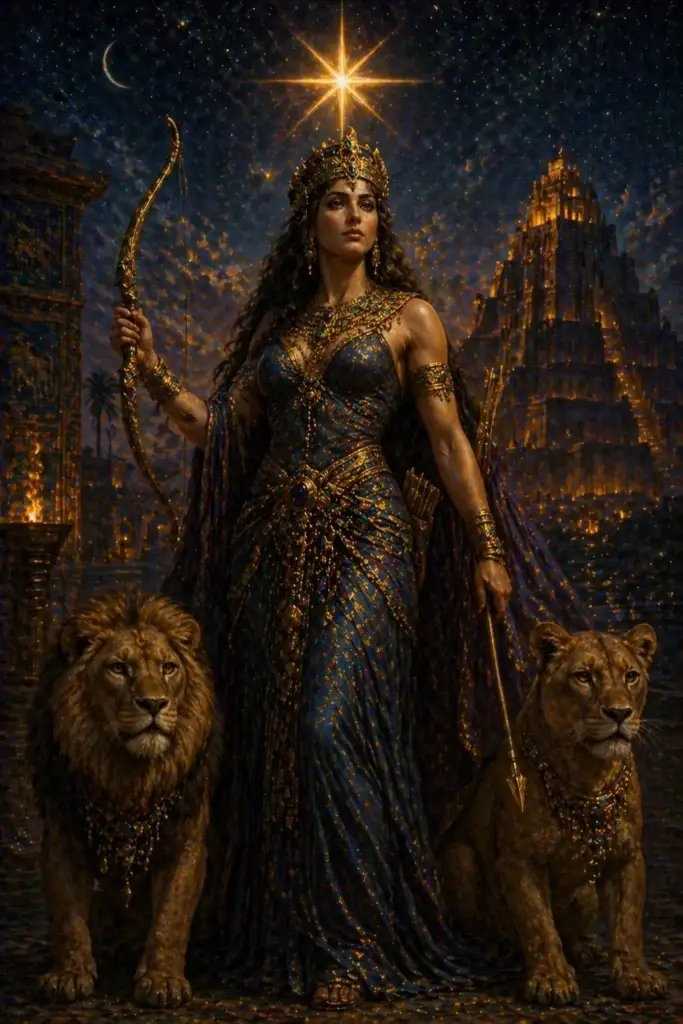
Baal-Hammon, Punic-Carthaginian chief god and Saturnus Africanus
By Ralf Ittermann · last reviewed on
Baal-Hammon (Punic bʿl ḥmn) is the supreme male deity of Punic Carthage and its colonies. He appears regularly alongside Tanit and is the recipient of votive offerings from the Tophet. In the Roman period he was identified with Saturnus.
Profile: Baal-Hammon
Baal-Hammon: the most important aspects at a glance. The following fields summarise origin, function, appearance, veneration, symbols and parallels.
Baal-Hammon is the supreme male god of Punic Carthage and its colonies. In the Phoenician homeland he was attested but secondary; in Carthage he stood with Tanit at the head of the pantheon. In Roman times his cult lived on as Saturnus Africanus into the 4th century AD.
Baal-Hammon is a high god with chthonic and solar aspects, at the same time god of grain and harvest and a chthonic father god. He was protective god of the city, the family and the harvests and recipient of vows (nēder) before journeys, battles, illnesses and births.
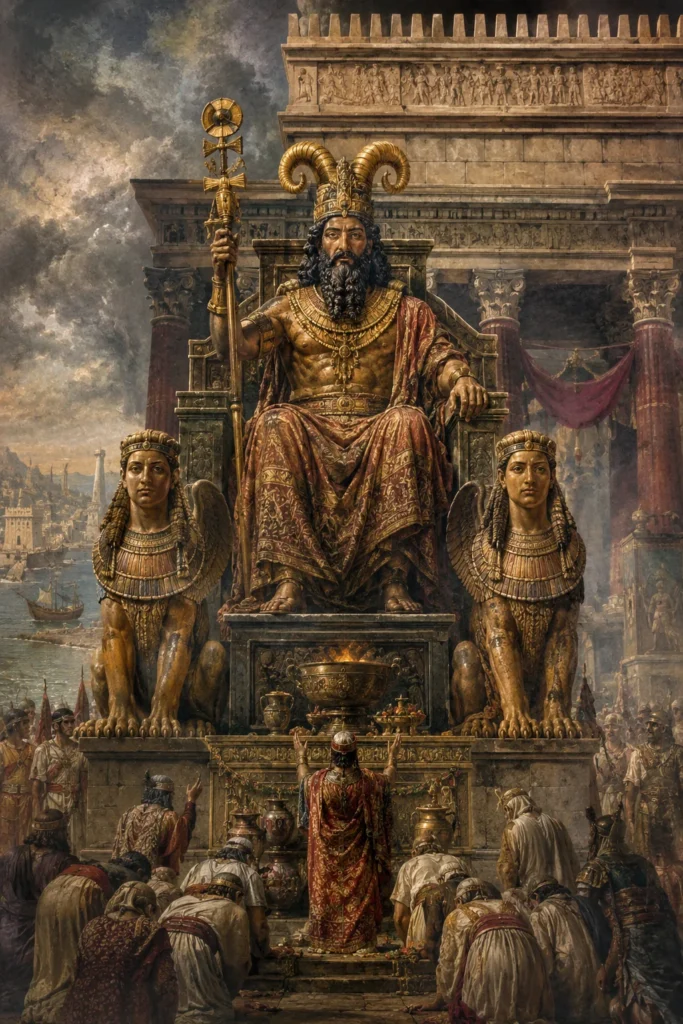
He mostly appears as an enthroned, bearded old man with a bull-horn crown, long pleated garment and sceptre. Bronze statuettes show him enthroned with a raised hand, a gesture of blessing. Roman stelae from North Africa depict him as a bearded old man with a sickle on the model of Saturn.
The main cult site was the tophet of Carthage; there were also tophets in Motya, Tharros, Sulcis, Hadrumetum and other places. There he was the chief recipient of the votive offerings, often together with Tanit. City temples stood, among other places, in Thinissut and on the Byrsa hill. Christianisation and the Vandal invasion ended his cult.
His sacred animal is the ram or he-goat; in Punic sacrificial rituals the ram was the preferred sacrificial animal. His signs include the bull-horn crown, sickle and caduceus, which also served as protective signs at house entrances. In the temple stood a cult image or a mazzeba, a sacred pillar.
Baal-Hammon is related to the Ugaritic El, the Mesopotamian Anu, the Roman Saturn and the Greek Kronos. With Kumarbi he shares the type of the displaced father god. A connection with the Egyptian Amun-Re was also made in Hellenistic times, but its significance is disputed.
Classification and Brief Profile
Baal-Hammon is one of the most important deities of the western Mediterranean Punic world.
Sabatino Moscati demonstrated in Il mondo dei Fenici (1966) that Baal-Hammon was attested in the Phoenician homeland but held a secondary rank there; in Carthage he reached the apex of the pantheon, sharing that position with Tanit. Within the Phoenician tradition he is the prototypical Punic supreme deity.
Maria Eugenia Aubet documented his Mediterranean distribution in The Phoenicians and the West (2001); Baal-Hammon sanctuaries are attested in Carthage, Motya, Tharros, Sulcis, Hadrumetum, and many other sites. In the Roman imperial period his veneration continued as Saturnus Africanus, achieving a remarkable persistence in the Numidian-Mauretanian province through to the 4th century CE.
In the history of religions, Baal-Hammon represents the type of the supreme deity with chthonic and solar aspects. Marcel Le Glay showed in Saturne africain (1966) that the identification with the Roman Saturnus was based on Baal-Hammon’s dual nature: he is both a grain and harvest god (Saturnian aspect) and a chthonic father god.
The Tophet stelae and the numerous inscriptions record his cult as a central finding in the history of religions.
The persistence of Baal-Hammon in the Roman imperial period as Saturnus Africanus is one of the most remarkable examples of religious-historical continuity following the political collapse of the Punic state. More than two thousand Saturn stelae have been preserved from the North African provinces, from the 1st through the 4th century CE.
Name and Etymology
The name bʿl ḥmn is composed of bʿl ‘lord’ and ḥmn, whose etymology is disputed. One interpretation connects ḥmn with the root ḥmm ‘to be hot’ and understands Baal-Hammon as ‘Lord of Heat’, presumably with a solar aspect.
Another interpretation reads ḥmn as a place name ‘Hammon’ (possibly a location in Phoenicia), making Baal-Hammon ‘Lord of Hammon’. A third possibility connects ḥmn with incense-cult objects (‘incense altar‘).
Charles Krahmalkov compiled the epigraphic variants in A Phoenician-Punic Grammar (2001); in inscriptions he appears as bʿl ḥmn or simply bʿl. The Greek rendering is Βάαλ-Ἀμμων (Baal-Ammon); in the Hellenistic period he was occasionally also identified with the Egyptian Amun (in traces).
The Roman identification with Saturnus is the most enduring and shapes African-Roman religious history.
In the Hebrew material, Hammon appears as a place name in Galilee; whether a direct religious-historical connection exists remains unclear. In Aramaic inscriptions from Palmyra, an ʿolam-deity with functions similar to Baal-Hammon appears; here too the precise relationship is disputed. In religious-historical terms, Baal-Hammon is a specifically western development.
A further etymological hypothesis connects ḥmn with Aramaic ḥmn ‘to have mercy’, which would carry a theologically profound connotation; however, it is not linguistically secure from a historical-linguistic standpoint.
Description and Iconography
Baal-Hammon appears in Punic iconography most commonly as an enthroned bearded old man wearing a bull-horn crown, a long pleated garment, and holding a scepter.
This pictorial tradition is widely attested on the Tophet stelae and distinguishes him from Baal-Hadad, who appears as a youthful storm god with a raised axe. Baal-Hammon’s aged profile connects him theologically with the Ugaritic El and with Saturnus.
His sacred animal is the ram or goat; in Punic sacrificial rituals the ram was the preferred sacrificial animal. On some stelae he appears flanked by sphinxes or griffins.
In Carthage, a colossal bronze statue of Baal-Hammon stood in the city temple; it is mentioned in sources concerning the Tophet offerings and is said to have had mechanisms that caused sacrificial animals or children to fall into a fire below. Source criticism on this point is disputed and is today assessed with considerable caution.
In the Hellenistic-Roman period, Baal-Hammon iconography increasingly merged with the Saturnus tradition; the late Roman Saturn stelae from North Africa (3rd and 4th century CE) show the god as a bearded old man with a sickle, following the Saturnus model exactly.
This Saturnus-Africanus iconography is Marcel Le Glay’s main subject and is treated in detail in his monograph.
An impressive archaeological source is the numerous bronze statuettes from the Tophet, which show Baal-Hammon enthroned with one hand raised in a gesture of blessing. These statuettes were placed partly in the Tophet itself as votive offerings and partly in private houses.
Mythological Narratives
Independent Baal-Hammon myths have not been transmitted; like Tanit, he is primarily a cultic-ritual figure. Ancient accounts (Diodorus, Polybius, Plutarch, Tertullian) mention child sacrifice in the Tophet as his principal cultic act.
Diodorus (20.14) gives a detailed account of a large child sacrifice in 310 BCE when Carthage was besieged by Agathocles of Syracuse; in a state of emergency, 200 noble boys were offered to appease the god’s wrath.
The historicity of these accounts has been debated for generations; they are Greek-Roman polemical sources and must be evaluated critically.
The archaeological findings from the Tophet do confirm, however, that infants and young children were buried there in considerable numbers; whether always as offerings or also as naturally deceased individuals is the subject of the Tophet controversy.
Augustine of Hippo polemicizes in De civitate Dei 7.19 against the Saturnus-Africanus cults and describes child sacrifice as ‘crudelis daemonum cultus’. This late antique polemic belongs to the construction of Christian Carthage and should be read with caution in religious-historical terms, yet it reflects the enduring association of Baal-Hammon with child-sacrifice topoi in ancient perception.
The scholarly assessment of this practice remains disputed.
Cult and Veneration
Baal-Hammon’s principal cult site was the Tophet of Carthage; further Tophets existed at Motya, Tharros, Sulcis, Hadrumetum, Cirta, Lambafundi, and numerous other sites.
At each of these sanctuaries, Baal-Hammon was the primary recipient of votive offerings, often together with Tanit. The dedicatory inscriptions follow a standard formula: ‘To the lady Tanit, Face of Baal, and to the lord Baal-Hammon, that which N.N. vowed, because he heard him’.
Beyond these, there were urban Baal-Hammon temples, for example at Thinissut and in Carthage itself (temple on the Byrsa hill). Sabatino Moscati documented Punic temple architecture in several publications.
The temples follow a tripartite plan: forecourt, main hall, and inner sanctuary. Inside stood the cult image or a ‘mazzeba’ (sacred pillar), the latter typical of the Phoenician aniconic tradition regarding the highest deity.
In the Roman imperial period, Baal-Hammon continued to be venerated as Saturnus Africanus; his temple in Carthage was renamed and reconsecrated.
The number of Saturn stelae in North Africa exceeds that of all other Roman deities in the region; Baal-Hammon-Saturnus was the most important deity of the African provinces through to the 4th century CE. Christianization and the Vandal invasion ended his cult.
An important numismatic source is the Carthaginian tetradrachms of the 4th and 3rd centuries BCE, which show the head of a female deity (Tanit/Kore) on the obverse and a horse and palm tree on the reverse. The coins were minted in large numbers to pay Carthaginian armies and disseminated this iconographic program as far as Spain and Sicily.
Protective Practice and the Apotropaic
Baal-Hammon was the protective deity of the city, the family, and the harvests. In the Punic inscriptions he appears as the recipient of neder vows in situations of distress: before journeys, before battles, during illnesses, and at births.
The frequency of his invocation in private votive offerings demonstrates the intense private piety of the Punic population.
On house entrances and in living spaces, his symbols were used apotropaically: the bull-horn crown, the sickle, and the ‘caduceus’ symbol, which is regularly associated with Baal-Hammon in the Punic world. Bronze statuettes of a bearded enthroned god with a bull-horn crown have been found at numerous Punic domestic sites.
From a religious-studies perspective, Baal-Hammon’s protective function is strongly tied to the political order but also anchored at the personal and family level.
The Tophet practice is to be understood as a special form of crisis piety, without this being interpretable in a positively evaluative religious-studies sense today. The iWell Guard records Baal-Hammon as a historical-religious studies figure without references to current efficacy claims.
The close connection of Baal-Hammon with Punic warfare is well documented; Hannibal’s oath at the Baal-Hammon altar at age nine, pledging to regard Rome as an eternal enemy, is one of the most famous ancient anecdotes and stands in the tradition of Punic war oaths.
Parallels in Other Cultures
Baal-Hammon is related in the history of religions to the Ugaritic El (ancient father god), to the Mesopotamian Anu, to the Roman Saturnus, and to the Greek Kronos.
The identification with Saturnus is the most enduring; Marcel Le Glay showed in Saturne africain (1966) that this syncretism fundamentally shaped the African Saturn cult of the imperial period.
With Kronos, Baal-Hammon shares the profile of the aged father god with child-sacrifice associations; the Greek Kronos myth contains the swallowing of his own children, which in Hellenistic perception was connected with the Carthaginian Tophet offerings. Plutarch (De superstitione) makes this connection explicit.
With Kumarbi of the Hittite tradition, Baal-Hammon shares the type of the overthrown or displaced father god.
In the history of religions he belongs to the international family of ancient Mediterranean father gods, whose function was partly displaced by the younger generation of storm gods. In the Roman province of Africa Proconsularis, this ancient Mediterranean tradition remained unusually long-lived.
The connection between Baal-Hammon and the Egyptian Amun-Re was actively made in the Hellenistic period; the oasis of Siwa with its Amun oracle was readily accessible from Carthage, and some sources report Carthaginian pilgrimages there. The religious-historical significance of this syncretism is disputed, but noteworthy.
Contemporary Reception and Research
Baal-Hammon scholarship today operates at a high level. Marcel Le Glay’s Saturne africain (1966) is the classic standard reference; Sabatino Moscati, Maria Eugenia Aubet, Helene Benichou-Safar, and Lawrence Stager have made important contributions to Tophet research.
Brian Doak’s Phoenician Aniconism (2015) addresses Baal-Hammon’s aniconic tradition. Josephine Quinn’s studies on Punic identity have been significant contributions in recent years.
In popular reception, Baal-Hammon is known primarily through the Tophet controversy and through ancient Christian polemic; the resulting image is distorted and hardly does justice to religious studies scholarship. More academically differentiated accounts can be found in the works cited.
In religious studies, Baal-Hammon is today regarded as a central subject of study for Punic religion, for the Saturnus-Africanus tradition, and for Mediterranean religious history.
Current research focuses on bioarchaeological Tophet analysis, on the Saturnus-Africanus stele tradition, and on the question of a Berber component. The iWell Guard records him as a historical member of the pantheon.
Current research by Josephine Quinn (In Search of the Phoenicians, 2018) has re-examined Punic identity and its religious self-definition, and has questioned Baal-Hammon’s role as ‘god of the Phoenicians’.
Literature and Sources
The following selection brings together the most important standard works on Baal-Hammon research. It encompasses archaeological reports, synthetic studies in the history of religions, and epigraphic editions.
Marcel Le Glay’s monograph is the classic reference; Moscati and Aubet provide the Punic framework; Doak the iconological perspective. Quinn’s more recent study leads the research into the critical identity discussion.
The Tophet of Carthage and the Stele Finds
The principal witness for the cult of Baal Hammon is not a text but a precinct: the so-called Tophet of Carthage, a sanctuary at the edge of the ancient city in the present-day district of Salambo.
Excavations began in the 1920s; a formative campaign was conducted by the American archaeologist Lawrence Stager and his team in the 1970s under the name “Punic Project”. The precinct contains thousands of small urns with the cremated remains of infants and young animals, with stone stelae erected above them.
Many of these stelae bear dedicatory inscriptions in Punic script. The standard formula names first the goddess Tinnit (often referred to as “Tinnit, Face of Baal”) and then Baal Hammon, followed by the name of the dedicant and his or her concern.
These inscriptions are the densest epigraphic source for Punic religion as a whole and make Baal Hammon the best-attested Carthaginian deity.
The interpretation of the Tophet has been contested since the 19th century. Ancient Greek and Roman authors such as Diodorus and Plutarch report Carthaginian child sacrifices, and part of the scholarly community sees in the Tophet the archaeological confirmation.
A counter-position, represented among others by Sabatino Moscati and later by others, interprets the precinct as a cemetery for infants who had already died of natural causes.
More recent osteological examinations of the cremated bones have not resolved the debate conclusively. For the description of Baal Hammon, this means: his most important cult site is simultaneously the most contested finding in Punic archaeology.
The interpretatio: Saturn, Kronos, and Survival in the Roman Period
Baal Hammon did not disappear with the destruction of Carthage in 146 BCE. In Roman North Africa he lived on under the name Saturnus Africanus, one of the most widely attested cults in the province of Africa.
Hundreds of Saturn stelae from the Roman period show that the Punic population continued to venerate their old principal deity under a Roman name, with distinctive iconographic features such as the god shown beneath a veil or holding a sickle.
The Greeks had already equated Baal Hammon with Kronos, a connection that plays a role especially in the accounts of child sacrifice, since Kronos devoured his own children.
The Romans then chose Saturn, the Latin counterpart to Kronos. This interpretatio is a double-edged tool for scholarship: on the one hand it reveals continuity, on the other it overlays the Punic figure with Greek-Roman conceptions.
The question of who Baal Hammon originally was cannot therefore be answered by the late Saturn equation alone. Discussion continues over whether the epithet Hammon refers to a place name, perhaps the north Syrian Hamath or a mountain, or to the Semitic word for “brazier” or “incense altar”.
Eric Gubel, Paolo Xella, and others have worked on these questions without a consensus having been reached. What is certain is only that the Roman Saturn mask is the latest, not the original, layer of the figure.
Literature (Selection)
- Marcel Le Glay: Saturne africain (Paris 1966)
- Sabatino Moscati: Il mondo dei Fenici (Milano 1966)
- Maria Eugenia Aubet: The Phoenicians and the West (Cambridge 2001)
- Helene Benichou-Safar: Le tophet de Salambo a Carthage (Rome 2004)
- Brian Doak: Phoenician Aniconism (Atlanta 2015)
- Josephine Quinn: In Search of the Phoenicians (Princeton 2018)
Baal-Hammon appears as the Punic-Carthaginian chief god, whose Tophet sanctuaries in Carthage attest his standing as the supreme protective deity; in the Roman phase he continues to be venerated as Saturnus Africanus.
Related key terms: Baal-Hammon Carthage Punic Saturnus Tophet child sacrifice Africana.
iWell Guard and Protective Traditions
iWell Guard draws on the cultural-historical tradition of wearable protective objects, in the tradition of Phoenician and many other cultures worldwide. 41 layers, real gold, platinum, silver, crafted in Germany. 30-day return policy.
Personal experiences may vary. Not a medical device. No efficacy promises.