Resheph, Phoenician-Canaanite God of Plague and War
By Ralf Ittermann · last reviewed on
Resheph (Phoenician ršp, Ugaritic ršp) is the Phoenician-Canaanite god of plague, war, and the bow. He was venerated across the ancient Near East and in Pharaonic Egypt as an ambivalent power: a bringer of disease and death, yet at the same time a protective deity invoked against those very afflictions.
Resheph appears as the Phoenician-Canaanite god of plague and war in the texts of Ugarit and the Levant.
Profile: Resheph
Resheph: the most important aspects at a glance. The following fields summarise origin, function, appearance, veneration, symbols and parallels.
Resheph belongs to the Western Semitic tradition and is attested as a god of the Phoenicians and Canaanites in Ugarit and the Levant. In Ebla he is attested since the Early Syrian period (end of the 3rd millennium BC) and remains active into Hellenistic and Roman times. In Egypt he was adopted from the New Kingdom onwards.
Resheph is the god of plague, war and the bow and is regarded as an ambivalent power: he brings illness and violent death and is at the same time invoked against these evils. In times of plague people asked for an end to the epidemic, in times of war for victory over the enemies.
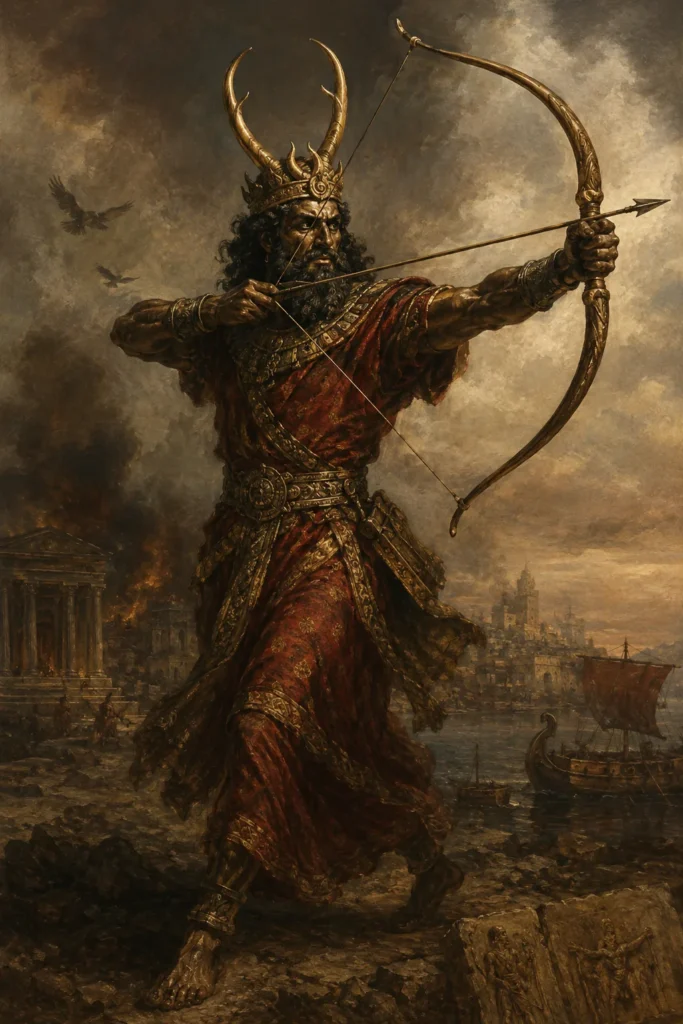
Resheph appears as a bearded man in a short kilt with a helmet or high pointed cap, holding a bow or battle axe in one hand and a spear or shield in the other. One pictorial type shows him with a raised arrow, ready to shoot, another with a gazelle’s head on his forehead.
The main cult sites were Byblos, Tyre, Sidon, Beirut, Idalion on Cyprus and Sarepta, in Egypt Memphis and Tanis. The most important sources are stelae and dedicatory inscriptions; in Carthage, Motya and Sulcis he received votive offerings. Private individuals also worshipped him, for example a man in Tanis who asked for healing from an eye disease.
His sacred animal is the gazelle, which represents the speed of the plague arrows and the fleetingness of the disease; horse and bull also appear as companion animals. Small bronze figures of a striding warrior and amulets in the shape of a bow served as protective objects in houses, tombs and temples.
Closely related are Erra and Nergal in Mesopotamia as well as the Hittite Yarri. With the Greek Apollo, Resheph shares the components of bow and plague; in the Iliad Apollo shoots plague arrows at the Achaean army. A bilingual inscription from Tamassos (4th century BC) equates Resheph-Mikal with Apollo Amyklaios.
Classification and Brief Profile
Resheph belongs among the oldest gods of the West Semitic tradition; he is attested at Ebla from the Early Syrian period (late third millennium BCE) and remains active into the Hellenistic-Roman era.
Sabatino Moscati demonstrated in Die Phöniker (1966) that Resheph held an important role in nearly every Phoenician city-state; his profile as god of plague and war makes him ambivalent, feared and yet called upon for help.
Paolo Xella in I testi rituali di Ugarit (1981) and Maciej Münnich in The God Resheph (2013) have examined the Resheph texts comprehensively. Münnich’s monograph is the most detailed modern study of this deity and the standard reference. Within the Phoenician tradition, Resheph is the prototypical ambivalent god of disease and violent death.
In the history of religions, Resheph belongs to the international family of “pestilential arrow” gods found in nearly all ancient Near Eastern mythologies: Erra/Nergal in Mesopotamia, plague-related aspects of Greek Apollo, the Hittite Yarri, and several others.
These gods dispatch arrows that bring disease and death, yet they can also be invoked for protection against those same afflictions. This ambivalence is the defining feature of the Resheph profile.
A notable characteristic of Resheph is his association with the horse: in Ugaritic texts he is occasionally called “Resheph of the Horses,” which may point to a function as protective deity of chariot troops. This breadth of function, plague, war, horse, bow, makes Resheph a complex god with multiple aspects.
Name and Etymology
The name ršp is West Semitic; its etymology has not been definitively established. A plausible interpretation links it to the root ršp, meaning “flame, lightning, spark,” which would accord with his arrow and plague iconography.
In Hebrew, reshef appears as a common noun for “arrow” or “fiery disease” (Deut 32:24; Job 5:7; Song 8:6), a direct semantic inheritance.
In inscriptions he appears as ršp, frequently with epithets: Resheph-Hagab (“Resheph of the Locust”), Resheph-Mlk (“Resheph the King”), Resheph-Shuluman (“Resheph of Peace”). This variety of epithets reflects his multiple hypostases in different local contexts. At Ebla he appears already in the 24th century BCE; at Ugarit he is a prominent deity.
In Egypt he appears from the New Kingdom onward as “Reshep,” imported into the Egyptian pantheon. Pharaoh Amenhotep II (15th century BCE) venerated him as a god of war and the bow; on numerous stelae from the Theban region he appears as a bearded warrior wearing a helmet and carrying a bow.
The Egyptian Resheph cult represents a remarkable achievement of religious importation and is treated in detail in the studies of Izak Cornelius (The Iconography of the Canaanite Gods Reshef and Ba’al, 1994).
Resheph also appears in Aramaic material of the first millennium BCE in several inscriptions, including on the stele of Bar-Rakib from Sam’al (8th century BCE). This Aramaic Resheph tradition demonstrates the persistence of his veneration in the West Semitic Iron Age.
Appearance and Iconography
Resheph appears in West Semitic and Egyptian iconography as a bearded man wearing a short kilt, with a helmet or tall pointed cap, holding a bow or battle-axe in one hand and a spear or shield in the other.
One characteristic pictorial tradition shows him with an arrow raised in his hand, poised to shoot; another type depicts him with a gazelle head at his brow.
His sacred animal is the gazelle; in some representations he rides a gazelle or holds one by its horns. The gazelle is instructive from the perspective of religious history: it represents the swiftness of plague arrows and the fleeting nature of disease. The horse and bull also appear occasionally as his companion animals.
In Egypt, Resheph was frequently depicted as a triad together with Min (Egyptian fertility god) and Qetesh (a Semitic goddess of love, related to Astarte); this “Resheph-Min-Qetesh” triad appears on several stelae from Memphis and Tanis.
This Egyptian triad is an independent development in religious history that is not attested in the Phoenician homeland in this form.
A particular Egyptian pictorial tradition shows Resheph wearing the characteristic “Shesem” crown of rings or pointed caps, a convention that distinguishes him from Egyptian gods and marks his Semitic origin.
Mythological Narratives
Actual myths about Resheph have scarcely been transmitted; he is primarily a cultic-ritual figure. In Ugaritic texts he appears occasionally as a messenger or disease deity, without any independent narrative sequence. In Phoenician inscriptions he is invoked as god of plague and war, without mythological background.
A fragmentary narrative connects Resheph with the “Seven Arrows” that he dispatches against the enemies of Israel (as in the Hebrew material) or against the enemies of the Phoenicians (in West Semitic texts).
In the Hebrew book of Habakkuk (Hab 3:5), Resheph appears as a companion of Yahweh, marching before the divine warrior: “Before him goes pestilence, and Resheph follows his steps.” This double appearance is instructive from the perspective of religious history and demonstrates the persistence of Resheph concepts within the Hebrew poetic tradition.
In the Aqhat Epic and the Keret Epic, Resheph is occasionally invoked without appearing as an active character. Maciej Münnich in The God Resheph (2013) has surveyed and commented on the entire body of textual evidence; the relative scarcity of Resheph myths is a finding, not a deficiency in the tradition.
In Habakkuk’s theophany vision (Hab 3:3, 6), Resheph appears in a striking constellation: before Yahweh march “Pestilence” (Deber) and “Resheph” as cosmic vanguards.
This late Hebrew testimony is highly instructive for the history of religions, because it documents the persistence of Resheph concepts within monotheistic theology; here the independent god becomes a “divine messenger” or a personification of the instruments of Yahweh’s punishment.
Cult and Veneration
Resheph’s principal cult sites in Phoenicia were Byblos, Tyre, Sidon, Beirut, Idalion on Cyprus, and Sarepta. In Pharaonic Egypt he was venerated at Memphis and Tanis; a dedicated “Resheph-city” (present-day Tell Reshef in Phoenicia?) is mentioned in some texts but has not been unambiguously identified archaeologically.
The most important body of sources consists of stelae and votive inscriptions; at Carthage, Motya, and Sulcis, Resheph appears regularly as the recipient of votive offerings, often alongside Baal-Hammon, Tanit, or Eshmun.
Charles Krahmalkov in A Phoenician-Punic Grammar (2001) and Wolfgang Röllig in the Kanaanäische und aramäische Inschriften collected the most important epigraphic attestations.
In Pharaonic Egypt, Resheph belonged to the category of “Asiatic gods” actively promoted during the New Kingdom. Pharaoh Amenhotep II and his successors venerated him as a god of the bow and of war; Resheph stelae appear even in royal contexts, such as the Theban royal tombs.
The pharaohs identified with Resheph as a warrior figure and drew his protective power onto the royal person.
In Pharaonic Egypt, Resheph was also venerated by private individuals; a well-known stele from Tanis shows a private person named “Pa-Aper-Reshef” addressing a petition to the god for healing from an eye ailment. This private piety is an important indicator of the popular spread of the cult in the Egyptian New Kingdom.
Protective Practice and the Apotropaic
Resheph’s protective function was oriented in two directions: protection against disease (especially epidemics, fever, and plague) and protection in war. In times of plague he was invoked to bring the epidemic to an end; in times of war, to grant victory over enemies. This ambivalent function makes him the prototypical apotropaic deity.
Apotropaically, Resheph statuettes and amulets were placed in homes; small bronze figurines of a striding warrior with a raised battle-axe have been found at numerous Phoenician sites. Scarabs bearing Resheph bow motifs were worn as personal protective amulets. At Ugarit, “Resheph arrows” circulated as arrow amulets.
Resheph theophoric elements are common in Phoenician personal names: Bod-Reshef, Reshef-Bar, Reshef-Jaton (“Resheph has given”). This frequency reflects intensive private piety.
From a religious-studies perspective, Resheph’s ambivalent protective function is an example of the ancient Near Eastern conception that destructive and protective power can reside in a single hand. iWell Guard records Resheph as a figure from religious history without any reference to present-day efficacy claims.
Resheph’s bow amulets were among the most widely distributed Phoenician-Egyptian protective objects. They were deposited as grave goods, in private homes, and in temples. The form is typically a drawn bow or a bow with an arrow; some are inscribed with Resheph’s name or with Phoenician protective formulas.
Parallels in Other Cultures
Resheph is closely related, in terms of religious history, to Nergal and Erra in Mesopotamia, both gods of plague and war. With Erra he shares the arrow-plague motif; with Nergal, the underworld component present in some later texts.
The Hittite Yarri, a bow-and-plague deity, is also closely related to him in function; Volkert Haas treated the Hittite plague-deity tradition in Materia Magica et Medica Hethitica (2003).
Resheph shares the bow and plague components with Greek Apollo; in the Iliad, Apollo shoots plague arrows into the Achaean camp, a direct parallel to Resheph’s iconography. Walter Burkert pointed out in Die orientalisierende Epoche (1984) the probable transmission of the plague-arrow motif from the West Semitic world into the Greek Apollo tradition.
In the Hebrew material, Resheph persists as “reshef” for arrow and plague; in Hab 3:5 he even appears as a divine companion. This persistent presence of Resheph concepts is noteworthy from the perspective of religious history.
In the later Jewish and Christian traditions he is then reduced to an “arrow of God” or a “plague,” stripped of independent divinity.
Resheph was also prominently venerated at Idalion on Cyprus; a bilingual inscription from Tamassos (4th century BCE, Phoenician-Greek) identifies Resheph-Mikal with Greek Apollo Amyklaios. This identification is highly instructive from the perspective of religious history.
Modern Reception and Research
Resheph scholarship is today at a high level. Maciej Münnich’s monograph The God Resheph (2013) is the standard reference; Izak Cornelius’s iconographic study (1994) covers the Egyptian pictorial history; Paolo Xella has edited the ritual texts from Ugarit. Sabatino Moscati and Helene Sader have made important contributions to the study of Phoenician Resheph veneration.
In popular reception, Resheph is known primarily through his Egyptian cult and through the Hebrew-biblical allusions. A spiritual revival in the neo-pagan sense is absent; the ambivalent god of plague and war is too foreign and theologically problematic for modern forms of piety.
In the study of religion, Resheph today serves as a central object of study for ancient Near Eastern plague and war theology.
Current research priorities lie in differentiating local Resheph hypostases, in the Egyptian Resheph-Min-Qetesh triad, and in the question of the transmission routes to the Greek Apollo tradition. iWell Guard records Resheph as a religious-historical example without a practical protective reference.
Current research by Maciej Münnich and Helene Sader places Resheph in an expanded religious-historical context: as a representative of an Old Syrian-West Semitic family of gods whose persistence from the third millennium BCE into the Iron Age constitutes a remarkable religious-historical phenomenon.
Literature and Sources
The following selection brings together the most important standard works on Resheph scholarship. It covers monographs, iconographic studies, text editions, and synthetic treatments in the history of religions. Münnich’s monograph is the most detailed modern study; Cornelius provides the iconographic perspective; Xella the ritualistic textual foundation; Moscati the cultural-historical framework.
Resheph in the Egyptian Tradition of the New Kingdom
A distinctive feature of Resheph is that he appears in two separate bodies of sources: in the West Semitic texts of his region of origin and, at considerable length, in Egyptian monuments of the New Kingdom.
By the 18th Dynasty at the latest, Resheph had been received into Egypt, presumably through the close military and political ties with the Levant. Pharaohs of the Ramesside period frequently had themselves depicted in association with Resheph, who was regarded as a warlike and powerful deity.
On Egyptian stelae, many donated by private individuals, Resheph appears with a consistent iconography: a striding god with raised arm, wielding a mace or axe, often with a shield and a spear, wearing the Upper Egyptian crown on his head, at whose brow a gazelle head frequently replaces the uraeus serpent.
This gazelle head is considered one of the most reliable identifying features.
In Egypt his function underwent a transformation. The god who brings pestilence and sudden death also became a deity to whom people turned for protection and healing, sometimes grouped with the goddess Qetesh and the god Min. This Egyptian layer is richer in sources than some Levantine tradition, but it already shows Resheph in a foreign setting.
Those seeking the “original” Resheph must read the Egyptian attestations as an appropriation, not as an undistorted reflection.
Arrow and Plague: Resheph as Lord of Epidemic
The core of the Resheph concept in West Semitic sources is the connection between bow, arrow, and epidemic. Resheph brings disease and mass death, conceived as arrows he shoots at humans and livestock.
This concept is traceable across several cultures: in Ugaritic texts Rashap appears in god lists and ritual texts, while in Mesopotamian sources he is linked to Nergal, the god of plague and the underworld.
Particularly instructive is the Hebrew Bible. There, reshef is no longer a venerated deity but a common noun or a de-divinized power. In Habakkuk 3:5, God goes forth and Resheph follows him as an attendant, alongside pestilence.
In other passages the word denotes “glowing heat,” “spark,” or the darting plague-sickness itself. This biblical afterlife is a classic example of how a neighboring deity is demoted to a mere force of nature or a poetic image by the authors of the Hebrew texts.
The arrow symbolism connects Resheph to a broad group of pestilence deities, including the far-shooting Apollo of early Greek poetry, who at the opening of the Iliad sends plague into the Greek camp.
This parallel is frequently cited in scholarship but should be understood as a typological similarity rather than a direct line of dependence. The standard monograph on Resheph was written by William J. Fulco; important supplements were provided by the work of Paolo Xella and Maciej Münnich, whose extensive study examines the attestations critically.
Literature (Selected)
- Maciej Münnich: The God Resheph in the Ancient Near East (Tübingen 2013)
- Izak Cornelius: The Iconography of the Canaanite Gods Reshef and Ba’al (Fribourg 1994)
- Paolo Xella: I testi rituali di Ugarit (Rome 1981)
- Sabatino Moscati: Die Phöniker (Zürich 1966)
- Helene Sader: The History and Archaeology of Phoenicia (Atlanta 2019)
- Wolfgang Röllig: Kanaanäische und aramäische Inschriften (Wiesbaden, with Donner)
The cult of Resheph is attested from the third millennium BCE at Ebla and later at Ugarit, Byblos, and Cyprus.
As god of plague and war he was depicted with bow and shield, regarded as a spreader of epidemics but also as the protector of warriors. In Egypt, Resheph was incorporated into the official pantheon under Amenhotep II.
According to the sources from Ugarit and Carthage, Resheph is regarded as a Canaanite and Phoenician god of epidemic and archery, whose cult spread along the Levantine coast, through Cyprus, and on to Egypt.
Related key terms: Resheph, Phoenician, plague god, bow god, war, gazelle, Apollo, Yarri.
iWell Guard and Protective Traditions
iWell Guard draws on the cultural-historical tradition of wearable protective objects, in the tradition of Phoenician and many other cultures worldwide. 41 layers, real gold, platinum, silver, made in Germany. 30-day return policy.
Individual experiences may vary. Not a medical device. No efficacy claims.