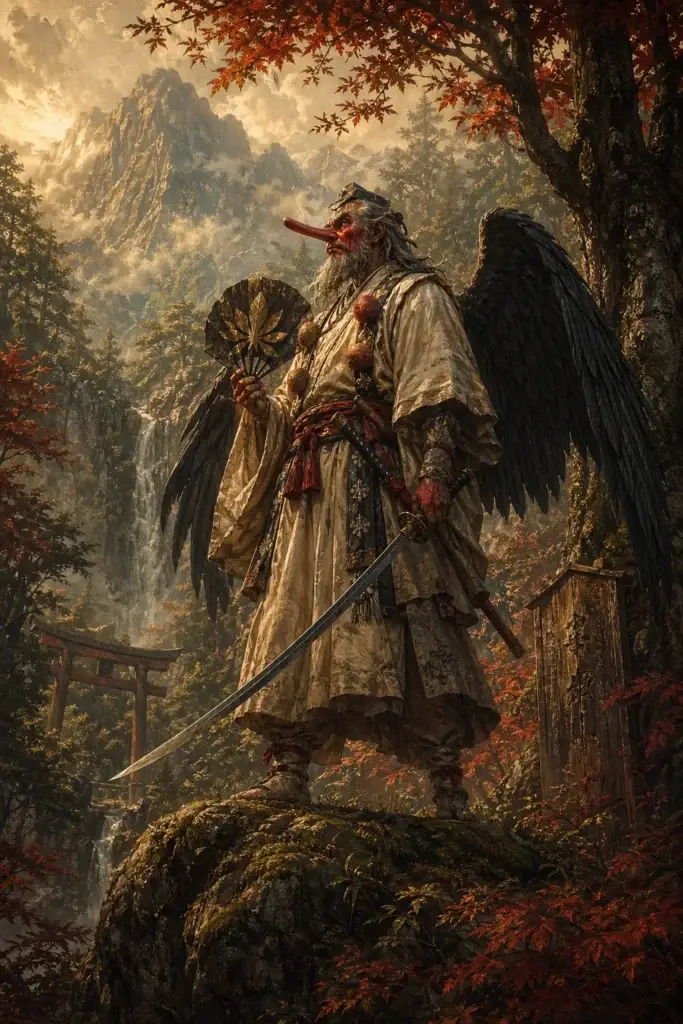
Stallo: Man-Eating Giant and Trickster Antagonist of Sámi Tradition
By Ralf Ittermann · last reviewed on
Stallo, in dialectal variants also Staaloe or Staaloh, is the man-eating giant of the Sámi narrative tradition. He appears as an antagonist in numerous tales in which Sámi protagonists defeat him through cunning. From the perspective of religious studies, he belongs to the broad class of giant antagonists in northern European mythologies.
Stallo is regarded as a giant antagonist in the narratives of Sámi communities, a cannibalistic outsider.

Profile: Stallo
Stallo: the most important aspects at a glance. The following fields summarise origin, effect, appearance, function, protection and parallels.
Stallo, in variants also Staaloe or Staaloh, is a narrative being of the Sami storytelling tradition, found from northern Sweden through Norway to Finland and Russia. The name is etymologically unexplained: one hypothesis links it with Old Norse stallari, another with a Sami root for giant or great one.
Stallo lives in the wilderness, threatens people and lies in wait especially for children and lone travellers. He is regarded as man-eating, gluttonous and violent. The tales also served to warn children of the dangers of the wilderness.
Stallo is a large, strong and at the same time stupid, cruel giant. He often wears iron equipment, whereas the Sami traditionally used wood, bone and horn. In some stories he owns a dog and riches of silver.
In the tales Stallo is the antagonist whom the Sami defeat by cunning. His position between religion and folklore is disputed; some scholars read him as an initiation figure of Sami shamanism.
In the tales he is warded off by cunning. A child or a clever woman gets him to hurt himself, fall into a pit or attack his own relatives. A hunter lures him into a rock crevice.
Comparable are the Old Norse jötnar, the Finnish jätit, the Russian giants called volot and the giant tales of the Inuit. Unlike the jötnar, Stallo has no mythological genealogy of his own, no gods of his own and no theology of his own.
Classification and Brief Profile
Stallo belongs to the narrative layer of Sámi tradition, which is assigned less to actual religious theology than to the mythological-narrative tradition. Unlike Beaivi, Ráhka, or the Akkas, Stallo is not a cultic figure but a narrative being who appears in numerous tales.
The Stallo narratives are widespread across the Sámi language regions, from northern Sweden through Norway to Finland and Russia. They mostly depict Stallo as a brutish yet dim-witted giant who is defeated by the cleverer Sámi through cunning. This trickster-anti-hero configuration is, from a phenomenology-of-religion perspective, a phenomenon in its own right.
In religious studies, the precise position of Stallo between religion and folklore remains contested. Some scholars (Pentikäinen) view him as a historically idealized antagonist, others (Rydving) as a purely narrative figure, while still others point to his shamanic function as an initiation figure.
The narrative giant figure of Stallo has also been addressed in more recent scholarship through expanded approaches that combine ethnographic precision, philologically critical examination of the tradition, and comparative classification. Sámi scholars today contribute to this research themselves and correct earlier Western interpretations of Stallo, which in some cases reflected colonial perspectives.
In the broader comparative context of religious studies, Stallo, whose stories are told from northern Sweden through Norway to Finland and Russia, fits into the pattern of a circumpolar religious-narrative topography.
The fact that its basic structure remains stable across thousands of kilometres is regarded as one of the most remarkable findings in the field and continues to be discussed to this day.
Name and Etymology
The etymology of the name Stallo has not been conclusively established. One hypothesis connects it with Old Norse stallari, which originally meant marshal or stable-master and in Old Norse saga literature designates an honorary function.
Another hypothesis points to an independent Sámi root meaning giant or large one. This question is methodologically significant, because an etymological connection to an Old Norse term would suggest a stratum of cultural-historical contact.
Dialectal variants include Staaloe in South Sámi, Staaloh in Ume Sámi, and Stállo in Lule Sámi usage. The variety of forms corresponds to the general dialectal differentiation of the Sámi languages and confirms the figure’s wide distribution.
From a sociology of religion perspective, one may additionally ask what function the Stallo narratives fulfilled within the social order of the traditional Sámi community, for instance as instructive tales about cunning, danger, and cohesion.
Religious belief and social practice were not separate here either, but closely intertwined. This interweaving constitutes a distinct field of religious-anthropological research that has been systematically investigated in particular by Håkan Rydving.
A further dimension concerns the contemporary significance of Stallo for Sámi identity politics. In the context of Sámi self-governance and the recognition of indigenous rights under international law, the narrative figures of the tradition are also gaining new visibility.
The relationship between religious studies and political self-assertion constitutes a distinct area of work that has received increasing attention in recent years.
Description and Character
In the narratives, Stallo is typically described as a large, powerful, but dim-witted and cruel giant. He is often equipped with iron gear, which sets him apart from the Sámi, who traditionally used wood, bone, and horn. This material asymmetry is instructive from a religious-studies perspective.
In terms of character, Stallo is gluttonous and violent but easily outwitted. In the narratives, the Sámi usually defeat him through cunning, for example by luring him into a trap, making him drunk, or deceiving him with an allegory. This trickster-cunning configuration is typical from a narrative-phenomenological standpoint.
Iconographically, Stallo was not depicted in traditional culture. In contemporary Sámi art and literature he appears more frequently, often as a critically humorous figure or sometimes as an allegory of colonial threat. This modern appropriation is a phenomenon in its own right from a phenomenology-of-religion perspective.
Stallo Narratives and Their Structure
The typical Stallo narrative follows a fixed pattern: a Sámi person encounters Stallo, falls into danger, finds a cunning solution, defeats Stallo, and returns with spoils. This structure resembles the trickster narratives found in many cultures.
Specific stories vary in their details. In one well-known tale, a Sámi hunter suggests to Stallo that they eat together, lures him into a rock crevice, and kills him there.
In another narrative, two brothers lure Stallo into a hut where they thrust a glowing iron rod down his throat. These violent resolutions are typical from a narrative-phenomenological perspective.
From the standpoint of religious studies, the Stallo narrative literature has been extensively documented in the major Sámi story collections, such as those of Just Knud Qvigstad and Konrad Nielsen. These collections constitute a distinct field of research and are valuable from a religious-ethnological perspective.
Historical Interpretations
A prominent hypothesis in older scholarship interpreted Stallo as a mythologized memory of non-Sámi intruders, such as Scandinavian Viking raids or Russian colonizers. This hypothesis has the advantage of explaining the material asymmetry (Stallo with iron, Sámi with wood).
From the perspective of religious studies, this hypothesis is plausible but not fully convincing. Stallo narratives exist even in regions where no direct contact with foreign intruders is attested. A purely historical-rationalizing interpretation therefore falls short.
An alternative reading sees in Stallo a cosmological antagonist figure that serves in every culture as the necessary counterpart to the cultural self. This structuralist reading is productive from a phenomenology-of-religion perspective and corresponds to the broader class of giant antagonists found in many mythologies.
Stallo and the Shamanic Initiation Rite
Some scholars have proposed reading Stallo as an initiation figure of Sámi shamanism. Young noaidi candidates had to demonstrate their competence in symbolic confrontation with Stallo-like figures. This hypothesis is contested but has heuristic value.
If this reading is correct, Stallo would be not only a narrative but also a ritual figure. The phenomenological significance would be considerable, since it would shift the boundary between folklore and religion in the Sámi tradition.
Methodologically, this hypothesis is difficult to verify because direct ritual practice was largely discontinued through missionary activity. Indirect indications within the narratives can support the hypothesis but cannot prove it conclusively. This methodological caution is called for in religious studies.
Stallo in the Comparative Study of Giant Antagonists
Stallo belongs to the broad class of giant antagonists in northern European mythologies. Structurally comparable figures include the Old Norse Jötunn, the Finnish jätit, the Russian volot giants, and the Inuit giant narratives in which mythological predecessor beings are defeated.
Compared to the Old Norse Jötunn, Stallo is considerably simpler in construction. He has no mythological genealogy comparable to the Jötunn world of Útgardr, no gods of his own, no independent theology. Stallo is more of a stock figure than a fully developed mythological counterpart.
This narrative simplicity is instructive from a religious-studies perspective. It shows that the Sámi tradition employs giant antagonists as narrative tools without developing them into a full mythological world. From a phenomenology-of-religion standpoint, this functionality stands on its own terms.
Stallo in Contemporary Appropriation
In contemporary Sámi culture, Stallo is a productive figure. Writers such as Nils-Aslak Valkeapää, artists such as Britta Marakatt-Labba, and filmmakers such as Nils Gaup have taken up Stallo, often as an allegory of colonial threat or as a symbol of self-assertion against external powers.
The film Pathfinder (Ofelaš, 1987) by Nils Gaup prominently featured Stallo-like figures, making the figure accessible to an international audience. This reception is a phenomenon in its own right from a phenomenology-of-religion perspective.
In the pedagogical practice of Sámi schools, Stallo is used as a figure of identification. The didactic function lies in the example of the clever Sámi who defeats brute force through cunning. This pedagogical appropriation constitutes a distinct field in the didactics of religion.
Research and Current State of Scholarship
Research on Stallo is extensive. Just Knud Qvigstad provided a foundational collection in his Lappische Märchen- und Sagenvarianten (1925). Juha Pentikäinen and Håkan Rydving have undertaken the religious-anthropological scholarly work.
In comparative phenomenology of religion, Stallo is treated as a case study of northern European giant antagonists. This classification allows structural comparisons that are productive for religious studies.
Specific research gaps remain in the precise differentiation between the ritual-religious and the narrative-folkloristic function of Stallo. This differentiation is methodologically difficult but important for an accurate scholarly positioning of the figure.
Cross-References within the Lexicon
Stallo connects with Beaivi, Mánnu, Ráhka, Sara-Akka, Uksakka, Juksakka, Madderakka, Jabmiidaibmu, and Saivo. The culture hub Sámi Tradition contextualizes the narrative tradition. Structurally comparable giant antagonists are found in many northern European mythologies, such as the Old Norse Jötunn.
Stallo in the Sámi Narrative Tradition
Stallo, in North Sámi form Stállu, is not a deity but a figure from the Sámi narrative tradition, passed down orally through fairy tales and legends.
In these stories he appears as a large, dim-witted, and gluttonous ogre who lives in the wilderness, threatens people, and lurks especially for children and lone travellers. Despite his dangerousness, he is slow-witted, so the human heroes regularly overcome him through cunning.
A typical narrative pattern has a child or a clever woman outwitting Stallo: he is made to injure himself, fall into a pit, or attack his own kin.
In some stories Stallo has a dog that must also be fought, and silver treasures that the victorious hero claims at the end. Stallo is often associated with an iron implement, such as an iron rod, which he uses to lure or seek out his victim.
Finnish and Norwegian folklore research, particularly in the context of the collections compiled by Just Knud Qvigstad, who in the early twentieth century recorded and published extensive Sámi narratives, has documented a large number of Stallo stories.
These collections are the most important source, because Sámi culture long had no written tradition of its own and the oral material was committed to writing only at a late stage.
Within this tradition, Stallo is among the most frequently attested figures and also served in the narratives as a pedagogical figure, through which children were warned about the dangers of the wilderness.
The Stallo Pits and the Archaeological Debate
In the mountain landscapes of northern Sweden and Norway, archaeology recognizes a particular type of house foundation known in scholarship as Stallo pits or Stallo sites.
These are round or oval structures slightly sunken into the ground, typically arranged in rows along elevated terrain, dated to the Iron Age and the early Middle Ages, roughly spanning the first millennium of the common era.
The designation goes back to Sámi informants who, in more recent times, associated these ground features with the legendary figure Stallo, without any historical connection necessarily existing. In archaeology it has been debated for decades who actually laid out and used these sites.
An older view saw in them traces of Norwegian tax collectors or foreign hunters. Inge Zachrisson and others have argued instead that these are settlement remains of the Sámi population itself, possibly connected with an early and more intensive form of reindeer herding.
The debate touches on a fundamental question in northern Scandinavian history: since when and in what form did the Sámi use the high mountain terrain, and how did their economic practices change. The Stallo pits are a central piece of evidence here, being well dateable finds.
From a religious-studies perspective, the retrospective naming is of particular interest: it shows how a later population connects incomprehensible traces of the past with a narrative figure and thereby interprets them. The name Stallo thus passed from a legendary being to an archaeological technical term, without the legend itself revealing anything about the true builders.
Scholarly Interpretations of the Stallo Figure
The question of what Stallo originally represents has occupied folklore studies and religious studies since the nineteenth century. Several explanations stand side by side, without any one having definitively prevailed.
A widespread interpretation sees in Stallo the narrative processing of historical experiences of threat. The Sámi were exposed for centuries to foreign tax demands, attacks, and competing population groups. The dangerous but dim-witted Stallo, who can be defeated by cunning, would on this reading be an image of the overwhelming but outwittable foreigner.
Supporting this view is the fact that Stallo in many narratives is associated with iron, silver, and wealth, that is, with goods linked to foreign traders and powers. Linguistically, the name is occasionally connected with the Old Norse stallari (stable-master or marshal), which would support this direction, though it is not firmly established.
Another interpretation emphasizes the function of Stallo within the narrative community itself. As a figure of terror he served the purposes of education and the transmission of behavioural norms, such as warning children not to venture too far from the settlement alone.
Still others have connected Stallo with older ideas about spirits of the wild or with the dead.
More recent scholarship, including work in the field of Sámi folkloristics, tends to assume several of these layers simultaneously and not to reduce Stallo to a single origin.
He thus remains a multifaceted figure, whose popularity in the narrative tradition may lie precisely in the fact that he combines threat and its overcoming in a single character.
Selected Bibliography
- Just Knud Qvigstad: Lappische Märchen- und Sagenvarianten (Helsinki 1925)
- Håkan Rydving: The End of Drum-Time (Uppsala 1993)
- Juha Pentikäinen: Saamelaiset. Pohjoisen kansan mytologia (Helsinki 1995)
- Nils Gaup: Ofelaš (Pathfinder) (Film, 1987)
Stallo appears in Sámi narratives as a man-eating giant and trickster antagonist who puts heroes to the test and in didactic tales marks the boundary between wilderness and human settlement.
Related key terms: Stallo Staaloe Stállu Sámi giant antagonist trickster narrative Qvigstad.
iWell Guard and Protective Traditions
iWell Guard draws on the cultural-historical tradition of wearable protective objects, in the tradition of Sami and many other cultures worldwide. 41 layers, solid gold, platinum, silver, crafted in Germany. 30-day return policy.
Personal experiences may vary. Not a medical device. No healing claims.