Yacumama (Quechua Yaku Mama, water mother) is the great water-serpent goddess of the Andean-Amazonian tradition. She is regarded as the mother of all waters, as the inhabitant of the great rivers of Amazonia and the sacred highland lakes, and as a relative of the mountain mother Mama Cocha.
Yacumama is venerated in the Andean-Amazonian region as the mother of all waters.
Yacumama belongs to the class of zoomorphic water deities that hold particular importance in the transitional zone between the Andean highland cultures and the Amazonian lowland cultures. She is venerated in a tradition widely distributed beyond the Quechua- and Aymara-speaking villages, reaching into the Amazonian Ashaninka, Shipibo, and Cocama communities.
From a religious-studies perspective, Yacumama belongs to the class of great water-serpent beings that play a central mythological role in most river regions of the world.
Structurally comparable beings include the African Mami Wata, the Australian Aboriginal Rainbow Serpent, the North American Horned Serpent, the Mesoamerican Quetzalcoatl figure in its water-serpent dimension, and the Indian Naga tradition.
In the Inca-period pantheon, Yacumama held no elevated state position; she belongs to the non-state, more chthonic sphere of Andean religiosity. Only in the post-colonial phase, especially in the course of growing appreciation for indigenous Amazonian traditions, did she become a prominent figure of pan-Amazonian identity.
Marlene Dobkin de Rios described the central role of Yacumama in the ayahuasca visions of the Ashaninka and Shipibo in Visionary Vine (1972).
An important theological distinction concerns the relationship between Yacumama and Mama Cocha. Both are female water numinosities, yet their respective domains differ: Mama Cocha is primarily the mother of large, still waters (sea, highland lake), while Yacumama is more the mother of moving, flowing waters (rivers, streams, whirlpools).
In some villages, the two beings are described as sisters or as two aspects of the same water mother; in others, they are regarded as clearly distinct beings with their own cult traditions.
The name Yaku Mama is a direct Quechua formation from yaku (water) and mama (mother). Diego Gonzalez Holguin gives yaku in his Vocabulario (1608) as agua corriente, flowing water, which clarifies the specifically fluvial connotation of Yacumama in comparison to the more lake-oriented Mama Cocha.
In Aymara the equivalent is Uma Tayka; in the Amazonian Quechua variant (so-called Quechua Lamista) and in the Shipibo language, further regional designations exist such as Ronin or Yakuruna.
The latter designation, water person, points to an anthropomorphic variant of Yacumama in which she appears as a water-obsessed man who lures women on the riverbank into the depths.
Linguistically interesting is the double connotation of yaku: it designates both ordinary drinking water and dangerous river water. Yacumama is therefore simultaneously the life-giving mother of water and the deadly depth of the riverbed.
This morally ambivalent dual structure is characteristic of indigenous water theologies of Amazonia and differs from the more uniformly nurturing Mama Cocha tradition.
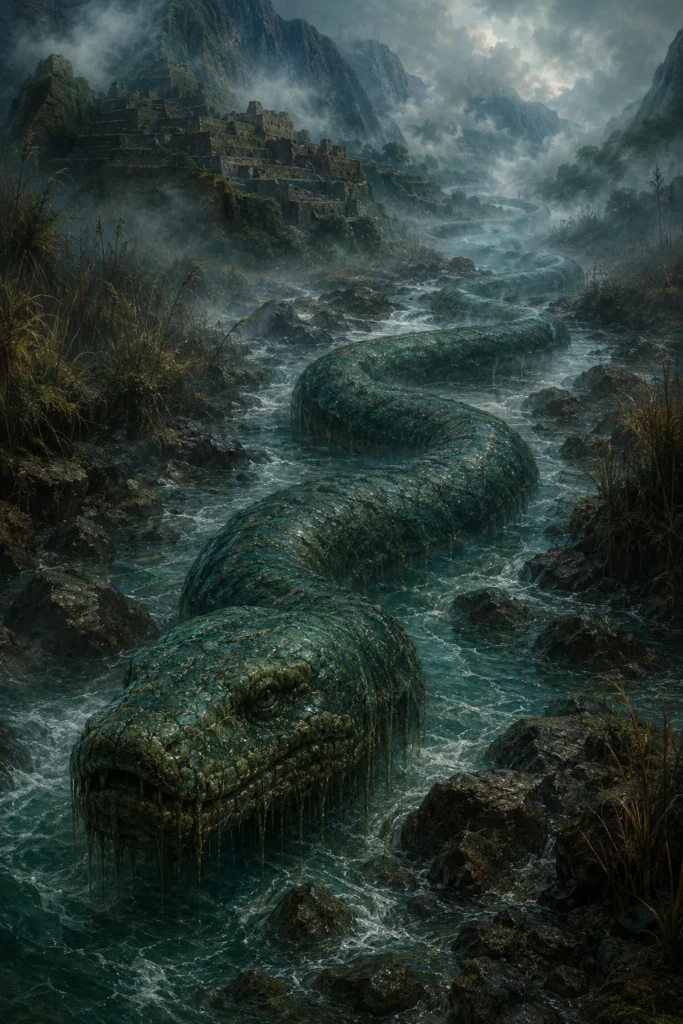
Yacumama is described in indigenous narratives of Amazonia and the Quechua-Amazonian border predominantly as a gigantic anaconda-like serpent, whose body is said to be hundreds of meters long and whose gleaming scaly covering unites within it all the colors of the rainbow.
She moves through the rivers, occasionally surfaces to impress observers, and retreats into deep whirlpools, where her true domain lies.
On traditional Shipibo-Conibo textiles, Yacumama is present as a geometric serpent motif that forms the typical labyrinthine line patterns.
The Shipibo anthropologist Angelica Serrano has shown in her work on Shipibo iconography that the kene line patterns of Shipibo weavings are understood as Yacumama lines; it is the serpent herself who draws the patterns across the cloth.
In the modern folk iconography of Amazonia, Yacumama is often depicted as a beautiful woman with a fish tail or a serpent tail, a blend of traditional indigenous and colonial-Spanish mermaid tradition.
This depiction is found primarily in the street markets of Iquitos, Pucallpa, and Manaus and is an expression of a hybrid urban Amazonian folklore.
A particular iconographic tradition is found in the geometric body paintings of some Ashaninka and Shipibo communities, in which the kene lines are interpreted as a direct manifestation of Yacumama on the skin.
The lines appear in the visionary experience first on the practitioner’s own skin and are then transferred by more experienced weavers into textile patterns. This iconography has received significant attention in the ethnological discussion around the concept of embodied religiosity, because it acknowledges no separation between pictorial art and bodily practice.
The mythological tradition surrounding Yacumama is rich and differently accented in the various Amazonian languages. A central narrative class describes Yacumama as the creator of the great rivers: her body, crawling through the earth, has carved out the riverbeds.
Where she turns around multiple times, the meandering bends of the lowland rivers are formed. Where she rests, the oxbow lakes, the cut-off crescent-shaped lakes of the Amazonian floodplain, come into being.
Another central narrative describes Yacumama as the mother of river inhabitants: from her womb come the pirarucu, the caimans, the pink boto dolphins, and the electric eels.
When a fisherman catches an unusually large fish, he should throw a portion back into the water so that Yacumama does not become angry. This reciprocal offering logic is also widespread in modern Amazonian fishing practice.
A particularly widespread narrative class concerns Yacumama’s power of seduction. She is said to lure young men, sometimes in the form of a beautiful woman, to the riverbank and pull them into the depths.
In Ashaninka narratives, the water-woman seductress is a central warning to young men who swim or fish too long at the river. Marlene Dobkin de Rios described this narrative tradition for the mestizo population of the Peruvian Amazon as the sirena complex, in which indigenous Yacumama conceptions and European mermaid tradition merge.
A fourth narrative class concerns the cosmic battle: in some Ashaninka and Shipibo narratives, Yacumama fights against a thunder spirit (comparable to Illapa) and is struck to pieces by him, from which the individual rivers and lakes arise.
This aetiology of the river landscape as the dismemberment of a cosmic serpent body is also found in other Amazonian traditions and has been described by Eduardo Viveiros de Castro in his work on Amazonian mythology as the cosmic dismemberment motif.
Yacumama has no centrally institutionalized veneration comparable to the Inca-period Inti cult. Instead, her veneration takes place in a decentralized manner: at every river-crossing ritual, at every first catch of the season, at every birth of a child in a riverside community.
The ritual specialists are the vegetalistas or curanderos of the Amazonian villages, who invoke Yacumama in their healing sessions.
Yacumama plays a special role in the ayahuasca tradition of the Amazonian peoples. In the visionary experiences with the ayahuasca plant brew (Banisteriopsis caapi + Psychotria viridis), she appears regularly as a great serpent teacher who guides the healer through the subterranean and supranatural worlds and imparts diagnostic and healing knowledge to them.
This Yacumama vision has been described extensively by Amazonian anthropology, Stephen Beyer (Singing to the Plants, 2009), Marlene Dobkin de Rios, and Luis Eduardo Luna.
In the modern urban syncretism religions of the Amazonian cities (e.g., Santo Daime, Uniao do Vegetal, Brazilian ayahuasca churches), Yacumama remains present as a figure of sacred water wisdom, often in syncretic connection with Christian Marian devotion and with Afro-Brazilian Orisha traditions such as Yemanja.
In the ayahuasca sessions of the Peruvian vegetalistas, the icaros, the ritual healing chants, play a central role. Many of these icaros contain invocations to Yacumama, in which the water serpent as teacher is asked to show the healer diagnostic visions or to identify the illness of a patient.
Stephen Beyer documented in Singing to the Plants (2009) a comprehensive collection of such icaros with reference to Yacumama and showed how this practice of invocation integrates indigenous Amazonian and mestizo-Catholic elements in a distinctive ritual form.
Protective practice in relation to Yacumama has a distinctively two-layered character. On the one hand, she is invoked as a protective deity against river dangers: against drowning, against crocodile attacks, against illness spirits that come by water.
On the other hand, one must be protected from Yacumama herself, because her power of seduction can turn harmful.
Concrete apotropaic practices include wearing a piece of aji pepper at the neck while swimming (the sharp scent is said to repel Yacumama), the ritual spitting of water before drawing it, and the avoidance of certain whirlpool spots and deep-water zones that are regarded as Yacumama’s dwelling places.
A specific practice concerns the treatment of the so-called chuyo or cutipado, an illness said to have arisen from too close contact with the water without ritual preparation. It is treated through a vegetalista ritual involving tobacco, ayahuasca, and dieta practices.
In the highlands, Yacumama is venerated primarily as a protective deity of irrigation streams and sacred springs. According to traditional belief, anyone who pollutes or improperly uses a large highland spring risks Yacumama’s anger, which is said to manifest in skin rashes, swellings, or eye diseases.
This conception has played an important role in the religio-ethnological discussion as the moral ecology of the Quechua-Aymara water theology.
Water-serpent deities are a worldwide religious and mythological phenomenon with a remarkably consistent structure.
Structural parallels to Yacumama are found in the West African Mami Wata (which achieved wide distribution through the slave migration to Brazil and the Caribbean), in the Australian Aboriginal Rainbow Serpent, the North American Horned Serpent of the Algonquian language family, the Mexican Quetzalcoatl figure in its water-serpent dimension, the Hindu Naga tradition, and the Chinese dragon theology.
Carl Jung classified the water serpent in his writings on symbol analysis as an archetypal image and interpreted it as a symbolic equivalent of psychic depth or the unconscious.
From a religious-studies perspective, this interpretation is problematic because it levels the cultural-historical specificity of each water-serpent tradition in favor of a universalist reading. Nevertheless, the structural convergence is so clear that it demands explanation. Mircea Eliade described the phenomenon extensively in Patterns in Comparative Religion (1958).
Within the Americas, Yacumama shows clear proximity to the Amazonian-Brazilian Cobra Grande (sucuri serpent), which is likewise narrated as a river mother and figure of seduction. The conception of a gigantic water serpent is widespread throughout the Amazonian lowlands and reaches from the Brazilian Tupi peoples to the Colombian Tucano language groups.
Within comparative Americas religious studies, the relationship of Yacumama to the Thunderbird figure of North America is particularly illuminating.
In numerous American indigenous mythologies, the water serpent fights against the thunder bird; the conflict is the cosmic personification of the weather cycle between precipitation (water serpent) and thunderstorm (thunder bird). This transversal mythic constellation, attested equally among the Lakota, Algonquian, Ashaninka, and Shipibo, demonstrates a remarkable pan-American structural consistency.
Yacumama has experienced a remarkable renaissance in the 21st century. The growing attention to Amazonian indigenous religions, the spread of ayahuasca practice beyond South America, and the recognition of indigenous natural-being rights in the constitutions of Bolivia and Ecuador have drawn Yacumama into a broader religious-political discourse.
In academic research, the ethnographic study of the ayahuasca-vegetalista tradition stands in the foreground. Luis Eduardo Luna (Vegetalismo, 1986), Stephen Beyer (Singing to the Plants, 2009), Marlene Dobkin de Rios, and younger scholars such as Beatriz Caiuby Labate have described Yacumama as the central visionary-mythological teacher of the Amazonian healing tradition.
The question of how far this vegetalista tradition is of pre-Christian indigenous provenance and how far it is a modern syncretic product is discussed controversially in the research.
From a religious-studies perspective, Yacumama is an important example of the mobility of indigenous water theologies under the conditions of modernity.
What in the 16th century was a rather peripheral chthonic figure at the margins of the Inca pantheon has today become a prominent figure of a pan-Amazonian, ecologically connoted spirituality, a development that deserves religio-sociological attention.
The iWell Guard reference to the Yacumama tradition describes these findings from a religious-historical perspective, without claims of efficacy or spiritual recommendations.
A relevant observation of religio-sociological research concerns the difference between indigenous Amazonian and urban-Western ayahuasca practices.
In the indigenous Ashaninka and Shipibo sessions, Yacumama is embedded in a comprehensive cosmological narrative order with concrete ethical obligations; in the urban syncretism churches of Brazil and Peru, she has become more of a free-floating symbol figure charged with individual spirituality.
This difference has been systematically described by Bia Labate and Edward MacRae in their work on the globalization of the ayahuasca tradition.

The following selection lists central works of Amazonian ethnology and Andean research that are central to understanding Yacumama and the water-serpent theology.
Unlike the gods of the Inca state cult, Yacumama, whose name can be translated from Quechua as water mother, is barely documented by colonial chroniclers. Her attestation rests primarily on oral narratives that are passed down to the present day in the river regions of the Peruvian, Ecuadorian, and Brazilian lowlands.
There she is regarded as a powerful water serpent or as a spirit being that inhabits deep stretches of river, lagoons, and estuaries and watches over the animals living there.
The narratives vary greatly by region and intermingle with conceptions of the real anaconda, which in many lowland cultures is already regarded as a mythically charged animal. In some versions, Yacumama generates whirlpools that drag boats into the depths; in others, she calls forth mist or storms with her breath.
Mestizo narrative traditions along the Amazon, for example in the area around Iquitos, know her as a being that can be avoided or appeased by making noise or by certain whistled tones.
Research faces here the fundamental problem that a unified, clearly defined figure does not exist. What is grouped together under the name Yacumama is rather a bundle of related water-spirit conceptions that draw on indigenous lowland traditions, Andean concepts, and elements of mestizo folk culture.
Collections of lowland narratives, such as those compiled by ethnologists and folklorists since the 20th century, document this diversity without allowing a self-contained mythological system to be reconstructed from them. Related water figures of the region are discussed in the entry on Mama Cocha.
Yacumama, Quechua for Mother of Water, is in the Andean-Amazonian tradition a gigantic water serpent whose habitat encompasses the great waterways of the Amazon basin and its tributaries.
She is regarded as the guardian of currents, whirlpools, and river mouths; fishermen and travelers invoke her before navigating deeper waters and trace behavioral rules back to her, such as keeping silent near certain lagoons. In research, Yacumama is situated at the intersection of indigenous tradition, mestizo cosmology, and colonial travel accounts.
Yacumama is regarded in Andean-Amazonian tradition as a powerful water serpent and mother of the rivers, whose narratives are transmitted to the present day in the border zone between the high Andes and the rainforest among Quechua- and Shipibo-speaking groups.
Related key terms: Yacumama Yakuruna Sucuri Ayahuasca Vegetalista Shipibo Anaconda Ashaninka.
iWell Guard draws on the cultural-historical tradition of wearable protective objects, in the tradition of Andes / Inca and many other cultures worldwide. 41 levels, real gold, platinum, silver, crafted in Germany. 30-day right of return.
Personal experiences may vary. Not a medical device. No healing claims.
Against its influence, cross-cultural tradition names these protective means:
Recommended protective means
The simplest protective means in this collection: 41 layers of fine gold 999, platinum, silver and silicon, manufactured in Ruhla, Thuringia. It requires no activation, is bound to no person, and is effective within a radius of around 50 meters, even without being worn.
Related Beings

Pania of the Reef, the beautiful sea woman of the Māori. Origin, the tragic love for Karitoki and...

Kel Essuf, the Tuareg spirits of wilderness and solitude. Origin, the tende healing ritual and th...

Brahmarakshasa, the powerful spirit of a Brahmin in India. Origin, the dual nature of horns and t...

The Gwragedd Annwn, benevolent lake fairies of the Welsh Otherworld. Origin, the Lady of Llyn y F...

The Brownie, the prototype of the British household spirit. Origin, the clothing taboo and the re...

Shinigami, the Japanese death spirit. Origin as a young figure of the Edo period, its closeness t...