Raijin, god of the Japanese tradition
By Ralf Ittermann · last reviewed on
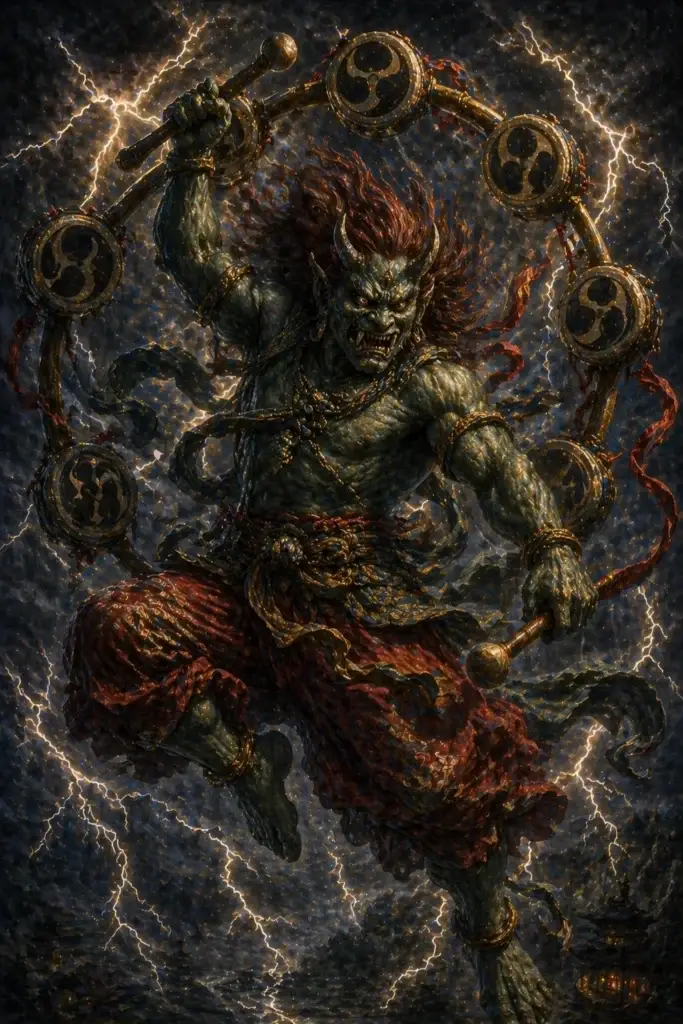
Thunder god, wild in the sky, drummer of the storm. Raijin is one of the most demonic deities of Japan, though not evil. The god of thunder and lightning is depicted as a red or blue figure with wild hair, touched by lightning bolts, surrounded by drums.
He sits on a cloud or hovers above arcs of electricity, and his finger drumming produces the thunder that illuminates Japanese villages. In medieval Japan, thunderstorms led to offerings to Raijin, and people reported direct encounters with him, demonic yet as unavoidable as nature itself.
Brief Profile: Raijin
Type: Japanese deity, god of thunder and storms (Shinto)
Pantheon: Shinto and popular Buddhist tradition
Function: thunder, lightning, storm, rain
Principal attributes: ring of drums (taiko), loincloth, subdued demonic features
Principal cult sites: Sanjusangendo (Kyoto), Senso-ji (Tokyo, Thunder Gate)
Companion deity: Fujin (god of wind)
Historical Classification
Period of the Texts
Raijin has been attested in literature since the 8th century (Nara period) in the Kojiki and Nihon shoki. The main flowering of the iconographic tradition falls in the Heian and Kamakura periods.
The famous pair of images of Raijin and Fujin by Tawaraya Sotatsu (17th century, Kennin-ji) is the most popular depiction. The Kaminari-mon (Thunder Gate) of the Senso-ji in Tokyo shows Raijin as a red protective god.
Area of Distribution
Principal cult sites: Sanjusangendo in Kyoto (with the statues of Raijin and Fujin), Senso-ji in Tokyo (Kaminari-mon, Thunder Gate), Kennin-ji in Kyoto (the Sotatsu image). In addition, in every Japanese shrine that guarantees protection from the weather or agricultural fruitfulness. In modern Japan he is present in meteorology and storm myths.
State of the Sources
Central sources: Kojiki (Book I), Nihon shoki (storm myths), Sotatsu’s paintings (Kennin-ji), the Senso-ji temple records. Secondary literature: Kasahara, A History of Japanese Religion; Aston, Shinto. The Way of the Gods; Breen/Teeuwen, Shinto in History.
Name and Variants
Raijin is a demonically wild figure, often coloured red or deep blue, with hair standing on end that resembles fire. His body is muscular, his expression angry but not evil. Central to him are his drums (taiko): several drums surround him, which he beats to produce thunder.
Lightning bolts shoot from his fingers. He rides on clouds or sits on a wildly toppled throne. Fujin (the god of wind) is often shown beside him, in a symbiotic partnership: Raijin booms, Fujin blows, and together they bring the thunderstorm. Amulet charms show his face or his drums as a protective sign.
Characteristic Traits
Raijin is the bringer of rain, and without him there is no harvest. But thunder kills, and lightning sets houses ablaze. The folk tradition is ambivalent: one makes offerings to Raijin for protection, not for blessing.
Amulets are worn, especially during the summer monsoon season. In medieval Japan, lightning strikes on people were rare but were regarded as cases of Raijin possession or direct contact.
Buddhist temples show Raijin in their artworks as one of the heavenly rulers (Kouroku-ten). The trust placed in him is functional: one respects Raijin, one does not build directly at the sites of his activity, and one keeps amulets. A direct cult with shrines is minimal.
Appearance and Symbolism
Raijin is depicted as a red or orange being with wild hair, often with horns. He carries drums (taiko) around his body, which he beats to produce thunder. Lightning radiates from him. He is often shown on a cloud together with Fujin, sometimes fighting or playing with one another.
Profile: Raijin
The most important aspects of Raijin at a glance. The following fields summarise origin, function, appearance, veneration, symbols and parallels.
Raijin is the son of the creator goddess Izanami. In the Kojiki he arises from her decaying body in Yomi (the underworld), as one of eight thunder aspects.
In later traditions he is linked with the wind god Fujin as a brother or companion. In some versions the parents are: Susano-o (god of storms) and his consort.
Patron of the weather, feared (the lightning strike) as much as entreated (the rain). Central to the agricultural tradition, since the irrigation of rice depends on timely rain. In the popular Buddhist tradition he is also a wanderer between worlds and a guardian of thresholds (the Thunder Gate of the Senso-ji).
A red, muscular man’s body with demonic features (horns, wild hair, sharp teeth), surrounded by a ring of drums (several taiko drums whose strokes produce thunder). He wields two drumsticks.
He wears only a loincloth or a tiger pelt. He is accompanied by Fujin, who releases the wind from a sack. In the classical images (Sotatsu) he hovers on a cloud.
Sphere of influence: In farming regions Raijin is entreated for timely rain and invoked for protection against lightning strikes. Animal offerings (in the premodern era) were customary at thunder sanctuaries.
A modern popular belief: during thunder one should cover one’s navel, otherwise Raijin will steal it. At the Senso-ji every visitor touches the thunder lantern as a good-luck ritual.
Ring of drums (several taiko drums), drumsticks, horns, sharp teeth, wild hair, tiger-skin loincloth, red (sometimes blue-green) skin colour, a cloud base. Sacred animals: the tiger (its pelt). Sacred plant: bamboo.
Raitaro (Japanese folk tradition, lesser thunder demons of popular mythology), Thor (Germanic, hammer thunder god), Indra (Hinduism, the vajra thunderbolt), Zeus (Greece, the thunderbolt), Jupiter (Rome), Perun (Slavic), Tarhunna/Teshub (Hittites), Adad (Mesopotamia), Lei Gong (China, the Chinese variant of the thunder god with drum and hammer).
Practical Defence
Rituals of Veneration
Raijin (Japanese 雷神, “god of thunder”) is a weather god of Shinto and Buddhism, often depicted as a pair with Fujin (the god of wind).
The principal cult sites are the Kaminari-mon gate of the Senso-ji temple in Tokyo (Asakusa, founded 645 CE; Kaminari means thunder) and the Sanjusangen-do in Kyoto (1164), where monumental statues of Raijin and Fujin flank the central hall. Local fishing villages hold Raijin-Matsuri festivals to calm the storms in summer.
Invocations
Sanno Shinto and Shugendo integrate Raijin as a mountain weather god. In Buddhism he is compared to the Nio guardian bodhisattvas, as a wrathful protective god. Popular conjuration formulas against lightning strikes invoke the Buddha Yakushi for help. In classical Noh theatre Raijin appears in several plays as an ambivalent natural power.
Amulets and Protective Symbols
Statues of Raijin with a tomoe drum semicircle (three drums on each side plus three above) as a thunder symbol. Dark-blue or green skin, horns, a tiger-skin loincloth.
Protective amulets from the Kaminari-mon (Senso-ji) in red silk. The tomoe symbol (three swirling commas) serves as protection on traditional Japanese house gables. Limestone thunderbolts (known as raiseki) were traditionally built out of walls as apotropaia.
Raijin, Parallels in Other Cultures
Raijin resembles the Indian Indra (rain god, slayer of dragons), the Greek Zeus (god of lightning), and the Norse Thor (thunder). Unlike Zeus or Thor, Raijin is not central to the mythology of rulership but remains wild, peripheral and close to the demonic.
With the Mexican Tlaloc (rain god) Raijin shares the ambivalence of blessing and destruction. His partnership with Fujin resembles that of the Greek Aeolus (master of the winds), but Raijin and Fujin are of equal weight, not hierarchical. The drum metaphor is unique: thunder as a musical act, not merely a force of nature.
Raijin and Fujin: The Divine Pair of Thunder and Wind
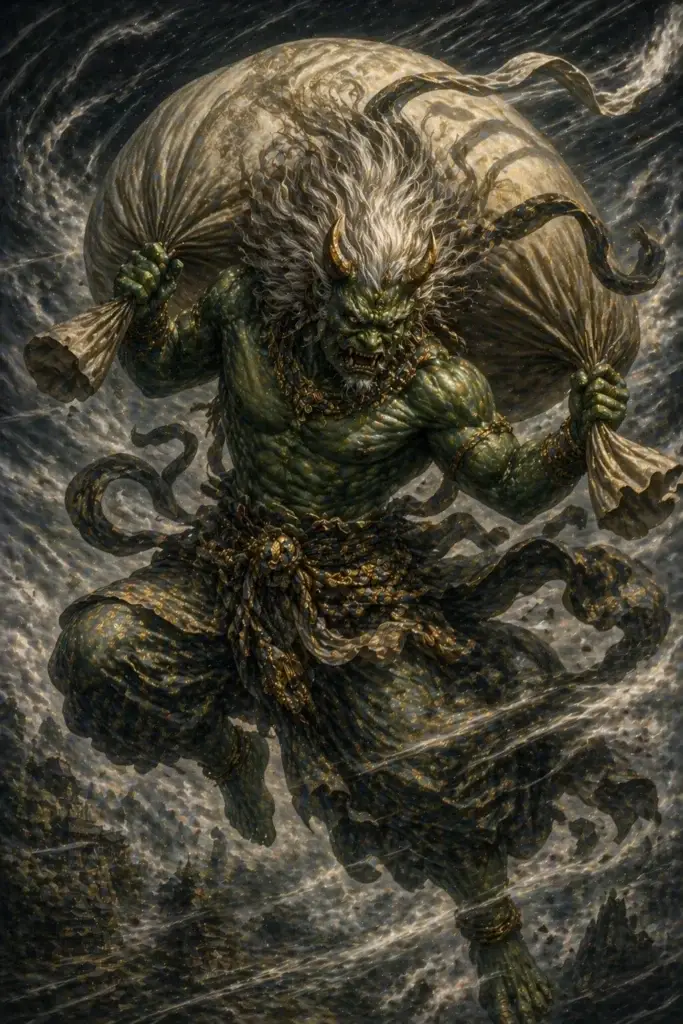
In the Japanese tradition, Raijin almost always appears together with Fujin, the god of wind. The two form a fixed pair that embodies weather, storm and atmospheric violence. While Raijin commands thunder and lightning, Fujin carries the wind in a great sack over his shoulders, from which he releases the storms.
The most famous pictorial rendering of this pair is the pair of folding screens Fujin Raijin zu by the painter Tawaraya Sotatsu from the first half of the 17th century, today in the Kennin-ji in Kyoto.
Sotatsu shows the two gods against a golden background, Raijin with his ring of drums, Fujin with the green wind sack. The work was copied and varied in the 18th century by Ogata Korin and later by Sakai Hoitsu; this pictorial tradition decisively shaped the modern appearance of both gods.
Iconographically, Raijin appears as a muscular demon, often coloured red or blue, with a wild face, surrounded by a ring of drums that he works with mallets to produce thunder. These drums are his most important attribute.
Scholarship points out that the design of Raijin took on traits of Buddhist guardian figures; his demonic, fearsome exterior corresponds to the visual language of the oni, the demons, without Raijin himself being regarded as malicious.
The pair stands for the ambivalence of the forces of nature. Thunder and storm bring destruction, but also the rain that is essential to life. In the agrarian piety of Japan, Raijin was therefore at once a threatening and a longed-for power.
The Thunder God at the Kaminari-mon and in Popular Belief
One of the best-known religious structures in Japan bears Raijin in its name: the Kaminari-mon, the Thunder Gate, which forms the entrance to the Senso-ji temple in the Asakusa district of Tokyo. Its full name is Furaijin-mon, the Gate of the Gods of Wind and Thunder.
In the niches of the gate stand the statues of Raijin and Fujin as guardians; the present figures date from the middle of the 19th century, after the gate had burned down several times. The large red lantern beneath the gate is one of the most photographed motifs of the city.
In popular belief Raijin is associated with a number of concrete ideas. A common warning to children was to cover their belly during a thunderstorm, for Raijin, sometimes in the company of his animal, was said to be after the navels of those who were asleep.
This story probably has a practical background: during a change of weather with a thunderstorm the temperature drops, and an uncovered belly could lead to a chill.
Also associated with Raijin is the raiju, the thunder beast, a figure of popular belief that was imagined as a being in animal form and was said to descend to the earth during a lightning strike. Lightning strikes, split trees and places struck by lightning were interpreted as traces of this being.
Places struck by lightning were in many cases regarded as dangerous, but also as filled with particular power. In some places small shrines arose at the spots where lightning had struck. The piety directed toward Raijin was thus closely bound to the immediate experience of the thunderstorm and its visible consequences.
Thunder, Sugawara no Michizane and the Wrath of the Dead
A chapter of its own in Japanese religious history links thunder not with Raijin himself but with a deified human being: Sugawara no Michizane, a highly educated court official and poet who was brought down by intrigue at the end of the 9th century and sent into exile in Kyushu, where he died in 903.
After his death a series of misfortunes followed in the capital: deaths in the families of his political opponents, epidemics, and finally, in 930, a lightning strike on the imperial palace that killed several court officials.
These events were interpreted as the revenge of Michizane’s enraged spirit. He was now regarded as an onryo, a wrathful spirit of the dead, whose resentment discharged itself in thunder and lightning.
In order to appease the spirit, Michizane was rehabilitated, his offices and ranks were posthumously restored to him, and he was finally venerated as the deity Tenjin. The most important shrine is the Kitano Tenmangu in Kyoto, founded in the 10th century.
In the early veneration of Tenjin the aspect of the thundering, punishing spirit was pronounced; only later did the character of the protective god of scholarship and of examination candidates come to the fore, the role in which Michizane is best known today.
This case shows that thunder in Japan could be interpreted religiously in two ways: as the working of a nature deity such as Raijin, and as an expression of the wrath of a dead person treated unjustly.
The pictorial narratives of the Michizane legend, such as the Kitano Tenjin engi, are among the most impressive testimonies to the second interpretation.
Further Links
Literature (Selection)
Further standard works in the literature index.