Jiangshi, Spirit of Chinese Tradition
By Ralf Ittermann · last reviewed on
The hopping corpse, China’s own vampire figure. This entry presents the Jiangshi as a Spirit of Chinese tradition, the hopping corpse known as China’s own vampire figure.
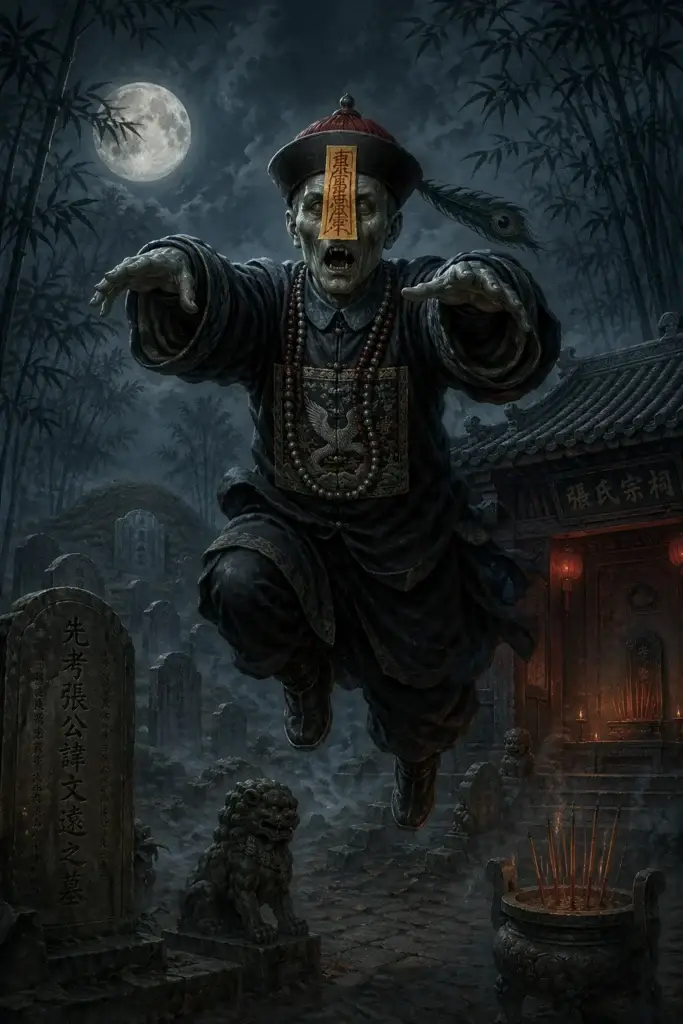
Jiangshi
The Jiangshi (僵尸, “stiff corpse”) is one of the most iconic figures of Chinese demonology and at the same time a globally known horror motif. A physically present revenant, typically in Qing dynasty official robes, with outstretched arms, stiff limbs and the characteristic mode of movement in hops.
Its breath is deadly: Jiangshi identify the living by their breath; whoever holds their breath is safe. They do not suck blood but rather qi (life energy) or yang qi, which makes them structurally different from the European vampire, but functionally related.
The Jiangshi conception has several roots. A folk-etymological explanation: “traveling corpses”, during the Qing era the dead were often found far from home; Daoist priests are said to have led them back to their homeland at night in procession (“Xiang Xi Gan Shi”, driving corpses out of Xiang Xi”).
Another root: the deceased whose soul could not leave the grave transformed into Jiangshi. Modern reception, above all through Hong Kong films of the 1980s (Sammo Hung’s Encounters of the Spooky Kind, Lam Ching-Ying’s Mr. Vampire), has made Jiangshi known worldwide.
Profile Summary: Jiangshi
Type: Physical revenant, qi drainer
Origin: Qing-era folk belief, possibly from Daoist corpse-transport practices
Texts: Yuan Mei’s Zi Bu Yu, Qing-era notebooks, Hong Kong film
Period: Qing dynasty to the present
Weakness: holding the breath, talismans, rooster blood
Context
Period of the Texts
Qing dynasty folk beliefs (17th to 19th centuries) as the origin. Yuan Mei’s Zi Bu Yu (18th century) and other notebook collections describe Jiangshi encounters. Hong Kong films of the 1980s establish the modern image. Since the 2000s, international reception in games, anime, Western fantasy.
Area of Distribution
The Chinese cultural sphere, especially southern China and Taiwan. Made known worldwide through Hong Kong cinema. Modern Chinese diaspora communities maintain the tradition. Japanese and Korean films adapt the motif.
Source Situation
Yuan Mei’s Zi Bu Yu (18th century), Ji Yun’s Yuewei Caotang Biji, Qing dynasty notebooks, modern folklore studies, filmography (especially Hong Kong vampire films of the 1980s and 90s).
Designation and Spellings
Chinese: 僵尸 (jiāngshī), “stiff corpse”; regionally also 跳屍 (tiàoshī, “hopping corpse”).
Japanese: Kyonshī (direct adoption).
English: “hopping vampire”, “Chinese zombie”, both terms omit important aspects.
Etymology: 僵 (“stiff, rigid”) + 尸 (“corpse”), the name describes the most striking characteristic.
Gradations: young Jiangshi (weak), old Jiangshi with greenish hair and claws (powerful), “royal” Jiangshi with white hair (dangerous).
The Qing dynasty official robes of the classic depiction are historically significant: they mark the Jiangshi as “from another era” and fit the people’s perception of foreignness under Manchu rule. Modern films have established this iconography worldwide.
Characteristics
Appearance
Stiff, with outstretched arms (rigor mortis motif), pale greenish or grayish. Clothing: Qing official robes with a round hat and talismans. Movement: by hopping, not walking. Eyes often glowing red. In powerful Jiangshi: long white hair, claws, supernatural strength.
Behavior
Active at night. Identifies the living by their breath; whoever holds their breath is safe. Drains qi energy, usually through breathing or a bite to the neck. Can decimate entire villages if not fought in time.
Sphere of Action
Graves, burial mounds, abandoned villages, paths at night. More active in rain and thunderstorms (yin reinforcement). Especially present in folk tradition in the rural regions of southern China.
Mythological Classification
A deceased person whose soul does not leave the grave, because of improper burial, a violent death, lack of care for the dead, or because of an injury inflicted by evil spirits at the coffin. Daoist interpretation: a surplus of yin qi over yang qi in the corpse.
Profile: Jiangshi
The most important aspects of the Jiangshi at a glance.
A deceased person whose soul did not leave the grave; in Daoist terms: a yin-yang imbalance in the corpse. Possibly turned into literature from Daoist corpse-transport custom.
Rural village communities, cemetery visitors, travelers at night, families with improperly buried relatives.
Qing official robes, stiff outstretched arms, pale greenish. Movement in hops. In more powerful ones: white hair, claws, glowing eyes.
Drains qi (life energy) from the living, usually through breathing. Can wipe out villages. Transmission through a bite is possible.
Holding the breath (the Jiangshi recognizes the living only by their breath), sticking Fu talismans to the forehead, a peachwood sword, rooster blood, sticky rice (has a paralyzing effect), ceremonial cremation by fire.
Defense and Daoist Exorcism
First Encounter
The most important rule: hold your breath. Jiangshi orient themselves by the exhalation. Do not run away, the hopping movement is surprisingly fast. Instead, stand still and wait until they hop past.
Daoshi exorcism
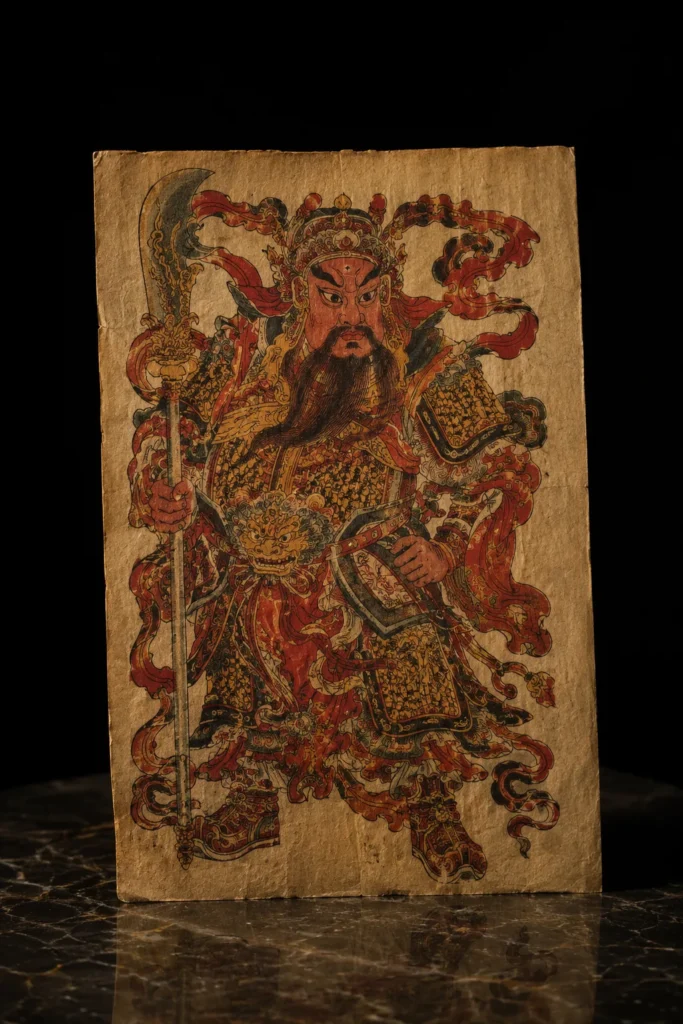
The Daoist priest (Daoshi) sticks a yellow Fu paper with red ink to the forehead of the Jiangshi, which paralyzes it. Then peachwood sword and rooster blood. Final destruction by burning, the ashes into the river. The Hong Kong films have iconically established this sequence.
Preventive Burial
Careful care for the dead, a sevenfold dirge, protective objects in the coffin, a Daoist blessing before closing. Peachwood at the grave, red cloths. Ancestor tablets in the family with regular offerings.
Reception and the Modern Era
Hong Kong Vampire Film
The 1980s were the golden age of the Jiangshi film. Sammo Hung’s Encounters of the Spooky Kind (1980) started the trend. Ricky Lau’s Mr. Vampire (1985), with Lam Ching-Ying as the Daoshi, became iconic. The series ran into the 1990s and established the genre.
East Asian Neighbors
The Japanese Kyonshī is taken up in anime and manga, in part made humorous (karaoke-singing Jiangshi in comedy shows). Korean zombie films of the 2010s (Train to Busan) pick up motifs.
Gaming and Fantasy
Video games such as Phantom Fighter (1988) and modern mobile games have spread the Jiangshi worldwide. Fantasy role-playing games (Dungeons & Dragons) adopt it as a specific monster. In Hong Kong pop culture it remains an iconic figure.
The Two Souls and the Logic of the Restless Corpse
To understand the jiāngshī, the “stiff corpse”, one must know the Chinese conception of the multipart soul.
The widespread teaching distinguishes two soul complexes: the hún souls, assigned to yang, lighter, of a spiritual nature, and after death striving upward or entering the ancestor tablet, and the pò souls, assigned to yin, heavier, bound to the body, and remaining with the corpse in the earth.
In the ordered case, the soul parts separate cleanly at death, the body is buried, the hún is cared for through the ancestor cult, the pò rests with the corpse. The jiāngshī arises when this order is disturbed.
If the pò souls remain active and the hún has not been properly released, for instance because the dead person was not buried correctly, because they died far from home, because there is a violent or unavenged death, then the corpse can move without a complete, rational human being inside it.
The jiāngshī is therefore not a re-awakened deceased person with consciousness, but a body moved by the lower soul parts, driven and without a person.
This conception explains its characteristic features: the stiffness that lets it advance only by hopping, because the body is no longer pliantly ensouled, and its drive to draw the life force qi from others, because it itself lacks what makes a living being.
The jiāngshī is the embodiment of a failed separation of body and soul.
The Homecoming of the Dead and the Origin in a Real Practice
A much-discussed explanatory approach connects the jiāngshī belief with a concrete social practice: the transport of corpses over long distances for burial in the homeland. It was considered important that a person be buried in the earth of their ancestors.
Anyone who died far from home, for instance as a migrant worker, was to be brought back. The tradition, especially from southern China, knows for this the notion of “driving the corpses”, in which specialized men moved the dead across the land at night.
In the folk elaboration, the corpses were transported upright and led in rank and file, often described as guided by a Daoist going ahead with a bell, so that the dead followed in a kind of hopping step.
How much of this depiction is real practice and how much is already legend is disputed in scholarship; much suggests that the practical difficulties of corpse transport and folk pleasure in storytelling combined into this image.
Independently of the precise historical core, this complex plausibly explains two key features of the jiāngshī: the upright, stiff posture and the hopping mode of movement. From a religious-studies perspective, the case is an example of how a supernatural figure attaches itself to a real social concern.
The fear of death in a foreign land, of the impossible homecoming and the disturbed rest of the dead it caused, was real. The jiāngshī gave this fear a vivid form: the dead person who cannot find their way home and therefore is themselves on the move, unfinished and dangerous.
Means of Defense and Their Symbolic Logic
The means of defense against the jiāngshī are richly developed in the tradition and follow a consistent symbolic logic. The best known is the banishing slip, a strip of yellow paper with red writing, which a Daoist specialist inscribes and sticks to the corpse’s forehead.
It works not through physical force, but through the written word of the ritual tradition, which binds and stills the restless body.
Other means target the yin nature of the jiāngshī. Since it is a pure yin being, things that embody strong yang work against it: the wood of the peach tree, which in Chinese tradition has long been regarded as demon-repelling, the blood of certain animals, fire, sunrise, light.
Sticky rice likewise plays a role in the tradition as a purifying substance. The mirror can frighten off the jiāngshī, and sounds such as the crowing of the rooster, which announces daybreak, drive it back.
A distinct motif is the holding of the breath. Since the jiāngshī is blind in many tales and locates its victims by their breath, one can escape it by holding one’s breath and not moving.
This idea connects it with the image of an instinct-driven, non-thinking being that reacts only to simple stimuli. Overall, the means of defense show that the jiāngshī belief was firmly anchored in Daoist ritual culture and in yin-yang cosmology.
The means are not arbitrary tricks but follow from the nature of the being: against an unfinished yin corpse, what helps is what embodies yang, writing and order.
In modern popular culture, especially in Hong Kong cinema of the 1980s, this repertoire became the basis of its own film genre, which made the jiāngshī known far beyond China.
Further Links
Further reading:
- China (Daoism and folk belief)
- Gui, Yaoguai, E Gui, Huli Jing
- Upyr, Draugr, Vetala (Hinduism), parallels
- Daoist Fu talisman magic
Literature (Selection)
Further standard works in the literature index.
The protective practice described here is a religious-studies classification of historical traditions. iWell Guard ties in with this cultural-historical line of wearable protective objects and represents a contemporary form of it. More about the iWell Guard →