Churinga: the sacred wooden or stone object of the Aboriginal peoples of Australia
By Ralf Ittermann · last reviewed on
Churinga, more precisely often spelled Tjurunga, is a term from the language of the Arrernte in Central Australia and refers to sacred objects made of wood or stone that are connected with the religion of several Aboriginal groups.
Such objects bear engraved patterns and are regarded as inseparably linked with the ancestors, with the order of creation known as the Dreaming, and with particular places and persons.
Churinga are highly secret, and viewing them is traditionally strongly restricted. From the perspective of religious studies, the greatest restraint is therefore called for. This text describes only what is generally documented in the scholarly literature, and refrains from any depiction of protected particulars.
The Churinga is a sacred wooden or stone object of the Aboriginal peoples of Australia.
Classification of the Churinga
Churinga is a term that originally comes from the language of the Arrernte in Central Australia and is used in scholarship for sacred objects of several Aboriginal groups. More precisely, the word is often spelled Tjurunga.
The Aborigines are the Indigenous peoples of Australia, who have inhabited the continent for a very long time. They do not form a single group, but many peoples with their own languages, religions and traditions.
Churinga are sacred objects made of wood or stone. They bear engraved patterns and are regarded as inseparably connected with the ancestors, with the order of creation and with particular places and persons.
Unlike a freely accessible amulet, the Churinga is highly secret. Who may see it, touch it or know of it is traditionally strictly regulated. This secrecy belongs to the very nature of the object.
In terms of religious studies, the Churinga belongs within the broader context of protective symbols and sacred objects. It is, however, a particularly sensitive case, because so much about it is protected knowledge.
The Churinga differs from many other objects in this lexicon precisely in that its meaning is not meant to be spread publicly. An appropriate account here consists above all in respecting the secrecy and in limiting oneself to what is generally documented.
What matters for a respectful account is restraint. This text describes only what is generally documented in the scholarly literature, and refrains from any reproduction of patterns, narratives or particulars that are regarded as secret.
Origin and History
The religions of the Aborigines are very old. They are shaped by the idea of an order of creation, which in scholarship is often rendered with the word Dreaming, though the individual peoples have their own terms for it.
In this conception, ancestral beings brought forth the land, its forms, its living creatures and the order of life. The paths and deeds of these beings are present in the landscape and in sacred objects.
The Churinga belongs within this religious context. It is regarded as an object in which the connection to an ancestral being, to a place and to particular persons is present. Its meaning reaches far back into the history of the respective group.
Written accounts of Churinga begin with the ethnographic research of the late nineteenth and early twentieth centuries. The work of Baldwin Spencer and Francis Gillen on the Arrernte made the term known in scholarship.
The terms Churinga and Tjurunga entered the international scholarly literature through these early works. Later researchers have pointed out that a single term from the language of the Arrernte does not do justice to the diversity of the peoples and their own designations.
The use of the word is therefore itself part of a critically examined history of research.
This early research is at the same time the beginning of a grave problem. Numerous Churinga came into museums and private collections during this period, often without the consent of the communities to whom they were sacred.
With the European settlement of Australia, the Aborigines suffered profound intrusions into their land, their society and their religion. The history of the Churinga is therefore inseparably bound up with colonial history and with the loss of sacred objects.
Form, Material and Manufacture
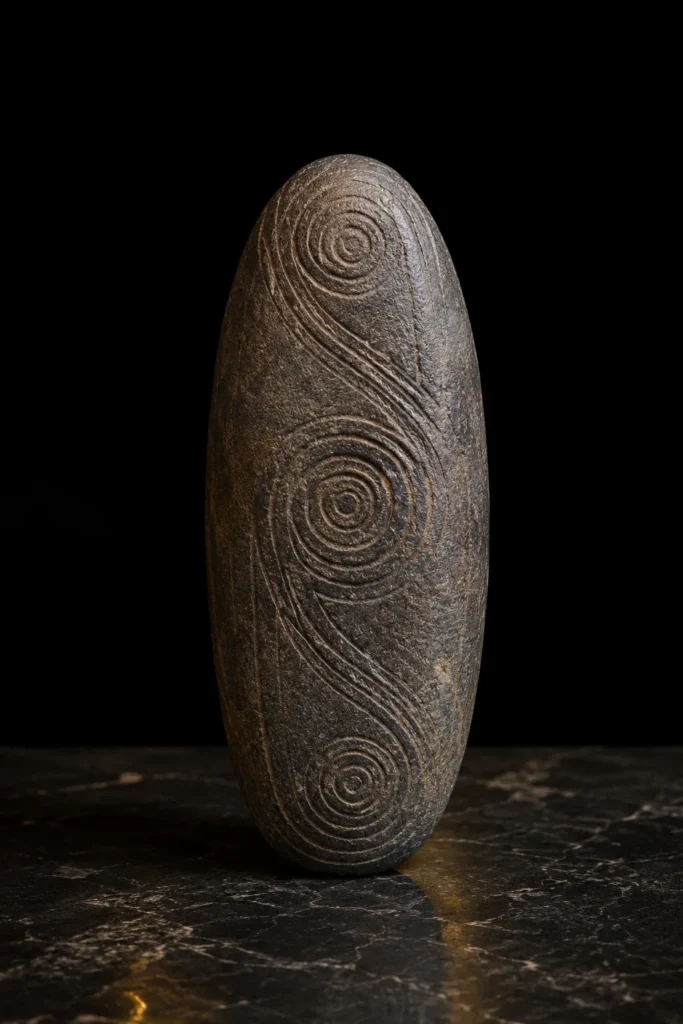
Churinga are made of wood or stone. They are frequently elongated or oval in shape and bear engraved patterns on their surface. Size and exact form differ from people to people and from object to object.
The engraved patterns often consist of lines, circles, arcs and dots. These patterns are not mere decoration, but carry meaning. They refer to ancestral beings, to places and to the paths of the order of creation.
This text does not reproduce the patterns and does not describe them in detail. The meaning of the patterns is protected knowledge, accessible only to particular persons within the respective community.
The manufacture of a Churinga was bound to religious rules. It took place within the framework of religious acts and through persons authorized to do so. The making was not a free act of crafting, but part of the religion.
Churinga were traditionally kept at hidden, sacred places. They were not meant for the sight of all, but were protected from the eyes of those who were not authorized.
This text deliberately does not give precise instructions for making one or a description of the manufacture. The Churinga is a sacred object of a foreign religion, whose making is bound to authorizations that cannot be acquired from outside.
Religious and Mythological Background
The religious background of the Churinga is the order of creation of the Aborigines, in which ancestral beings brought forth the land and life. This order is not merely the past, but remains present in land and objects.
The Churinga is regarded as an object in which this presence is especially dense. It connects an ancestral being, a place and particular persons. In some conceptions it is closely tied to the life force or the essence of a person.
Because of this dense connection, the Churinga is regarded as highly sacred. Its unauthorized viewing, its unauthorized touching, or the unauthorized passing on of knowledge about it are regarded as serious transgressions.
Knowledge about Churinga is graded within the communities. Certain narratives, patterns and acts are accessible only to particular persons, often depending on age, gender and religious initiation.
In terms of religious studies, the Churinga can be understood as an object in which the religion of the Aborigines expresses its connection of land, ancestors and person in a particularly condensed form. It is not an amulet, but a sacred center.
What matters is restraint. Since so much about the Churinga is protected knowledge, this text confines itself to the general classification within religious studies and refrains from any depiction of secret narratives or meanings.
Ritual Use and Bearers
The ritual use of the Churinga is part of the religion of the respective groups and is subject to strict rules. These rules determine who may see and touch a Churinga and in what context it may be used.
Churinga could play a role in religious acts, for example in initiations. Since these acts and the knowledge of them are protected, this text does not describe them in detail, but refers only to the fact of their existence.
The bearers of knowledge about Churinga are authorized persons within the communities. Which knowledge is accessible to a person depends on their age, their gender and their religious initiation.
The keeping of the Churinga at hidden places was itself part of their protection. The place where a Churinga was kept was reserved for particular persons and protected from the others.
The secrecy is not an incidental feature, but belongs to the nature of the Churinga. To respect it means to take the religion of the Aborigines seriously and not to expect that all knowledge must be openly available.
For this reason, this text refrains from a precise account of the ritual use. A respectful treatment of the subject consists here precisely in acknowledging the limits of what can be said publicly.
Regional Variants and Related Objects
Sacred objects made of wood or stone are attested among several Aboriginal peoples, not only among the Arrernte. The term Churinga, widespread in scholarship, must not obscure the diversity of the peoples and their own terms.
Among each people, the sacred objects belong to a religion of their own with its own narratives, places and rules. A uniform description of all these objects would not do justice to their diversity.
Related to the Churinga are further sacred objects of the Aborigines as well as the sacred places themselves, with which the objects are connected. Land and object form a single context in the religion of the Aborigines.
In terms of religious studies, the Churinga can be compared with sacred, protected objects of other cultures, for example with objects whose viewing is restricted. Such comparisons, however, must not blur the distinctive character of the religion of the Aborigines.
Within the field of protective symbols, the Churinga is an example of a sacred object whose knowledge is deliberately protected. The article on amulet and talisman explains how it differs from an amulet.
The Churinga thus shows a limit. Not every religious object is meant to be described in detail in a lexicon. Some objects call above all for respect for their secrecy.
Religious studies and ethnology have in recent decades learned to name this limit explicitly. An account that respects sacred objects does not describe everything it knows, but holds back where the source communities call for secrecy. This restraint is today regarded as part of a responsible scholarly approach.
Meaning as a Protective Object
The Churinga is occasionally also mentioned in scholarship in the context of protection, yet this classification is to be made with caution. The Churinga is first and foremost a sacred object, not an amulet in the usual sense.
Insofar as a protective meaning is described, it is bound to the connection of the Churinga with the ancestral beings, with the land and with the person. From this connection a sense of stability and belonging can arise.
Protection is not to be understood here as the warding off of an external danger, but as the consequence of a proper order. The Churinga stands for the ordered connection of person, ancestors and land.
In terms of religious studies, this meaning can be described as part of a comprehensive religious order in which the well-being of the individual is bound up with the land and with the ancestors. The Churinga is a sign of this order.
This text makes no claims about actual protective effects. It describes only the manner in which the religion of the Aborigines ascribes meaning to the Churinga. Promises of healing and assurances of effect are expressly excluded.
It remains to be noted that the Churinga is not to be understood as a self-acting protective object. It is a sacred object whose meaning remains bound to the religion and to the secrecy of the respective community.
History of Research, Ethical Questions and Cultural Appropriation
The scholarly engagement with the Churinga began with the work of Baldwin Spencer and Francis Gillen on the Arrernte around the turn of the twentieth century. This work made the term known in scholarship.
This history of research is at the same time a history of injustice. Numerous Churinga came into museums and private collections without the consent of the communities. For the Aborigines this meant the loss of sacred objects.
Since Churinga are sacred and their viewing is restricted, their display in museums was a serious intrusion. Objects that could be shown only to particular persons were made accessible to an unlimited public.
Today the return of Churinga is an important concern. Australian museums work together with the source communities, and numerous Churinga have returned into the care of their peoples. Many institutions no longer display Churinga.
Restraint is also called for in the handling of knowledge. Scholarly literature that reproduces patterns or protected narratives is today viewed critically. A serious account refrains from reproducing protected particulars.
A culturally appropriating use of the Churinga, for example as an esoteric or decorative object, is to be rejected. The Churinga is a sacred object of the Aborigines, whose secrecy is to be respected. This text therefore describes it only in a general form.
Reception Today
For the Aborigines, the Churinga is a sacred object whose protection and whose return are of great importance. The renewal of their own culture and the return of sacred objects belong together for many communities.
Australian museums have fundamentally changed their handling of Churinga. Many institutions no longer display them, keep them only in agreement with the communities, and support their return to the source peoples.
The return of Churinga is advanced through legal provisions and through the cooperation of museums and Aboriginal organizations. Numerous objects have returned into the care of their peoples.
In the public sphere, awareness has grown that not every religious object is suited for presentation in the media or in exhibitions. The Churinga is regarded as an example of an object whose secrecy is to be respected.
In media and educational practice too, the handling of the Churinga has changed. Where formerly images and descriptions were spread without hesitation, restraint is today regarded as called for. This development is part of a broader recognition that the Aborigines themselves determine the presentation of their sacred objects.
A commercial or esoteric use of the Churinga is to be rejected and is clearly opposed by the Aborigines. A respectful attitude consists in acknowledging the limits of what is publicly accessible.
For interested readers, the greatest restraint is therefore advisable. It is legitimate to know in a general form of the existence and the meaning of the Churinga. Further, less sensitive protective objects are presented in the protective symbols section.
Literature (Selection)
Related key terms: Churinga Tjurunga Aborigines Australia sacred object Dreaming Arrernte ancestral beings protected knowledge repatriation Indigenous religion secrecy.
iWell Guard and Protective Traditions
iWell Guard stands within the cultural-historical line of portable protective objects, to which the Churinga also belongs. A modern companion for people who live with protective symbols: made in Germany, 41 layers of solid gold, platinum and silver, with a 30-day right of return.
Personal experiences may vary. Not a medical device. No promise of healing.