Nix, Spirit of the Germanic Tradition
By Ralf Ittermann · last reviewed on
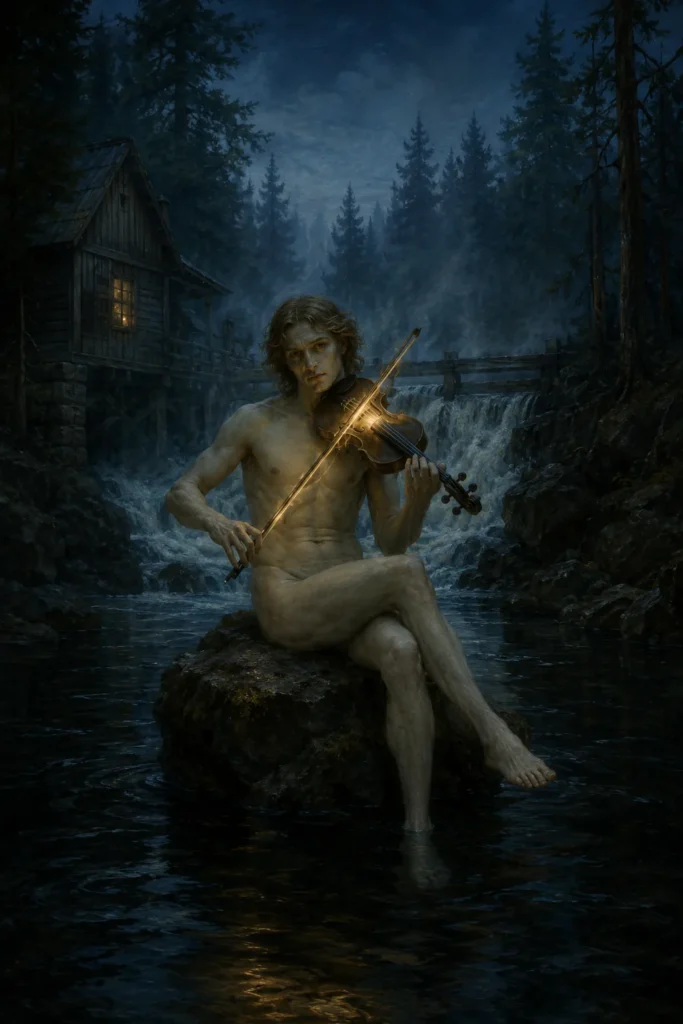
The water spirit, luring at the riverbank. The Nix is considered a spirit of the Germanic tradition that draws people under its spell along riverbanks.
The Nix is the archetypal water spirit of Germanic folk belief. Living in rivers, ponds, lakes, and occasionally at the sea, it appears to people on the bank as a handsome young man with a fiddle, as a white horse (Bäckahäst), or as a woman (Nixe/Nöck).
Its primary effect is seduction: through music, beauty, or curiosity it draws people into the water, where they drown.
The figure is pan-Germanic with regional variation: Nix/Nixe (German), Näck/Neck (Swedish), Nøkk (Norwegian), Nicker (Dutch), Neck (Anglo-Saxon). The English Old Nick for the devil is attested only in the early modern period, its origin is uncertain.
Parallel water-spirit motifs exist in nearly every culture: the Slavic Rusalka, as well as the Greek nymphs. The Lorelei on the Rhine is a Romantic literary reworking of the Nix motif.
Etymology and Nordic Roots
The German Nix is related to Old Norse nykr, a water spirit with goat-like or horse-like features. The Old English nicor and Old Saxon nikar attest a widespread Germanic root.
From the common Germanic root form, the Neck (English, Scandinavian) and the German Nix developed during the Middle Ages. The etymology most likely traces back to an Indo-European root meaning “water” or “moisture”, radiating across several language families.
In the course of Middle High German, Nix became standardized as a gender-neutral or masculine water spirit, while the feminine variant Nixe developed alongside it. This morphological differentiation reflects a cultural specialization of water-being folklore, in which male and female roles acquired distinct narrative functions.
Quick Overview: Nix
Type: Water spirit, luring figure
Origin: Rivers, lakes, ponds, springs
Sources: Edda, medieval sermons, folk ballads, Grimm
Period: Early Middle Ages to the present
Key feature: Alluring music, shape-shifting, drowning
Classification
Attested early in Old Norse and Old High German tradition. Richly documented in folk ballads (“The Water Man”) and legend collections of the 19th century (Grimm, Afzelius, Asbjornsen). During the Romantic period (Lorelei, Heine) the figure became a literary character.
The entire Germanic language area: Scandinavia, the German lands, the Netherlands, the British Isles (as Nykur/Neck). Similar figures exist in neighbouring cultures (Slavic, Celtic).
Old High German glosses (nihhus applied to “crocodile”), medieval sermons, Scandinavian folk ballads, the Grimm collections, and ethnographic studies of individual regions.
Name
Old/Middle High German: nihhus, nicker, “water spirit”, secondarily “crocodile”.
Old Norse: nykr (water horse), nykkr.
Swedish: Näck; Norwegian: Nøkk.
Old English: nicor, appearing in Beowulf as a sea monster.
Feminine form: Nixe, Undine, Nereid parallels.
The English Old Nick for the devil is attested only in the early modern period; its origin is uncertain and is more often traced back to the name Nicholas. The Scandinavian form Näck remains unbroken in modern folklore.
Description
Appearance
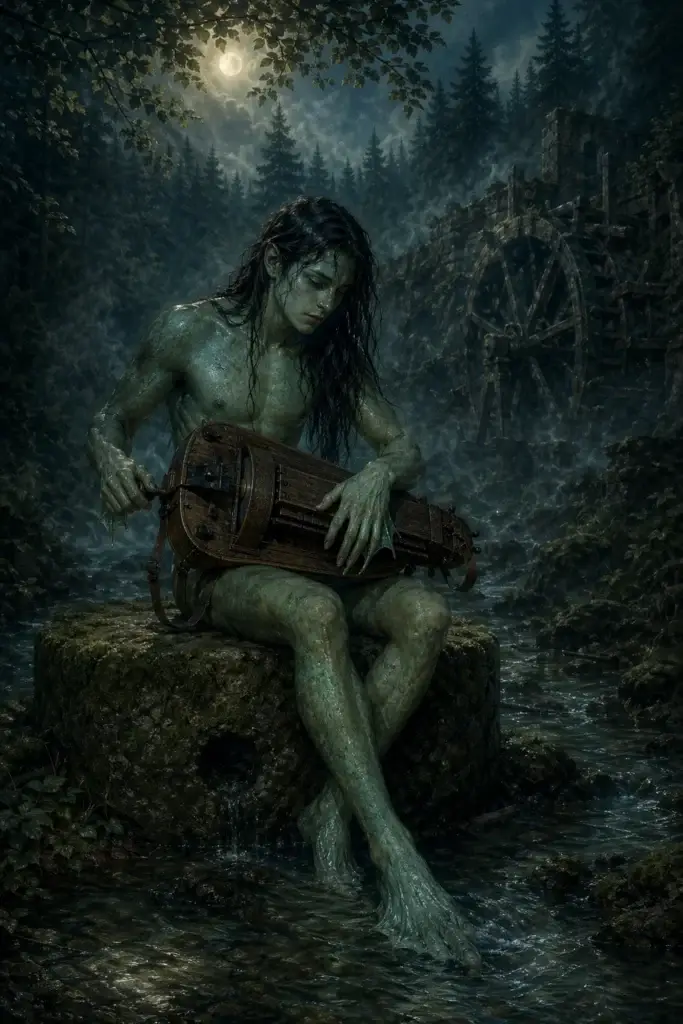
Usually a young man with wet hair, often carrying a fiddle. Or a white horse that joins travelers at the bank and drags the rider into the water. Occasionally female (Nixe) with a fish tail. In folk ballads: beautiful, melancholic, musically gifted.
Behavior
Luring. It plays music that draws people to it as if by magic. It makes promises, strikes pacts, demands tribute, traditionally one drowning per year. It can also impart musical knowledge if addressed correctly.
Domain
River rapids, mill ponds, waterfalls, bathing spots. Certain stretches of bank carry the warning “Nix will take you!”: a spot where someone drowns each year is attributed to the Nix.
Mythological Classification
No clear genealogy. The Nix belongs to the broad family of nature spirits, related to elves, kobolds, and forest beings. Christianization partially demonized it and partially left it as a natural phenomenon.
Nix and Nixe in the Grimm Legend Collection
Jacob and Wilhelm Grimm published their Children’s and Household Tales from 1812 onwards, followed later by the German Legends. In these works they documented numerous Nix and Nixe accounts from the German-speaking world.
The tale The Water Nixie (KHM 79) depicts a water woman who seduces or abducts human children. Other legends describe Nixe who obstruct river crossings or harass fishermen. Wilhelm Grimm’s commentaries on the etymology and distribution of these figures laid the foundation for modern folklore scholarship.
The Brothers Grimm treated Nix and Nixe as a distinct class of beings, not merely as variants of other spirits or demons. This categorization shaped subsequent folkloristic work and made later comparisons with Scandinavian and Slavic water beings possible.
Profile: Nix
The most important aspects of the Nix at a glance.
Germanic water spirit, pan-Germanic with regional variants. Related to the nature spirits of the elf and kobold family.
Swimmers, fishermen, millers at mill ponds, and travelers along riverside paths. Particularly children and young men with a passion for music.
A young man with a fiddle and wet hair; or a white horse at the bank; or a female Nixe with a fish tail. Capable of shape-shifting.
Lures with music, beauty, or horse form into the water. Drowns victims, demands an annual sacrifice. Can also impart musical knowledge through a pact.
Throw salt into the water, carry steel (a knife, horseshoe) on your person, do not leave children unattended near the bank, call out the baptismal name. In some regions: throw bread into the water as an offering.
Slavic Rusalka, Greek nymphs, Celtic Kelpie (Scottish), Finnish Nakki, Lorelei-type Romantic figures.
Protection in Daily Life
Behavioral Rules
Do not go near water alone, do not wade barefoot into mill ponds, and do not join in the fiddle music of a stranger. While bathing: make the sign of the cross before and after, throw bread into the water as an offering.
Protective Objects
Steel on the body (a knife, horseshoe, or nail in the belt) and salt are both considered repellent to the Nix. In some traditions: a silver button or a bell.
Ritual Practice
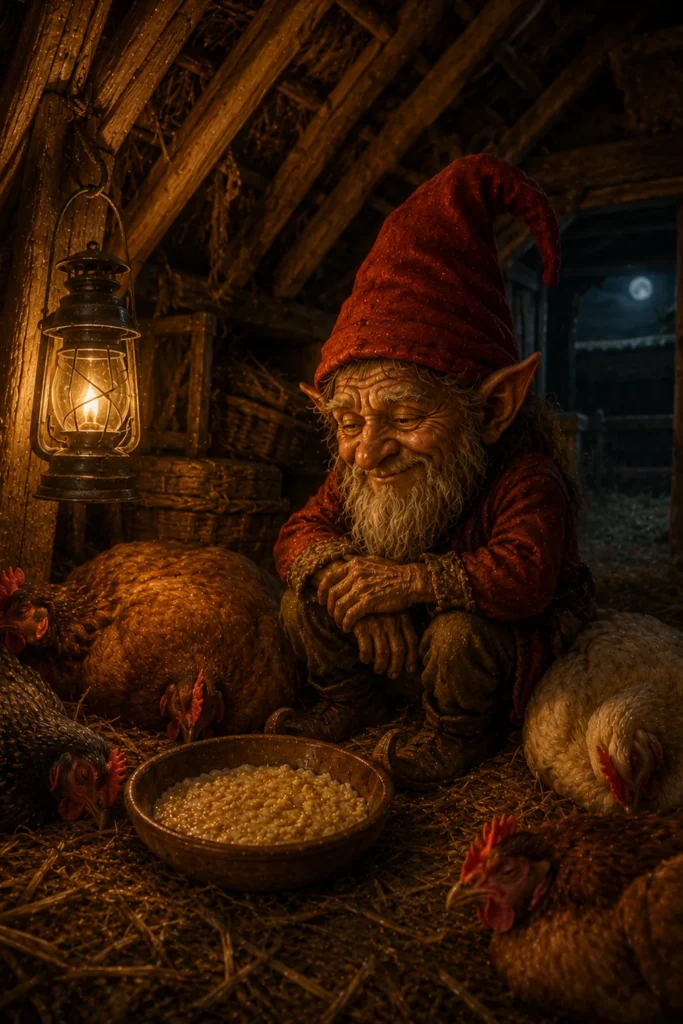
At certain stretches of river, offerings were made before mill construction. Attested as late as the 19th century: a chicken thrown into the mill pond to appease the Nix.
Parallels and Afterlife
Folk belief in neighbouring cultures: The Slavic Rusalka, the Scottish Kelpie (a malevolent water horse), Celtic mermaids, and Greco-Roman nymphs and undines share fundamental motifs. The figure of “the water spirit that lures and drowns” appears throughout Europe.
Literary reception: Fouque’s Undine (1811), Heinrich Heine’s Loreley (1823), and Dvorak’s opera Rusalka. The Romantic period shaped the Nix into a melancholic, beautiful figure. Andersen’s Little Mermaid (1837) is a distant relative.
Modern Era
The figure remains present in fantasy literature and film. The English expression Old Nick for the devil is attested only in the early modern period, its origin is uncertain; in contemporary Scandinavian culture the Nack remains a living folklore figure.
Lorelei, Heine, and Romantic Literature
Heinrich Heine’s poem Die Lorelei (1823) popularized the Nixe figure during the Romantic period. The poem tells of a beautiful, mysterious woman on a cliff above the Rhine who seduces sailors and leads them to their ruin.
Although Heine did not explicitly name the water fairy a Nixe, the connection was immediate to contemporary readers. The Lorelei legend itself had older roots (Clemens Brentano, Godwi, 1801), but Heine’s literary shaping turned it into a symbol of German-speaking culture.
The Lorelei influenced subsequent music, drama, and the visual arts, making the Nixe an iconographic figure of German Romanticism. This literary elevation changed the folkloristic understanding of the Nix itself, transforming it from a pure folk spirit into a literary-aesthetic figure.
The Nix in the Legend Collections of the 19th Century
A large part of our knowledge about the Nix comes from legend collections produced in the 19th century in the course of the Romantic folklore movement.
Jacob and Wilhelm Grimm included several water-spirit narratives in their German Legends of 1816, and Jacob Grimm treated the Nix in detail in his German Mythology of 1835. There he gathered regional designations and attempted to reconstruct a coherent Germanic water-spirit conception.
This state of sources is methodologically double-edged. On one hand, the collectors preserved narrative material that would otherwise have been lost. On the other, they filtered and smoothed the material according to their own ideas of an original folk poetry.
More recent narrative scholarship, including critical studies of the formation of the Grimm collections, has shown that the collectors selected their informants and revised the texts stylistically. What was presented as ancient Germanic mythology was often already a reworked product of the 19th century.
For the Nix this means: the coherent image of a unified Germanic water spirit is to a considerable degree a scholarly construction. The historical evidence is regionally fragmented and inconsistent.
In some areas the Nix is primarily a dangerous drowner; in others a skilled musician; in still others a fairly harmless bogey used to keep children away from the water.
Methodological caution in religious studies requires that this diversity not be hastily unified into a system, but that the individual regional traditions be taken seriously in their own right.
Etymology and Linguistic Kinship
The name Nix belongs to a widely branching West Germanic and North Germanic word family. Old High German attests nihhus, Old English nicor, and Old Norse nykr.
The Old English word also appears in Beowulf, where it designates the water monsters the hero fights. These attestations show that the concept of a dangerous being dwelling in water reaches back to the earliest recorded layer of the Germanic languages.
Linguistic research connects the word family to an Indo-European root that is likely to have meant something like “wash” or “bathe”. The Nix would thus be named after its element, as the “washer” or the being connected with water.
Other explanations exist alongside this, but the water root is regarded as the best-supported. What is certain is that the word is very old and did not arise in the modern period.
Through the North Germanic form nykr there is a close connection to Scandinavian water-spirit conceptions. The Swedish nack and the Norwegian nokk belong to the same word stem. They too are known as musicians who play their fiddle and lure people into the water.
The feminine counterpart, the Nixe, is linguistically a derived feminine form. The shared linguistic root across several Germanic languages is one of the strongest arguments that the water spirit represents genuinely ancient common Germanic folk belief, even if the concrete narratives were recorded only at a late date.
The Nix as Musician
One of the most striking motifs in the northern European water-spirit tradition is the musical gift of the Nix. In numerous narratives, especially Scandinavian ones, it sits at the bank or under a bridge and plays a melody on its fiddle of such beauty that listeners cannot resist.
The music has an ambivalent effect: it is enticing but dangerous, for those who follow the playing end up in the water.
From this motif grew the popular belief that a musician could learn his craft from the Nix. Anyone who brought the water spirit an offering, such as a black animal or brandy submerged in the water, could hope to receive from it the mastery of certain particularly artful melodies.
In some traditions there are pieces considered dangerous because they force everything and everyone to dance, including inanimate objects, and cannot be stopped by the player. Such narratives combine the fascination of music with the fear of loss of control.
In the history of religions this motif is revealing because it shows the Nix as a mediator between spheres. It possesses a skill that is superhuman and is willing to pass it on under conditions. In this respect it stands alongside other spirit beings that appear as teachers of forbidden or dangerous knowledge.
Folkloristic research has documented the musician motif extensively in Scandinavian material, while it is less prominent in the German-speaking world. This too is an indication that the northern European water spirit had very different regional profiles, and that musical ability was not everywhere part of its core character.
The Water Spirit and Christianization
Many of the transmitted Nix narratives bear clear traces of Christian reinterpretation. A widespread narrative type tells of the Nix asking a clergyman or a pious person whether it too may hope for salvation.
The answer is typically that there is no salvation for it, whereupon the water spirit breaks into lament and sets aside its fiddle. In some versions the clergyman relents or withdraws the harsh verdict, and the Nix joyfully takes up its playing again.
These narratives are not evidence of pre-Christian mythology, but a product of Christianized popular piety. They work through the question of what place the old spirit beings hold in a Christian world order.
The Nix is not simply declared a devil; it appears as a suffering being excluded from the order of salvation. This ambivalent treatment distinguishes the water-spirit tradition from the harsher demonization applied to other figures.
Further traces of Christianization appear in the protective measures. Against the Nix, steel, the sound of church bells, and the utterance of the being’s name are said to help, alongside Christian means such as the sign of the cross or the name of God.
This mixture of older and Christian defensive measures reflects the long process by which the pre-Christian spirit belief did not disappear but was fitted into the Christian worldview. The Nix was neither fully demonized nor fully accepted, and scholarship in religious studies speaks here of a coexistence of two layers.
Sources and Literature
Further standard works in the literature index.
The protective practice described here represents a religious-studies classification of historical traditions. iWell Guard connects with this cultural-historical line of wearable protective objects and represents a contemporary form of it. More about iWell Guard
Frequently Asked Questions about Nix
What is a Nix in Germanic mythology?
The Nix (Middle High German nicker, Old High German nihhus) is a male water spirit of Germanic-German mythology, living in rivers, streams, and lakes.
It is a shape-shifter that often appears as a handsome youth, sometimes as a horse (water horse), with green hair or a green beard. Nix beings are often musically gifted: they play fiddle or harp and can lure people to the water.
What is the difference between Nix and Nixe?
The Nix is the masculine form (also Wassermann, Wasserkonig), while the Nixe (plural Nixen) is the feminine. Classic Nixe figures include the Loreley (a Rhine myth, though shaped literarily first by Clemens Brentano in 1801), the Lorelei cliff-siren on the Middle Rhine, and the Danube Nixen.
Both forms are ambivalent: beautiful and deadly at once. Most myth narratives warn against entering into an intimate relationship with them.