Lamia, Demoness of the Greek Tradition
By Ralf Ittermann · last reviewed on
Lamia is a demoness of the Greek tradition.
Child-bed demoness and seductress, the dark side of Eros myths.
Lamia is the Greek individual figure of a child-killing female demoness whose name later becomes a generic designation. Mythologically she was a former Libyan queen, beloved of Zeus, whose children were killed by the jealous Hera, after which Lamia descended into madness and began devouring the children of others.
From this single figure there grew, from the late Roman Republic onward, the class of the Lamiae; in the Middle Ages lamia became a theological term for demons and witches. In the later tradition, especially in the Victorian nineteenth century (Keats, Burne-Jones), Lamia transformed into a demonically beautiful seductress with a serpentine body.
Quick Overview: Lamia
Type: Child-bed demoness, seductress
Origin: Libya/North Africa in early legend; daughter of Poseidon or Belos; beloved of Zeus
Texts: Aristophanes, Diodorus, Horace, Philostratus, folk narratives
Period: Archaic to Late Antiquity
Distribution: Greece, Rome, the Byzantine world
Warding off: Protective formulas, child-bed amulets, names of angels in Judeo-Christian reception
Historical Context
Earliest mentions appear in Aristophanes (5th century BCE) as a child-devouring ghost; Diodorus provides the origin legend (Libya, the affair with Zeus, the curse by Hera); Horace and later Roman authors refer to Lamia primarily as a class; Byzantine folk texts kept the figure alive into the Middle Ages.
Mythological Classification
Lamia (singular) is in Greek mythology a royal woman who became a demoness. She was forced to devour her own children, which drove her to madness. She is a figure of tragedy and transformation. She is not evil by nature, but condemned through suffering.
The legend originates in North Africa, migrated early into the Greek cultural sphere, and then spread through Rome across the entire Mediterranean world. In the Late Antique and Byzantine tradition Lamia remained strongly present in popular belief and survived into modern Greek child-fright figures.
No dedicated text corpus exists. Lamia appears in comedy, historical prose, Late Antique literature, and in magical papyri. The densest body of evidence comes from short folk-literary references that remain consistent across the centuries.
Names and Spellings
Greek: Λάμια (Lamia), plural Lamiai.
Latin: Lamia, often plural Lamiae.
Etymology: connected with terms for “gullet” and “devouring”; fits the child-killing function.
Noteworthy is the alternation between an individual figure (the Lamia with her own biography) and a class (the Lamiai as a group of child-killing demonesses). This duality makes Lamia a prototypical example of the movement from an individual mythological figure to a popular ghost.
Characteristics
Appearance
Difficult to pin down: the iconographic spectrum ranges from a beautiful woman to a hybrid being with a serpentine lower body.
In Aristophanes and the comedies of the classical period she is a concrete, named female demoness; in the Hellenistic era and Late Antiquity she grows increasingly formless. The Victorian image of the serpent-woman (John William Waterhouse, John Keats) is a late synthesis of Lamia and Echidna.
Behavior
Lamia abducts and devours children not her own. She prowls through houses at night, enters bedchambers, and steals infants.
In some versions she simultaneously seduces men and drains them of vital force, a blend of the Empusa motif and succubus function. Because of her wakefulness (Hera cursed her so she cannot sleep) she is active both day and night.
Sphere of Influence
Infant death, cot death, madness of the mother, loss of male vital force, nightmares. In archaic folk interpretation also unexplained sudden infant deaths. As a didactic figure she served from the classical period onward as a threat used against disobedient children.
Appearance and Symbolism
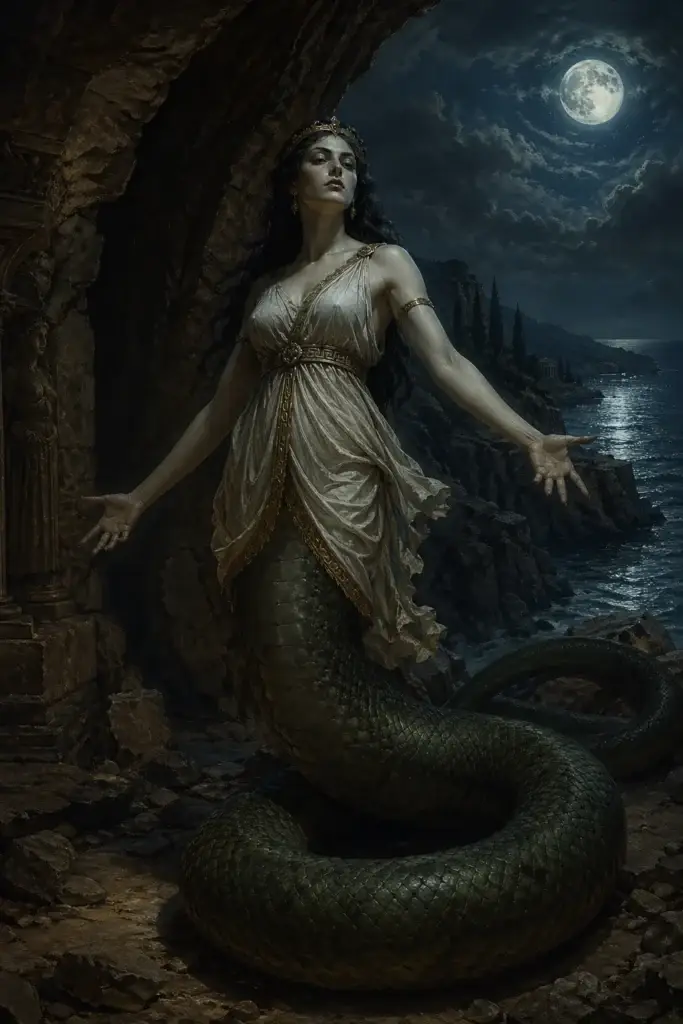
Lamia is depicted with the upper body of a strikingly beautiful, sorrowful, or raging woman and the lower body of a serpent. Sometimes the entire being is serpentine. She possesses supernatural beauty and strength. The serpent element is central: transformation and venom.
Profile: Lamia
The most important aspects of Lamia at a glance. Details on name, description, warding off, and parallels can be found in the following sections.
Libyan princess, beloved of Zeus, cursed by Hera. Out of grief and revenge she became a child-snatcher.
Primarily infants and young children. Secondarily sleeping young men (in the sense of the Empusa motif of the Late Antique tradition). Mothers and women in childbed indirectly, as those whose children are threatened.
Variable: beautiful woman, terrifying old figure, hybrid with serpent tail. In more recent tradition often depicted with a serpentine body concealed beneath robes.
Abduction of children, infanticide, draining and killing of young men through erotic encounter, nocturnal haunting.
Child-bed amulets, protective formulas, and later Christian warding with the names of angels. In Byzantium, icons of Saint Sisinios and protective prayers.
Expanded in the Roman tradition into the class of the Lamiae. Functionally related: Empusa (companion of Hecate, succubus component), Striga (Roman Late Antique witch-vampire), Lilith (Jewish, with full childbed-threat function). In medieval theology, Jerome translated Lilith in the Vulgate as lamia, giving rise to a persistent identification of Lilith and Lamia.
Protection in Everyday Life
Rituals for Protection
Child-bed rituals that protect both mother and infant together. Symbolic purification of the sleeping chamber. In Byzantium and later also in modern Greek popular belief, saints are invoked, in particular Saint Sisinios as the vanquisher of Lamia.
Incantations
A Late Antique and medieval text corpus centered on Saint Sisinios transmits protective formulas against Lamia and her sisters. They follow a fixed pattern: accusation of Lamia, recitation of her names, banishment by a higher power.
Amulets and Protective Symbols
Byzantine and early medieval amulets frequently depict Saint Sisinios on horseback, piercing a fleeing Lamia. The iconographic program follows the pattern of the “rider-saint against a female malevolent being” and was later transferred to George and the Dragon.
Cult and Veneration
Lamia was not officially venerated, but in private rites she was sometimes acknowledged or appeased. Her tragedy made her a subject of magic. Practitioners of dark magic knew her names and seals. In mystery traditions she was understood as a hidden goddess. Respect for her was widespread.
Lamia: Parallels in Other Cultures
Mesopotamia
Lamashtu is the older and more fully developed variant of the child-killer complex; whether a direct cultural pathway to Greece exists is debated, but the functional parallel profile is clear. The Assyro-Babylonian ardat-lili is likewise related.
Rome
The strix and the Lamiae form the close Roman family of related beings. The strix (owl-witch) takes over the infant threat in popular tradition; lamiae becomes the class name for an entire category of beings.
Middle Ages
Jerome translates the Hebrew lilith with lamia in the Vulgate. Scholastic thought continued this identification; lamia became a collective term for witches, demonic women, and succubi. The Italian strega, the Spanish bruja, and the Slavic vedma share the essential profile.
Modern Reception
The Romantic reactivation by John Keats (Lamia, 1819) transformed the child-killer into a beautiful, demonically tragic serpent-woman. Pre-Raphaelite painters took up the motif. In the twentieth century she became established in fantasy and horror literature as a seductive serpentine figure (for example, in Dungeons & Dragons as a distinct monster class).
The Myth of Lamia and the Wrath of Hera
The ancient tradition knows Lamia as a figure originally human or semi-divine who was turned into a terrifying being by a dreadful fate. According to the widely attested account, Lamia was a queen of Libya, renowned for her great beauty. Zeus fell in love with her, and she bore him children.
The jealous Hera, wife of Zeus, took revenge by killing Lamia’s children or by compelling Lamia to kill them herself. Consumed by grief and despair, Lamia was transformed, or transformed herself, into a monster that out of envy and sorrow abducted and killed the children of other people.
A further variant of the tradition relates that Hera deprived Lamia of sleep, so that she roamed without rest. Zeus then granted her the ability to remove and set aside her own eyes, a peculiar detail that appears in several sources.
This narrative explains why Lamia became a child-fright figure in ancient imagination. Mothers and nurses used her name to frighten children into obedience. In this function Lamia belongs to a group of child-threatening female figures of the ancient world that also included Gello and Mormo.
Scholarship sees in this myth the familiar pattern in which a being destroyed by suffering and injustice converts its pain into destructive violence. Lamia is thus simultaneously perpetrator and victim. Related female terror figures appear in Empusa and among the Greek beings of ill omen.
Lamia between Individual Figure and Generic Concept
A notable feature of the Lamia tradition is that the name can designate both a specific individual mythological figure and an entire class of beings. In some sources Lamia is the Libyan queen of the myth described above. In other texts the Lamiai appear in the plural as a type of dangerous female demon.
In this second sense the Lamiae are seductive beings that prey on young men, beguile them, and drain them of vital force or blood.
They are partly equated with or closely associated with the Empusa and the Mormolykeia. The ancient sources here present a fluid picture in which the individual terror figures are not sharply distinguished from one another.
The most famous literary elaboration of this type appears in the Vita Apollonii of Philostratus from the third century CE. There the sage Apollonius of Tyana unmasked a beautiful woman who wished to marry a young man as a Lamia or Empusa, a being that intended to fatten the youth and consume him.
This episode was later taken up many times over.
Scholarship explains the oscillation between individual figure and generic concept by the way popular belief and literary mythology interact here. Learned myth knows the one Lamia with her backstory; living superstition knows many Lamia-like beings. Both strands ran side by side throughout Antiquity and influenced one another.
Lamia in the Middle Ages and Early Modern Period
The concept of Lamia did not disappear with the end of Antiquity; instead it was carried forward by the learned and ecclesiastical tradition of the Middle Ages.
In Latin texts the word lamia served to translate and designate various uncanny female beings. Church writers and later encyclopaedists adopted the term and connected it with ideas of nocturnal malevolent female figures dangerous to children or sleeping persons.
In the early modern period the word acquired a particular and consequential meaning. In literature on witchcraft lamia became one of the Latin terms for witch.
Some treatises of the period use the word expressly in this sense, so that the ancient terror figure merged with the image of the witch of the persecution era. The old mythological name thus acquired real and dangerous effect in the context of witch trials.
At the same time Lamia lived on in regional popular traditions. In parts of southern Europe, for example in Greece, Spain, and the Basque Country, there are folk figures whose names go back to Lamia.
These later figures are, however, not simple continuations of the ancient Lamia but independent formations that adopted only the name and certain features.
Scholarship emphasizes that Lamia is a good example of the long life of mythological terms. The name travels across the centuries, repeatedly fills itself with new content, and adapts to the prevailing conceptions of female threat, from the ancient child-fright figure to the witch of the persecution era to the regional legend figure.
Selected Bibliography
Further standard works in the literature index.
The protective practice described here represents a religious-studies classification of historical traditions. iWell Guard connects with this cultural-historical line of wearable protective objects and constitutes a contemporary form of it. Learn more about the iWell Guard →
In later sources Lamia is increasingly described as a demon in female form, one that targets especially children and sleeping men, detaching itself from the older mythic narratives.
Frequently Asked Questions about Lamia
Who was Lamia in Greek mythology?
Lamia was originally a Libyan queen loved by Zeus. Out of jealousy Hera caused her children to die, and Lamia thereafter became a malevolent being that abducted and killed children at night.
In later Greco-Roman mythology Lamia became an entire class of demonesses (Lamiae) with serpentine bodies and the ability to seduce young men. They are regarded as forerunners of later succubus conceptions.
How does Lamia differ from similar beings?
Lamia shares characteristics with Lilith (child-snatcher, seductress, serpentine form), with the Greek Empusa (shape-shifting seductress), and with the Roman Striges (vampiric bird-women).
In the medieval Hammer of Witches (Malleus Maleficarum, 1487) Lamiae are described together with other witch-figures as a real threat. In modern literature (Keats’s Lamia, 1820) she has become a melancholic and tragic being.