Metsaema, Estonia's motherly guardian of the forest
By Ralf Ittermann · last reviewed on
Metsaema is a goddess of Estonian tradition.
The forest mother who takes game and grazing livestock into her care. The profile emphasizes the motherly care with which Metsaema watches over Estonia’s forest creatures and grazing herds.
Metsaema, literally the forest mother, is in Estonian folk tradition the female protectress of the forest and its animals. She embodies the caring side of Estonian forest beings and watches over people using the forest with care.
Those who observed the traditional rules could count on her goodwill; forest wrongdoing, on the other hand, brought consequences, ranging from getting lost to a failed berry harvest.
Type: Female protectress of the forest and its animals
Origin: Estonia and the surrounding Baltic Sea region
Texts: folkloric collections by Kreutzwald, Eisen, Loorits and Paulson
Period: recorded in the 19th and 20th centuries, single attestation in 1854
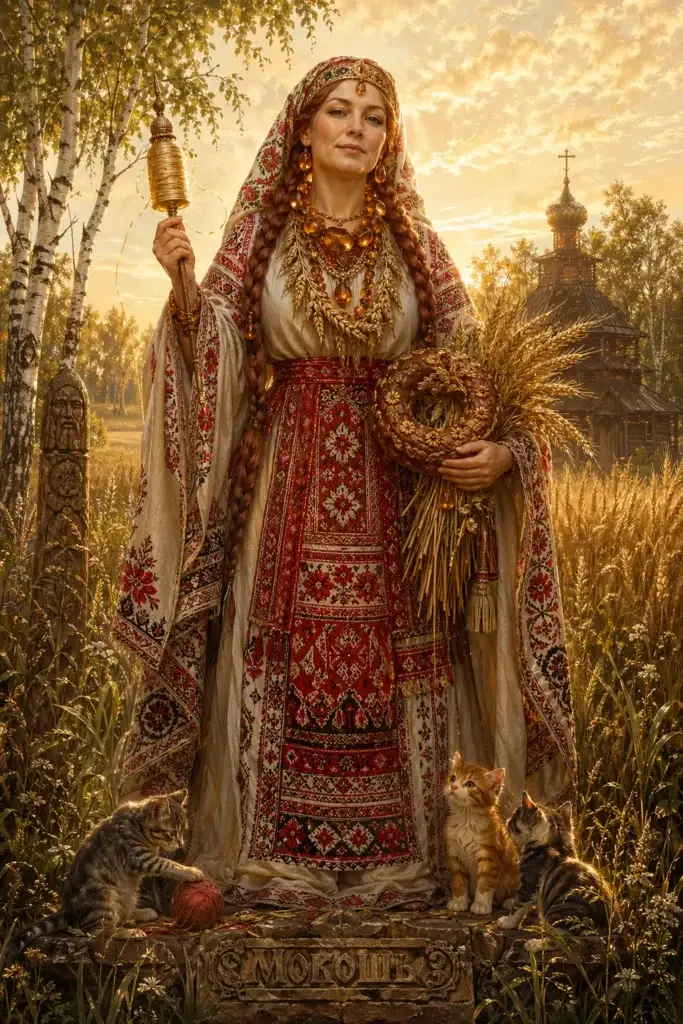
Appearance: sometimes a stately woman in a white shirt, sometimes a stooped old woman

Source context
Period of the Texts
Written testimony from pre-Christian times is entirely lacking; the figure only becomes tangible in the folkloric collections of the 19th and 20th centuries, with a single attestation in Kreutzwald in 1854.
Area of Diffusion
Estonia and the surrounding Baltic Sea region. Notable is the East Baltic preference for female forest beings, whereas Russian traditions are dominated by male forest lords.
Sources
Honestly described as thin: narrative and custom traditions from peasant informants recorded by Eisen, Loorits and Paulson, no documented cult.
Name and variants
Estonian: metsaema, literally the forest mother. The figure stands alongside the male Metsavana or Metsaisa and the more general metsavaim, the forest spirit; the whole belongs to the Estonian world of protective beings, the haldjad, and the mothers and fathers of individual natural domains.
Form and symbolism
Appearance
The tradition knows no uniform image. Some accounts describe Metsaema as a stately woman in a white shirt, occasionally with a rake in her hand; in more recent, Christian-influenced texts, features of the Mother of God are woven in. Other tales turn the figure towards the uncanny, showing a stooped old woman with a long nose and claw-like hands. The pale clothing links her to other Estonian protective beings, who were imagined dressed in white linen.
Effect
Metsaema regulates the yield of the forest: berry harvests, mushroom finds and hunting luck depend on her goodwill, and shepherds invoked her as protector of the herd. Those who wilfully damaged trees, made noise or cursed could find their path confused, their catch withheld, or their livestock sickened. Malice without cause is not attributed to her; the game is regarded as her herd, and both faces, the nurturing and the punishing, belong to the same role.
Profile: Metsaema
The key aspects of the forest mother at a glance.
Part of Estonian folk religion with its protective beings (haldjad) and the mothers and fathers of individual natural domains.
Shepherds, hunters, berry pickers and forest workers: all who use the forest and depend on her goodwill in doing so.
Two faces: the stately woman in a white shirt, sometimes with a rake, and the stooped old woman with a long nose and claw-like hands.
Berry harvests, mushroom finds, hunting luck and the protection of grazing livestock; some texts attribute to her the features of a midwife.
Forest greeting, request for permission, small gifts such as bread, salt or the first berries; sacred groves (hiis) remained untouched.
Metsavana, the old man of the forest, is the male counterpart: he stands for the hunt and wild animals, while the forest mother stands more for care and yield.
A forest mother from the collections
Estonian folk religion animates the landscape with guardian beings (haldjad) and with a series of mothers and fathers of individual natural domains. Metsaema stands alongside the male Metsavana or Metsaisa and the more general metsavaim, the forest spirit. Written testimonies from the pre-Christian period are entirely lacking; the figure only becomes tangible in the folkloristic collections of the 19th and 20th centuries, above all in the work of Matthias Johann Eisen and in Oskar Loorits’s Grundzüge des estnischen Volksglaubens.
Friedrich Reinhold Kreutzwald reported in 1854 that, as late as the 17th and 18th centuries, straw figures were dressed alternately as the forest mother and the forest father during the custom of metsiku tegemine; more recent research (Ergo-Hart Västrik) however considers it possible that it was Kreutzwald himself who first linked these names to the figures. The source material must honestly be described as thin. What remains striking is the East Baltic preference for female forest beings: while male forest lords dominate in Russian tradition, figures such as Metsaema and the Latvian Meža māte are more prominent in Estonia and Latvia.
From folklore collection to environmental education
The Estonian national romanticism of the 19th century, above all Kreutzwald, took up the forest beings in its collections and shaped the image that prevails today. In Estonia, where roughly half the country’s land area is forested, the forest mother remains part of the cultural self-image to this day; she appears in school materials, children’s literature and environmental education.
Typologically, Metsaema belongs to the type of the Mistress of the Animals, a figure widely developed in the forest and hunting cultures of Northern Eurasia. Important clarification: whether one addresses her as a goddess or as a nature spirit is a matter of definition, since no temple or sacrificial cult can be demonstrated; her classification as a deity follows the function that Ivar Paulson described as guardian of a sphere of life. The Christian overlay with Marian traits was only added in the modern era. And organised neo-pagan veneration is a recent marginal phenomenon that should not be confused with the folkloristic tradition.
Forest greeting, offerings and sacred groves
The collections mention above all forms of respectful conduct. On entering the forest, people greeted it; before felling timber or gathering, they asked permission. Small offerings such as bread, salt or the first berries were placed on a tree stump or beneath an old tree, and sacred groves (hiis) were to be neither cleared nor defiled. Anyone who lost their way, in the old understanding thus led astray by a forest being, turned a garment inside out or swapped their shoes to break the spell. These customs are well documented in folklore studies; a formal sacrificial cult for Metsaema, however, is not attested.
Forest mothers and forest lords of the neighbours
The closest relative is the Latvian Meža māte, the forest mother of the southern neighbouring country. In Mordvin mythology she corresponds to Vir-ava, the forest mother of the Volga Finns. In Russian folk belief, by contrast, a male forest lord dominates, the Leshy; the motif of the punishing old woman of the forest also touches on the ambivalent Baba Yaga. The male counterpart within Estonia is Metsavana, the forest elder, who is more strongly associated with hunting and wild animals.
Frequently asked questions about Metsaema
Is Metsaema a goddess or a forest spirit?
The boundary is fluid in Estonian tradition. A formal cult is not attested, but a fixed role as guardian of the forest is. Her classification as a deity follows this function; many folklorists simply list her among the forest beings, the metsavaimud.
How, according to folk belief, was her influence recognised?
Above all through the fortunes of people and animals in the forest: getting lost, poor hunting or berry luck, and sickly grazing livestock were regarded as signs of her displeasure, prosperity and rich finds as signs of her favour.
Do the customs surrounding the forest mother still exist today?
As a living everyday practice they have largely died out, but as narrative material and traditional knowledge they are well documented. The forest greeting and small offerings are occasionally taken up deliberately in Estonia today, for instance in environmental education.
Further links
Literature (selection)
Further standard works in the bibliography.
As the Estonian forest mother, Metsaema embodies the caring side of the forest and at the same time shows how strongly forest spirits have shaped Estonian mythology and folk tradition: here, the forest is a house with a mistress who insists on mindfulness.