Medeina, wolf maiden and guardian of the Lithuanian forests
By Ralf Ittermann · last reviewed on
Medeina is a goddess of Lithuanian tradition.
Mistress of the wild game, to whom even a king made offerings.
Medeina is the Lithuanian goddess of the forests and the hunt, and one of the few Baltic deities attested by name as early as the 13th century. The Hypatian Codex mentions her for the year 1252 among the gods to whom King Mindaugas remained loyal even after his baptism.
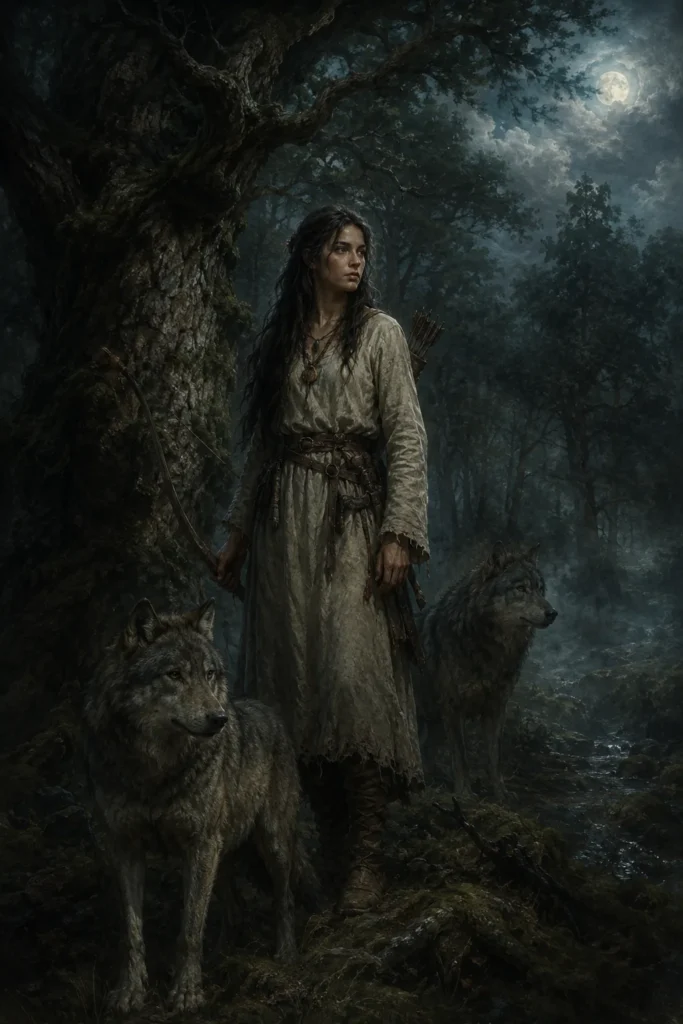
Her profile is clearly defined: she is mistress of the forest and protects the wild game, not the hunter. Research portrays her as a young huntress and, at the same time, as a wolf maiden who roams the forests with a retinue of wolves.
Type: Goddess of the forests and the hunt, mistress of animals
Origin: Lithuania, particularly Samogitia
Texts: Hypatian Codex (under 1252), the Malalas insertion, Łasicki’s De diis Samagitarum
Period: 13th to 17th century
Appearance: young huntress, also a wolf maiden with a wolf retinue
Origin and sources
Period of the Texts
The evidence spans from the 13th century, the Hypatian Codex under 1252 and the Malalas insertion from the middle of that century, to Łasicki’s list of gods from the 16th century, printed in 1615.
Area of Diffusion
Lithuania, particularly Samogitia. Hills and stones that popularly bear her name still link the goddess to Lithuanian landscape tradition today.
Sources
Sparse: a few brief chronicle notes and early modern lists of gods. Much has been reconstructed, which is why research strictly distinguishes between medieval evidence and later embellishment.
Name and variants
Lithuanian: Medeina, derived from medis, tree, or medė, forest. In the 16th century Jan Łasicki lists a Modeina among the Samogitian forest deities. Many scholars also equate her with Žvorūna, the mistress of animals from the Malalas insertion, whose name relates to žvėris, wild animal.
Nature and effect
Appearance
The medieval notes describe no appearance; the image of the goddess is reconstructed from the interpretation of her name, comparative material and folklore. Research portrays her as a young, beautiful huntress who does not wish to marry, and as vilkmergė, a wolf maiden with a retinue of wolves. The wolf is regarded as her animal; in the interpretation as Žvorūna the hunting dog is added. There is no pictorial tradition from pre-Christian times; all known depictions are modern.
Effect
Medeina rules over forest, trees and wild game. Her task is not to drive prey towards the hunter but to protect the forest and its inhabitants: she can obscure tracks, warn the game and lead hunters astray. She is not credited with hostility towards people outside the context of the hunt; she is dangerous to those who abuse the forest.
Profile: Medeina
The most important aspects of the forest goddess at a glance.
Baltic goddess, attested in 1252 in the circle of King Mindaugas; she symbolises the forest as a space beyond human control, dense, trackless and inaccessible to human intervention.
Forest, trees and wild game. Whoever hunts enters her domain and needs her favour; in the 13th century the hunt was an act of lordship.
No pre-Christian pictorial tradition; reconstructed as a young huntress and wolf maiden with a wolf retinue, all known depictions are modern.
Obscures tracks, warns the game and causes offending hunters to lose their way; attacks on humans are not recorded.
According to the chronicle, King Mindaugas secretly made offerings to her even after his baptism; gifts before the hunt and shares of the quarry correspond to Baltic hunting custom.
The Latvian Meža māte as a maternal counterpart within the same domain, along with Artemis and Diana as hunting mistresses of animals.
From royal offering to list of gods
The earliest mention appears in the Hypatian Codex: under the year 1252 it reports that Mindaugas, the first and only king of Lithuania, secretly continued to make offerings to the old gods even after his baptism, Medeina among them. The chronicle also names a hare god; whether he is identical with Medeina remains disputed in scholarship. A Slavonic insertion in the Chronicle of John Malalas from the middle of the 13th century mentions Žvorūna, a mistress of animals whom many scholars equate with Medeina. The chronicle further records that Mindaugas did not dare ride into the forest if a hare crossed his path.
In the 16th century Jan Łasicki lists a Modeina among the forest deities in his catalogue of Samogitian gods; after that her trace fades, and features of the goddess passed into legendary figures of folklore. The national romanticism of the 19th century, notably Teodor Narbutt, greatly embellished the sparse material, which is why present-day research strictly separates the medieval evidence from later embellishment. Algirdas Julien Greimas analysed the sources semiotically, and Gintaras Beresnevičius from the perspective of the history of religion.
Afterlife and interpretation
National romanticism turned Medeina into the ancestral mother of forest-rich Lithuania; Narbutt’s imaginative mythology continues to influence popular depictions to this day. The contemporary neopagan Romuva movement venerates her as goddess of the forests, her name is used in Lithuania as a given name and appears in art and children’s literature. Internationally she remains little known, but increasingly appears in surveys of Baltic mythology.
From the perspective of religious studies, Medeina is a case study in the source problems of Baltic religious history: a few lines of chronicle written in a foreign language carry an entire divine profile. Methodologically she is regarded as a representative of the mistress-of-animals type. Three points require clarification: the medieval evidence must be strictly separated from Narbutt’s embellishment. Her relationship to Žvorūna, whether identity or dual form, remains as open as the question of the hare god and a possible warlike component of the royal cult. And her decline into folklore corresponds to the usual path of dethroned deities after Christianisation.
Offerings, omens and forest rules
What is firmly attested is, first of all, the offering: the Hypatian Codex describes Mindaugas making offerings to the old gods, Medeina among them. Gifts before the hunt and shares of the quarry correspond to what is attested for Baltic hunting customs generally. Equally well attested is the system of omens: a hare crossing one’s path was taken as a warning to avoid the forest that day. Added to this are rules of conduct from Lithuanian folk tradition: moderation in hunting, sparing the young animals, respect for sacred groves. Tradition knows no protective means against the goddess herself; whoever respected her order had no reason to protect themselves.
Medeina and Meža māte: two mistresses of the forest
The closest comparison is the Latvian Meža māte, who occupies the same domain in a maternal rather than maidenly manner: Medeina is the young huntress, the forest mother is the mistress of the household of the forest. In the ancient world she is matched by Artemis and Diana as hunting mistresses of animals, with whom early modern authors already compared Medeina. The Slavic Leshy embodies the same guardian role as a male spirit, and the god Veles reveals the close proximity of livestock, forest and wilderness in the Baltic-Slavic region.
Frequently asked questions about Medeina
Is Medeina the same figure as Žvorūna?
Probably, but not certainly. Both names denote a mistress of wild animals, yet they appear in different sources. Part of the research considers them a single goddess with two names, another part sees two closely related figures.
Why did a Christian king make offerings to a forest goddess?
Mindaugas had himself baptised in 1251 for political reasons. The chronicle accuses him of secretly remaining loyal to the old gods, particularly those connected with forest and hunting, the core domain of a ruler’s life.
How dangerous is Medeina?
Not at all for the respectful forest visitor. Tradition records no attacks on people, though it does mention thwarted hunts and getting lost as a response to wrongdoing. Her protection applies to the forest, not to people.
Further links
Further reading:
- Meža māte – the Latvian mother of the forest as a maternal counterpart
- Leshy – the Slavic lord of the forest
- Artemis – the hunting mistress of animals from antiquity
- Amulet, Talisman, Smoke cleansing, Juniper – traditional protective means
- Protection Compass – protective means at a glance
Literature (selection)
Further standard works in the bibliography.
As a Lithuanian forest goddess, Medeina represents the forest as a space that cannot be commanded. Whether one calls Medeina goddess of the hunt or guardian of wild animals, her protection applies to the forest, and whoever respected its order had nothing to fear from her.