Kasermandl, the penitent spirit of the empty alpine pasture
By Ralf Ittermann · last reviewed on
The Kasermandl is a spirit of the alpine tradition.
The alpine spirit who inhabits the empty herder’s hut as penance.
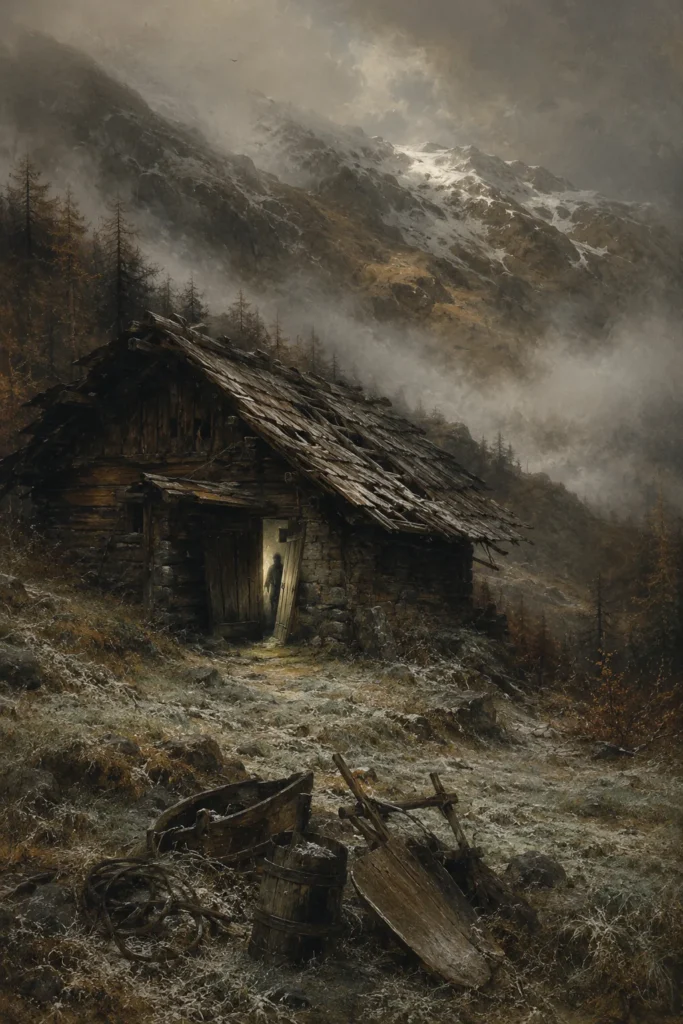
The Kasermandl is a Tyrolean alpine spirit that inhabits the herder’s huts once the cattle have been driven down to the valley in autumn. According to legend, it was once a herdsman himself who was condemned to do penance on the empty alp because of careless work with cheese and butter.
Until Martinmas on 11 November, it causes mischief there, alternating between pranks and genuine terror. The place of origin of the best-known version is considered to be the Umbrüggler Alm above the Hungerburg near Innsbruck, though related tales are widespread across large parts of Tyrol.
Type: Tyrolean alpine spirit, bound to the abandoned herder’s hut
Origin: Umbrüggler Alm near Innsbruck, with versions in Wildschönau, Brixental, the lower Inn valley and the Upper Styrian Ennstal
Texts: Zingerle, Sagen aus Tirol (1850s/1891), Kasermandl song by Josef Pöll
Period: older in oral tradition, documented in writing since the mid-19th century
Appearance: mostly perceptible only as a sound or disturbance, more rarely as a small, inconspicuous man-like figure
Context of tradition
Period of the Texts
Older in oral tradition, documented in writing since the mid-19th century: Ignaz Vinzenz Zingerle recorded the associated custom as early as 1850.
Area of Diffusion
Tyrolean alpine regions, including the Umbrüggler Alm near Innsbruck, Wildschönau, Brixental and the lower Inn valley, with offshoots reaching into the Upper Styrian Ennstal.
Sources
Well supported by regional legend texts, above all Zingerle, as well as living customs and a well-known Tyrolean folk song.
Name and variants
Tyrolean dialect: Kasermandl, a compound of Kaser, the alpine term for the herder’s hut or alpine hut, and Mandl, little man. The legend itself travels within Tyrol from the Umbrüggler Alm to Wildschönau, Brixental and the lower Inn valley, and reaches the Upper Styrian Ennstal in its own variant.
Being and effect
Appearance
Most versions lack a fixed physical description of the Kasermandl; it is more often perceived through its actions, through sounds, shadows and disturbance in the otherwise quiet hut, than through its appearance. Where it is depicted more precisely, it appears as a small, inconspicuous man-like figure, wavering between good nature and malice.
Effect
Once the cattle have been driven down in autumn, the Kasermandl begins to cause mischief in the empty herder’s hut. It frightens and confuses visitors and sometimes offers them a mysterious porridge, the eating of which, according to legend, would redeem the being, though it is said to be mixed with dirt and is thus regarded more as a trap than a gift. It remains bound to the alp until Martinmas.
Profile: Kasermandl
The key aspects of the alpine spirit at a glance.
A house-spirit type of Tyrolean alpine farming, documented in writing since the mid-19th century by Zingerle.
Alpine herders as well as occasional visitors who stay in the abandoned hut after the cattle drive.
Usually only perceptible as a sound, shadow or disturbance, more rarely described as a small, inconspicuous man-like figure.
Frightens and confuses visitors in the empty hut, bound to the period between the cattle drive and Martinmas.
The communal custom of the Martinistampf, in which disguised young men drive the Kasermandl noisily out of the valley.
The British Brownie and the Scandinavian Nisse as related farmyard and house spirits with similar ambivalence.
From careless herdsman to legendary figure
The place of origin of the best-known version is considered to be the Umbrüggler Alm above the Hungerburg near Innsbruck, though related tales are widespread across large parts of Tyrol, for instance in Wildschönau, Brixental and the lower Inn valley, as well as with its own features in the Upper Styrian Ennstal. The core of the legend lies in the motif of penance: the Kasermandl was, during his lifetime, a herdsman who neglected his work, for instance by using balls of butter for skittles instead of processing them carefully, and was therefore condemned to spend the winter as a spirit on the abandoned alp.
The legend collector Ignaz Vinzenz Zingerle recorded the associated custom as early as 1850, in which young men in disguise symbolically drive the Kasermandl out of the valley. This so-called Martinistampf or Almerfahren traditionally takes place around Martinmas and shows how closely the legendary figure is woven into the rural yearly cycle and alpine farming. In the 20th century, the Tyrolean songwriter Josef Pöll set the tale of the Umbrüggler Alm to music in a folk song that remains well known to this day.
Customs and classification
The Kasermandl song by Josef Pöll remains to this day a fixed part of Tyrolean folk music, and the custom of the Martinistampf or Almerfahren is still practised in certain Tyrolean communities. As a tourist motif, the Kasermandl occasionally appears in regional legend tours and hiking descriptions, usually with reference to the Umbrüggler Alm as its place of origin.
In terms of religious studies, the Kasermandl belongs to the type of the house spirit that arises from a deceased person who became guilty and remains bound to a particular place of work. The legend links economic diligence, here the careful production of cheese and butter, with religious penance, and at the same time marks the seasonal transition from the inhabited summer alp to the abandoned winter hut. Important for classification: the Kasermandl frightens and teases but is not regarded as a deadly danger, its restlessness is interpreted as penance rather than pure malice.
The Martinistampf as a banishing custom
Tradition knows above all the communal custom of the Martinistampf as an effective countermeasure: disguised young men move through the valley making noise and symbolically drive the Kasermandl from the alp, a ritual that Zingerle documented as early as the 19th century. Alongside this, the simple rule applies not to stay in the empty huts without reason after the cattle drive and not to accept the dubious porridge offered there. Anyone who nevertheless had to enter the alp did well to do so in daylight and in company. No protective magic beyond this has been handed down for the Kasermandl.
Farmyard and hut spirits compared
As a spirit bound to a particular hut and its economy, wavering there between help and mischief, the Kasermandl resembles the British Brownie, which likewise inhabits farm and house and becomes a nuisance when treated badly. A closer parallel is offered by the Scandinavian Nisse, a farmyard and stable spirit that watches over the work on the farmstead and punishes negligence in a similarly strict manner to how the Kasermandl responds to neglected herding work. The Kasermandl is clearly distinct from the Venedigermandl, another alpine mandl figure: while the Kasermandl remains bound as a penitent house spirit to a single hut, the Venedigermandl travels anew through the mountains each summer as a foreign ore prospector.
Frequently asked questions about the Kasermandl
Why does the Kasermandl haunt the hut in autumn in particular?
Because it is bound to alpine farming: as long as cattle and herders are on the alp, it remains inconspicuous. Only after the cattle drive in autumn, once the hut stands empty, does the Kasermandl, according to legend, become active, until the custom of the Martinistampf symbolically drives it out around 11 November.
Is the Kasermandl malicious?
The tales depict it as ambivalent: it frightens and teases visitors but is not regarded as a deadly danger. Its restlessness is interpreted as penance for its own misconduct during its lifetime, not as pure malice.
What is the Martinistampf about?
It is a Tyrolean custom in which young men in disguise move through the valley making noise in order to symbolically drive the Kasermandl from the alp. Zingerle documented this custom as early as 1850.
Further links
Further reading:
- Alpine Region – all beings of alpine folklore
- Venedigermandl – the other alpine Mandl figure for comparison
- Bergmönch, Schrat – further alpine pasture spirits
- Bells, Threshold Protection, House Protection, Smoke Cleansing – traditional forms of protection
- Protection Compass – protective means at a glance
Literature (selection)
Further standard works in the bibliography.
Whether told as the Kasermandl, an alpine spirit of the Tyrolean Alps, or in the more elaborate Kasermandl legend of Tyrol, the story remains bound to the autumn descent of the herds and the empty dairy hut, until the Martinistampf drives it away anew each year.