Fuxi, primordial Chinese emperor and culture bringer
By Ralf Ittermann · last reviewed on
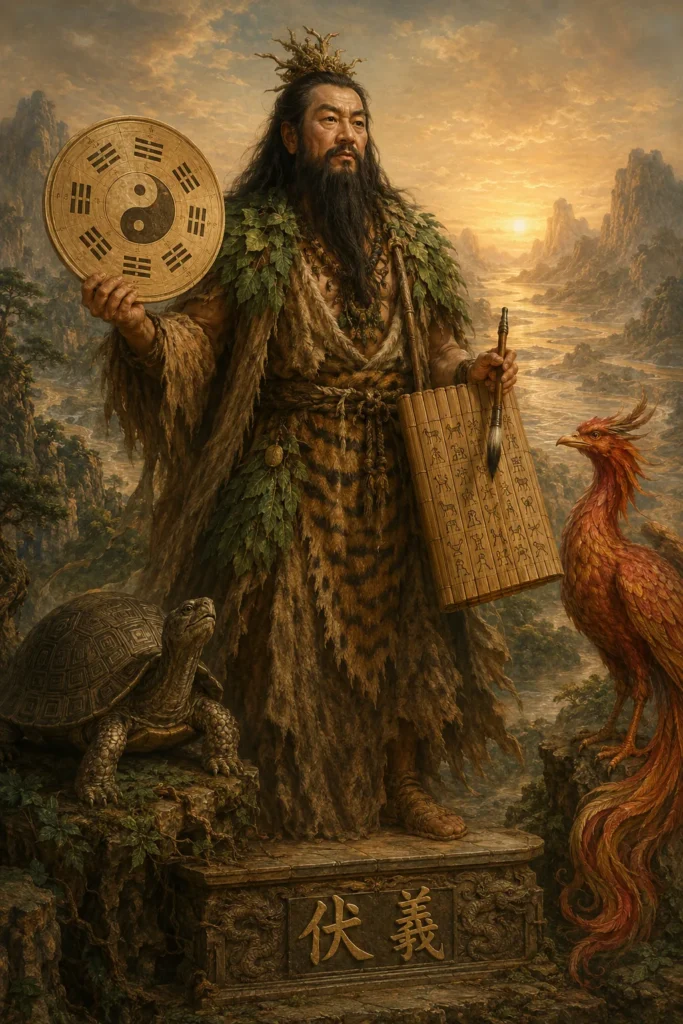
Fuxi is regarded as a primordial Chinese emperor and as a culture bringer, credited with the invention of writing, fishing and the eight trigrams. Fuxi (also Fu Hsi, written Fu Xi) is, in Chinese mythology, the first of the “Three Sovereigns” (Sanhuang), the mythical culture heroes of prehistoric times.
He is credited with the invention of the Eight Trigrams (bagua), the writing system, marriage, fishing with nets and music. In terms of the history of religion he belongs to a mythical prehistory that was fixed canonically in the Han period in order to trace the beginning of Chinese civilization back to concrete, culture-hero figures.
The Three Sovereigns
The conception of the “Three Sovereigns” arose in the late Zhou and above all in the Han period, and it was filled out in various ways.
In a widely circulated variant, Fuxi, Shennong and Huangdi form the three mythical forefathers. In other versions Fuxi, Nüwa and Shennong appear as the trio, as in the addendum by Sima Zhen (Tang period) to the “Shiji”, which itself begins with Huangdi.
The list is not fixed; it reflects the attempts of Han-period scholars to construct a coherent prehistory of the empire. Anne Birrell (“Chinese Mythology. An Introduction”, Baltimore 1993) emphasizes that these constructions are to be understood less as historical than as legitimizing: they create a mythical origin of civilization that can personify cultural achievements.
Mythological Life
According to the traditional account, Fuxi was born on the bank of the River Lei; his mother Huaxu stepped into the footprint of a giant, whereupon she became pregnant. This birth legend is a typical mythological motif for the extraordinary origin of a culture hero.
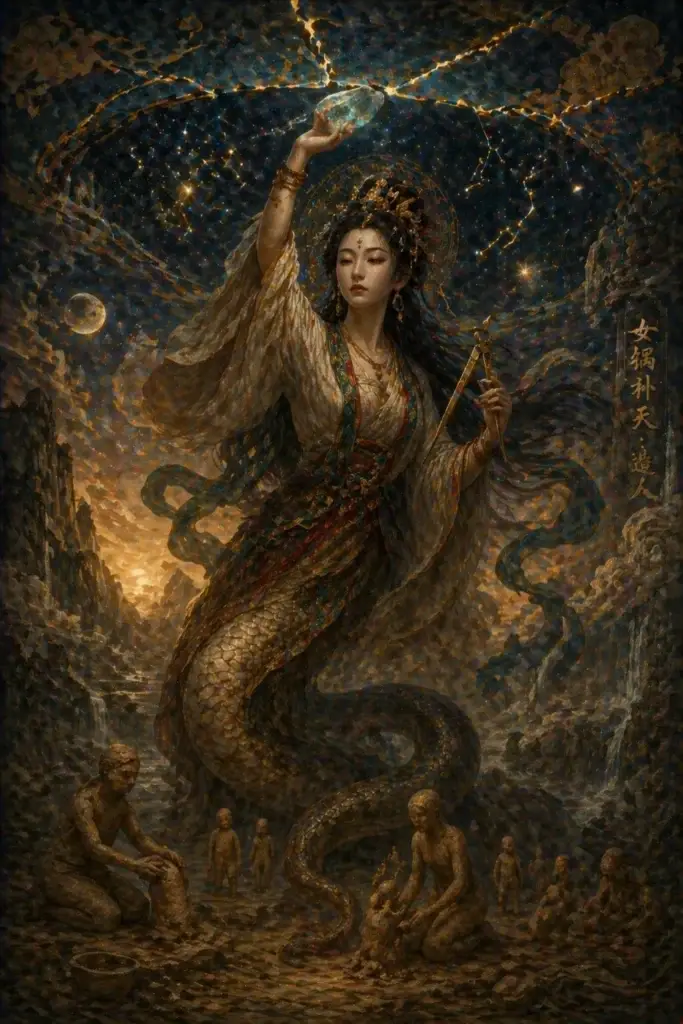
In the older tradition Fuxi is depicted as a hybrid being, with a human upper body and a serpent’s or dragon’s body, in Han-period iconography mostly shown together with Nüwa as an intertwined serpent-bodied pair.
The tomb reliefs of Wu Liang Ci in Shandong and numerous other Han-period finds present this constellation as the canonical image of cosmic order.
The Eight Trigrams
Fuxi’s most important invention is, according to the traditional tradition, the system of the Eight Trigrams (bagua). These eight signs, each made up of three unbroken or broken lines, are the basic unit of the Yijing (“Book of Changes”), one of the oldest and most influential texts of Chinese philosophy.
In the “Xici Zhuan”, the oldest surviving commentary on the Yijing (approximately fourth to third century BCE), the invention of the trigrams is attributed to Fuxi.
He is said to have derived them from the observation of nature: the patterns on the back of a turtle that rose from the River Lo are said to have inspired him.
In terms of the history of religion, this narrative belongs to the context of the so-called “Luoshu” and the “Hetu”, two mythical diagrams that are regarded as primordial sources of cosmic order. Hellmut Wilhelm, in “Sinn des I Ging” (Düsseldorf 1972), systematically presented the mythological background of the Yijing.
Marriage and Genealogy
Fuxi is regarded, according to the traditional tradition, as the founder of marriage and thus of ordered family formation. This function is closely tied to his relationship with Nüwa. In the widespread versions they are siblings who, after a cosmic catastrophe, survived as the only human beings and re-engendered humankind through a sibling marriage.
This narrative is preserved in several southwestern Chinese ethnic traditions, above all among the Miao, Yi and Zhuang, in independent versions, which points to a very old, pre-Han stratum of the motif.
Mark Lewis, in “The Flood Myths of Early China” (Albany 2006), analyzed the motif in connection with the flood tradition of early Chinese mythology.
Further Cultural Achievements
Besides the trigrams and marriage, further civilizational inventions are attributed to Fuxi. The invention of fishing with nets, of writing in an early form (various versions name knotted cords or pictographic signs), the observation of the seasons and the composition of the first music are assigned to him.
This list is not identical in all sources; it grows and shrinks according to tradition.
What does appear consistently, however, is the conception of Fuxi as a transitional figure between animal primeval time and human civilization. Sarah Allan, in “The Heir and the Legend” (San Francisco 1981), showed how the culture-hero figures of early Chinese mythology form a systematic program for explaining the beginning of civilization.
Geographical Localization
Fuxi’s mythological homeland is traditionally located in Chen (today Huaiyang in Henan Province). There stands a mausoleum (Taihao Fuxi Ling) which in its present form dates from the Tang and Song periods but was erected upon older predecessor buildings.
It is one of the most important pilgrimage sites of central China; the annual spring festival on the third day of the third lunar month draws tens of thousands of visitors.
The archaeological stratum of the site reaches back into the Neolithic Yangshao culture, which fuels the supposition that the Fuxi tradition builds upon very old prehistoric cult forms whose concrete content can, however, no longer be reconstructed.
Connections in the History of Religion
An important research question concerns the relationship of Fuxi to comparable culture heroes of other East Asian traditions. Structural parallels are found, for instance, with the Korean Dangun and the Japanese Jinmu.
These parallels are less evidence of a direct transmission; rather they point to a common narrative type of the “founder of civilization”, which was independently constructed in several advanced cultures of East Asia.
Fuxi in Daoism and in the Yijing Commentary
In the Daoism of the Han period and the following centuries, Fuxi is classified not as a pure culture-hero figure but as a cosmic teacher. The school of “Inner Alchemy” (Neidan) sees in the construction of the trigrams an instruction for inner alchemy and for self-perfection.
This reading is a later appropriation, but it shows how the Fuxi tradition could be integrated into the Daoist discourse of self-cultivation. Stephen Bokenkamp (“Early Daoist Scriptures”, Berkeley 1997) has edited and commented on individual texts of this line.
History of Reception
In Confucian thought Fuxi takes first place in the sequence of mythical sage rulers, whose regular mention in the classical texts constitutes an important element of political theory.
He is mentioned above all in the Xici zhuan, the Zhuangzi and the Guanzi, though with differing emphasis. In the Han period, above all under Emperor Wu, the Three Sovereigns sequence became part of the state’s self-description.
The later tradition retained this constellation, without Fuxi thereby becoming primarily a cult figure. Today the cultural-historical and iconographic memory of Fuxi predominates; a living practice is associated above all with the mausoleum in Huaiyang and with the Yijing tradition.
Classification in Religious Studies
In the Chinese tradition Fuxi stands for an independent category in the phenomenology of religion: the culture hero as a counter-figure to the actual god. Unlike the Jade Emperor, who heads a bureaucratically organized divine hierarchy, Fuxi is not primarily a cultically venerated deity in the narrower sense.
He is a mythical ancestor whose significance lies in the invention of cultural structures. This differentiation between god figures and culture-hero figures is important for religious studies; it shows that Chinese mythology knows no homogeneous class of gods but rather different functional figures, each with its own religious status.
Sources and Further Reading
Primary sources: Yijing (“Book of Changes”), with the Xici Zhuan as the oldest commentary; Shiji, Sima Qian, early first century BCE; Shanhaijing; Han-period tomb reliefs of Wu Liang Ci, Shandong; local genealogies of the Taihao mausoleum in Huaiyang.
Secondary literature: Anne Birrell, “Chinese Mythology. An Introduction”, Baltimore 1993; Mark Lewis, “The Flood Myths of Early China”, Albany 2006; Sarah Allan, “The Heir and the Legend“, San Francisco 1981; Hellmut Wilhelm, “Sinn des I Ging”, Düsseldorf 1972; Edward Schafer, “Pacing the Void”, Berkeley 1977; Stephen Bokenkamp, “Early Daoist Scriptures”, Berkeley 1997.
The Eight Trigrams in Detail
The eight trigrams (bagua), whose invention is attributed to Fuxi, are a system of three lines each, which are either unbroken (Yang) or broken (Yin).
They yield eight possible combinations: Qian (three unbroken, Heaven), Kun (three broken, Earth), Zhen (Thunder), Xun (Wind), Kan (Water), Li (Fire), Gen (Mountain), Dui (Lake). These eight trigrams can be combined with one another into sixty-four hexagrams, which make up the system of the Yijing.
In the later Yijing commentaries a distinction was made between the “Fuxi arrangement” of the trigrams (sequence according to the “Earlier Heaven”, xian tian) and the “King Wen arrangement” (sequence according to the “Later Heaven”, hou tian).
The first is regarded as the original cosmic order, the second as the arrangement effective in the human world. Hellmut Wilhelm, in “Sinn des I Ging”, set out the history of these two arrangements and their philosophical implications in detail.
The Luoshu Diagram
With the invention of the trigrams by Fuxi, the traditional tradition connects the appearance of the “Luoshu”.
It is a magic square that, according to legend, appeared on the shell of a turtle that rose from the River Lo. The arrangement of the numbers from one to nine in a 3×3 square yields the sum fifteen in all rows, columns and diagonals.
This diagram is one of the oldest documented magic squares in the world and was later taken up in numerous cultural contexts.
In China it has a particular cosmological significance, since it is read as a basic image of the distribution of cosmic energies (qi) in space. It is the foundation of later feng shui practice and of bagua-based cosmic geography.
Sarah Allan, in “The Shape of the Turtle”, examined the religious-historical background of the Luoshu and pointed to the possible connection with the image of the world as a turtle.
Fuxi and the Calendrical Order
In some sources Fuxi is credited with the invention of the calendar. He is said to have systematized the observation of the heavenly bodies, ordered the phases of the moon and introduced the twelve “animal stations” (corresponding to the later Chinese zodiac signs).
These attributions are ahistorical, but they reflect the later tendency to trace all fundamental achievements of Chinese civilization back to the mythical culture heroes.
In the concrete historical sense, the Chinese calendar system arose over several centuries from the Shang period onward and was comprehensively reformed for the first time in the Han period. The attribution to Fuxi is a retrospective construction intended to support the cultural identity of the Han period.
Fuxi as Patron of Diviners
In popular belief Fuxi is the patron of diviners and of Yijing interpreters. Whoever works professionally with the Book of Changes traditionally makes an incense offering before each consultation at an image of Fuxi. In the Yijing shrines that exist in numerous Chinese cities, Fuxi is often the central pictorial figure.
The divinatory practice itself is multilayered in terms of the history of religion.
It encompasses not only the casting of yarrow stalks or coins to determine a hexagram but also the interpretation of dreams, the reading of facial features and the calculation of astrological constellations. In all these areas Fuxi is invoked as the mythical forefather.
The Trigrams in the Hexagram System
The eight trigrams (bagua), attributed to Fuxi, are the foundation of the Yijing system. They are combined into 64 hexagrams by placing two trigrams one above the other.
This doubling is attributed in the older tradition to King Wen of Zhou (twelfth century BCE), while the assignments of meaning to the individual hexagrams are said to derive from his son, the Duke of Zhou.
The “Ten Wings” (shi yi), philosophical commentaries, are attributed to Confucius but are historically more likely to be assigned to the late Zhou and early Han period.
Richard Wilhelm (“Das Buch der Wandlungen”, Jena 1924) produced the now classic German translation with an extensive commentary. The research of Edward Shaughnessy and Richard Smith has philologically clarified the layering of the Yijing’s composition and classified the traditional authorial attribution as legendary.
The Mawangdui Finds and Alternative Hexagram Sequences
Among the Mawangdui tomb finds (Hunan, 168 BCE), a silk version of the Yijing was discovered which exhibits a different hexagram sequence from the version canonical today.
In the Mawangdui sequence the book begins with the hexagram Qian (the Creative), as in the canonical version, but the following arrangement diverges. This proves that the Yijing tradition in the early Han period knew several parallel sequences.
Edward Shaughnessy (“I Ching: The Classic of Changes”, New York 1996) translated the Mawangdui version and compared it with the canonical one.
The Mawangdui finds have considerably changed Yijing research in recent decades and shown that the standardization of the text took place only after the early Han period, through the school around the Han Confucian Tian He.
The Hetu and the Luoshu
The two mathematical-mystical diagrams “Hetu” (Map from the Yellow River) and “Luoshu” (Writing from the Luo River) are regarded in the later tradition as visualizations of cosmological order that were revealed to Fuxi.
The Hetu shows the numbers 1 to 10 in an arrangement linked with the five phases of transformation. The Luoshu shows the numbers 1 to 9 in a magic-square arrangement.
The myth reports that a dragon horse rose from the river and carried the Hetu on its back, and that a divine turtle displayed the Luoshu on its shell. These diagrams are only indirectly attested in their early form; their standardized form goes back to the Song dynasty.
Liu Mu (eleventh century) and Zhu Xi (1130 to 1200) integrated the diagrams into Neo-Confucian cosmology. The research of Joseph Needham (“Science and Civilisation in China”, volume 3, Cambridge 1959) examined these diagrams in the context of early Chinese mathematics and numerology.
Fuxi and the Invention of Writing
A separate mythical tradition attributes to Fuxi the invention of knotted-cord writing (jie sheng), a pre-graphic notation technique in which knots in cords served to record data. The great Yijing commentary (Xici zhuan) mentions this primeval knotted-cord writing, which was later replaced by written characters, but does not attribute it to Fuxi.
This tradition stands in tension with the competing attribution of the invention of writing to Cangjie, the secret scribe of the Yellow Emperor (Huang Di).
The two traditions are historically complementary: Fuxi stands for proto-symbolic notation, Cangjie for graphic completion. Mark Edward Lewis (“Writing and Authority in Early China”, Albany 1999) interpreted the writing-invention myths as symbolizations of different phases of early Chinese bureaucratization.
Fuxi and the Twelve Zodiac Signs
The later astronomical tradition attributes to Fuxi the introduction of the twelvefold zodiac (shengxiao). This attribution is not attested in the oldest texts and belongs to the popular thickening of myth that ascribed ever more civilizational achievements to him.
The twelve animals (Rat, Ox, Tiger, Rabbit, Dragon, Snake, Horse, Goat, Monkey, Rooster, Dog, Pig) have been attested in literature since the Han period and are used in astrological calendars to this day.
Wolfgang Behr and Hans van Ess have researched the etymology and cultural history of the shengxiao system. The origin most likely lies in Central Asian steppe traditions and is likely to have traveled to China along the Eurasian axis.
The attribution to Fuxi is a secondary cultural connection meant to underline the universality of his work as a culture founder.
The Tianshui Tomb Chambers as Archaeological Evidence
Fuxi’s mythical region of birth is identified with Tianshui in Gansu.
Here stands the famous Maijishan temple complex (Mountain of the Wheat Stack) and the Fuxi temple, which, according to the common account, was built in the Ming period. Archaeological finds from the region, above all from the Dadiwan culture (approximately 5800 to 5400 BCE), show efforts to tie mythical genesis to concrete prehistoric sites.
The state Fuxi rites in Tianshui were entered into the Chinese register of intangible cultural heritage in 2006. The annual sacrificial festivities in Tianshui, which take place each year on the 16th day of the first lunar month, draw hundreds of thousands of believers and tourists.
The cultural-political revaluation of the Fuxi cult since the 1990s is part of a broader rediscovery of pre-Confucian mythology as a national identity resource and was documented by John Lagerwey and Vincent Goossaert in several studies.
Frequently Asked Questions
Did Fuxi exist historically? No, Fuxi is a mythical figure. In Chinese cultural history he represents the transition from prehistoric wildness to human civilization. A historical person behind the figure cannot be demonstrated.
What are the Eight Trigrams? A system of eight combinations of unbroken and broken lines that forms the foundation of the Yijing (“Book of Changes”). They represent eight fundamental cosmic forces or aspects of the world.
What are the “Three Sovereigns”? A triad of mythical culture heroes which in the classical sequence comprises Fuxi, Shennong, Huangdi. In an alternative sequence, Fuxi, Nüwa and Shennong appear as the trio.
Where is Fuxi venerated today? The main sanctuary is the Taihao Fuxi mausoleum in Huaiyang (Henan). In addition there are smaller temples in many Chinese cities, above all in those where Yijing divination traditions are alive.