Bhairava, god of the Hindu tradition
By Ralf Ittermann · last reviewed on
Bhairava is a god of the Hindu tradition.
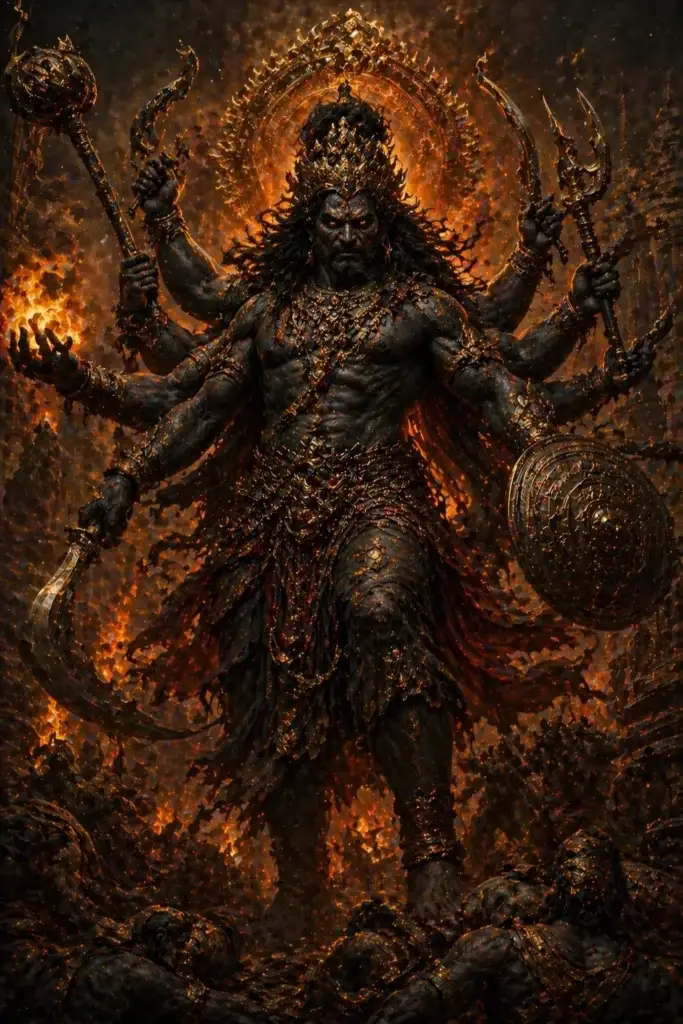
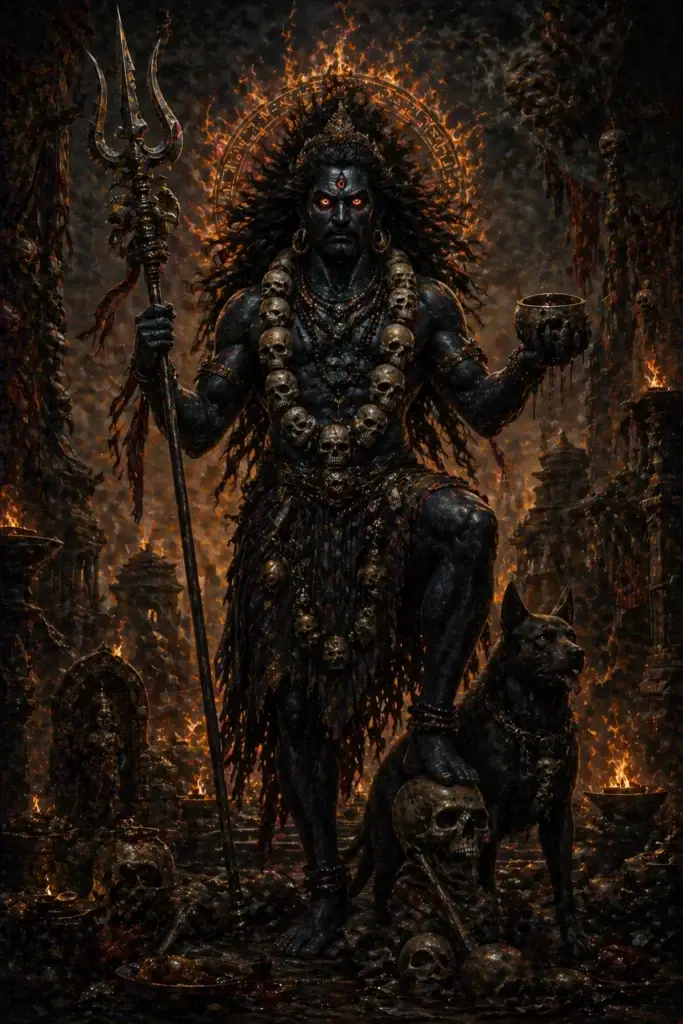
The terrible form of Shiva, guardian of the sacred threshold. Bhairava is Shiva in his fearsome shape, not the gentle ascetic of the cave but the wild destroyer, with the black dog at his side.
With a bloodthirsty tongue, a skull garland and a body covered in ash, Bhairava stands at the temple gates and protects the faithful from evil forces.
In Tantra, Bhairava is a powerful god of transformation whose intense worship promises enlightenment. A god for those who do not take the gentle path but who wish to behold the abyss and walk through it.
Bhairava
Type: Major Hindu deity, wrathful aspect of Shiva, protective deity
Pantheon: Hinduism (Shaivism, Tantra), Buddhism (Mahakala kinship)
Function: protection from death and illness, destruction of egocentricity, guardian of sacred sites
Main attributes: trishula (trident), khatvanga (skull staff), dog as mount
Main cult sites: Varanasi (Kashi Vishwanath temple), Khajuraho, Kathmandu (Nepal)
Tibetan identification: Mahakala (secondary)
Context
Bhairava is attested since the Purâṇas (4th to 10th century CE) as a wrathful manifestation of Shiva. The main cult site, Varanasi, emerged at the latest in the 8th century with the Kâlâbhairava temple.
He is central to the tantric Kâpâlika and Aghori traditions from the 8th century onward. In Nepal he is the main aspect of the Newar pantheon. In the 20th century he became popular worldwide through the yogi tradition and tantric schools of practice.
Main cult sites: Varanasi (with the Kâlâbhairava temple as protector of the city), Khajuraho (Bhairava temple), Kathmandu (Nepal, Newar tradition with the 64 Bhairavas), Ujjain. He is central in tantric Kâpâlika sanctuaries as well as in the Aghori tradition. International dissemination came through tantric and yogic schools.
Central sources: Bhairava Tântra, Skanda Purâṇa, Linga Purâṇa, Vijñâna Bhairava Tântra (a central tantric text), Bhairavâṣṭottara Tântra. Secondary literature: Sanderson, The &Saacute;aiva Age; Lorenzen, The Kâpalikas and Kâlâmukhas; Michaels, Der Hinduismus.
Name and spellings
Bhairava is dark, black or deep blue, his body smeared with ash to symbolize the transience of all things. A garland of severed heads or skulls encircles his neck. A long red tongue hangs from his mouth.
A black dog (Shvan or Shvana) is his constant companion, sometimes the dog itself, sometimes a demonic being. He carries a trident and often a sword. His third eye is open and fiery.
Characteristics
Bhairava is the protective god of sacred boundaries, especially of the entrances to temples. His name means “the terrible one” (Bhaya = fear), yet this fear is not evil but purifying. In tantric practices Bhairava is invoked as the supreme master, especially in nocturnal meditation (sadhana).
Bhairava worship is intense and not suited to beginners; it leads to the direct experience of emptiness (Sunyata) and to liberation. The black dog is the disciple, and every practitioner becomes a dog who serves Bhairava.
Profile: Bhairava
The most important aspects of Bhairava at a glance. The following fields summarize origin, function, appearance, worship, symbols and parallels.
In myth, Bhairava arises from an encounter between Shiva and Brahma: when Brahma boasts of being the supreme god, from Shiva’s wrath Bhairava emerges, who strikes off one of Brahma’s five heads and must carry the severed head on one hand until he is released in Varanasi.
Bhairava is thus the embodied wrathful aspect of Shiva. In the tantric scheme there are eight principal Bhairavas, and in Nepal 64 Bhairavas.
Protection from sudden death, illness and all external threats. Destroyer of ego identification in tantric practice. Guardian of sacred sites; in Varanasi the Kâlâbhairava is regarded as protector of the city.
For every pilgrim in Varanasi it holds: without a visit to Bhairava the pilgrimage is incomplete. In tantric practice he is a tool of self transformation.
A wrathful, dark-skinned male figure with three or four eyes, long black hair (often as a crown of locks) and a fiery face. Four or more arms. Trishula (trident), Khatvanga (skull staff), Damaru (drum), sword.
In one hand a severed skull or a skull bowl (kapala). A skull necklace (mundâ-mâla). Mount: dog (shvana-vahana). A tiger-skin loincloth. An upright posture or in dance.
Sphere of effect: Bhairava is invoked before journeys and in acute emergencies. In Varanasi, before visiting the Vishwanath temple, one first pays a visit to Kâlâbhairava, without whose permission one cannot meet the king of the city.
In tantric practice he is the focus of central meditation: the Vijñâna Bhairava Tântra contains 112 meditation methods for the direct realization of Bhairava. In Newar Nepal the Indra Jatra festival features the 64 Bhairavas.
Trishula (trident), khatvanga (skull staff), damaru (drum), sword, skull bowl (kapala), skull necklace, tiger-skin loincloth, snake as belt. Mount: black dog. Sacred plants: the bilva tree, datura. Sacred colors: black and fiery red. In Varanasi black dogs are regarded as his manifestation and are fed.
Mahakala (Buddhism, tantric adoption), Yamantaka (Tibetan Vajrayana), Heruka (tantric), Rudra (Vedic, early precursor of Shiva and Bhairava). Global wrathful-deity parallels: Sekhmet (Egypt, wrathful goddess), the Erinyes (Greece), Seth (Egypt, chaos aspect). Functionally: every guardian of the threshold to the deeper spirit world shares Bhairava’s functions.
Protective practice
Worship rituals
Bhairava is the wrathful aspect of Shiva, the angry protective form for the eight city districts (ashta-bhairava). His main pilgrimage destination is Kashi (Varanasi), where Kala Bhairava is regarded as the “city guardian”; pilgrims must first register with Kala Bhairava before they are permitted to visit Vishvanath (Shiva himself).
Bhairava pujas take place on Wednesdays and on the 8th lunar day (ashtami). Tantric worship once included nocturnal rituals in cemeteries (shmashana-sadhana), today largely symbolic (cf. White, The Alchemical Body).
Mantras and invocations
The Bhairava bija mantra “Hraum” and the mula mantra “Om Hraum Kalabhairavāya Namaḥ”. The Vijnana Bhairava Tantra (a Kashmiri Shaiva text, 8th century) is his central theological text, with 112 dharanas. The Kalabhairava Ashtakam (attributed to Adi Shankara) is the liturgical standard.
Amulets and protective symbols
His mount is the black dog (dogs are sometimes fed at Bhairava temples). Symbols: trishula (trident), damaru (drum), skull (kapala), the severed skull of Brahma. Black-gray stone pendants engraved with Bhairava images. Eight apotropaic Bhairava images at the city quadrants of Varanasi form a protective arrangement thousands of years old.
Bhairava, parallels in other cultures
Bhairava and the severed head of Brahma
The central myth that explains Bhairava’s nature is the story of how he deprived the creator god Brahma of his fifth head. The account is preserved in several Puranic texts, with variations in detail. In the best-known version, Brahma laid claim to supreme authority or spoke arrogantly toward Shiva.
From Shiva’s wrath Bhairava arose, who struck off one of Brahma’s five heads with his fingernail or with a sword. By doing so, however, Bhairava committed the gravest conceivable transgression: the murder of a Brahmin, indeed of the creator god himself.
As punishment and penance the severed skull remained stuck to his hand, and Bhairava had to wander about as a beggar until the guilt was wiped away.
This wandering finally led him to Varanasi, the sacred city on the Ganges. There, at the site of Kapalamochana, the place of the release of the skull, the skull at last fell from his hand.
The myth thus explains several things at once: Bhairava’s epithet Kapalin, the skull-bearer, his connection to Varanasi, where he is venerated as protective god of the city, and the religious model for the Kapalika, an ascetic movement whose followers carried a skull as a begging bowl and ritually re-enacted Bhairava’s penitential wandering.
Kala Bhairava as protective god of Varanasi
In the sacred city of Varanasi, Bhairava holds a special position. As Kala Bhairava he is regarded there as the protector and, in a sense, as the city’s commander, who watches over the holy city.
A widespread belief holds that no one can die in Varanasi without Kala Bhairava taking note of it, and that the deceased must, in a manner of speaking, answer to him.
The Kala Bhairava temple in Varanasi is an important place of pilgrimage. Pilgrims who come to the city traditionally seek him out to ask for Bhairava’s permission and protection.
A characteristic element of the local cult is the connection with the dog, Bhairava’s mount. Dogs are considered sacred in his sphere, and the image of the god accompanied by the black dog is firmly associated with the city.
Bhairava’s function as kshetrapala, as guardian of a sacred district or a city, is found not only in Varanasi. Throughout India, and especially in the Kathmandu Valley in Nepal, Bhairava shrines stand at city gates, crossroads and boundary points.
In the Nepalese context, for example at the great Indra Jatra festival in Kathmandu, a monumental Bhairava mask plays a central ritual role.
Religious studies sees in this protective function an important side of Bhairava: the fearsome, transgressive god is at the same time the reliable guardian who wards off evil from outside, because he is himself a match for it.
Bhairava in Tantra and in ascetic practice
Bhairava is a key figure of the tantric currents of Hinduism, especially of the Shaiva Tantra traditions. In these schools he is regarded not only as the wrathful manifestation of Shiva but, in some texts, as the supreme reality itself.
The influential Kashmiri text Vijnana Bhairava Tantra presents the teaching as a dialogue between Bhairava and the goddess and describes numerous meditative exercises for realizing absolute consciousness.
Characteristic of tantric Bhairava worship is the deliberate transgression of ordinary religious boundaries. The ascetic movements associated with Bhairava, historically the Kapalika and later the Aghori, seek out the places of death, the cremation grounds, and use substances and practices that contradict the orthodox order of purity.
The religious meaning of this practice lies in overcoming the duality of pure and impure, of attraction and revulsion.
Religious studies has examined the Bhairava traditions intensively, among other things the question of how transgressive tantric practice relates to socially integrated temple worship.
Bhairava exists in both spheres: as the object of a radical, skull-bearing asceticism and at the same time as a venerated village and city god to whom the broad population makes offerings.
The eight or sixty-four Bhairavas that some texts enumerate, as well as the close connection with the mother goddesses, the matrikas, show how highly differentiated this field is. Bhairava thus remains one of the theologically most demanding figures of Shaivism.
Further links
Sources and literature
Further standard works in the literature index.