Pehar, god of the Tibetan tradition
By Ralf Ittermann · last reviewed on
Pehar is a protective deity of the Tibetan Buddhist schools, above all the Nyingma. Originally a demon or local mountain spirit, he was later converted into a guardian of the Dharma and integrated into oracle practices. His history illustrates the Tibetan practice of subduing non-Buddhists under a Buddhist oath. Pehar is Tibet’s oracle spirit of Nechung, and the following text explains what that designation covers.
Pehar is depicted as a mounted war god, often on a horse with armor and weapons. In the Nechung tradition (the national oracle of the Dalai Lama until 1959) he was the primary deity. Described at night as a tiger, Pehar is the protector against external and internal enemies of Buddhism.
Brief profile: Pehar
Type: Tibetan Buddhist protective deity, chief dharmapâla of Nyingma Buddhism
Pantheon: Tibetan Buddhism (especially Nyingma, alongside Gelug and folk religion)
Function: protection of the Dharma, protector of the Tibetan government through the Nechung oracle trance
Main attributes: tiger skin, multicolored court robes, sword, arrows, bow, mount tiger or lion
Main place of worship: Nechung Monastery near Lhasa (seat of the state oracle)
Special form: Pehar Gyalpo, chief king of the five Gyalpo protective gods
Context
Pehar (Tib. Pe har Rgyalpo) is described in the Tibetan Buddhist sources as an original protective god of the Mongol class of gods, who was subdued by Padmasambhava (8th c. AD) and bound to the protection of the Dharma.
Principal flowering of the Pehar tradition: from the 13th/14th c. onward with the consolidation of the Nechung oracle seat.
In the 17th c., under the Fifth Dalai Lama, Nechung becomes the official state oracle of the Tibetan government. In the modern exile tradition (in India since 1959) the tradition has been continued; the current Nechung oracle in exile in Dharamsala still consults Pehar.
Main place of worship: Nechung Monastery near Drepung in the vicinity of Lhasa (original center of the Pehar cult). In the modern exile, the Nechung Monastery in Dharamsala (India).
Alongside these, Pehar statues and shrines in many Nyingma monasteries (Mindrolling, Dorje Drak, Pelyul, Kathok, Shechen). In the Mongolian Tibetan Buddhist tradition as a central protective deity. Internationally present in Tibetan Buddhist centers worldwide.
Central sources: Pehar sadhana texts (various versions depending on the monastic tradition), Padmasambhava hagiographies (containing the story of Pehar’s subjugation), the history of the Fifth Dalai Lama.
Secondary literature: Nebesky-Wojkowitz, Oracles and Demons of Tibet (the standard work on Tibetan protective deities); Linrothe, Ruthless Compassion; Lopez, Religions of Tibet in Practice; Karmay, The Arrow and the Spindle (on Tibetan folk religion).
Designation and spellings
Pehar is depicted with particular iconographic elements that are symbolically encoded and carry deep meaning. These elements convey, in a central way, the functions, sources of power, areas of responsibility and cosmic role of this entity.
The visual system allows initiates and the culturally educated to grasp the deeper meaning. Colors, sacred objects or weapons, bodily attributes, specific accessories: everything is significant and traditionally handed down. The system remains stable and recognizable across generations, which points to fundamental archetypal structures.
Description
Pehar was central to the religious practice and the everyday understanding of Tibet. In critical situations or at particular ritual seasons of the year, people turned to this entity with structured rituals, prayers or offerings. The practice was handed down precisely and was often led by priests or specialists.
The continuity of these practices over many generations shows that they were regarded as effective and necessary. The functions were manifold: preventive (warding off misfortune), healing (relief of suffering), transformative (accompaniment through transitions) and protective (continuous watch).
Appearance and symbolism
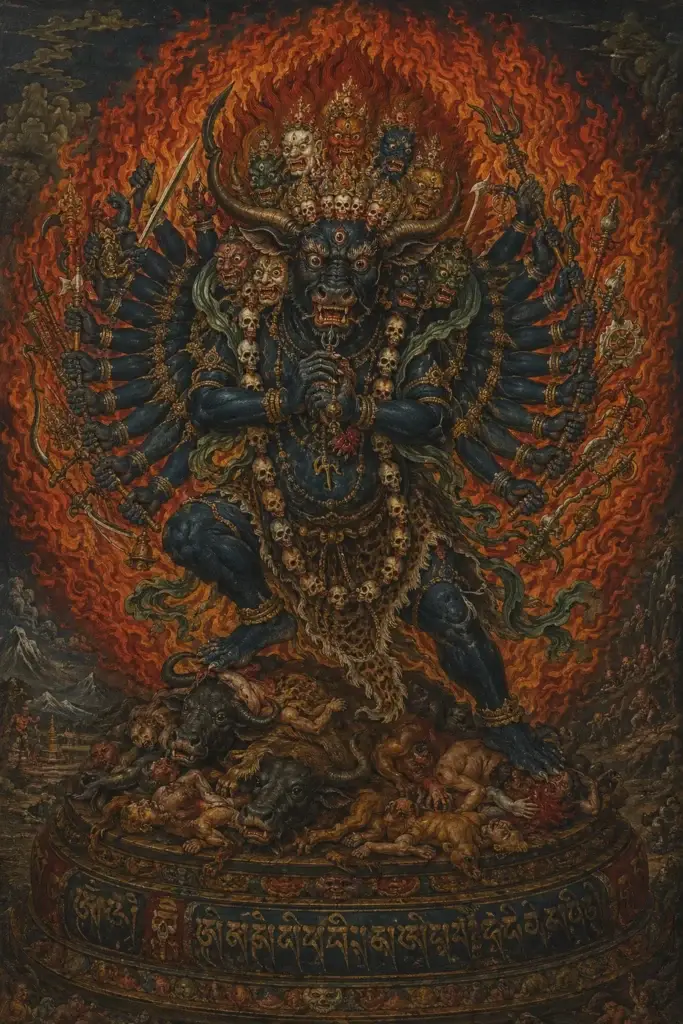
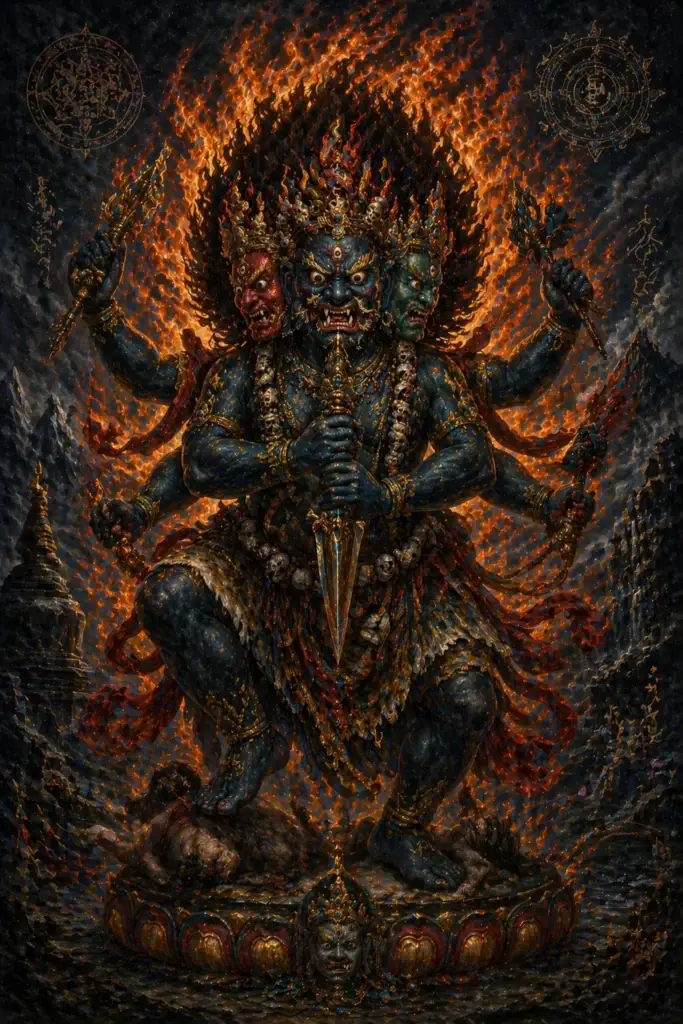
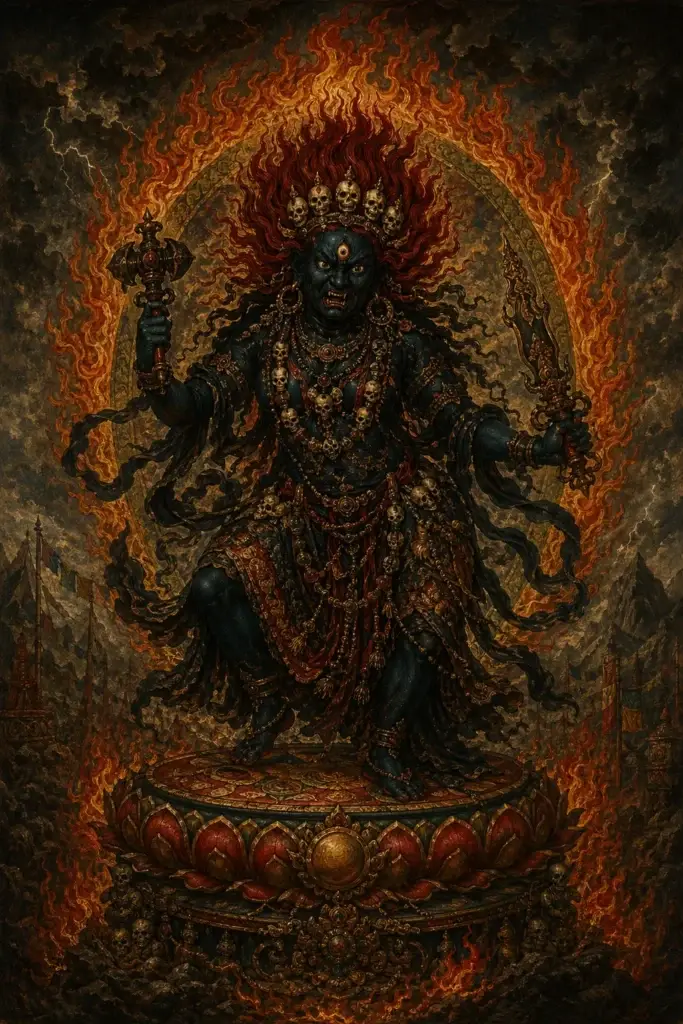
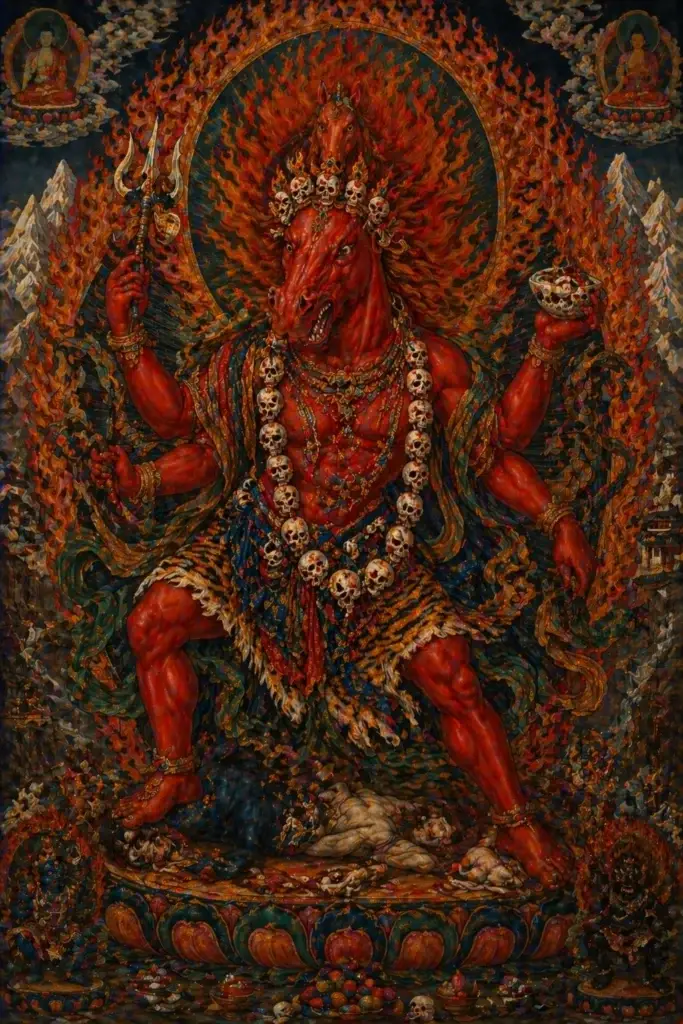
Pehar is often depicted as a warrior or as an enigmatic supernatural spirit with changing appearance. His iconography varies: sometimes he shows himself as a wrathful god with weapons, sometimes as a black-blue spirit with flames. He often wears armor and symbolizes martial protective energy. His mount is sometimes a bird or a phantom.
The most important aspects of Pehar at a glance.
The following fields summarize origin, function, appearance, veneration, symbols and cultural parallels, and draw on the canonical ritual texts of the Nyingma and Gelug schools as well as on the historical accounts of the Nechung oracle, which embodied Pehar as the state oracle at Nechung Monastery near Drepung until 1959.
Cultural context
According to Tibetan tradition, Pehar was originally a powerful demon king of the Mongolian or Hor folk religion, who was subdued by Padmasambhava during the spread of Buddhism in Tibet and bound to the Dharma through a protective oath: a classic pattern of the Tibetan synthesis (old folk deities integrated into the Buddhist system as “converted” protective deities).
Chief king of the five Gyalpo protective gods (Tsiu Marpo, etc.).
Related to
Chief dharmapâla (protective deity) of Nyingma Buddhism and of the Tibetan government. Influence through the Nechung oracle trance: a specially selected monk (Kuten) is possessed by Pehar through an elaborate ritual, speaks answers to questions of government in trance, and prophesies political and military decisions.
From before the 5th Dalai Lama (17th c.) until the Tibetan government in exile, Pehar was consulted through the Nechung oracle in every significant government decision.
Form
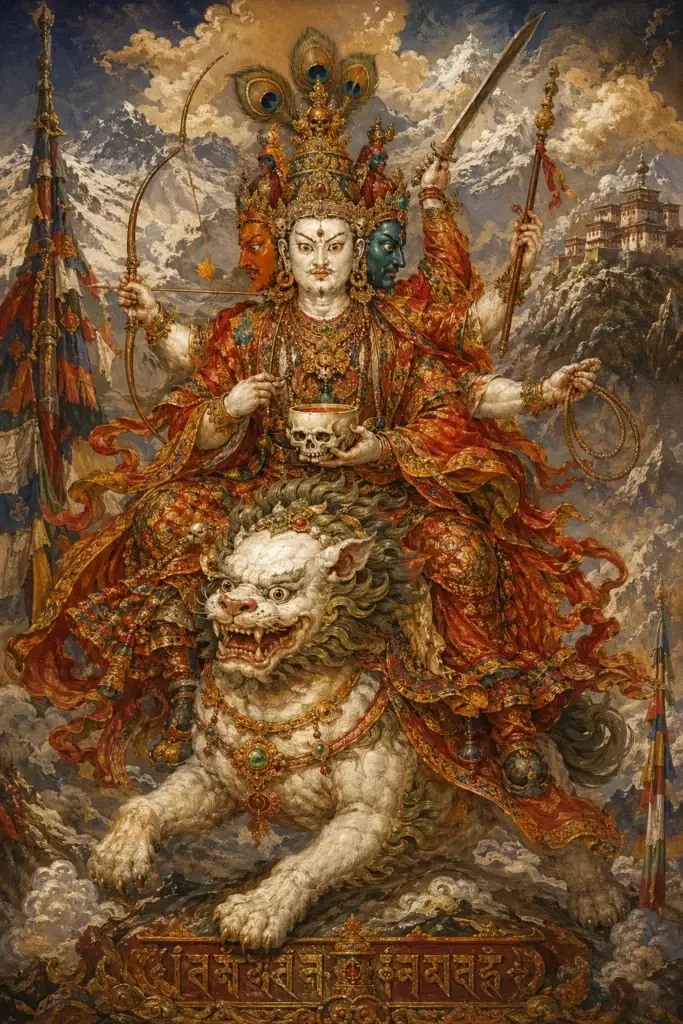
A terrible male figure with three heads (in some versions) or a single main head, three eyes, a bright or dark countenance. Wears a colorful court robe with a tiger-skin cloak and an official’s hat. In his hands: a sword, bow and arrows, lasso, precious staff.
Rides on a tiger, lion or horse. In the Nechung trance ritual, the Kuten is clothed in a characteristic Pehar costume (a multilayered brocade cloak, a heavy helmet, a sword) that turns him into the living manifestation of Pehar.
Activity
Area of influence: Pehar is venerated in every Nyingma monastery. The main cult is the Nechung oracle rite, one of the most famous trance traditions among the religions of the world.
The Kuten is brought into a trance state through long meditative preparation, then clothed in the Pehar costume, and writes his answers to questions of government with vigor and in an archaic, prophetic style. In the personal household cult, he is invoked (invocation) for protection against demonic afflictions.
Means of protection
Sword, bow and arrows, lasso, tiger skin, official’s hat, precious staff. Mount: tiger, lion or horse. Sacred animals: tiger. In the Nechung trance: a heavy helmet, multilayered brocade. Sacred colors: bright and multicolored (unlike the monochrome black Mahakala forms).
Comparable
Mahakala (Buddhism, a related wrathful protective deity), Palden Lhamo (Buddhism, female protective goddess of the Gelug tradition), Yamantaka (Buddhism), Tsiu Marpo (Buddhism, one of the five Gyalpo protective gods under Pehar), Hayagriva (Buddhism).
In the worldwide tradition of protective deities: Lugal-irra and Meslamta-ea (Mesopotamia, Nergal guardians), Set (Egypt, protection of the solar barque), St. Michael (Christian, protective archangel). The trance oracle tradition of Pehar has parallels to the Delphic Pythia and to the ecstatic prophets of the ancient world.
Pehar, parallels in other cultures
Many advanced cultures know oath and oracle gods bound to a temple or a ritual, from the Greek Apollo at Delphi to the Mesopotamian Šamaš; Pehar’s function as state oracle of the Gelug school holds a comparable position there.
Jewish tradition: The demon as a creative force, transformed through the use of exorcisms, shares with Pehar’s conversion myth the logic of subjugation and regeneration.
Greco-Roman world: Mars/Ares as a martial force and Plato’s demiurge as a fashioner of the world share with Pehar the possibility of a moral transformation of raw power.
Germanic tradition: The incorporation of local forest spirits and land gods into Christianity parallels Pehar’s incorporation into Buddhism; both show processes of cultural absorption.
Hinduism: Ganesha, originally an obstacle demon who was later transformed into a bringer of blessings, follows the same mythological logic as Pehar.
Pehar and the state oracle of Nechung
Pehar attained his greatest historical significance through his connection to the oracle of Nechung. Nechung Monastery, located near the great monastery of Drepung at Lhasa, had been the seat of the state oracle of Tibet since the 17th century.
The principal deity venerated here is Dorje Drakden, who in the Tibetan tradition is regarded as an emanation or close companion of Pehar. Through the medium of the Nechung oracle, this spirit power spoke in trance ceremonies to the highest offices of the Tibetan government.
The rise of Pehar to state protector is traditionally linked to the Fifth Dalai Lama (1617 to 1682), under whose rule the institution of the Nechung oracle received its central political position. The oracle was consulted on affairs of state, in the search for the reincarnations of high teachers, and in times of crisis.
The religious-studies literature, such as the studies by René de Nebesky-Wojkowitz and more recent work by Christopher Bell on Pehar and Nechung, shows that the trance sessions followed a fixed ritual sequence in which the medium wore a heavy headdress set with mirrors.
The institution has also endured in exile. After 1959 the Nechung oracle was newly established near the seat of the Dalai Lama in Dharamsala in India. Pehar is thus one of the few Tibetan spirits whose ritual practice is documented without interruption up to the present.
Scholarship has the opportunity to compare textual tradition, iconographic representation and lived ritual directly with one another, which makes Pehar a central case study for the study of Tibetan protective deities.
Origin narratives and the binding by Padmasambhava
The Tibetan tradition knows several narratives about the origin of Pehar. One widespread version connects him with foreign, non-Tibetan origins and names a Central Asian or Mongolian setting.
Pehar appears here as an originally foreign spirit power that was brought to Tibet. One tradition links his binding to Buddhism with the founding of Samye Monastery in the 8th century, the first Buddhist monastery of Tibet.
According to this account, Padmasambhava, who brought the teaching to Tibetan Buddhism, subdued a number of native and foreign spirits and bound them by oath to the protection of the teaching. Pehar is said to have been appointed protector of the monastic treasures and the temple goods of Samye.
By way of intermediate stations that the tradition associates with particular monasteries, his cult finally reached Nechung. This migration of the cult from Samye through several places to Nechung is itself the subject of narrative elaboration and underscores the notion that a powerful spirit remains bound to places and objects.
Pehar is frequently depicted as the head of a group of five king spirits, the rgyal po sku lnga, each assigned to a cardinal direction and an aspect. Iconographically he most often appears white or bright, three-faced and six-armed, riding on a lion, with attributes such as a bow, an arrow and a staff.
This complexity, a leader with a retinue, several faces and an elaborate hierarchy, is typical of the high-ranking Tibetan protective deities, who are conceived not as isolated beings but as the summit of an entire court of spirits.
Further links
Literature (selection)
Further standard works in the literature index.
Frequently asked questions about Pehar
Who is Pehar in Tibetan Buddhism?
Pehar (also Pehar Gyalpo) is a powerful protective spirit of Tibetan Buddhism who, according to tradition, was bound by Padmasambhava in the 8th century and placed in the service of the Buddhist teaching.
He is regarded as the king of a group of spirits and is venerated as the leader of the guardians over monastic property and teaching. Pehar is often depicted riding on a lion, with three faces and six arms, bearing a bow and other weapons.
How is Pehar connected with the state oracle of Nechung?
Pehar acts through the state oracle of Nechung, the most important oracle of Tibetan Buddhism. In this, the deity manifests through a human medium monk, the Kuten, who answers questions in deep trance.
Strictly speaking, it is usually Dorje Drakden, a minister or aspect of Pehar, who speaks. The Nechung oracle was consulted for centuries by the Tibetan government and the Dalai Lamas on important decisions and remains part of the Tibetan government in exile in India to this day.