Tsen, Spirit of the Tibetan Tradition
By Ralf Ittermann · last reviewed on
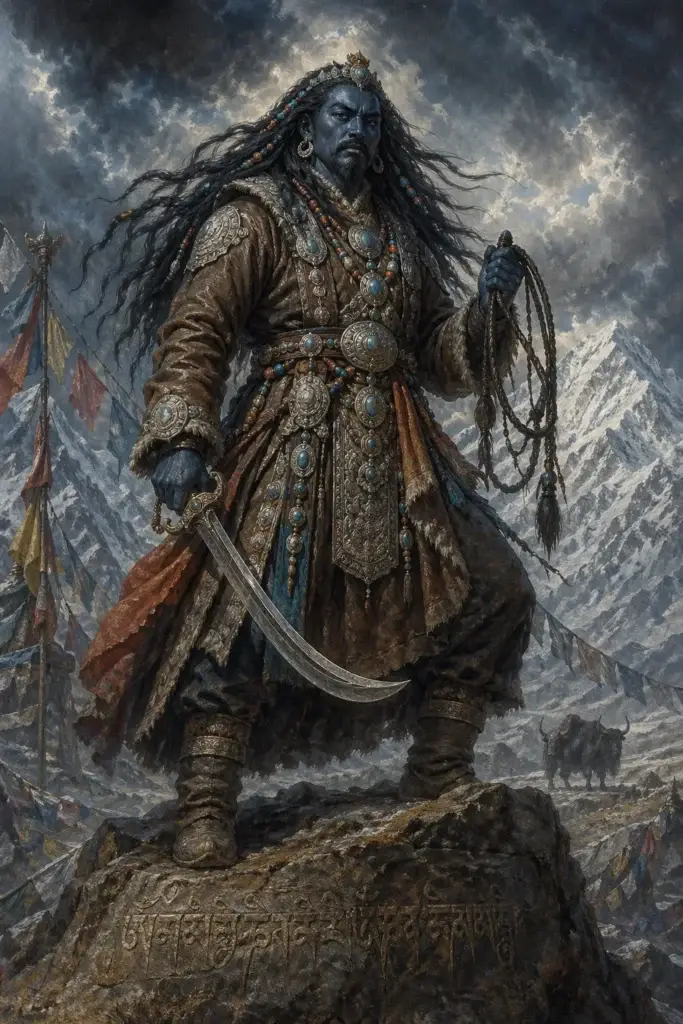
Tsen is a spirit of the Tibetan tradition.
Red warrior spirits of the Tibetan mountains, lords of the rocks and passes.
Tsen (btsan)
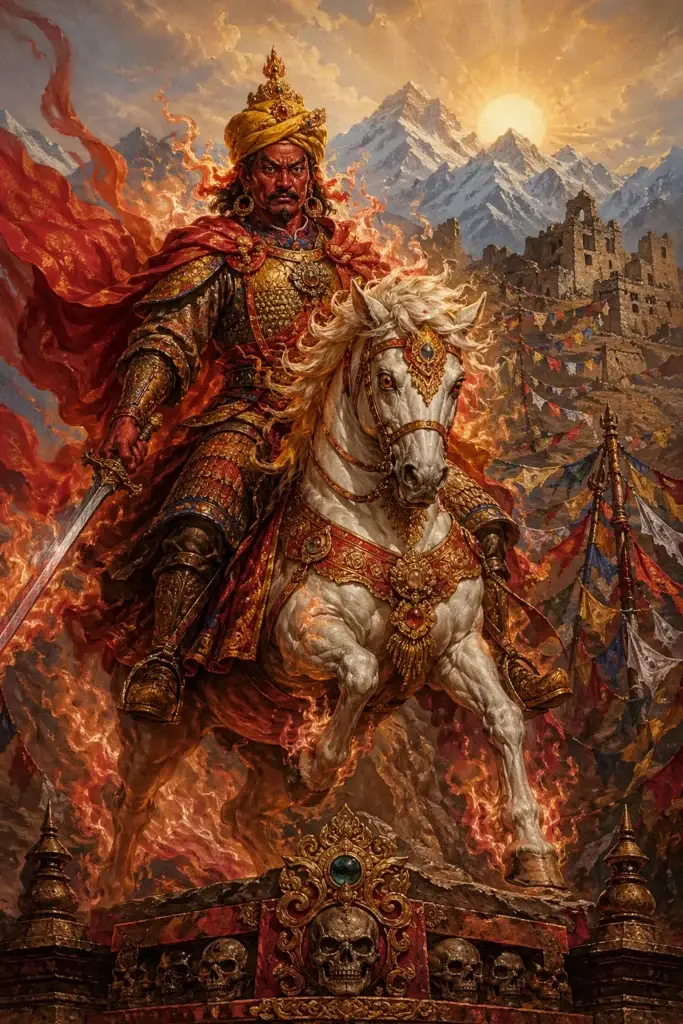
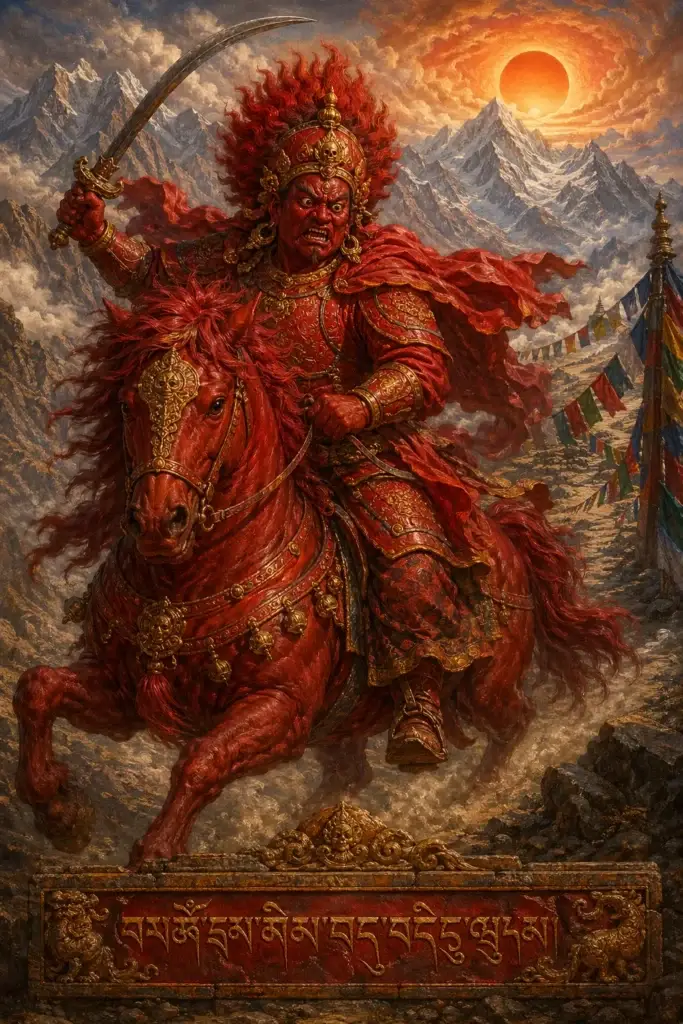
The Tsen (Tib. btsan) form a distinct class of Tibetan spirit beings: warrior spirits of the rocks, passes, and steep mountain slopes. They are consistently described as red-clad, male warrior figures who ride red horses, carry bow and sword, and can appear suddenly out of rock crevices.
Tsen are not fundamentally malicious, but dangerously unpredictable. They punish disrespect at once; their territories are surrounded by strict rules of conduct.
Many Tsen were bound by oath during the Buddhist penetration of Tibet and installed as protective spirits (Dharmapalas) of particular monasteries. A prominent representative is Pehar, who was brought to Samye in the 8th century and bound to the state oracle.
Bon prehistory and the spirit hierarchy
The Bon religion, Tibet’s pre-Buddhist religious tradition, divided the supernatural world into a complex hierarchy of non-human beings. The Tsen belonged to this classification as specialized mountain and war spirits. According to Bon sources, the Tsen arose in an earlier cosmic phase, before deities or Buddha natures ordered the world.
They are therefore older than Buddhism and more deeply rooted in Tibetan soil. The Bon priesthood (drangpo) specialized in pacifying the Tsen through sacrifice and contracts. In the 7th to 11th century, during Tibet’s Buddhist turn, many of these spirits were not destroyed but incorporated into Buddhism.
Short Profile: Tsen
Type: Warrior spirit, mountain demon
Origin: Pre-Buddhist Bon tradition; often fallen warriors or banished princes
Texts: Padmasambhava cycles, Gesar epic, local ritual books
Effect: Sudden illnesses, accidents at passes, possession
Defense: Sang sacrifice, Tsen torma, avoidance at the wrong time
Historical Classification
Period of the Texts
The Tsen figure derives from the pre-Buddhist Bon religion. They form one of the three original classes of beings (lha, klu, btsan).
With the Buddhist turn in the 7th to 8th century, numerous Tsen are integrated into the new religious system; some are established as protective spirits, others remain present as feared lords of the mountains.
The Gesar epic, one of the largest oral epics in the world, knows numerous Tsen figures as both adversaries and allies. To this day, Tsen shrines are maintained at many passes.
Area of Distribution
Tsen are bound to particular rock formations, passes, steep mountain slopes, and individual striking rocks. Every important pass in the highlands has its Tsen, often with its own name and specific rituals.
Typical sites: pass summits with prayer flags (lung ta), free-standing boulders, red or conspicuous rock faces, springs at the foot of such formations. Some Tsen also inhabit old ruins and fortresses, especially when these are connected with historical battles.
State of the Sources
Core sources: Padmasambhava cycles, especially the subjugation narratives; the Gesar epic in its oral and written versions; local ritual books that survive for individual shrines. Standard works: Nebesky-Wojkowitz (1956); Samuel (1993); Blondeau (1998).
On Pehar specifically: Gibson, Todd (1991) “From btsan rgod to dharma-pala”; further, the literature on the Nechung state oracle.
Name and Variants
Tibetan btsan, pronounced Tsen or Tsaen.
- Btsan rgyal, “king of the Tsen”.
- Yul lha dang btsan, local protective spirits and Tsen together.
- Pehar, the most prominent Tsen, made the protective lord of the Nechung oracle.
- Dorje Legpa, originally a Tsen-like being, bound by Padmasambhava.
Characteristics
Appearance. A deep-red, male warrior in full armor, with a red cloak, red helmet, bow and sword, on a red horse with red caparisons. In thangka depictions often with scorpion or bird-of-prey attributes.
Behavior. Appearing at dusk and at night, suddenly out of rock crevices. They pursue the disrespectful, ride across lonely passes, and can appear in groups. The encounter can be experienced as sudden physical weakness, dizziness, fever, or shortness of breath.
Protective function. Bound Tsen are loyal guardians of their monasteries and places. In this function they belong to the class of srung ma, protective deities.
Classification of Tsen, Nyen, Lu, and Du within Bon
In the Bon system there exists a close classification of supernatural beings according to sphere and element: Tsen are mountain and sky beings; Nyen are mountain spirits and forest dwellers; Lu are Naga-like water dwellers; Du are earth-bound spirits. Within this classification the Tsen are the highest and at the same time the wildest.
Unlike other mountain spirits, the Tsen have a strong martial orientation: they protect territorial borders and family honor. They are less interested in fertility than in bravery and glory. This difference explains why Tsen were more often invoked by warriors and kings, while Lu spirits were asked by farmers for the blessing of water.
Profile: Tsen
The most important aspects of the Tsen at a glance.
Pre-Buddhist Bon tradition; frequently fallen warriors or deposed princes who returned as spirits.
Travelers on high passes, hunters, herders, traders with caravans; construction workers in unconsecrated terrain.
Deep-red warrior figure in full armor, on a red horse, with bow and sword; sometimes with a scorpion attribute.
Sudden altitude sickness, fever, shortness of breath, accidents at passes, possession with rage; on the positive side: resolute protection as a guardian.
Sang smoke offerings at passes, Tsen torma, recitation of specific ritual texts, the placing of red prayer flags; strict rules of conduct at Tsen sites.
Mongolian mountain warrior spirits; North Iberian and Germanic mountain beings; Indian yaksha as mountain guardians.
Protective Practice
Sang sacrifice at passes. Travelers stop at high passes, kindle small fires of juniper branches, and scatter flour; the call lha sol lo (“to the deities be it offered”) and prayer flags (lung ta) accompany the crossing.
Tsen torma. In monastic ceremonies, torma figures are prepared especially for the Tsen class, often red configurations of tsampa, with red dyes.
Shrines and stone cairns. At the foot of Tsen rocks and on pass summits stand small stone cairns (la btsas), onto which travelers place an additional stone.
Oracle. Some Tsen are institutionalized as oracle rulers; Pehar speaks through the Nechung oracle to this day in the Tibetan government in exile.
Tsen, Parallels in Other Cultures
Mongolia. After the Buddhist penetration of Mongolia in the 13th to 16th centuries, Tsen-like figures are integrated into the Mongolian system of protective spirits.
India / Buddhism. Yaksha as guardian figures share the basic profile of the militarily shaped place spirit.
Europe. Red warrior spirits at mountains and passes are found in North Iberian and Alpine legends; no historical connection exists.
Shamanic traditions. Siberian and Central Asian notions of mountain lords share numerous basic features.
Local religious practice and the Tsen contract system
On the local spiritual level, Tsen function as cosmic allies of local communities. A mountain is inhabited and ruled by a specific Tsen. Travelers must introduce themselves and ask for a blessing.
Warriors concluded contracts with local Tsen in order to obtain victory. The Tsen contract system (damtsig) shows a reciprocal relationship: the human promises veneration, the Tsen grants protection and success.
These contracts were understood as serious and binding; breaches of Tsen agreements were punished with misfortune for several generations. The motif of the contract with mountain spirits is present in many pre-Buddhist cultures, but Tibet preserved it in a unique form of integration into a large religious system.
Placement within the Tibetan System of Local Spirits
The btsan (pronounced tsen) belong to the autochthonous spirit classes of Tibet that structured the Tibetan worldview even before and alongside Buddhism.
The religious-studies literature, above all the foundational work Oracles and Demons of Tibet by Rene de Nebesky-Wojkowitz (1956), places them within a dense system that includes, among others, the klu of the waters and the underworld, the gnyan of the middle sphere, and the lha of the sky.
Within this scheme the btsan are the spirits of the middle to upper region, frequently bound to rocks, passes, red mountain flanks, and individual striking trees.
Characteristic is their red color. Btsan are imagined as red riders on red horses, in armor and armed with bow or lance. This iconography connects them with battle, the hunt, and sudden death.
Illnesses that occur without warning, above all feverish ones or those accompanied by paralysis, were traditionally interpreted as a btsan attack. The term btsan is at the same time an adjective in Tibetan for mighty and violent, which directly names the nature of the class.
Remarkable is the historical depth of the word. Btsan is a component of the royal title btsan po, with which the rulers of the Tibetan empire (7th to 9th century) were designated.
Scholarship sees in this an indication of an originally close connection between kingship, the mountain cult, and the notion of a mighty, warlike class of spirits. With the establishment of Buddhism, the btsan, like the other pre-Buddhist spirits, were not abolished but integrated into the Buddhist system and in part bound as protective deities.
Binding to Buddhism and the Role as Protectors
The Tibetan tradition knows the motif that powerful teachers such as Padmasambhava in the 8th century subjugated the native spirits and bound them by oath to the protection of the Buddhist teaching. For the btsan this meant a double existence.
On the one hand they remained unbound wild spirits, lurking at their rocks and passes. On the other hand, individual, especially powerful btsan could be raised to srung ma, to protective deities of monasteries and lineages.
The best-known example is the protective god Pehar, or rather his circle, whose retinue is in part assigned to the btsan class. The famous monastery protector Tsiu Marpo, venerated at the central monastery of Samye, is also regarded as a btsan: a red, armored rider who could be consulted as an oracle deity.
Here it becomes clear that the class was by no means only negatively cast. A bound btsan was a potent protector precisely because his original wildness and fighting power were preserved and now placed in the service of the monastery.
In the ritual everyday life of the monasteries, this binding was renewed regularly. Offerings, above all red substances, and the recitation of the binding formulas maintained the relationship. Scholarship emphasizes that this relationship was considered precarious.
A neglected or offended protective btsan could turn against the very community he was supposed to guard. This makes the Tibetan handling of the btsan fundamentally different from a mere warding off of demons. It was not about destruction, but about the lasting administration of a dangerous yet usable power.
Further Links
Literature (Selection)
Further standard works in the literature index.
The protective practice described here is a religious-studies classification of historical traditions. iWell Guard ties in with this cultural-historical line of wearable protective objects and represents a contemporary form of it. More about the iWell Guard →