Tengu, Spirit of the Japanese Tradition
By Ralf Ittermann · last reviewed on
Tengu is a spirit of the Japanese tradition.
A winged mountain being between deity and demon, tester of the yamabushi monks.
Tengu
Tengu (天狗, “heavenly dog”) are among the most ambivalent figures of Japanese demonology. At once mountain beings, mountain deities and demons, they stand at the intersection of Shintō, Buddhism and ascetic mountain tradition.
Over the centuries their profile shifts, from the early depiction as ominous birds of prey, through the Muromachi-era seducers of monks, to the Edo-era protective spirit of swordsmanship.
Two main types have become established: the karasu-tengu with a crow or bird-of-prey head, and the ō-tengu or yamabushi-tengu with a red face and a long nose, in the garb of the mountain ascetic.
Konjaku Monogatari and the Two Tengu Morphologies
The collection Konjaku Monogatari (Tales of Now and Then, 12th century) documents the Tengu in their oldest canonical form and already establishes the distinction between Daitengu (great Tengu) and Kotengu (smaller Tengu).
In these narratives, Daitengu are tall, long-lived beings with human intelligence and form, often equipped with supernatural abilities of shadow-creation and imitation of human shape.
Kotengu appear as lower, more bird-like variants, destructive and less rational. This classification correlates with socio-religious status: Daitengu are frequently wanderers or hermits who attained superhuman asceticism, whereas Kotengu lead a wild, mountain-bound life.
The Konjaku collections also document early Tengu-abduction narratives, in which priests or nobles vanish mysteriously and later return with supernatural insights, a motif that echoes down into modern Japanese yokai literature.
Quick Overview: Tengu
Type: mountain deity, demon, tester figure
Origin: From Chinese star-being traditions (tiāngǒu) merged with the Japanese mountain cult
Texts: Nihon Ryōiki, Konjaku Monogatarishū, Heike Monogatari, Tengu-Sōshi
Period: Attested from the 8th c.; typical iconography from the 14th c.
Seat: Sacred mountains, among them Kurama (Kyōto) and Takao
Context
Period of the Texts
The term tengu derives from the Chinese tiāngǒu (“heavenly dog”), a designation for shooting stars and ominous light phenomena. The term reached Japanese in the 8th century through Buddhist texts.
In early Japanese tradition, tengu are at first ominous beings; an episode in the Nihon Shoki (720) reports a flying “dog” in the sky, which a monk identifies as a tengu.
Between the 12th and 14th centuries the image shifts: tengu become mountain beings with bird heads who seek to bring ascetic monks to ruin. From the Muromachi period onward, the yamabushi-tengu emerges in monastic garb with a hooked nose.
Area of Distribution
Tengu traditions are concentrated on sacred mountains. Especially well known are Mount Kurama north of Kyōto (the dwelling of the mythical Sōjōbō, the “chief tengu”), Mount Takao west of Tōkyō, and Mount Ōmine in Nara, central sites of shugendō mountain asceticism.
Distributed across the archipelago are local tengu deities; many smaller mountain shrines keep tengu masks in their treasuries and hold annual festivals.
State of the Sources
Textually central are the setsuwa collections (Konjaku Monogatarishū, Uji Shūi Monogatari) as well as the Tengu-Sōshi, an illustrated scroll from the late 13th century. In the Heike Monogatari, tengu appear in several episodes.
The classical iconography becomes fixed in the illustrated works of the Edo period, for example with Toriyama Sekien. Modern standard works: De Visser, M. W. (1908) “The Tengu”; Wakabayashi Haruko (2012) “The Seven Tengu Scrolls”.
Name and Variants
The name is composed of 天 (“heaven”) and 狗 (“dog”), thus originally referring to a celestial star being.
- Karasu-tengu, raven tengu, bird-headed, with wings; older form.
- Yamabushi-tengu / ō-tengu, mountain-ascetic tengu, red face, long nose; later form.
- Kotengu, smaller, lower tengu followers.
- Sōjōbō, the legendary king of all tengu on Mount Kurama.
Description
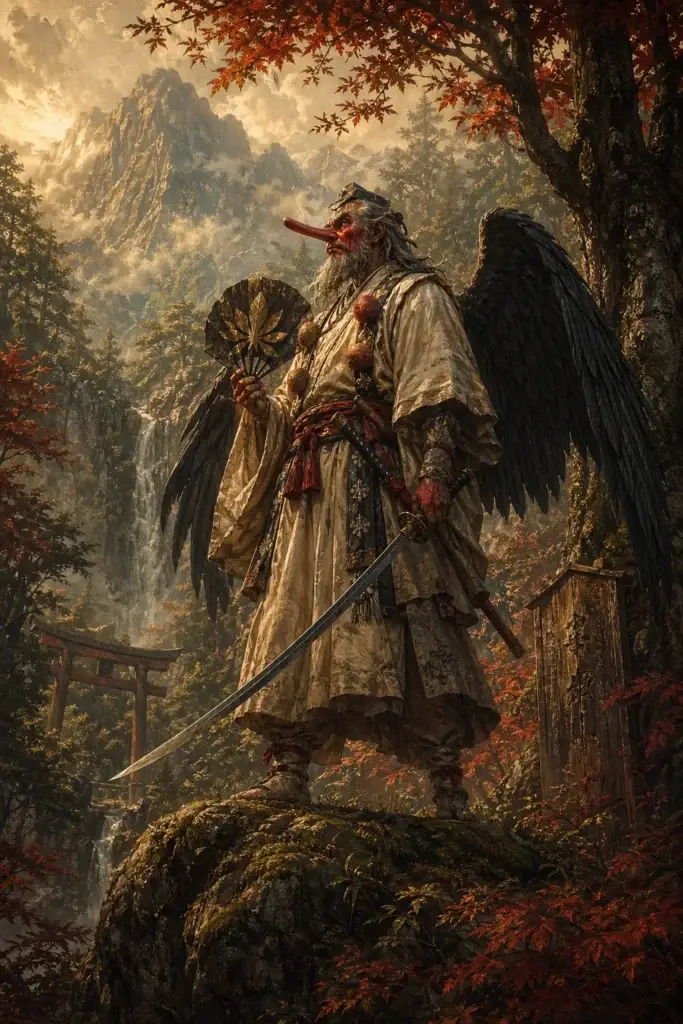
Appearance. The karasu-tengu has a raven or bird-of-prey head, clawed hands and wings; it wears the garb of a yamabushi (small cube-shaped forehead cloth, conch horn, sword). The yamabushi-tengu is human, with a red face, bushy eyebrows and the characteristic long nose; it likewise wears yamabushi garb and carries a feather fan.
Equipment. Feather fan (hauchiwa) for stirring up storms, long sword, conch horn (horagai), geta with a high single tooth.
Behaviour. Tengu live in mountain monasteries and forests, drive off intruders, abduct ascetic monks, and test warriors for courage. One tradition reports that Minamoto no Yoshitsune learned swordsmanship from Sōjōbō on Mount Kurama.
Morphological Diversity: Long Nose versus Bird Head
The visual depiction of the Tengu shows a characteristic morphological divergence between two archetypes. The Karasu-Tengu (crow tengu) takes a bird-headed shape with feathers and claws, frequently with black coloration and a pointed beak.
The Yamabushi-Tengu or Daitengu, by contrast, is often depicted with an elongated red or golden nose, a humanoid body, and frequently in yamabushi monastic robes.
This divergence reflects theological and regional differences: the crow tengu are associated with chaotic mountain natural forces, while the nose-bearing tengu stand in intellectual, cultural opposition to humans, often characterized as learned ascetics. Edo-era iconography normalized this diversity of forms into canonical woodblock-print motifs that to this day dominate the popular iconography of the Tengu.
Profile: Tengu
The most important aspects of Tengu at a glance.
Chinese “heavenly dog” concept, merged with the Japanese mountain cult and shugendō asceticism.
Ascetic monks (yamabushi), proud Buddhist dignitaries, warriors on the path to mastery.
Raven-like or red-faced human figure with wings; yamabushi garb, feather fan, long sword.
Child abduction, seduction of monks into vanity, the stirring up of windstorms, the sudden disappearance of people (kamikakushi).
Sutra recitation, humility and the avoidance of arrogance, veneration of the mountain shrines, avoidance of certain passes after nightfall.
Chinese tiāngǒu; in Korea there is no direct equivalent (the kkachi-horangi is the folk-art motif of the magpie and the tiger); the Garuda of the Indian-Buddhist tradition.
Practical Defence
Avoidance of a proud bearing. In setsuwa literature, tengu seduce especially proud monks; the classic countermeasure is inner humility and strict asceticism.
Sutras and mantra. The recitation of the Heart Sutra and of the mantras of Fudō Myōō and Shōten was considered effective for warding off tengu influence.
Mountain shrines. At many sacred mountains, tengu are venerated as protective deities; visitors bring sake, travel with reverence, and avoid the paths after nightfall.
Tengu masks. Red-faced masks with a long nose hang in many households as an apotropaic sign; the symbol protects through the presence of the protective being itself.
Tengu, Parallels in Other Cultures
China. The tiāngǒu as a shooting-star omen and heavenly dog is the direct lexical model; the iconography develops independently in Japan.
India/Buddhism. Garuda as a bird-shaped deity forms a model for the karasu-tengu iconography.
Korea. A direct equivalent is lacking; mountain deities exist but are differently configured.
Europe. Parallels to winged mountain and wind spirits (harpies, Nordic mountain trolls) exist typologically, not historically.
Shugendo and the Yamabushi Connection
Shugendo (the way of mountain asceticism) established a direct religious link between Tengu and yamabushi (mountain monks) that remains alive in ritual practice to this day. Shugendo texts classify Tengu not primarily as evil, but as a dangerous supernatural power that can only be controlled or sublimated through specific ascetic practices.
The yamabushi order developed protective techniques against Tengu influence, combining Shinto purification with Buddhist mantra recitation. Historical accounts document cases in which yamabushi masters deployed supernatural powers against Tengu manifestations in public confrontations.
This connection made the Tengu into religious instances of testing: whoever could withstand Tengu influence proved spiritual maturity and entitlement to higher consecration within the Shugendo system.
From Bird of Ill Omen to Mountain Demon
The Tengu has a long and highly changeable history in Japan. The character with which its name is written means literally heavenly dog and comes from China, where it designated a kind of ill-omened or comet creature.
In Japan, however, the name was transferred to a quite different figure, and the earliest tangible Japanese conception of the Tengu is that of a bird-like, beaked being.
In medieval literature, especially in Buddhist-influenced narrative collections such as the Konjaku monogatari from the twelfth century, the Tengu is above all a disruptive, dangerous power. It is regarded as a reincarnation form of people who were too proud, too wrathful or religiously deluded, in particular of arrogant monks.
The Tengu lures ascetics from the right path, abducts people, causes fires and feigns false religious apparitions. In this phase it is an opponent of true Buddhism.
The later, more familiar figure with a long nose, red face and more human body develops only gradually out of the bird-shaped Tengu.
Scholarship, for instance the work of Haruko Wakabayashi, has shown that over the course of the Middle Ages the Tengu changed from a purely negative being into an ambivalent figure. This transformation is closely bound up with the history of the Japanese mountain cult and of ascetic Buddhism.
Karasu-Tengu and Yamabushi-Tengu
The tradition distinguishes two main types of Tengu that reflect different stages of development. The karasu-tengu, the crow tengu, is the older, more animal form: a being with a bird head, beak, wings and claws.
The yamabushi-tengu is the younger, more human form with a long red nose, a red face and the clothing of a mountain ascetic.
The clothing in particular is revealing. The long-nosed Tengu typically wears the garb of the yamabushi, the mountain ascetics of Shugendo, a current that combines Buddhist, Daoist and indigenous elements and seeks its practice in the mountains.
It often holds a feather fan, the hauchiwa, with which it can create storms, and sometimes a small shrine or a staff. This iconography links the Tengu closely with the sacred mountains of Japan.
Certain mountains are regarded as seats of the Tengu, above all Mount Kurama near Kyoto and Mount Takao. A particularly well-known narrative tradition is connected with Mount Kurama: the Tengu Sojobo, a king among the Tengu, is said to have taught the young warrior Minamoto no Yoshitsune there in swordsmanship and battle tactics.
In this story the Tengu no longer appears as an enemy of religion, but as a teacher who imparts extraordinary abilities to a chosen human. The change from seducer to teacher is one of the most striking features of Tengu history.
Tengu between Shrine, Mask and Theatre
The Tengu is firmly anchored in Japanese material culture. Its red, long-nosed face is among the best-known masks of the country and appears at festivals, at shrines and in homes as an object of defence.
The mask is regarded as protection, meant to keep misfortune at bay, and the oversized nose has in part been interpreted as a symbol of luck and fertility. Some shrines, especially those on Tengu mountains, preserve large Tengu masks as cult objects.
In theatre the Tengu appears in both No and Kabuki. In the No play Kurama tengu, the encounter of the Tengu with the young Yoshitsune is dramatized. Here the ambivalent nature shows itself especially clearly: the Tengu is fearsome and supernatural, but also a helpful mentor.
In folk belief the notion remained alive that the Tengu can abduct children; the so-called tengu kakushi, hiding by the Tengu, was a widespread explanation for the trackless disappearance of children.
From the perspective of religious studies the Tengu is interesting because the change in the assessment of mountain asceticism can be read from it. As long as Shugendo was suspect to established temple Buddhism, its practitioners and the Tengu associated with them appeared suspicious and dangerous.
With the growing recognition of mountain religion, the Tengu too was upgraded, from an arrogant demon to a guardian of the mountains and a keeper of secret knowledge. Today the Tengu is a largely benevolent, if respect-commanding, figure of folk belief, without the dark layers of its history having entirely disappeared.
Further Links
Research Literature
The protective practice described here is a religious-studies classification of historical traditions. iWell Guard ties in with this cultural-historical line of wearable protective objects and represents a contemporary form of it. More about the iWell Guard →
Frequently Asked Questions about Tengu
What is a Tengu in Japanese mythology?
Tengu are mountain beings of the Japanese Shinto-Buddhist tradition, usually depicted as warlike, bird-like beings with long red noses or beaks.
They are regarded as masters of swordsmanship and of military cunning; many samurai legends tell of sword pupils who were taught by Tengu in the mountain forest. Tengu are ambivalent: now protectors of mountain shrines, now tricksters who punish arrogant monks.
What is the difference between Karasu-Tengu and Yamabushi-Tengu?
Karasu-Tengu (crow tengu) is the older form, a bird-like being with a beak, black feathers and crow wings. Yamabushi-Tengu (mountain-priest tengu) is the later form, humanoid, with a long red nose, dressed like a mountain ascetic (yamabushi monk). The transformation reflects the merging of Tengu belief with Buddhist yamabushi asceticism.