Alp, Spirit of the Germanic Tradition
By Ralf Ittermann · last reviewed on
The nocturnal pressure spirit of German folk belief.
Alp
Alp is a spirit of the Germanic tradition.
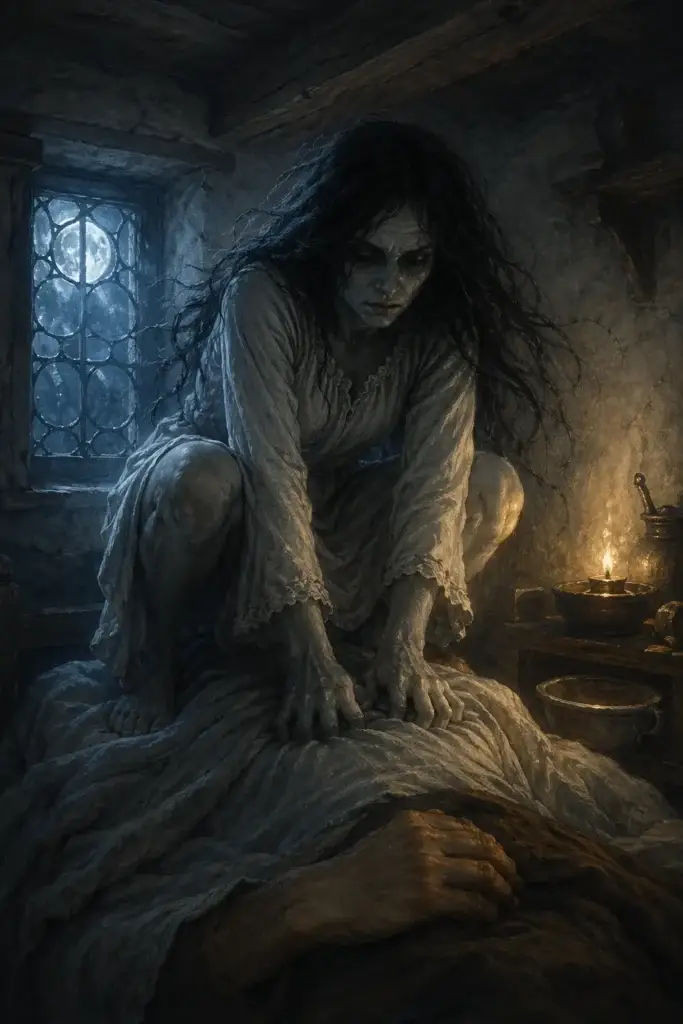
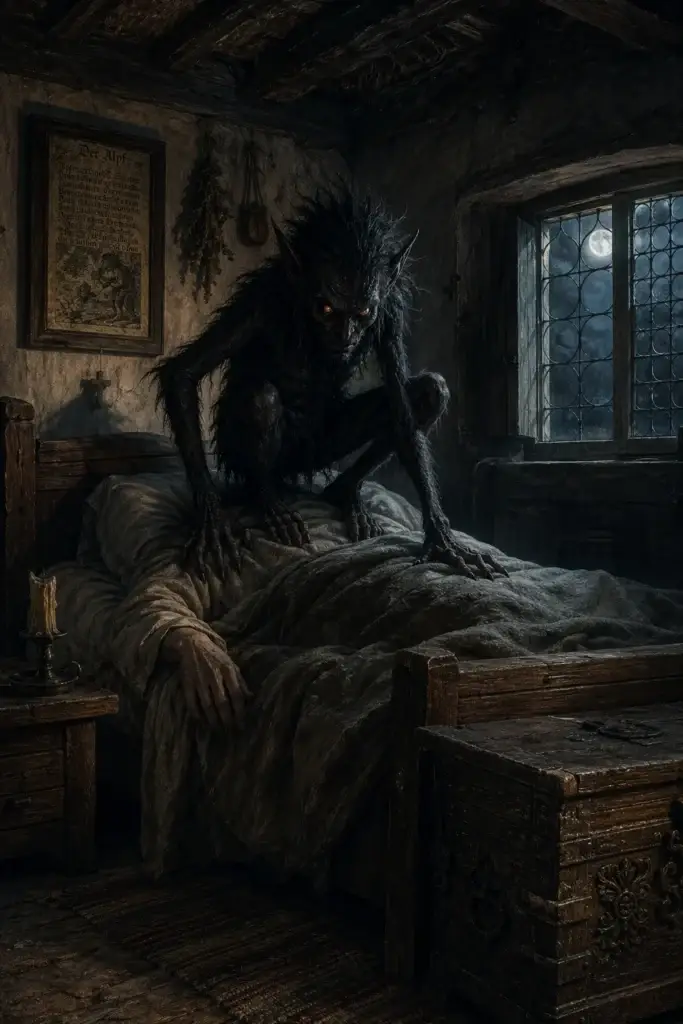
The Alp is the classic figure of sleep paralysis in Central European folk belief. A small, heavy spirit settles on the chest of the sleeping person at night, takes away their breath, and induces nightmare experiences.
The German word “Albtraum” (nightmare) preserves this figure in everyday vocabulary to this day, making it one of the few medieval demon names that has remained linguistically intact.
The tradition extends from Middle High German literature and legal sources through the Grimm collections to modern ethnographic archives.
The Alp is culturally closely related to the Mahr (originally feminine) and to the English mare in the word nightmare. It is warded off by marks on the threshold, a knife under the pillow, prayers, and folk apotropaic formulas.
Middle High German Sources and the Malleus Maleficarum
The lines of Alp tradition can be traced back to Middle High German. Wilhelm Grimm documented accounts of nightmares and nocturnal visitations in his collections, in which a demonic being sat on the chest of the sleeper and threatened to strangle them.
The term itself appears in various regional variants: Alb in Swabia, Alp in Bavaria, Elf in Holstein. This variation points to a folk tradition distributed across centuries, in which the nature of the being remained stable while the nomenclature diverged by region.
In the Malleus Maleficarum (Heinrich Kramer and Jacob Sprenger, 1487), cases of nocturnal affliction by demonic forces are described. Although the Alp is not named there explicitly, the symptoms described (paralysis, breathlessness, visions of oppressive weight) correspond to accounts from later folklore.
The witch-hunters interpreted these phenomena as demonic intervention, not as a physiological sleep disorder as nineteenth-century medicine would later do.
Quick Overview: Alp
Type: Nocturnal pressure spirit, nightmare bringer
Origin: Small spirit, often associated with the dead or witches
Texts: Middle High German legal sources, Grimm, ethnographic collections
Period: Early Middle Ages to the present (linguistically to this day)
Warding off: Pentagram (Drudenfuss), shoes placed backwards, knife under the pillow
Historical Classification
Attested early in Middle High German literature (Nibelungenlied, Walther) and in legal sources (harmful magic). Richly documented in collections of the 19th and 20th centuries (Grimm, Wolf, Müller-Bergström). As a word, still present today in “Albtraum” (nightmare).
The German-speaking world; similar figures with other names (Nachtmahr, Drude, Trud) in surrounding regions. The English compound nightmare derives from the Mahr variant.
Middle High German texts, legal sources (witchcraft trials), Grimm’s Deutsche Mythologie, ethnographic archives of the 19th and 20th centuries, and modern sleep research as a secular continuation.
Name and Variants
Middle High German: alp, alb. Etymologically related to “Elf”; the Alp is originally an elf in a negative function.
Regional variants: Trud/Drud (Bavarian), Nachtmahr (widespread), Walrider, Doggeli (Swiss), Mart (Low German).
English: mare in nightmare.
The equation Alp = Elf surprises only at first glance: in the older Germanic conception, elves were ambivalent beings, not the friendly figures of later folklore. “Elf-shot” for sudden illness belongs to the same complex.
Characteristics
Appearance
Small, heavy, often nondescript. In some accounts taking animal form: cat, spider, weasel, sometimes a distorted child. Rarely fixed in visual terms; more often perceived as pressure and weight.
Behavior
Enters at night through keyholes, chimneys, or door cracks. Settles on the chest of the sleeping person, removing breath and movement. The victim cannot cry out or flee. By current sleep research standards, this is classic sleep paralysis symptomatology.
Domain
The sleeping space, especially on certain nights (threshold days, full moon). In rural traditions, also horses: the Alp “rides” the horse at night, and in the morning its mane is found tangled.
Mythological Classification
Originally an elf figure, shifted in folk belief toward a threatening pressure spirit. In Christian reinterpretation, understood partly as a demon or as the soul of a witch. In modern interpretation, sleep paralysis as a neurological phenomenon.
Sleep Paralysis and Cultural Interpretation
Modern medicine knows this state as sleep paralysis or isolated sleep paralysis. It occurs when consciousness awakens during REM sleep while the body remains paralyzed by the natural muscle-tone suppression of dreaming.
Patients report hallucinations, breathlessness, and the sensation of oppressive weight on the chest; often a perceived threatening presence in the room accompanies the episode.
Cultural interpretation fluctuated between the supernatural and the medical depending on period and region. In the German-speaking world, the Alp long remained the accepted explanation for these phenomena. David Hufford documented the phenomenological consistency of these experiences across cultures in The Terror that Comes in the Night (1982).
The lines of Alp tradition did not disappear with secularization but were reinterpreted. Psychological and therapeutic literature of the twentieth century partly drew on folklore collections to contextualize sleep disorders historically. The Alp remained a cultural archive for the unknown that initially eluded rational explanation.
Profile: Alp
The most important aspects of the Alp at a glance.
Derived from the Germanic conception of elves; transformed in folk belief into a threatening pressure spirit. In Christian reinterpretation, understood partly as a demon, partly as the soul of a witch.
Sleeping people, particularly those lying on their backs. In rural tradition, also horses in the stable.
Small, heavy, shapeless. Can take animal form (cat, spider, weasel). More often perceived as pressure than seen.
Pressure on the chest, inability to move, breathlessness, intense nightmares. Modern interpretation: sleep paralysis.
Pentagram (Drudenfuss) on door and bed, shoes placed backwards in front of the bed, knife with blade facing upward under the pillow, St. John’s wort placed under the bed, prayers.
Mahr, Lilū and Lilītu, Empusa, Strix, Slavic Kikimora, and modern sleep paralysis research.
Protective Practice
Threshold and Bed Protection
A pentagram (Drudenfuss, one point facing upward) on the door or above the bed. Shoes placed backwards in front of the bed are said to confuse the Alp. A knife with the blade facing upward under the pillow is attested throughout Central Europe.
Verbal Formulas
Short folk sayings spoken at bedtime. The Alp is to be addressed by name, whereupon it must give its own name to the caller and then departs. Folk belief knows “Alp-callings” as an apotropaic practice.
Horse Protection
In the stable: horseshoes, an Alp mirror (a small reflective metal piece), burning lanterns. In some regions, the horse is fitted with a collar of bells; the Alp is said to fear their ringing.
Parallels and Modern Interpretation
Worldwide Parallels: Lilū/Lilītu in Mesopotamia, Empusa in Greece, Strix in Rome, Kikimora in the Slavic world, Baka Jaga in certain nocturnal forms. Everywhere the same structure: a female or small-statured night spirit that afflicts sleepers.
Sleep Research: Modern sleep laboratory research identifies the symptomatology as sleep paralysis, the transition from REM sleep in which muscle atonia and consciousness overlap. Ethnographic research demonstrates cross-culturally identical phenomenological descriptions of the experience.
Reception: The Alp lives linguistically to this day in “Albtraum” (nightmare). Füssli’s famous painting “The Nightmare” (1781) is the best-known artistic treatment of the subject. Modern horror literature and film draw on the motif.
Relationship to the Mahr and Other Night Spirits
The Alp is closely related to the Mahr; both are night spirits that sit on sleeping humans and cause oppression. The difference often lies only in grammatical gender and regional distribution: where the Alp (masculine or neuter) appears, the Mahr (feminine) may explain the same phenomenon in neighboring regions.
Scandinavian counterparts such as the Norwegian Mareritt and the Icelandic Mara point to a Germanic root that spread across northern and central Europe.
In comparative religious studies, the Alp is sometimes classified as a subtype of demon, but is often treated as an independent category of beings, because the locality and recurrence of the experiences seem more characteristic than the abstract malice of a classic demon. This boundary remains debated in the scholarly literature.
The Alp and the Word "Nightmare"
The clearest trace the Alp has left in the modern language is the word Albtraum (alongside the older spelling Alptraum), the German word for nightmare. It literally denotes the dream caused by the Alp.
This linguistic finding leads directly to the core of the Alp conception: the Alp is above all a pressure spirit, a being that settles on the sleeper at night, weighs down the chest, and thereby produces heavy, frightening dreams together with a feeling of suffocation and paralysis.
The word family reaches far back. It is related to the Old Norse alfr, which designates the elves or Alben, and to the English elf.
In English, the old conception survives in the word nightmare, whose second element mare belongs to the same root area as the German Mahr. These cross-linguistic connections show that the conception of a nocturnal pressure being was very old and widespread in the Germanic-speaking world.
From the standpoint of linguistic history, it is notable that the Alp originally appears to have belonged to the Alben, that is, to an entire class of nature beings, and only later narrowed to the specific function of the nocturnal oppressor.
Research into Germanic mythology and historical folklore studies has shown that the meaning of the word shifted several times: from a general spirit being to a pressure spirit and finally to the almost exclusively figurative meaning preserved in the word Albtraum.
The Alp is thus an example of how a mythological conception survives in language long after belief in the being itself has faded.
Sleep Paralysis: The Medical Core of an Ancient Belief
The Alp conception is a well-studied example of how a real physical experience is interpreted culturally. The experience underlying the Alp narrative corresponds in many respects to what modern sleep medicine describes as sleep paralysis.
In this state, consciousness awakens while the muscular relaxation characteristic of dream sleep persists. The person affected is awake but cannot move, often perceives pressure on the chest, breathlessness, and fear, and not infrequently also perceives a threatening presence in the room.
This experience is attested across all cultures and periods, and in almost every case it was explained by an attacking being. German folk tradition interpreted it as the work of the Alp; other cultures know comparable pressure spirits.
Cross-cultural research on sleep paralysis has shown that the basic physical symptoms are remarkably stable, while interpretation varies from culture to culture. The being one believes one perceives carries the features that the local tradition assigns to it.
This insight does not devalue the Alp conception but makes it comprehensible. It explains why belief in the Alp was so widespread and so persistent: it rested on a recurring, compelling experience for which there was no other explanation before modern sleep research.
Ethnographic and religious-studies scholarship therefore sees the Alp as a model case for the intertwining of physical experience and cultural interpretation. The experience was real, the explanatory being was a cultural construction, and together they formed a belief complex that remained stable over centuries.
Related Beliefs and the Mahr
The Alp does not stand alone but belongs to a cluster of closely related conceptions of the nocturnal pressure spirit. Its most important relative is the Mahr, which fulfills the same function across large parts of the German-speaking world: it presses the sleeper, rides them, weighs down their chest.
In some regions the two terms were used side by side; in others, one or the other predominated. This regional distribution is a well-documented field of historical folklore studies.
Characteristic of the entire conceptual complex is the blending of several images. The pressure spirit is conceived partly as an independent spirit being and partly as the projected soul of a living person who afflicts others consciously or unconsciously.
In this second interpretation, the Alp conception merges with witch belief: a particular person in the village could be suspected of coming to others as an Alp. A nocturnal experience thereby became a social problem capable of generating suspicion and blame within the community.
The transmitted means of warding off the Alp and their underlying logic are also explained by this conceptual world. Since the Alp entered through an opening such as a knothole or a gap, such openings should be closed. Since it could be made to count, giving it a counting task helped.
Since it had to leave by the same path it entered, it could be trapped by blocking the entrance. These measures make sense only against the background of a specific model of how the Alp operates.
Religious-studies research therefore reads such apotropaic practices as a key to the underlying conception: from what people did against the Alp, one can reconstruct what they thought about it.
Further Links
Further reading:
- Germanic
- Mahr (close relationship), Draugr, Nix, Troll
- Lilū and Lilītu, Empusa
- Sleep paralysis research
Research Literature
Further standard works in the literature index.
The protective practices described here represent a religious-studies classification of historical traditions. iWell Guard connects to this cultural-historical line of wearable protective objects and represents a contemporary form of it. More about the iWell Guard →
Frequently Asked Questions about the Alp
What is an Alp in Germanic mythology?
The Alp is a nocturnal harmful spirit of the Germanic-German tradition that settles on the chest of sleeping people and causes nightmares. The German word “Albtraum” (nightmare) derives from the Alp (an older attested form is “Alpdruck”, meaning the pressure of the Alp).
In modern sleep research, the phenomenon is described as sleep paralysis, the temporary inability to move during the transition into REM sleep, often accompanied by a sensation of pressure, breathlessness, and vivid hallucinations.
How did folk belief protect against the Alp?
Traditional folk medicine knew numerous apotropaic practices: placing shoes backwards in front of the bed, laying an open knife under the pillow, sticking an iron needle into the bed, reciting the Lord’s Prayer before sleep, drawing a pentagram on the door.
In northern Germany, the Alp was also driven away by a spoken formula (“Alb, Alb, go away, you do not belong here”).