Hel, Goddess of the Germanic Tradition
By Ralf Ittermann · last reviewed on
Hel is a goddess of the Germanic tradition.
Mistress of the realm of the dead, daughter of Loki and the giantess Angrboda, sister of the wolf Fenrir and the Midgard serpent Jormungandr. Hel receives the souls of all those who did not fall in battle, that is, those who do not enter Valhalla or Folkvang.
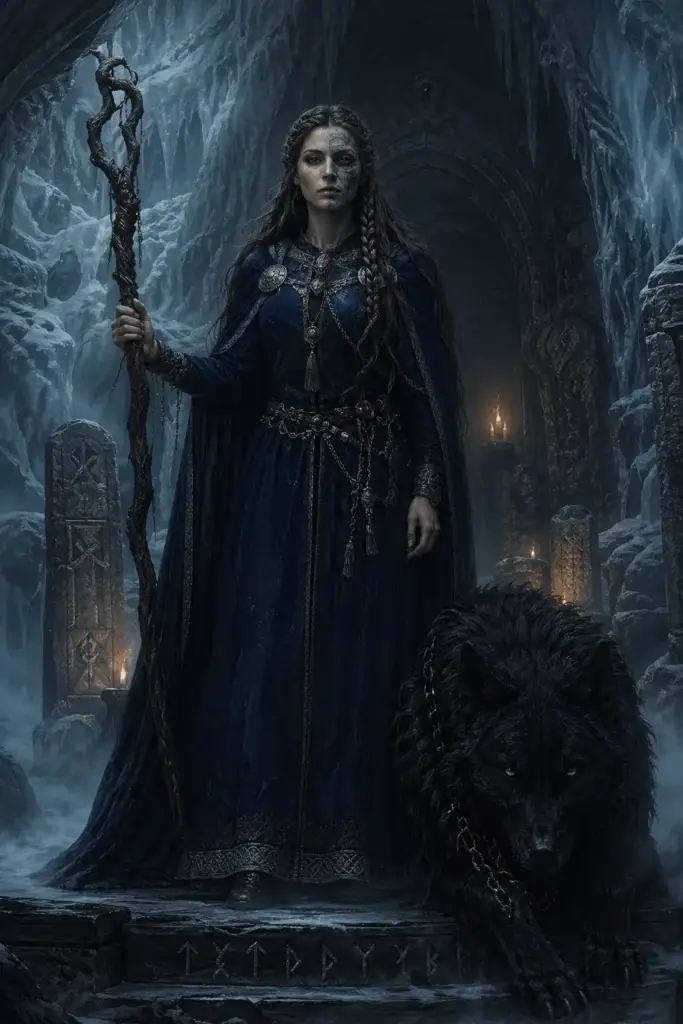
Her realm Helheim is not a place of torment but a neutral land of the dead for those who died of illness, old age, or ordinary causes. She is depicted as half alive and half decayed, a symbol of the threshold between life and death.
Hel is the death goddess of Germania and the daughter of Loki.
Hel
Quick Overview: Hel
Type: Death deity, mistress of the underworld
Pantheon: Germanic (Norse)
Function: Mistress of the realm of the dead Helheim, receiver of the dead, keeper of the boundary between life and death
Main attributes: Halved face (alive and decayed), black robe, the hound Garm, the bridge Gjallarbru
Abode: Helheim (realm of the dead), the hall Eljudnir, the river Gjoll
Germanic parallel: (none, distinct within Norse mythology)
Historical Classification
Period of the Texts
The tradition concerning Hel derives from the literary sources of the High Middle Ages, yet springs from older oral tradition of the Viking Age and the Migration Period.
The Prose Edda (earliest manuscripts from the thirteenth century) and the Poetic Edda (written down around 1270, but going back to poems from the ninth to eleventh centuries) are the main sources.
Saxo Grammaticus’ Gesta Danorum (around 1200) offers parallel accounts with a Christian coloring. Shrine and grave finds from the sixth to tenth centuries suggest that Hel played no central role in cult practice but was firmly anchored in eschatological awareness.
Area of Distribution
Hel was a concept of Scandinavian and Germanic mythology, widespread in Scandinavia (Denmark, Norway, Sweden), Iceland, and in territories under Danish and Norwegian control. The Edda tradition is Icelandic and Scandinavian.
Linguistic derivations of the name (English “Hell” for the Christian place of damnation) show that the name was also current in Anglo-Saxon settlement areas. With Christianization (from 1000 CE onward) Hel and Helheim were reinterpreted as a model for the Christian conception of Hell.
State of the Sources
The central sources are the Prose Edda, especially Gylfaginning (chapters 34 and 49), the Poetic Edda (especially Voluspa and Vafthrudnismal), as well as Saxo Grammaticus’ Gesta Danorum. The prose preface to the Poetic Edda and the prose introductions provide genealogical contexts.
The mythical reference “Baldrs draumar” (Baldur’s Dream) describes Odin’s ride to Hel to inquire about Baldur’s fate. Archaeological finds from graves, runestones, and skaldic poetry round out the picture but are sparse regarding Hel’s specific person.
Name
Old Norse: Hel (nominative: Hel, genitive: Heljar), a female being, meaning “the concealing one” or “the hiding one” (related to hehlen, “to conceal,” “to veil”). Epithets: No independent epithets are preserved, but Old Norse literature refers to her as “mistress of the realm of the dead” (Drottning hins dauða rikes).
Christian reception: In the Middle Ages the name Hel became the direct model for the Christian conception of “Hell” (English “Hell,” Middle High German “Hölle”), especially through Icelandic and Scandinavian Christians who had allegorized the heathen underworld.
Germanic kin: Scandinavian-Germanic, no direct name relatives in other cultures. Family: Daughter of the god Loki and the giantess Angrboda. Sister of the wolf Fenrir (Fenrir) and the Midgard serpent (Jormungandr). As mistress of Helheim, she commands Ganglati and Ganglot.
Description
Appearance
In Old Norse sources Hel is depicted as half and half: one side of her body is bright, alive, and of blooming flesh, the other side dark blue to black like a corpse. This iconic depiction symbolizes her position at the threshold between life and death.
She wears black or dark green robes. Her face, half beautiful and half decayed, shows neither malice nor mercy, only the inescapable nature of mortality. She sits on a throne in her hall Eljudnir (drizzling rain or place of dampness).
Nature and Activity
Hel is not evil in the Christian sense but neutral, a cosmic force. She administers the realm of the dead without passion. Whoever comes to her remains, unless the gods or others obtain a return (which happens extremely rarely, attempted only for Baldur).
She receives all the deceased who did not die in battle: women, children, the old, the sick. In this her realm differs fundamentally from Valhalla (for fallen warriors) and Folkvang (for the goddess Freya). Unlike Hades, Hel is not portrayed as a judge who decides upon merits, but as the administrator of an unavoidable fact.
Profile: Hel
The most important aspects of Hel at a glance. The table summarizes origin, function, appearance, veneration, symbols, and parallels.
Daughter of the god Loki and the giantess Angrboda, in Old Norse Angrbodhe. Loki is himself not a god in the higher sense but a giant who moves within the fellowship of the Aesir.
Angrboda is a giantess, the mother of Loki’s children. Hel’s siblings are the wolf Fenrir and the Midgard serpent.
Mistress of the realm of the dead Helheim. She receives and administers the souls of those who did not die in battle. She is not a judge but an administrator of the cosmic order. She keeps the boundaries of Helheim and permits no return unless the gods or other powers expressly grant it.
Half alive, half decayed. One side of the body blooms and is rosy, the other is swollen blue and black like flesh long after death. Black or dark green robes. Eyes without warmth, but also without malice, inexhaustibly neutral. She often wears a crown or diadem of bone.
Hel's Veneration
Hel was not a popular cult deity in the sense of temples or regular festivals. She was, however, mentioned in sagas and oaths.
In skaldic poetry Hel was used metaphorically for the fear of death and for the past. No offerings are specifically recorded.
Hel's Symbols
The half-and-half divided face, black robes, the hound Garm (guardian before Helheim), the bridge Gjallarbru (resonance bridge over the river Gjoll), the hall Eljudnir, the table Hunger, the spoon Slaegr (sloth).
Hades (Greece, functionally similar but male), Ereshkigal (Mesopotamia, likewise a female mistress of the underworld), Yamaraja (Hinduism, neutral administration of the realm of the dead), Persephone (Greece, an ambivalent aspect of life and death), Hekate (Greece, threshold function), Mictecacihuatl (Aztec, mistress of the realm of the dead, female).
Mythical Roles and Stories
The Abduction of Baldur and Hel’s Promise
The best-known story in which Hel figures centrally is the death of Baldur, the fairest of all gods.
Loki tricks the blind god Hodur into casting a sprig of mistletoe at Baldur, the only substance that could harm him (because all other beings and things had promised to do him no injury). Baldur dies and falls into Hel’s realm.
The gods send Hermod, Odin’s messenger, down on Sleipnir (Odin’s eight-legged horse) to ask Hel for Baldur’s return. Hel promises: Baldur may return if all living things weep for him. Almost everything weeps, gods, humans, animals, stones.
Only the old giantess Thokk (or Loki in disguise) refuses to weep. Therefore Hel keeps Baldur with her. This myth shows Hel as incorruptible and immovable: her power over death is greater than the power of the gods themselves.
Hel, Parallels in Other Cultures
Greek tradition: Hades (male ruler of the underworld) shares with Hel the function of administrator and neutral force. Unlike Hel, however, Hades also involves moral judgments and hierarchies (the Furies, Elysium vs. Tartarus). Helheim has no such distinction; it is for all the dead without a judgment of the soul.
Mesopotamian tradition: Ereshkigal (mistress of the underworld Irkalla, female, like Hel) shows a similar neutrality. The story of Inanna’s descent to Ereshkigal has structural parallels to the Baldur story: a powerful figure is brought down to a female ruler of the underworld and returns (in part), but the conditions are inexorable.
Egyptian tradition: Osiris is a just judge rather than a mere administrator; Anubis is a guide. Hel combines both functions, without the moral-juridical layer.
Hindu tradition: Yamaraja (ruler of the realm of the dead Yamaloka) shares with Hel neutrality and inevitability. Unlike Hel, however, Yamaraja is not bound to a place but regularly visits the world.
Celtic tradition: The banshee and other otherworldly figures are companions rather than rulers. Gwydion and the Celtic underworld Annwn are less personified than Hel’s quite concrete figure.
Christian Reception and Etymology
With the Christianization of Scandinavia (from around 1000 CE) the heathen Hel and her realm Helheim became a metaphor for the Christian Hell. Icelandic homiletic texts and sermons of the twelfth to fourteenth centuries speak of “Helheim” as Hell, of Hel’s messengers or demons as fighters of Hell.
The Old Norse name Hel (the concealing one, the veiling one) was reinterpreted into the English “Hell” and the Middle High German “Hölle”; the etymological connections are disputed, but the semantic equation is attested in the sources. The name Hel thus underwent a transformation from a cosmic force into a symbol of damnation.
The State of the Sources: Snorri Sturluson and the Problem of Systematization
Almost everything that counts as a coherent picture of the death goddess Hel derives from a single source: the Prose Edda of the Icelandic scholar and politician Snorri Sturluson, composed in the early thirteenth century.
In the Gylfaginning Snorri describes Hel as the daughter of Loki and the giantess Angrboða, as the sister of the wolf Fenrir and the Midgard serpent, half dark and half of ordinary skin color, and he recounts how Odin cast her into the underworld and gave her power over all who die of illness and old age.
This self-contained portrayal must be read with caution. Snorri wrote more than two centuries after the Christianization of Iceland. He was a Christian-educated author who sought to order, explain, and shape the heathen material in literary form.
Scholarship has long debated how much of Snorri’s Hel goes back to old tradition and how much is his own systematization, possibly influenced by the Christian conception of Hell that already resonated in the Old Norse word hel.
The older sources, the lays of the Poetic Edda and skaldic poetry, certainly know hel, but mostly as a place name for the realm of the dead rather than as an elaborated figure of a goddess.
The phrase “to journey to Hel” first of all simply means “to die.” Whether a personified mistress stood behind the place from the beginning, or whether the personification was only secondarily developed, cannot be decided with certainty. Anyone speaking about Hel should always note this uncertainty of the sources.
The Death of Baldur and Hel's Condition
The most important coherent narrative in which Hel appears as an acting figure is the myth of the death of the god Baldur, transmitted in Snorri’s Gylfaginning.
Baldur, the fair and beloved son of Odin, is killed through a ruse of Loki: the blind god Höðr, guided by Loki, casts a sprig of mistletoe at him, the only thing that had not sworn to Baldur to spare him. Baldur dies and journeys down into Hel’s realm.
The gods wish to bring him back. The messenger Hermóðr rides on Odin’s horse Sleipnir nine nights through dark valleys to the gate of Hel’s world. He finds Baldur seated there in a place of honor and asks Hel to release him.
Hel sets a condition: if truly all things in the world, living and dead, weep for Baldur, he may return; if even one does not weep, he remains with her.
The gods send messengers throughout the world, and everything weeps, humans, animals, stones, and trees. Only a giantess named Þökk, behind whom the tale suspects Loki, refuses. Thus Baldur remains in Hel’s realm until the end of the world.
In this episode Hel’s character becomes visible. She is neither cruel nor deceitful; she negotiates, she abides by conditions, she treats Baldur honorably. But she gives nothing without something in return, and her condition is so framed that a single resistance suffices to make it fail.
Hel embodies the non-negotiability of death in the form of a negotiation that almost succeeds. The narrative also belongs within the great arc of Norse mythology, because Baldur’s death is regarded as the first sign of the approaching Ragnarok.
Etymology and the Meaning of Concealing
The name Hel belongs to a Germanic root meaning “to conceal,” “to veil,” “to cover.” The same root lies in words for the hidden and the veiling; in German “hehlen” and “verhehlen” are related, as is “Höhle” (cave).
Hel is accordingly originally “the concealing one” or “the hidden,” and the realm of the dead that bears her name is the hidden, covered place to which the dead go.
This etymology is illuminating from the standpoint of religious history, because it shows that the name primarily designates a place and a state, not a person.
The concealing, the being-under-the-earth, the being-withdrawn-from-sight is the core. The personification as the goddess Hel would then be a second step: the hidden place receives a mistress who bears its name.
By way of the Old Norse hel the word migrated into the Christian conceptual world. When the Germanic languages were Christianized, it was natural to transfer the existing word for the realm of the dead to the Christian place of punishment.
Thus the Germanic hel became the German “Hölle” and the English hell. This transfer, however, distorted the original conception. The Old Norse Hel is not a place of punishment and torment.
It is the abode of those who die of illness and old age, in contrast to those fallen in battle, who go to Valhalla.
The moral separation into a good place and a place of punishment, which the Christian word carries with it, was foreign to the original Hel concept. Here lies one of the most persistent misinterpretations of Norse mythology.
Hel's Realm in the Topography of the Other World
Hel’s realm is part of a complex otherworldly geography that the Old Norse sources, above all Snorri again, sketch out. It lies in the north and below, reachable by the long, dark road that Hermóðr travels in the Baldur myth.
A bridge over the river Gjöll, guarded by a watcher named Móðguðr, leads across; a gate closes off the realm. Snorri gives Hel’s dwelling and implements dark, telling names that denote hunger, sickness, and decay.
The place of this realm within the overall system is not transmitted entirely free of contradiction. Besides Hel, the sources know Valhalla, the hall of those fallen in battle, and the realm of the goddess Freyja, which likewise receives a portion of the dead.
How these regions relate to one another and by what criteria a dead person reaches which one is not systematically clarified in the sources. The notion that the manner of death decides the otherworldly fate is the most common, but it does not cover all the evidence.
In addition there is the place Náströnd, the “corpse strand,” which the Völuspá describes, a hall of woven serpents in which oath-breakers and murderers suffer. Whether this place of punishment belongs to Hel’s realm or is a separate region is debated in scholarship; some see in it already a Christian influence.
The Old Norse conception of the otherworld is thus not a closed system but a juxtaposition of images from various times and regions, which the medieval compilers harmonized only incompletely. Hel’s realm is within it the largest and most general region, the place of ordinary, unspectacular death.