Ninurta, Mesopotamian god of war and agriculture
By Ralf Ittermann · last reviewed on
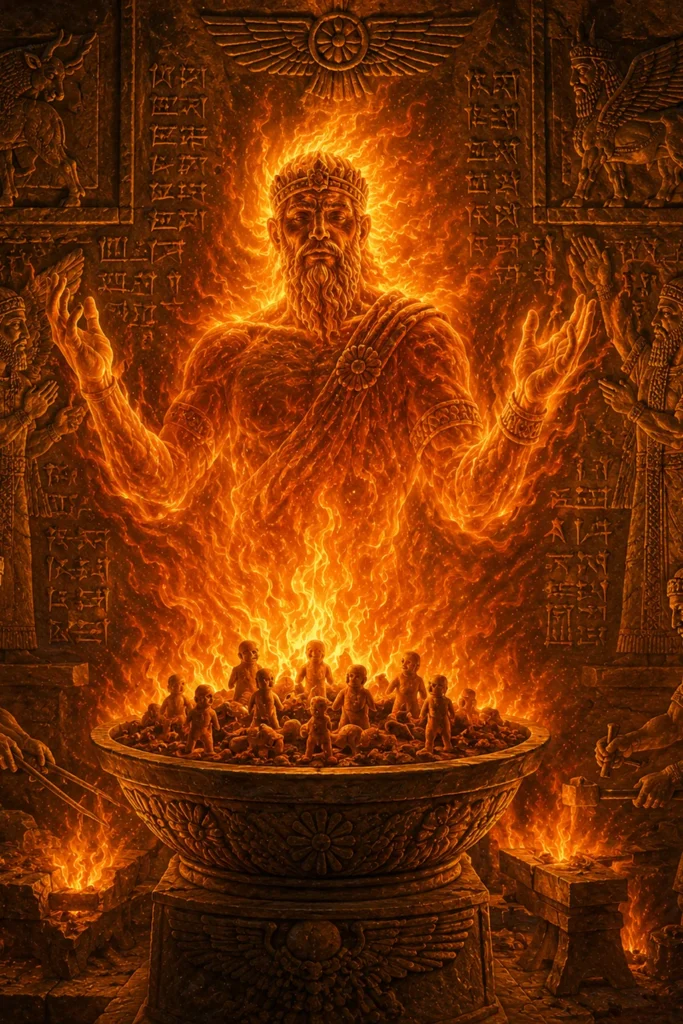
Ninurta is a Mesopotamian god of war and agriculture who was also invoked as a god of the hunt and as the vanquisher of chaos. Ninurta is a Mesopotamian god of war, the hunt, and agricultural labor.
His name unites two central poles of tension in ancient Mesopotamian religion: heroic bravery in the struggle against chaos and the ordering power of the plough.
He was venerated from the Old Sumerian period into the late Neo-Assyrian empires, with his principal cult at Nippur and a second center at Kalhu (Nimrud). His most important myth, the Anzu myth, ranks among the most striking heroic narratives of ancient Mesopotamian literature.
Myth and Origin
Ninurta appears prominently as early as the Old Sumerian sources of the third millennium BCE under the name Nin-Girsu. Nin-Girsu was the city god of the city-state of Girsu within the territory of Lagash.
In the Old Akkadian and Neo-Sumerian tradition, Nin-Girsu merged with Ninurta, whose principal cult lay at Nippur, the religious capital of Sumer. This merger is an important example of the capacity of ancient Mesopotamian religion to embed local deities into supra-regional pantheon structures.
His father is Enlil, the highest god of the Mesopotamian triad; his mother is Ninlil, Enlil’s consort. Ninurta thus belongs to the first generation after the creator deities and holds a prominent position in the pantheon.
Inscriptions of Gudea of Lagash in the 22nd century BCE name Nin-Girsu as his personal protective god and describe elaborate temple constructions in his honor, including the Eninnu, the «House of Fifty,» whose inscriptions count among the most striking literary testimonies of Old Sumerian religion.
In the Old Babylonian and Middle Assyrian periods, Ninurta increasingly took on martial traits. The Neo-Assyrian kings, above all Ashurnasirpal II in the 9th century BCE, elevated Ninurta to one of their most important imperial gods and had a magnificent temple built in his honor at Kalhu.
Assyrian royal ideology interpreted the ruler as Ninurta’s representative on earth, whose military successes brought the order of the god to bear over chaos.
The Anzu myth, in which Ninurta defeats the winged lion-eagle Anzu, is the most important mythical narrative concerning the god. Anzu had stolen the Tablet of Destinies, a magical object that guarantees the order of the world.
Ninurta is commissioned by the gods to retrieve the stolen object, which he accomplishes after several phases of combat. This narrative links the restoration of cosmic order with the heroic bravery of the hero and provides the theological foundation of his position in the pantheon.
Symbols and Attributes
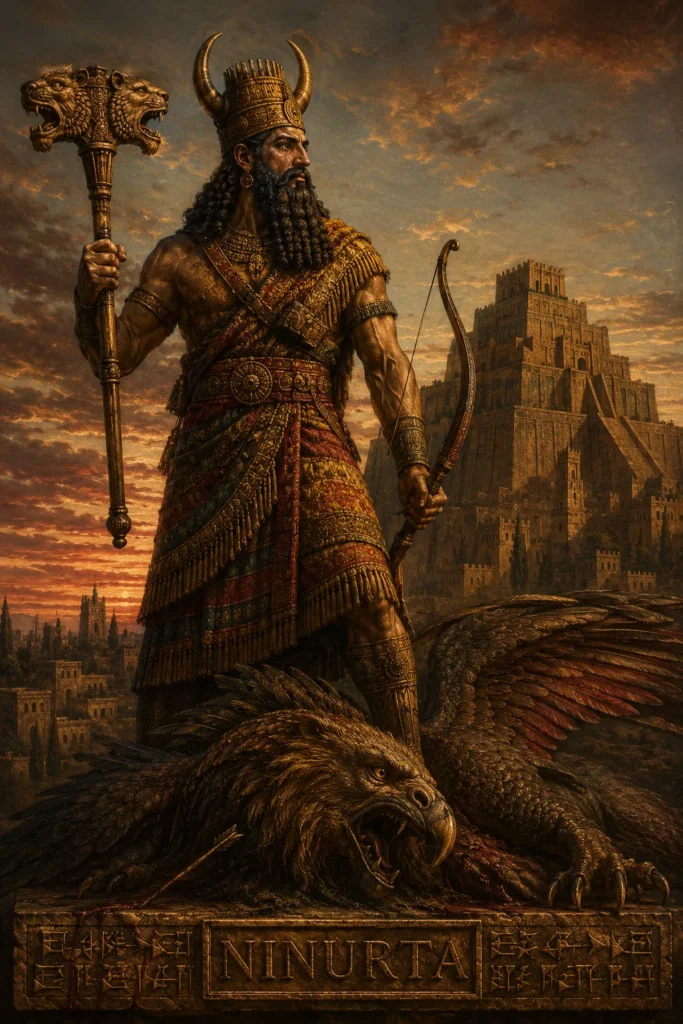
In visual art Ninurta is mostly depicted as a bearded warrior with bow, arrows, and a long mace.
The mace often bears the name Sharur, meaning «shatterer.» In some narratives Sharur is an independent figure, a speaking messenger of the god who urges him to battle against Anzu and mediates between him and the other gods.
Ninurta’s symbolic animal is the lion-eagle Anzu, the being he defeats. On seal impressions and reliefs Anzu sometimes appears beneath the god’s feet as a subjugated opponent, sometimes as his heraldic animal, since with the victory Anzu becomes a symbol of the god.
This iconographic shift is instructive for the history of religion, because the vanquished enemy becomes the emblem of the victor.
A further attribute is the plough. Ninurta is regarded at the same time as the creator of agricultural labor, and the narrative «Lugale» describes how the god shatters the mountains, covers the alluvial plain with fertile soil, and hands the plough to humankind.
This dual function as warrior and bringer of the plough makes Ninurta the embodiment of the civilizational foundations of Mesopotamian culture.
His temple at Nippur, the Eshumesha, was one of the most important buildings of the city complex.
Inscriptions describe the offering tables dedicated to him, standing and wall images, as well as processions that carried his statues through the city during festivals. At Kalhu, the Eninnu was the place where the Assyrian kings deposited dedications of spoils.
Cult and Veneration
Ninurta was venerated in both Sumerian and Akkadian contexts. The principal cult lay at Nippur, the central religious city of Sumer, whose significance endured from the Old Sumerian period into the Achaemenid era.
The Eshumesha sanctuary at Nippur was the meeting place of the Mesopotamian assembly of the gods and was rebuilt several times over the millennia. Inscriptions from the Old Babylonian period mention extensive offering meals and festival processions in which the statues of the most important gods of Nippur took part.
In Lagash and Girsu the cult of Nin-Girsu had merged with that of Ninurta. The inscriptions of Gudea, a city ruler of the 22nd century BCE, count among the most detailed sources on the temple cult.
They describe ritual purification, the felling of timber in Lebanon, the procurement of precious stones from Magan and Meluhha, as well as the production of statues, all at the god’s behest. These texts are composed in elegant Sumerian hymns and rank among the literary achievements of Mesopotamia.
In the Neo-Assyrian empire Ninurta was, alongside Ashur, the chief god of Assyria, the most important imperial god. Ashurnasirpal II had an enormous Ninurta temple erected in his new capital Kalhu (Nimrud), whose outer walls were decorated with relief scenes of his military campaigns.
The Assyrian kings styled their campaigns as repetitions of Ninurta’s struggle against chaos and presented the god with extensive dedications of spoils.
In popular religion Ninurta was especially favored among farmers and soldiers. Hymns from the Old Babylonian period praise him as a giver of rain and harvest. Healing texts invoke him when demons are to be warded off, especially in connection with stomach ailments and complications of childbirth.
In the late tradition he was partly merged with Nergal, the god of the underworld and of plague, because both gods were regarded as key figures in the administration of life and death.
Important Myths
The Anzu myth is the central text. Anzu, a giant lion-eagle, at first serves the god Enlil and then steals the Tablet of Destinies, the highest symbol of cosmic order. The gods deliberate over who can remedy the damage. Several candidates decline, until at last Ninurta accepts the task.
Three phases of combat follow, in which Anzu, through his particular power over the wind, can bend back Ninurta’s arrows. Only on the advice of Ea or Sharur does Ninurta succeed in severing the life-thread of Anzu.
With the recovery of the Tablet of Destinies the hero restores the order of the world. Stephanie Dalley and Wilfred Lambert reconstructed the standard version across several tablets.
A second narrative, «Lugale,» preserved in Sumerian and Akkadian versions, recounts Ninurta’s battle against the stone warrior Asakku and his hosts in the mountains. Ninurta defeats Asakku, piles up the scattered stones into a great dam, and thereby creates the foundations for cultivation in the plain.
He then holds judgment over the stones according to their conduct in battle: useful stones receive functions in the cult, harmful ones are banished into the ground. This mythical etiology of geology is unique in the history of religion.
A third narrative, the song «Ninurta’s Journey to Eridu,» describes a cultic visit of the god to Enki, the god of wisdom, at Eridu.
There Ninurta receives gifts and pledges his loyalty to the pantheon as a whole. The narrative integrates him into the theological geography of Mesopotamia and confirms his position within the divine order.
In the Neo-Assyrian period these myths were developed literarily and used as background texts for royal self-representation. Ashurnasirpal II had reliefs produced in which he himself and Ninurta defeat the enemy in a double pose, expressing the religious and political fusion of king and heroic god.
Relationships within the Pantheon
Ninurta is the son of Enlil and Ninlil and thus a member of the first generation of gods after the creative powers.
His most important ally is Ea (Enki), the god of wisdom, who supports him in several myths with decisive counsel. With Inanna he shares martial aspects, with Adad the responsibility for rain and weather phenomena.
His consort is Bau or Ninnibru, in later tradition sometimes also Gula. Bau is a city goddess of Girsu and a goddess of healing, which explains Ninurta’s connection with therapeutic practices.
In the Neo-Assyrian period she was replaced by Gula, which represents a theological consolidation: Gula as a goddess of healing with the dog as her attribute complements Ninurta’s martial function with the caring, healing side.
With Nergal, Ninurta shares many aspects in later tradition, which is why cultic mergers sometimes occurred, especially in the late Babylonian period. Both are regarded as gods who mediate between life and death, order and chaos.
In the Middle Assyrian period Ninurta increasingly merges with Ningirsu, the city god of Girsu in the south, who appears already in the Lagash inscriptions of the 24th and 23rd centuries as a god of war and irrigation.
The two gods, originally venerated separately, come to be understood increasingly in the 1st millennium as two names of one deity. The inscriptions of the Gudea cylinders A and B, which describe the temple construction of Ningirsu at Lagash, are the earliest texts attributed to the later Ninurta profile by way of Ningirsu.
In the Neo-Assyrian pantheon Ninurta stands close to Nergal, the god of the underworld and of pestilence. Both share the profile of the mighty fighter; Ninurta stands rather for royal victory, Nergal for destructive plague. A double identification of Ninurta and Nergal is documented in some incantation texts, especially in the Maqlu tablets.
Reception and Influence
Ninurta remained present in the literary tradition even after the end of high Mesopotamian culture. In the Hellenistic and Parthian periods his cult continued at Kalhu and Nippur. The last cultic records from Nippur date to the 1st century CE.
In the modern history of religion Ninurta has attracted attention because of the Anzu myth and the comparative parallels to Indian dragon-slaying myths.
Scholars such as Walter Burkert and Andrew George have discussed structural parallels between the Anzu myth and the Vrtra myth in the Rigveda, which has led to the thesis of a shared Near Eastern and Indo-European stock of myths.
In modern popular culture Ninurta is less well known than Inanna or Gilgamesh, but appears in nonfiction works, novels, and games on ancient Near Eastern culture.
He experienced a rediscovery through the finds at Nimrud, above all the reliefs uncovered by Austen Henry Layard between 1845 and 1847 and between 1849 and 1851, which come predominantly from the Northwest Palace and today stand in the British Museum.
In the Hellenistic period Ninurta was identified with Heracles in the Babylonian-Greek syncretistic movement, which reinforced the lion-combat iconography and the heroic profile.
Berossus of Babylon, the Babylonian priest and historian of the 3rd century BCE, equates Ninurta and Heracles in his «Babyloniaka,» preserved only in fragments, a testimony to the Mediterranean reception of Mesopotamian theology.
In modern biblical scholarship Ninurta is often seen as a model for the biblical Nimrod, who is described in Genesis 10:9 as a «mighty hunter before the Lord.» This identification, already advanced in the 19th century by Eberhard Schrader, is today one of several hypotheses, which also include Tukulti-Ninurta I and Sargon.
It would show how deeply the Ninurta myth had penetrated the Old Testament world of ideas. The dragon-fighter topos in biblical apocalyptic, for example in the storm depictions of Daniel and Revelation, has also been located by Frank Moore Cross and John Day within the Mesopotamian chaos-combat tradition.
Classification in Religious Studies
Thorkild Jacobsen sees in Ninurta the classic representative of the Sumerian «young-hero-defeats-chaos-demon» schema, which is attested for several Mesopotamian gods and which he analyzes in his work «The Treasures of Darkness» as a basic pattern of Old Sumerian religion. In this view Ninurta embodies the civilizing bravery that transforms chaos into order.
Jean Bottéro emphasizes Ninurta’s close connection with royal self-understanding. From this perspective the Neo-Assyrian veneration of Ninurta is less a religious deepening than a political self-elevation of the rulers, who present their campaigns as a cosmic necessity.
Stefan Maul and Walther Sallaberger work out the cultic practice at the Eshumesha and show how the temple economy at Nippur structured urban life over centuries.
Andrew George has opened up the literary tradition of the Anzu myth editorially. Wilfred Lambert and Simo Parpola have analyzed the theological depth of the myth in several studies and demonstrated the connections to Babylonian creation theology.
Scholarship of recent decades sees in Ninurta not only a war god but a central mediating figure between cosmic order, royal power, and agricultural labor.
The Anzu Myth and Lugal-e
Two great epic texts stand at the center of Ninurta theology. The Anzu myth reports how the lion-headed bird Anzu takes from the highest god Enlil the Tablets of Destinies, the tuppi shimati, and thereby withdraws cosmic law.
In this crisis a champion is sought. Adad and other gods refuse; Ninurta takes on the task and defeats Anzu in a dramatic arrow battle.
The Late Babylonian version of the myth, in three tablets in Akkadian, was edited by W. G. Lambert in Cuneiform Texts from Babylonian Tablets in the British Museum 46 (1965). The text presents Ninurta as the restorer of the disturbed cosmic order, a role-image that shapes his entire profile.
Lugal-e, Sumerian for «O King,» is a Sumerian mythic epic of 728 lines that recounts the combating of the stone demon Asakku by Ninurta. Asakku, a creature of heaven and earth, rules over the stones of the mountains and threatens the city.
Ninurta goes to battle, defeats Asakku, and afterward orders the stones: he assigns to each stone, lapis, marble, copper-bearing ores, a function for human life.
Ninurta thus becomes the inventor of mineralogy and the founder of stone-working techniques. An edition with detailed commentary was presented by Jan van Dijk in 1983 as «Lugal ud me-lám-bi nir-gál.» The interrelation of combat and the establishment of order is constitutive of the Mesopotamian image of the hero.
A third narrative, Angim, Sumerian for «Created like An,» describes Ninurta’s return to Nippur. His chariot is loaded with the captured demons and animals, among them the seven-headed dragon Mushmahhu, the calf-bull Kusarikku struck with the hammer, and Anzu himself.
The text stages a cosmic triumphal parade in which the defeated enemies attest the power of the victorious god. This imagery is the basis of numerous relief depictions, above all on the wall panels of the Ninurta temple of Kalhu under Ashurnasirpal II.
Nippur, Kalhu, and Cult
The oldest center of the Ninurta cult was the E-shumesha temple at Nippur, the religious capital of Sumer. Here Ninurta was venerated as the son of Enlil and Ninlil, with his own temple courtyard, his own priesthood, and a complex festival calendar.
The Nippur festival calendar, transmitted in the cuneiform texts BM 65217 and VAT 9412, knows the Ninurta festival of the month Eshunumun, which was probably connected with the spring harvest. This connection of war god and harvest god was unusual and makes Ninurta a twofold protective figure for city and countryside.
In Kalhu (Nimrud), the Assyrian capital under Ashurnasirpal II in the 9th century BCE, Ninurta was elevated to official imperial god alongside Ashur. The Ninurta temple on the acropolis hill of Kalhu was one of the most magnificent temple buildings of the Neo-Assyrian period.
The wall reliefs show him in combat with Anzu and Asakku in monumental form. The building inscription of Ashurnasirpal II (RIMA 2 A.0.101.1) lists endowments, including golden standards, bronze lion statues, and a garden with foreign tree species.
This furnishing was part of a state theology in which Ninurta reflected the military self-understanding of the empire.
Later Assyrian kings such as Adad-nirari III and Tiglath-Pileser III continued the Ninurta cult, often with explicit identification of Ninurta and Tiglath-Pileser in the sense of a royal theology. The eponym lists of this period also name Ninurta priests as date-bearers for the administration.
An unusual tradition is the custom of depositing war booty in the Ninurta temple, which returned after the campaigns as a votive offering. This practice has been studied by Jamie Novotny and Eckart Frahm in several essays.
Inscriptions and Iconographic Tradition
The iconographic depictions of Ninurta largely follow the schema of the Anzu fighter. On the wall reliefs of Kalhu (today in the British Museum) the god appears with a cloak suggesting wings, a horned crown, bow and arrow, as well as two maces, the Sharur and the Sharbur.
These two maces are, in the Anzu myth, personified weapons that can speak with the god. On some seal images Sharur even has a face of its own, which attests the personification of the divine weapon in the Mesopotamian world of ideas.
A special motif is the lion combat, in which Ninurta overpowers a lion or a lion-headed demon. The famous relief BM 124571 from the Northwest Palace of Kalhu shows him on a chariot drawn by lions that embody his defeated enemies.
This double meaning of lions as mount and defeated enemy is typical of the Mesopotamian symbolism of sovereignty.
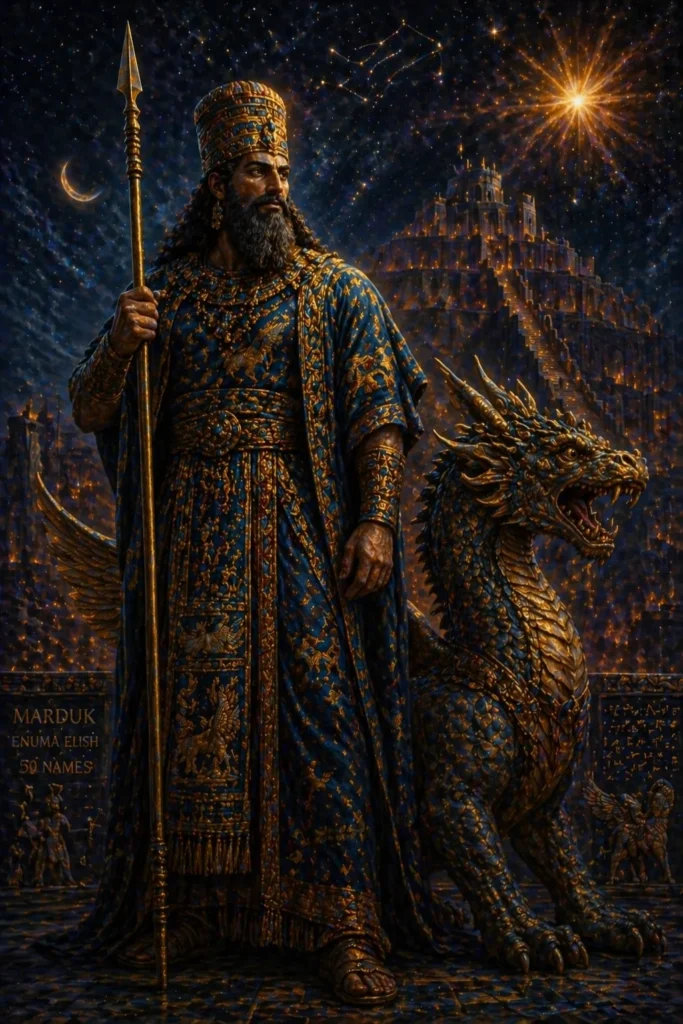
The Late Babylonian pictorial tradition continues in the reliefs of Babylon and in the glazed bricks of the processional way of Nebuchadnezzar II. Here Ninurta appears together with Marduk in an assimilatory identification that interprets him as an aspect of Marduk.
This theological shift, in which an independent god becomes an aspect of another, is attested in the Marduk acrostic of Tablet VII of the Enuma Elish. Lambert commented in detail on the individual Marduk names and their Ninurta references in «Babylonian Creation Myths.»
Sources and Further Reading
Antiquity sources: Anzu myth (standard version and Old Babylonian forerunners), «Lugale» (Sumerian-Akkadian), hymns to Ninurta and Nin-Girsu, Gudea statue inscriptions, inscriptions of Ashurnasirpal II.
Scholarly literature: Thorkild Jacobsen, «The Treasures of Darkness,» New Haven 1976. Jean Bottéro, «La religion babylonienne,» Paris 1952. Stefan Maul, «Die Wahrsagekunst im Alten Orient,» Munich 2013. Walther Sallaberger, «Der kultische Kalender der Ur III-Zeit,» Berlin 1993. Andrew George, «The Babylonian Gilgamesh Epic,» Oxford 2003. Wilfred Lambert, «Babylonian Creation Myths,» Winona Lake 2013. Stephanie Dalley, «Myths from Mesopotamia,» Oxford 1989.