Nguruvilu, the fox serpent of the deadly river ford
By Ralf Ittermann · last reviewed on
Nguruvilu is a demon of Mapuche tradition.
Fox serpent that drags those wading across into death with whirlpools and claw.
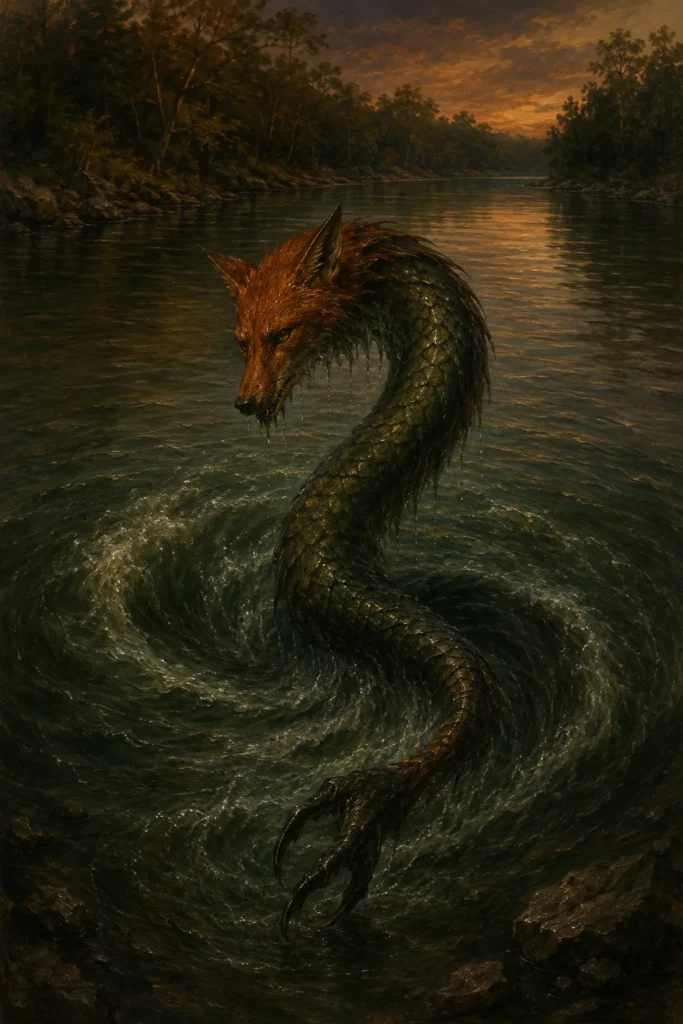
Nguruvilu is the fox serpent of the Mapuche, a water being with a fox’s head and a serpent’s body that haunts river fords in Chile and neighbouring Argentina. With the claw on its long tail it seizes those wading across, drags them to the bottom and drowns them.
Type: Fox serpent, ford demon
Origin: oral Mapuche tradition of Chile
Texts: ethnographic collections, including Guevara, Lehmann-Nitsche
Period: early 20th century to present
Appearance: fox head, serpent body, tail claw
Source Context
Period of the Texts
Systematically collected since the early 20th century by Guevara and Lehmann-Nitsche.
Area of Diffusion
Chile and neighbouring Argentina, tied to river fords, channels and quiet side arms.
Sources
Solid: ethnographic collections, above all Guevara and Lehmann-Nitsche, with regional variants.
Name and variants
Mapudungun: fox alongside vilu, serpent: fox serpent. A name taboo requires the circumlocution lord of the water instead of the name.
Form and Effect
Appearance
Fox head and serpent body; in some versions the clawed tail is regarded as the seat of its life force.
Effect
Feigns a shallow crossing at fords and drags those wading across to the bottom in a whirlpool.
Profile: Nguruvilu
The most important aspects of the fox serpent at a glance.
Oral Mapuche tradition of Chile, systematically collected since the 20th century.
People wading and pack animals at river fords and quiet side arms.
Fox head, serpent body, hook-like claw at the tail end.
Feigns shallow fords, creates whirlpools, drowns those wading across.
Banishment by machi or kalku, name taboo, avoidance of afflicted fords.
Distinct from the cosmic Caicai-Vilu and the benevolent Pincoya; related to the Scottish Kelpie.
Guevara, Lehmann-Nitsche and the ford on the Limay
The name combines the Mapudungun word for fox with vilu, serpent. Tomás Guevara described in 1908 a river-dwelling being with a fox head and a tail claw that drags victims to the bottom; Robert Lehmann-Nitsche collected further anecdotes in 1902, including one about a ford on the Limay.
From ford warning to bestiary
The Nguruvilu is part of Chilean-Argentine folklore collections and appears in bestiaries. From a religious-studies perspective it is a local danger spirit, not a god: the banishment by machi or kalku is a shamanistic control ritual at critical river crossings.
The banishment by machi and kalku
The main remedy is banishment: a machi or a kalku threatens the being at the whirlpool with a knife until it swears to reform. Iron, a protective circle and an amulet are regarded as protection.
Ford demons in cultural comparison
The closest parallel is the Scottish Kelpie; related are the cosmic Caicai-Vilu and, as a North American counterpart, the Mishipeshu.
Frequently asked questions about the Nguruvilu
How does the Nguruvilu deceive its victims?
It makes the ford appear safe and creates a deadly whirlpool at its centre.
Is there a natural explanation?
Lehmann-Nitsche suspected the sea otter as the origin of the legend.
Further links
Further reading:
Literature (selection)
Further standard works in the bibliography.
Those searching for Nguruvilu Mapuche will find a fox-serpent of Chile: a ford demon that drags those wading through with a whirlpool and clawed tail into the depths.