Multo, the dead with one final task
By Ralf Ittermann · last reviewed on
Multo is a spirit of Philippine tradition.
He returns until an unresolved matter is settled.
Multo, a Philippine spirit, is the spirit of a deceased person in the Philippines: the shadowy appearance of a dead person who returns for a specific reason. Unlike the predatory Aswang, he is fundamentally passive and acts mainly as a haunting, not as a physical threat.
The name comes from the Spanish muerto, the dead, and was adopted as a collective term into everyday Philippine culture; it overlays pre-colonial notions of ancestral spirits. As the soul of a dead person, the Multo returns for a specific reason: an unresolved matter, an improper burial, revenge, or a violent death.
Type: Returning spirit of the dead, usually passive and tied to an unresolved matter
Origin: Spanish-influenced term (muerto) over pre-colonial Philippine ancestor veneration
Texts: sparse specialist literature, as it is mainly an everyday phenomenon
Period: colonially shaped, still living everyday folklore today
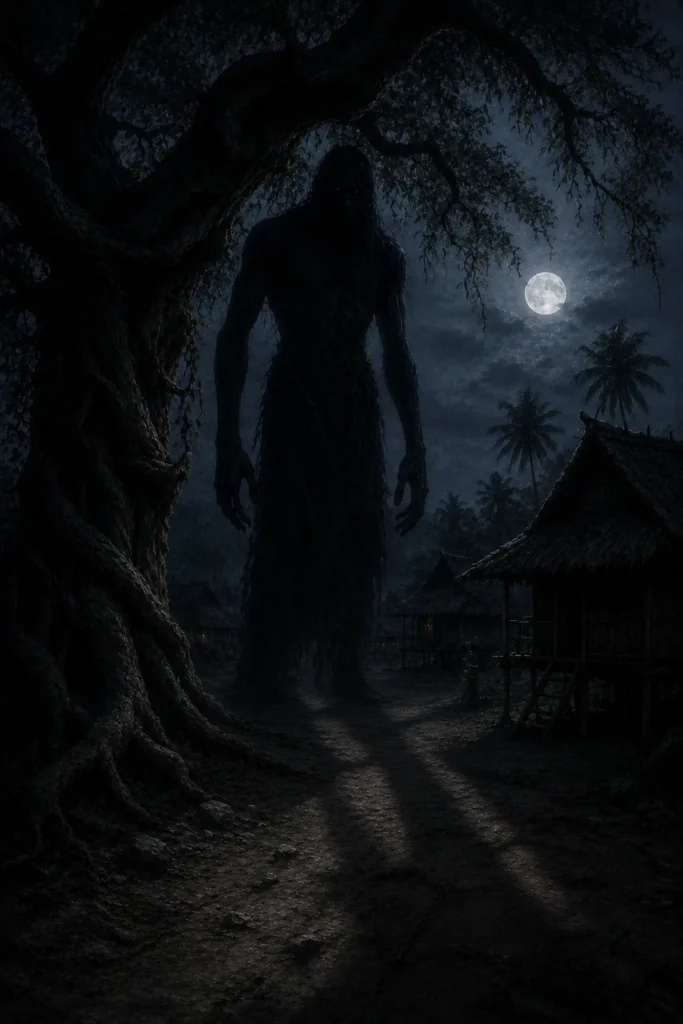
Appearance: shadowy figure of a deceased person
Source context
Period of the Texts
Multo is the most widespread paranormal being of Philippine everyday folklore: a Spanish-influenced term layered over an indigenous ancestor cult, still alive today.
Area of Diffusion
The belief is widespread throughout the country, especially in Tagalog-speaking regions.
Sources
Sparse: As an everyday phenomenon, the Multo is less thoroughly documented in monographs than the extensively researched Aswang complex; the specialist literature remains limited.
Name and variants
Spanish: The name Multo derives from the Spanish muerto, the dead, and was adopted as a collective term into mainstream Philippine culture. It thus overlays pre-colonial notions of ancestral spirits with a Spanish word.
Appearance and behaviour
Appearance
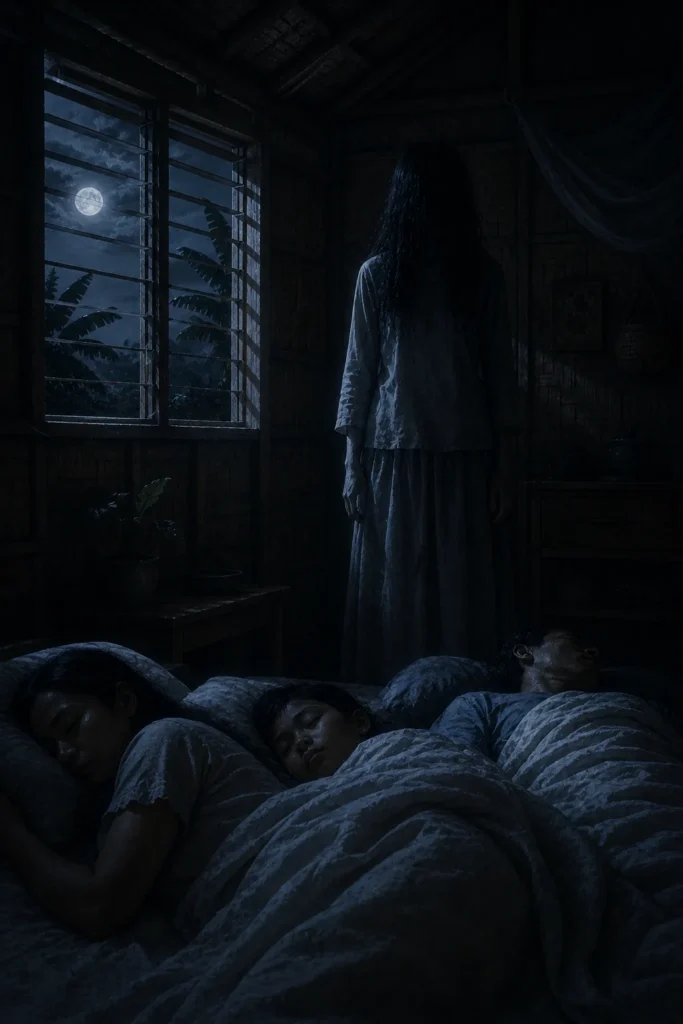
The Multo shows itself as a shadowy figure of a deceased person, appearing silently at places of death or in the vicinity of the bereaved. It stands for unresolved matters, disturbed rest of the dead, and the continuing influence of ancestors on the everyday life of the living.
Effect
The Multo returns because of an unresolved earthly matter, an improper burial, revenge, a violent or unusual death, to warn or protect relatives, or to fulfil a pact. Its effect is mostly psychological, manifesting as an apparition or haunting, not physically destructive.
Profile: Multo
The key aspects of the returning spirit at a glance.
The most widespread paranormal being of Philippine everyday folklore, a Spanish-influenced term layered over an indigenous ancestor cult.
Bereaved relatives and residents of places of death, to whom the spirit mostly appears because of an unresolved matter.
A shadowy, usually silent figure of a deceased person with no distinctive attributes.
Psychological haunting rather than physical attack; it warns, admonishes or seeks rest for an unresolved matter.
Prayers, funeral masses and a proper burial, along with blessed objects such as the rosary.
The predatory Aswang as a clear contrast, along with Pugot and the White Lady as further Philippine spirit figures.
From the Spanish muerto to the Philippine everyday spirit
The name Multo derives from the Spanish muerto, meaning ‘the dead’, and was adopted as a collective term into mainstream Philippine culture. It overlays pre-colonial notions of ancestral spirits: as the soul of a deceased person, the Multo returns to the world for a specific reason, rather than simply vanishing.
Unlike the Aswang complex, which was demonised through Spanish Catholic influence, the Multo remained at its core a familiar deceased person: not a monstrous predatory being, but a relative or acquaintance whose return is tied to a concrete, nameable cause.
The everyday term for spirit and ghost
In Filipino and Tagalog, Multo is the everyday term for spirit or ghost and is omnipresent in horror anthologies, on television and at Halloween.
From a religious-studies perspective, the Multo links the pre-colonial belief in ancestral spirits with the Spanish-named Christian spirit of the dead. It is the unobtrusive deceased, bound to unfinished business, whose rest depends on the correct rites performed by the surviving family.
Rosary, requiem mass and the proper burial
The Multo is approached with consecrated objects such as sacred items and the rosary; holy water is regarded as a Christian sign in dealing with the spirit. A worn amulet adds further protection. Central, however, is helping the spirit complete its unfinished task so that it may find rest: through prayers, requiem masses with the light of a protective candle, and a proper burial.
A haunting spirit with a Spanish name
The Multo is a classic haunting spirit with unfinished business and corresponds functionally to the Western ghost, though the term is linguistically derived from Spanish. It is related to the European concept of the revenant. Within the Philippine spirit world, it stands in clear contrast to the predatory Aswang; Pugot and the White Lady are further Philippine spirit figures.
Frequently asked questions about the Multo
Is the Multo the same as the Aswang?
No. The Multo is the spirit of a deceased person, whereas the Aswang is a monstrous, demonic predatory being.
Why does a Multo return?
Usually because of unfinished business or a disturbed rest of the dead.
Where does the word come from?
From the Spanish muerto, meaning ‘the dead’.
Further links
Further reading:
- Aswang – the predatory counterpart within the Philippine demon complex
- Pugot, White Lady – further Philippine spirit figures
- Tiyanak – another Philippine demon
- Revenant – the European parallel concept
- Holy water, amulet, protective candle – traditional protective means
Literature (selection)
Further standard works in the bibliography.
As a Philippine spirit, the Multo remains at its core exactly what its name says: the spirit of a deceased person who returns mostly because of unfinished business.