Vukodlak and the blurred boundary between wolf and vampire
By Ralf Ittermann · last reviewed on
Vukodlak is a demon of South Slavic tradition.
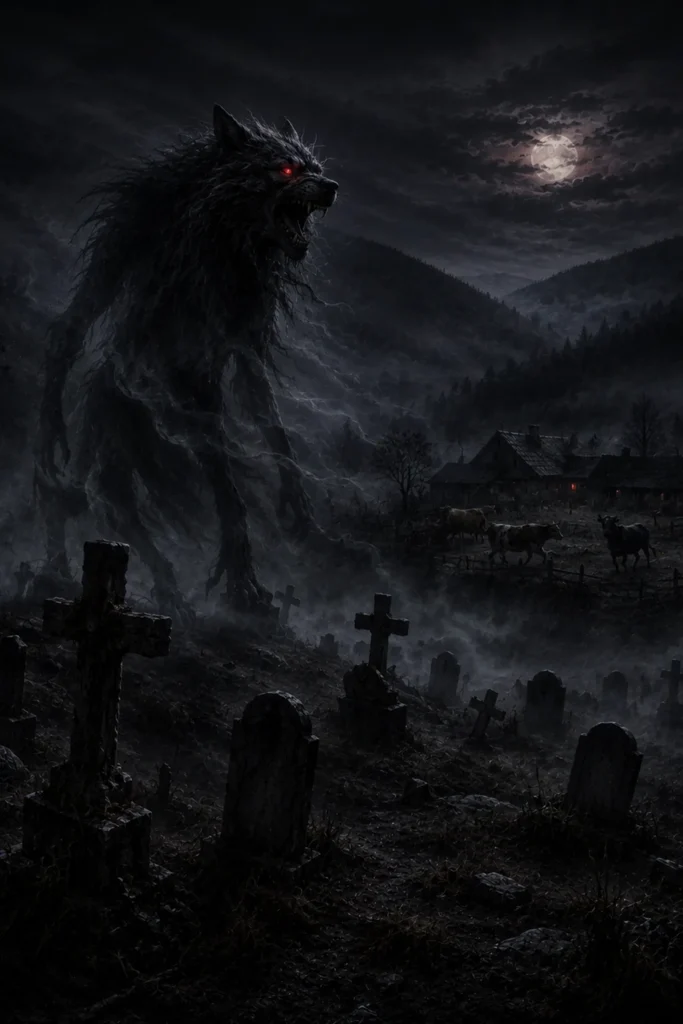
Half werewolf, half vampire: at night it strangles livestock. The profile describes the Vukodlak as a blurred boundary figure, half werewolf and half vampire, that strangles livestock by night.
Vukodlak is the werewolf-vampire undead of the South Slavic Balkans, found in Serbia, Montenegro, Bosnia, Croatia, Dalmatia and Slovenia. The term shifts by region between the original werewolf and the returning, blood-swollen corpse of vampire folklore.
At night it strangles and mauls livestock and torments the living; in its vampire form it also drains blood and life force. From its name derives the Greek word Vrykolakas, a direct linguistic testament to the reach of the South Slavic belief.
Type: Werewolf-vampire undead of the Balkans
Origin: South Slavic folk belief concerning revenants and werewolves
Texts: Karadžić’s dictionary of 1818, along with studies by Perkowski, Barber and Summers
Period: South Slavic tradition, linguistically very old, defined by Karadžić
Appearance: depending on region, either a werewolf or a returning, blood-swollen corpse
Area of origin and sources
Period of the Texts
The tradition is South Slavic and linguistically very old; it took definite shape through Vuk Karadžić’s definition in the early 19th century.
Area of Diffusion
Serbia, Montenegro, Bosnia, Croatia, Dalmatia and Slovenia: the entire South Slavic-speaking region of the Balkans.
Sources
Good: Karadžić’s dictionary of 1818, along with the studies by Perkowski, Barber and Summers.
Name and variants
Proto-Slavic: vьlko-dlakь from vьlkъ, wolf, and dlaka, pelt or animal hair, literally means in wolf’s pelt. In Serbian and Croatian the form is vukodlak, in Slovene volkodlak; the original meaning is werewolf, though in the folklore of Croatia, Montenegro, Serbia and Bosnia it shifted to vampire.
Form and effect
Appearance
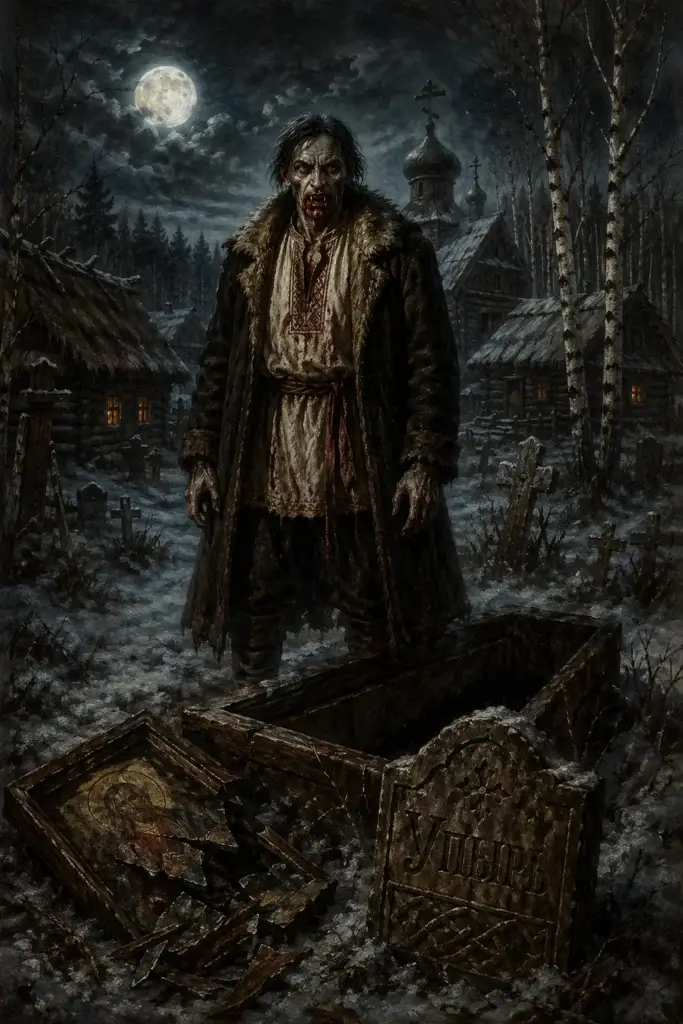
The Vukodlak has a dual nature depending on the region: wolf shape as a werewolf or a bloated, blood-swollen revenant. It embodies, in a single figure, the fears of werewolf and vampire that South Slavic thought does not keep separate.
Effect
The Vukodlak strangles and mauls livestock, plagues and kills the living; in its vampire form it drains blood and life force. It is nocturnal and moves from farm to farm.
Profile: Vukodlak
The key aspects of the werewolf-vampire at a glance.
South Slavic folk belief about revenants and werewolves, native to Serbia, Montenegro, Bosnia, Croatia, Dalmatia and Slovenia.
Livestock and the living: the Vukodlak strangles animals in stable and pasture and plagues the people of the farms at night.
Wolf shape as a werewolf or a bloated, blood-swollen corpse, depending on which interpretation prevails in the region.
Dual threat: as a werewolf it mauls livestock, as a vampire it drains people’s blood and life force.
Exhumation, staking with hawthorn, decapitation and burning the heart or the corpse when suspicion is well founded.
What distinguishes it from the West Slavic Upiór is its close link to the werewolf rather than the pure vampire figure; both go back to the same Slavic belief in the undead.
From wolf pelt to bloodsucker: the word's history
The name is etymologically clear: Proto-Slavic vьlko-dlakь is composed of vьlkъ, wolf, and dlaka, fur or animal hair, and literally means ‘in wolf’s fur’. The Serbian and Croatian form is vukodlak, the Slovenian volkodlak, and their original meaning is unambiguously werewolf. In the folklore of Croatia, Montenegro, Serbia and Bosnia, however, the meaning shifted to vampire, so that one and the same word denotes two fears.
Vuk Karadžić, in the early 19th century, defined the Vukodlak not as a wolf-man but as a blood-swollen corpse that rises from the grave to strangle livestock and plague the living. This name is also the root of the Greek word Vrykolakas, linguistic evidence of how far the South Slavic notion radiated.
From the Balkans into world literature
Via Vuk Karadžić and the Balkan vampire wave, the Vukodlak became part of the Western image of the vampire; in Gerard’s list for Stoker it is mentioned as Vrkolak. In modern South Slavic culture, in fantasy and in TV series it is present as a werewolf figure.
From a religious-studies perspective, the Vukodlak is a prime example of how, in the South Slavic region, belief in werewolves and belief in vampires historically were not separate categories but a shared notion of the dangerous dead who had died a violent death. The word predates the individual Slavic peoples and attests to the depth of this notion.
Staking, fire and garlic
Well attested in sources are exhumation and staking with hawthorn, which was preferred above all in Serbia, along with decapitation, removing and burning the heart, and burning the whole corpse; if the corpse appeared bloated and bloody upon exhumation, this was taken as proof. Correct burial, too, was meant to prevent the return of the dead from the outset.
In Slavic folk belief more generally, garlic, rowan branches at door and stable, and cold iron also served as protection against the undead and werewolves.
From Vukodlak to Vrykolakas: Slavic and Greek relatives
The Vukodlak is the direct source of the name of the Greek Vrykolakas and the South Slavic counterpart to Strigoi, Moroi and Pricolici as well as to the Polish Upiór. It shares the werewolf-vampire fusion with the Romanian Pricolici; within the Germanic-Nordic framework it is comparable to Nachzehrer and Gjenganger.
Frequently asked questions about the Vukodlak
Is the Vukodlak a werewolf or a vampire?
Both, depending on the region: the term wavers between the original werewolf and the vampire of South Slavic folklore.
What does it have to do with the Vrykolakas?
The Greek word Vrykolakas derives directly from the Slavic vukodlak.
How does one protect oneself against it?
Through staking with hawthorn, decapitation, burning the heart, garlic and correct burial.
Further links
Literature (selection)
Further standard works in the bibliography.
As a South Slavic werewolf and Balkan vampire combined in one figure, the Vukodlak shows how closely both fears are related: its name gave the Greek Vrykolakas its word, and its nightly grip fell on livestock and people alike.