Nang Tani, the green woman in the banana grove
By Ralf Ittermann · last reviewed on
Nang Tani is a spirit of Thai tradition.
The green spirit who appears at the banana shrub during the full moon. Nang Tani is known as the mistress of the banana tree in Thai folk belief.
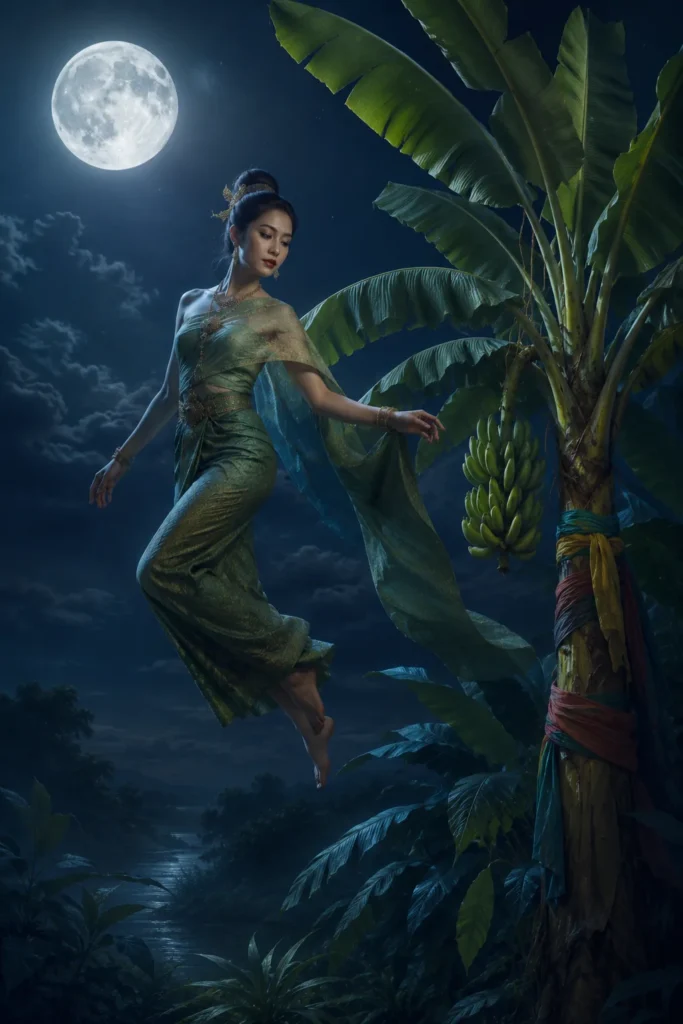
Nang Tani is the tree spirit of the wild banana tree in Thailand: a young, beautiful woman in green attire who appears at the banana shrub during the full moon and hovers, so that her feet do not touch the ground.
She is fundamentally good-natured: she offers food to passing monks and helps those in need. Towards men who have wronged women, however, she can become seductive and destructive; felling her banana tree is considered to bring misfortune.
Type: Tree spirit of the wild banana tree, subtype of the Nang Mai
Origin: Buddhist-animist syncretism and tree cult of Thailand
Texts: Oral tradition, documented by Anuman Rajadhon
Period: Animist-oral to present, present in popular culture
Appearance: young woman in green attire with red lips, hovering, at full moon
Source context
Period of the Texts
The tradition is animist-oral, documented by the Thai folklorist Anuman Rajadhon, and remains present in popular culture.
Area of Diffusion
Thailand: The belief attaches to the wild banana tree Kluai Tani and thus to groves and shrubs throughout the country.
Sources
Well documented: the works of Anuman Rajadhon and McDaniel’s study of the Thai spirit world.
Name and variants
Thai: nang, lady, and Tani, the wild banana tree Kluai Tani, botanically Musa balbisiana: the lady of the banana tree. Nang Tani is a subtype of the Nang Mai, the Thai tree ladies.
Appearance
Appearance
Nang Tani appears as a young, beautiful woman in green attire, the colour of the banana plant, with red lips, hovering so that her feet do not touch the ground. The full moon is her time of appearance; she embodies the soul of the banana clump.
Effect
Nang Tani offers food to passing monks and helps those in need; towards men who have wronged women, she can become seductive and destructive. This ambivalence carries a motif of justice. Felling her banana tree is considered to bring misfortune.
Profile: Nang Tani
The key aspects of the spirit of the banana grove at a glance.
A tree cult of the hamadryad type within Thailand’s Buddhist-animist syncretism, with a moralising motif of justice.
Men, especially those who have wronged women, as well as travellers, local residents and passing monks whom she gives gifts to.
A young, beautiful woman in a green garment with red lips, hovering above the ground, appearing by the banana tree at full moon.
Gifts for monks and help for those in need; seduction and ruin for men who have become guilty, misfortune for anyone who fells her tree.
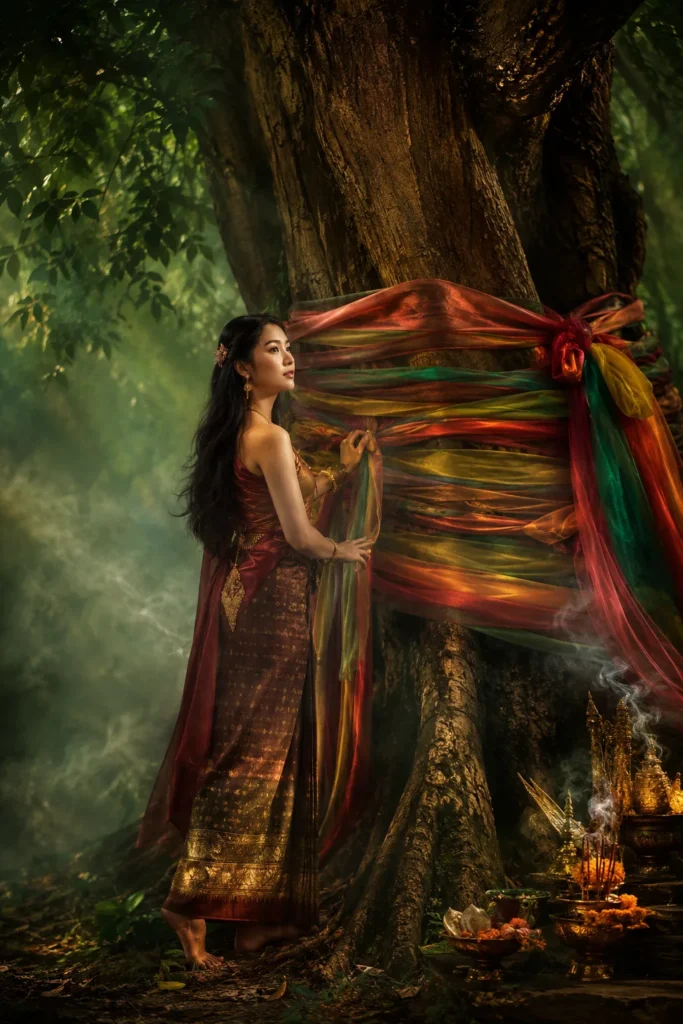
Colourful silk cloths wrapped around the trunk, offerings of incense sticks, flowers and sweets at its base; the banana tree is never felled.
Nang Mai is the general category of all tree ladies, Nang Ta-khian is the spirit of the hardwood tree; Nang Tani belongs to the banana grove.
Full moon, green garment and justice
The name combines nang, meaning lady, and Tani, the wild banana tree Kluai Tani, botanically Musa balbisiana. Nang Tani is a subtype of the Nang Mai; the background lies in Thailand’s Buddhist-animist syncretism and its tree cult.
Her profile is unmistakable: the green garment in the colour of the banana plant, the red lips, the hovering above the ground and the full moon as the time of appearance. Alongside this comes her particular ambivalence: kind to monks and those in need, punishing towards men who have wronged women, a motif of justice that sets her apart from other tree spirits.
From ghost story to cinema
Nang Tani is a classic figure of Thai horror and appears in films alongside Nang Nak, Krasue and Nang Ta-khian; she frequently features in ghost stories and media.
From the perspective of religious studies, Nang Tani expresses the tree cult of the hamadryad type within animist-Buddhist syncretism, carrying a moralising motif of justice aimed at protecting women. She is thus not simply an evil spirit: her punishing side is directed specifically at men who have become guilty, not at every passer-by.
Silk cloths and the untouched banana tree
Well documented are colourful silk cloths wrapped around the trunk, offerings at its base of incense sticks, flowers and sweets, and the principle of never felling the banana tree as her dwelling and honouring it through monks and rites. As with all of Thailand’s tree ladies, the rule holds: respect for the tree is protection from the spirit.
Banana spirits and tree nymphs
Nang Tani corresponds to the Greek Dryad, here bound to a banana tree instead of a deciduous tree, to the Japanese Kodama and to the Indian Yakshi. Related in motif are banana-tree spirits from Chinese and other Southeast Asian narrative traditions. Within Thailand she belongs to the category of Nang Mai, alongside Nang Ta-khian, the spirit of the Ta-khian tree.
Frequently asked questions about Nang Tani
When does Nang Tani appear?
Mainly at full moon, by the wild banana bush, whose soul she embodies.
Is she evil?
Basically good-natured: she gives gifts to monks and helps those in need. She only turns punishing towards men who have wronged women.
How is she honoured?
Through a colourful cloth around the trunk, offerings of incense sticks, flowers and sweets, and by not felling the banana tree.
Further links
Further reading:
- Nang Mai – the category of Thai tree ladies
- Nang Ta-khian – the spirit of the Ta-khian tree
- Kodama – the Japanese tree spirit as a counterpart
- Incense burning, Amulet, Circle of protection – traditional protective and cult means
- Protection Compass – an overview of protective means
Literature (selection)
Further standard works in the bibliography.
As the spirit of the banana tree, Nang Tani unites two faces that hardly any other Thai tree spirit combines in this way: the quiet benefactress of monks in the light of the full moon, and the punishing justice towards men who have wronged women.