Dziwożona, the wild woman of swamp and thicket
By Ralf Ittermann · last reviewed on
The Dziwożona is a spirit of Slavic tradition.
The swamp woman who steals children and substitutes changelings.
The Dziwożona, the wild woman, is a wild forest and swamp woman of Slavic tradition, ugly and hairy, with long hanging breasts. She steals newborns, substitutes her own child as a changeling, and lures men into the swamps.
Folk belief holds that certain women become a Dziwożona after a bad death, such as suicides, unmarried mothers, illegitimately born women, or pregnant women who died before giving birth. She thus belongs to the Slavic complex of the unclean dead.
Type: Wild forest and swamp woman, child thief from the complex of the unclean dead
Origin: oral West Slavic tradition
Texts: folkloristic collections of the 19th and 20th centuries
Period: oral tradition until its folkloristic recording
Appearance: ugly, hairy old woman with tangled hair, glowing eyes and long hanging breasts
Textual history
Period of the Texts
The figure belongs to oral West Slavic tradition and was recorded by folklorists in the 19th and 20th centuries.
Area of Diffusion
Poland, the Czech Republic and Slovakia, especially the Tatra region. Her places are swamp, thicket and bodies of water in bad weather.
Sources
Well documented: the standard folkloristic works of Máchal and Moszyński list the Dziwożona as a firmly established figure of West Slavic tradition.
Name and variants
Slavic: The name belongs to divy, wild or strange, and zona, woman, thus wild woman. Other names are Mamuna and Boginka.
Being and effect
Appearance
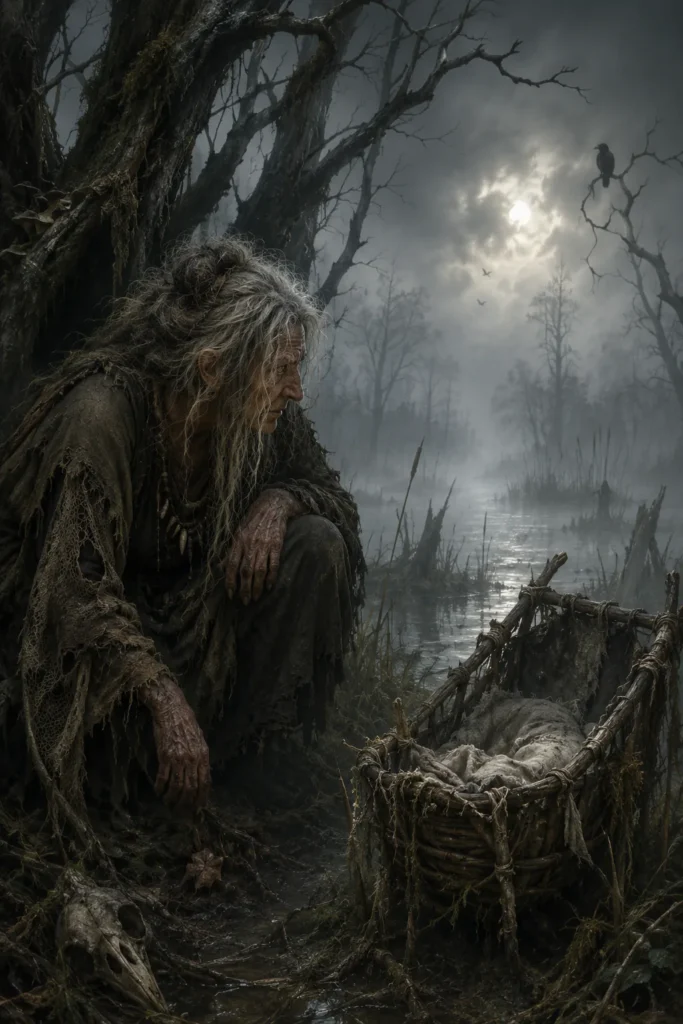
The Dziwożona appears as an ugly, hairy old woman with tangled hair, glowing eyes and long, hanging breasts, in bad weather among trees, near swamps and bodies of water. The overlong breasts are the mark of a distorted, false motherhood, of fertility turned grotesque; the matted hair and her dwelling in swamp and thicket mark her as a being beyond the cultivated order.
Effect
She steals newborns immediately after birth and substitutes her own child as a changeling, recognisable by a misshapen body, large belly, thin limbs, hairy body and malicious nature. She lures men into swamp and thicket, where she leads them astray or kills them.
Profile: Dziwożona
The key aspects of the wild woman at a glance.
West Slavic wild woman from the complex of the unclean dead: women who died a bad death become Dziwożony.
Newborns and women in childbed, who are threatened by child theft and changeling substitution, as well as men whom she lures into the swamps.
Ugly, hairy old woman with tangled hair, glowing eyes and long, hanging breasts, appearing in bad weather near swamps.
Child theft and changeling substitution immediately after birth; alongside this, the misleading and killing of men in the swamp.
Blessed and red objects placed with the child, a red ribbon and a red cap, never leaving the child alone or unbaptised, plus the changeling ritual.
From bad death to wild woman
The name Dziwożona derives from divy, wild or strange, and zona, woman, thus wild woman; other names are Mamuna and Boginka. According to folk belief, certain women become Dziwożony after a bad death: suicides, unmarried mothers, illegitimately born children and pregnant women who died before giving birth.
The wild woman thus belongs to the Slavic complex of the unclean dead, analogous to the Rusalka as the water spirit of drowned or unhappily deceased girls. The being does not come first; the disrupted death does: a death outside the social order creates a dead woman who remains dangerous to that order.
Folklore, fantasy and classification
The Dziwożona is a fixture of Polish folklore and modern Slavic fantasy and is regularly listed in compilations of Slavic mythology as a wild woman and swamp demon. The reception is chiefly folkloric.
From the perspective of religious studies, the Dziwożona is at once a wild-woman and a child-scare figure, embodying fears surrounding childbed and infant mortality; the changeling belief served as an explanation for sick or disabled newborns. The figure thus reveals more about the hardships of village life than about a being of the forest.
Red ribbon, baptism and the dung-heap ritual
Well documented are blessed and red objects placed with the child, a red ribbon around the infant’s wrist and a red cap, along with the rule never to leave the child alone or unbaptised. If a substitution did occur, folk belief knew the changeling ritual to reverse the exchange: the changeling is carried to a dung heap, struck with a birch switch and doused with water from an eggshell, while calling on the Dziwożona to take her own and return the true child.
Wild women and changeling beings in comparison
Through the motif of the bad death, the Dziwożona is closely related to the Rusalka, the water spirit of drowned girls. Typologically she is close to the wild woman of the German and Alpine region and to the changeling fairies of Western Europe; the Scandinavian Huldra, with her Huldrebarn, also belongs to the child-theft motif. Among the Slavic field and meadow spirits, the Poludnica is the nearest female figure of terror, though bound to the noon hour rather than the swamp.
Frequently asked questions about the Dziwożona
What turns a woman into a Dziwożona?
A bad death: suicide, death as an unmarried mother or as a pregnant woman, or social exclusion. She thus belongs to the Slavic complex of the unclean dead.
What is a changeling?
The substituted child of the Dziwożona, recognisable by deformity and malice; in folk belief this served as an explanation for sick newborns.
How does one get one’s own child back?
Through the dung-heap ritual with a birch switch and eggshell water, combined with the call for the wild woman to take her own child and return the stolen one.
Further links
Further reading:
- Slavic – all beings of Slavic tradition
- Rusalka – the water spirit from the same complex of the unclean dead
- Huldra, Poludnica – related female figures
- Amulet, Holy Water, Iron – traditional protective means
- Protection Compass – protective means at a glance
Literature (selection)
Further standard works in the bibliography.
As a Slavic wild woman, the Dziwożona embodies the fears surrounding childbed and infant mortality: the swamp woman who lays changeling children in foreign cradles, thereby making explicable what the village world could not otherwise explain.