Ognjena Marija, mistress of lightning and summer heat
By Ralf Ittermann · last reviewed on
Ognjena Marija is a goddess of the Slavic tradition.
Mistress of lightning fire and summer heat, sister of St. Elias. Ognjena Marija is venerated among the Slavs as the fiery sister of St. Elias.
Ognjena Marija, the Fiery Mary, in simplified transcription Ognyena Maria, is a fiery female figure of South and East Slavic folk belief. She rules over destructive fire, lightning and the dangerous heat of midsummer, and is regarded as the sister of St. Elias.
On her feast day a strict ban on work applies, the breaking of which she punishes with fire. At the same time she is not simply a pagan goddess but a Christian-folk-religious fusion phenomenon: the overlay of the Virgin Mary, or of St. Marina or Margaret of Antioch, with a fire figure.
Type: Mistress of lightning fire and summer heat, Christian-folk saintly figure
Origin: South and East Slavic folk belief
Texts: Ethnographic documentation of the 19th and 20th centuries, Orthodox iconography
Period: documented in the 19th and 20th centuries, alive to this day
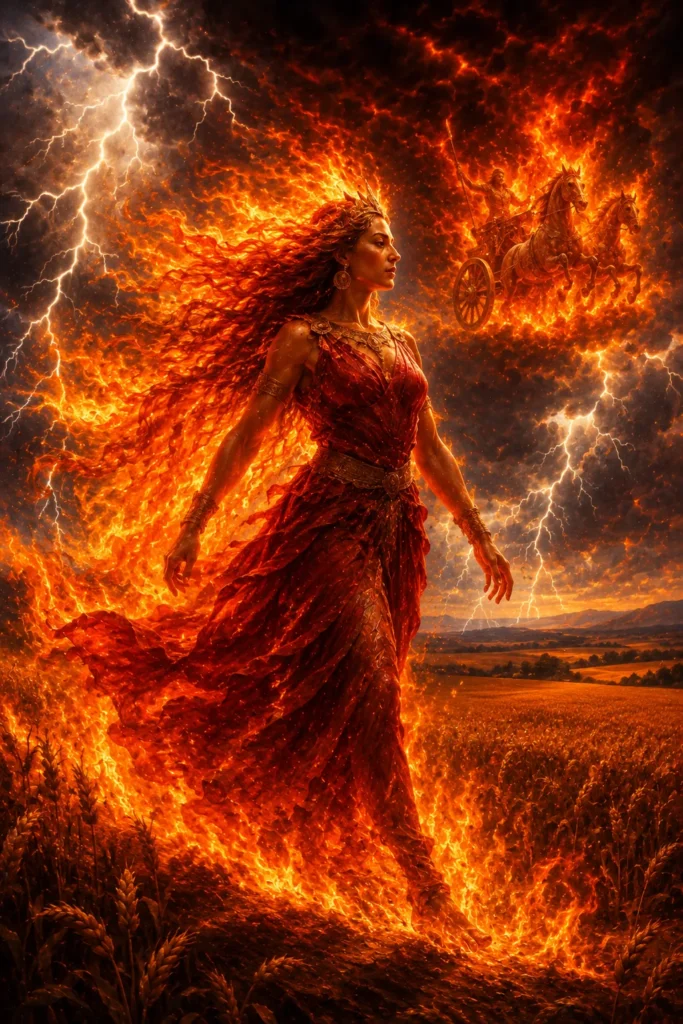
Appearance: fiery female figure, at times on a fiery chariot
Historical Classification
Period of the Texts
South Slavic folk belief, documented in the 19th and 20th centuries; the custom remains alive into the present.
Area of Diffusion
Serbia, Bosnia and Bulgaria, along with Ukraine: the South and East Slavic region where her feast day is observed.
Sources
Well documented ethnographically; hypothetical, on the other hand, remains the derivation from a pre-Christian fire goddess.
Name and variants
South Slavic: ognjena means fiery, from ogni, fire, related to Latin ignis and Old Indic agni, the word also borne by the Vedic fire god Agni. Ognjena Marija is thus literally the Fiery Mary.
Appearance and behaviour
Appearance
In Orthodox icons, Ognjena Marija appears as a fiery figure, at times in flames or on a fiery chariot after the Elias motif. Her attributes are flames and lightning; her symbolism combines scorching summer heat and lightning fire with fertility, hearth and the warding off of evil.
Effect
She rules over destructive fire and lightning, especially the dangerous midsummer heat, and punishes work on her day with fires. In Bulgarian tradition she hides on the day of her brother Elias so that his joy does not destroy everything with lightning; in Ukraine, on her day people hope for rain foretold by lightning for the fields.
Profile: Ognjena Marija
The most important aspects of the Fiery Mary at a glance.
Christian-pagan fusion phenomenon of South Slavic folk belief: Mary, or St. Marina or Margaret, overlaid with a fire figure.
Farmers and households: her cult aims at protecting house and harvest from fire, lightning and summer heat.
Fiery female figure of Orthodox icons, at times in flames or on a fiery chariot after the Elias motif, with flames and lightning as attributes.
Destructive fire, lightning and midsummer heat; on her feast day she punishes work with fires.
Feast day on 17 July Julian, 30 July Gregorian, with a strict ban on work; no sewing, no washing of laundry and similar tasks.
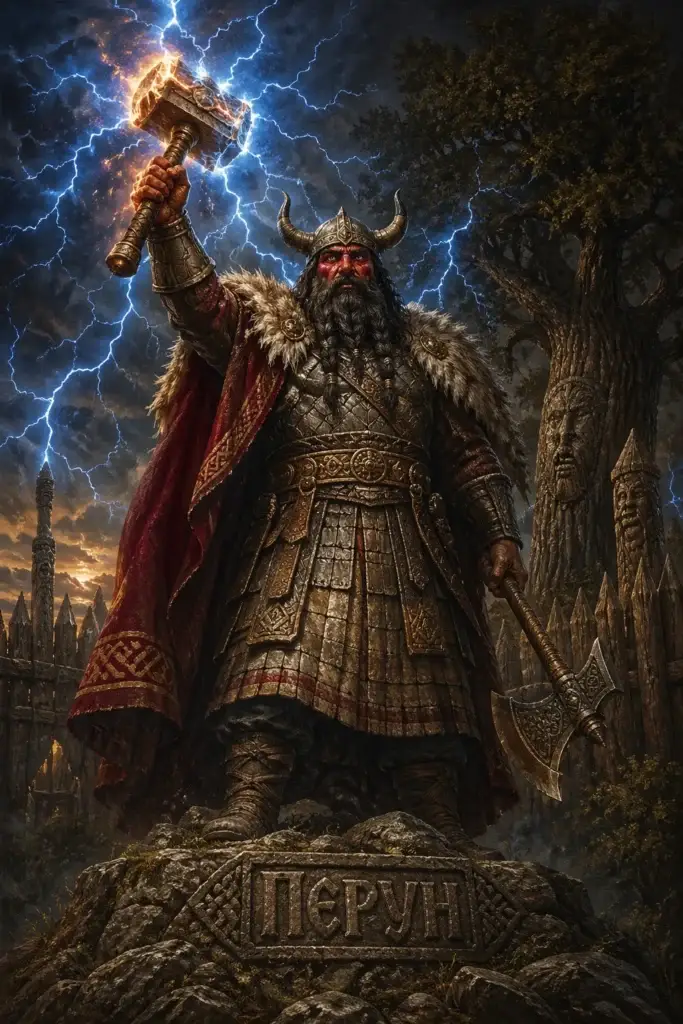
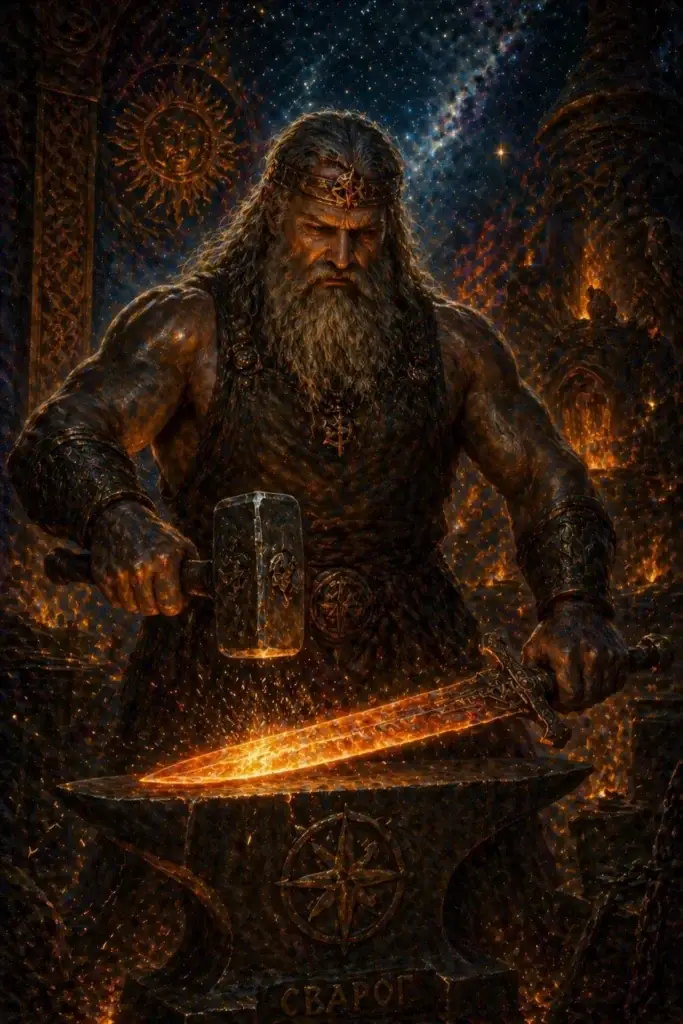
Perun and his Christian successor Elias regarding lightning; in the Slavic fire and sun sphere Svarožič and Dažbog.
Mary, Marina and the fire figure: a syncretism
South Slavic ognjena means fiery, from ogni, fire. Ognjena Marija is a Christian-pagan syncretism phenomenon: the fusion of the Virgin Mary, or of St. Marina or Margaret of Antioch, with a fire figure.
In folk belief she is regarded as the sister of St. Elias, who took over the succession of the thunder god Perun; through this kinship she is embedded in the Slavic lightning and fire circle. The customs themselves are well documented, while the derivation from a pre-Christian fire goddess remains partly hypothetical.
Living custom and interpretation
The custom surrounding Ognjena Marija is especially alive in Serbia and Bosnia into the present. She is a motif of Orthodox iconography and a popular example of Slavic-Christian syncretism, sometimes exaggerated in Neopaganism as a purely pagan fire goddess.
From a religious-studies perspective, the custom is well attested ethnographically; reconstructed, on the other hand, are her derivation from a pre-Christian fire goddess and her sibling relationship to Perun via the succession of Elias. Primarily, Ognjena Marija is a Christian-folk saintly figure with a pronounced fire and lightning function, not a securely attested pagan goddess.
The feast day with a ban on work
Her feast day in the Slavic folk calendar is 17 July Julian, corresponding to 30 July Gregorian. On this day a strict ban on work applies: no sewing, no washing of laundry and similar tasks; breaking it she punishes with fire. Her protective function is the warding off of fire, lightning and summer heat for house and harvest. Classical fire offerings are not recorded; the cult is a Christian-framed day of avoidance and protection.
Elias, Perun and the Slavic fire circle
Ognjena Marija is closely connected to Perun and his Christian successor Elijah through lightning, and stands close to the Slavic fire and sun domain around Svarožič and Dažbog. As a fiery female figure of lightning and heat, her regulating hiding on the Feast of Elijah recalls mediators between humans and destructive heavenly fire.
Frequently asked questions about Ognjena Marija
Who is Ognjena Marija?
The Fiery Mary, a fiery female figure of South Slavic folk belief, mistress of lightning fire and summer heat, and sister of St Elijah.
Why must one not work on her day?
Because she punishes work on her feast day with fires; sewing and doing laundry in particular are forbidden.
Is she a pagan goddess?
She is primarily a Christian-folk saintly figure; interpreting her as a pre-Christian fire goddess is a reconstruction.
Further links
Further reading:
- Slavic – all beings of the Slavic belief world
- Svarožič – the Slavic fire god from her sphere
- protective candle, salt, amulet – traditional protective means
- Protection Compass – an overview of protective means
Literature (selection)
Further standard works in the bibliography.
As mistress of lightning fire and as the Fiery Mary of Slavic folk piety, Ognjena Marija shows how closely Christian veneration of saints and older fire belief can intertwine: her feast day still tames the fire of midsummer today.