Fei Lian, storm chimera of ancient China
By Ralf Ittermann · last reviewed on
Fei Lian is a god of Chinese tradition.
A composite being of deer, bird and snake, lord of the wind. Fei Lian belongs among the composite storm beings recorded in ancient China.
Fei Lian is a Chinese wind god whom the Han-era commentary equates with the official title Feng Bo, Count Wind or Wind Lord. Fei Lian is the figure, Feng Bo the official title of the same deity, not two separate gods.
He appears in the oldest layer as a dragon-deer-bird-like composite being, later as an old man with a wind bag, and is lord over wind and weather: sometimes a rebel at the side of Chiyou, sometimes an orderly official within the Daoist pantheon.
Type: Wind god, figure behind the official title Feng Bo
Origin: China, originally the Chu tradition
Texts: Chuci, Shiji, Huainanzi
Period: Chuci around 300 BC to the Ming era
Appearance: deer-bird-snake composite being, later an old man with a wind bag
Textual history
Period of the Texts
The earliest attestation appears in the Li Sao of the Chuci around 300 to 200 BC; the tradition extends through the Shiji and Huainanzi into the Ming era.
Area of Diffusion
China, originally the Chu tradition of the south; later the wind lord becomes part of the empire-wide state cult and the Daoist pantheon.
Sources
Well attested: the Chuci with the Han commentary of Wang Yi, the Shiji and the Huainanzi, along with handbooks of Chinese mythology.
Name and variants
Chinese: Feng Bo means Wind Count or Wind Elder, an official title within the Daoist pantheon, with the variant form Fengshi, Wind Master. The name Fei Lian itself is etymologically disputed, plausibly meaning the flying wind. The Shiji glosses him as a malevolent wind and also names a Shang minister of the same name as an ancestor of the Qin.
Form and effect
Appearance
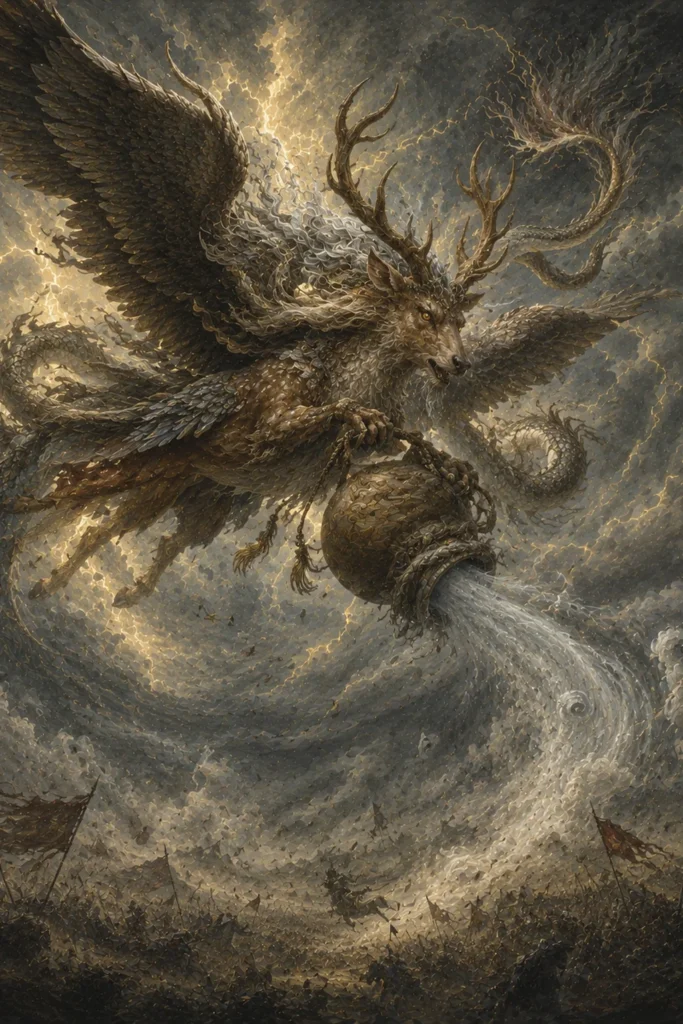
As a chimera, Fei Lian has a deer’s body, a bird’s head, horns and a snake’s tail with leopard-like spotting. As the official figure Feng Bo, he appears by the Ming era at the latest as an old man with a white beard, a yellow cloak and a wind bag made of goatskin.
Effect
Fei Lian is lord over wind and weather. In the War of Zhuolu, according to the Huainanzi, he fights alongside the rebel Chiyou and the Rain Master against Huang Di; alongside this stands the counter-role as a servant of Huang Di, sweeping the path before him. In one tale, the rebellious wind spirit is subdued by Houyi.
Profile: Fei Lian
The key aspects of the wind lord at a glance.
Wind god of the Chu tradition, equated in the Han commentary with the official title Feng Bo and later part of the Daoist Ministry of Thunder and Storm.
Wind and weather: the state cult addressed him with temples and offerings, attested under Emperor Wu of Han.
Deer’s body, bird’s head, horns and a spotted snake’s tail; by the Ming era an old man with a white beard and a wind bag made of goatskin.
Lord over wind and weather, at times a chaos-bringing ally of Chiyou, at times an orderly official and escort spirit of Huang Di.
An early attested state cult with temples and offerings according to the Shiji; private protective means specifically against Fei Lian are not recorded.
The wind-bag motif resembles the Greek Aeolus, without any historical connection; his female counterpart is considered to be Feng Po Po.
From the Chuci to the cult under Emperor Wu
The earliest attestation of Fei Lian appears in the Li Sao of the Chuci, composed around 300 to 200 BC; the Han commentator Wang Yi equates him there with Feng Bo. The Shiji glosses him as a malevolent wind, names a Shang minister of the same name as an ancestor of the Qin, and attests to Fei Lian cult buildings under Emperor Wu of Han.
The tales paint an ambivalent picture: according to the Huainanzi, the wind lord fights in the War of Zhuolu alongside the rebel Chiyou and the Rain Master against Huang Di; in the counter-tradition, he serves this same Huang Di and sweeps his path before him. Another tale tells how the archer Houyi subdues the rebellious wind spirit. Both roles, rebel and official, coexist within the tradition.
Art history and afterlife
Winged composite-being bronzes from the Han and Tang eras are considered, art-historically, to be depictions of Fei Lian; in popular culture he appears, among other places, in video games.
From a religious-studies perspective, Fei Lian is ambivalent: a chaos-bringing storm spirit and ally of Chiyou, yet also a helpful escort spirit and orderly official. Three clarifications are important: Fei Lian and Feng Bo are not two gods, but the figure and official title of the same deity. He is not merely a dragon; his oldest image is a deer-bird-snake chimera. And he does not always fight against Huang Di, both roles coexist.
State cult and wind ministry
The state cult of the wind lord is attested early, with temples and offerings, as the Shiji records for the era of Emperor Wu of Han; within the Daoist pantheon, Feng Bo belongs to the Ministry of Thunder and Storm. Private apotropaic protective means specifically against Fei Lian, however, are not recorded. The cloth trick, by which the wind spirit is subdued in one tale, likewise belongs to the narrative, not to cult practice.
Wind bags and wind countesses: parallels
Feng Shen is merely a generic term for a wind god, not a distinct deity alongside Fei Lian. The windbag motif resembles the Greek Aiolos, though no historical connection exists. The female counterpart is considered the Wind Grandmother Feng Po Po: while Fei Lian is the old windlord of the state cult, firmly anchored in text and cult history, she is a folk-religious and strongly popularised figure without a state cult.
Frequently Asked Questions about Fei Lian
Are Fei Lian and Feng Bo two gods?
No. Fei Lian is the figure, Feng Bo, Count Wind, is the official title of the same wind deity; the equation stems from Wang Yi’s Han-era commentary.
What does Fei Lian look like?
In the oldest layer as a deer-bird-snake chimera with horns and a spotted snake tail, later as an old man with a white beard, yellow cloak and windbag.
Is he good or evil?
Ambivalent: sometimes a chaos-bringing storm spirit and ally of Chiyou, sometimes an orderly official and escort spirit of Huang Di.
Further links
Further reading:
- China – all beings of Chinese belief
- Feng Po Po – the Wind Grandmother as female counterpart
- Aiolos – the Greek lord of the windbags
- Amulet, protective candle, salt – traditional protective means
- Protection Compass – overview of protective means
Literature (selection)
Further standard works in the bibliography.
As the Chinese wind god, Fei Lian unites two faces in one figure: the wild storm chimera of the old Chu poetry and the official Feng Bo, Count Wind, who watches over wind and weather in the orderly pantheon.