Madderakka - Primordial Mother, Receiver of Souls, and Highest Akka of the Sámi Religion
By Ralf Ittermann · last reviewed on
Madderakka, also written Maaddaraahka or Máttaráhkká, is the highest of the Akka goddesses in the pre-Christian Sámi religion. She is the primordial mother who receives souls before passing them on to her daughters Sara-Akka, Uksakka, and Juksakka.

Profile: Madderakka
Madderakka: the most important aspects at a glance. The following fields summarise origin, function, appearance, veneration, symbols and parallels.
Madderakka, also written Maaddaraahka or Máttaráhkká, is the highest of the Akkas in the pre-Christian Sami religion and is regarded as ancestral mother of Sara-Akka, Uksakka and Juksakka. The sources date from the 17th and 18th centuries, almost throughout from Lutheran missionaries, and are narrow.
Madderakka receives the souls before birth, examines them and passes them on to the responsible daughter: Sara-Akka for obstetric help, Juksakka for a boy child, Uksakka for the threshold. In other accounts she gives the child its body.
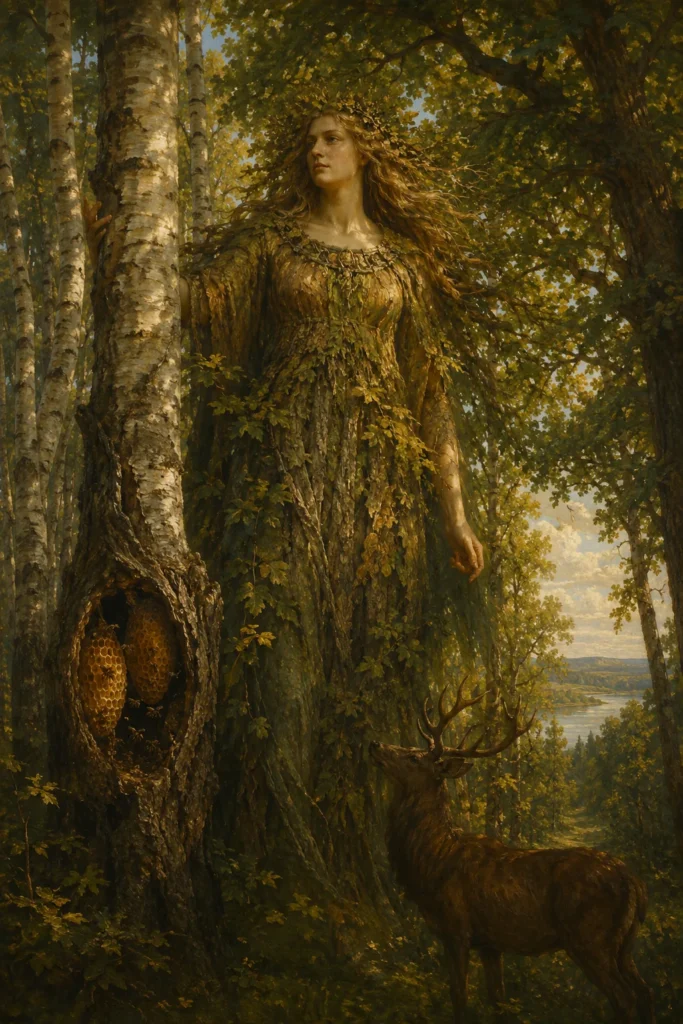
Madderakka is described as an old, dignified grandmother who lives under the earth or under the living space. On the shaman drums she is mostly depicted on the lowest level, often as a seated or resting woman.
Madderakka was worshipped on particularly important occasions, above all at the beginning of a pregnancy and at major family rituals. Direct cult was rare; in everyday life her daughters, especially Sara-Akka, were invoked more often. At the holy stones, the Sieidi, she sometimes received offerings.
Madderakka is associated with the earth, the ground, the root and primeval times. The name component madder is linked with stem, root or origin.
Structurally comparable are the Finnish Maa-Emoinen, the Hungarian Boldogasszony, the Greek Gaia, the Hindu Prithivi and the notion of an ancestral mother among the Inuit in Pinga. She is also related to notions of a Mother Earth in the Finnish and Estonian regions.
Classification and Brief Profile
Madderakka stands at the hierarchical apex of the Akka triad and is therefore the most important female deity of the Sámi religion. She receives souls from the high god Ráhka or from Beaivi and passes them on to her three daughters, who carry out the specialised birth functions.
This hierarchical structure is elaborately developed from a religious-studies perspective. It shows that Sámi Akka theology does not consist of independent deities but of an integrated family structure in which Madderakka holds the mother position and her daughters carry out the operative functions.
Schefferus, Leem, Læstadius, and the drum images are the principal sources for Madderakka.
The primordial mother Madderakka has been treated in recent scholarship through expanded approaches that combine ethnographic precision, critical examination of the linguistic tradition, and comparative perspective. Sámi scholars themselves now contribute to this work and correct older Western interpretations that had at times reflected colonial viewpoints.
As the hierarchical apex of the Akka triad, Madderakka fits into a circumpolar religious topography whose basic patterns recur across vast distances. This structural consistency over thousands of kilometres is among the most striking findings of comparative religious studies and remains the subject of ongoing research debates.
Name and Etymology
The name Madderakka derives from the Sámi word máddá, meaning origin, lineage, or grandmother. The Akka component, as with the other Akkas, is the common designation for female protective goddesses. Madder-Akka thus literally means primordial mother or ancestral grandmother.
Etymologically, the root máddá belongs to the Finno-Ugric stratum. Related terms are attested in Finnish maa for land or earth and in Estonian maa for land. This linguistic depth points to an ancient layer of religious concept formation.
Dialectal variants include Maaddaraahka in Southern Sámi, Máttar-akka in Ume Sámi, and Máttaráhkká in Northern Sámi usage. This diversity is typical from a phenomenology-of-religion perspective.
From a religious-sociology standpoint, the question arises as to what function Madderakka fulfilled in the social order of the traditional Sámi community.
Since her theological position as the soul-receiving mother of an entire family of goddesses mirrors the family structure, the religious was here closely interwoven with social practice. This entanglement forms a distinct field of religious anthropology, studied systematically above all by Håkan Rydving.
A further dimension concerns the present-day significance of Madderakka for Sámi identity politics. Within the framework of Sámi self-governance and the recognition of indigenous rights under international law, transmitted figures such as the highest Akka are once again entering public consciousness.
The relationship between religious scholarship and political self-assertion is a distinct field of inquiry that has received increasing attention in recent years.
Description and Iconography
In ethnographic sources, Madderakka is described as an old, dignified, venerable grandmother who dwells beneath the earth or beneath the living space. Her chthonic location is a distinct phenomenon from the perspective of religious phenomenology and connects her with the mother-earth theology of many indigenous religions.
On the shaman drums, Madderakka is usually depicted in the lowest drum register, often as a seated or reclining woman. Ernst Manker’s drum studies demonstrated her consistent iconographic position across most surviving drums.
Symbolically, Madderakka is associated with the earth, the ground, the root, and primordial time. This symbolism is a distinct phenomenon from the perspective of religious phenomenology and is well documented in comparative religious studies as the mother-earth type.
Reception of Souls and Pre-Birth
Madderakka’s central function is the reception of souls before birth. According to Sámi belief, the soul of an unborn child first comes to Madderakka, who examines it and passes it on to the responsible daughter: Sara-Akka for midwifery, Juksakka for a male child, Uksakka for the threshold.
This soul-reception function is elaborately developed from a religious-studies perspective. It shows that the Sámi tradition theologically divides the process of birth into several steps: reception of the soul, transfer to the specialised deities, and completion of the birth.
From a religious-studies perspective, this multi-stage birth theology is a distinct configuration. It differentiates the Sámi tradition from traditions with a single birth goddess and demonstrates the elaborate religious structuring of the female protective function.
Cult and Veneration
Madderakka was venerated on particularly important occasions, especially at the beginning of a pregnancy and during major family rituals. Direct cult practice was rare; more frequently her daughters, in particular Sara-Akka, were invoked in everyday life.
At the sacred stones known as Sieidi, Madderakka was sometimes the recipient of offerings, though more often Beaivi, the other Akkas, and the specialised functional deities were addressed. This asymmetry in cult practice is typical from a phenomenology-of-religion perspective for hierarchically superior high goddesses.
From a religious-studies perspective, the asymmetry between theological significance and concrete cult practice is a distinct phenomenon, observable also in the case of Ráhka. Madderakka is the female counterpart of this structural pattern.
Madderakka within the Akka System
Madderakka is the mother of the three other Akkas and thus the hierarchical apex of the Akka triad. The four-part constellation, Madderakka as primordial mother, Sara-Akka as birth assistant, Juksakka as guardian of boys, Uksakka as guardian of the threshold, is an elaborately developed system from a religious-phenomenology perspective.
This hierarchical family structure is instructive from a religious-studies standpoint. It shows that the Sámi tradition does not split the female protective function into independent deities but into an integrated family in which the mother coordinates the others.
From a religious-studies perspective, the question has been discussed whether this family structure is a late systematisation introduced by missionaries or an independent Sámi configuration. Håkan Rydving treats the system as a reconstructed and partly distorted tradition; the question cannot be settled with certainty from the sources.
Comparison with Other Primordial Mothers
Madderakka belongs to the class of mythological primordial mothers found across numerous religions. Structurally comparable figures include the Finnish Maa-Emoinen, the Hungarian Boldogasszony, the Greek Gaia, the Hindu Prithivi, and the Inuit primordial-mother concept embodied in Pinga.
The specificity of Madderakka lies in her embeddedness in a family hierarchy with three daughters. This elaborated structure is a distinct religious-phenomenological formation and distinguishes the Sámi tradition from traditions with only a single primordial mother.
Within the Finno-Ugric tradition, the Madderakka configuration is related to the Finnish mother-earth concept and to the Estonian Maa concept. This structural kinship points to an ancient Finno-Ugric stratum.
Mission and Modern Reception
Christian mission partially identified Madderakka with Mary and partly with Eve (as the primordial mother of humanity). From a religious-studies perspective, this identification is not a simple syncretism but a deliberate missionary-strategic choice intended to ease the transitional theology of the Sámi being missionised.
In contemporary Sámi cultural revitalisation, Madderakka is a significant figure. Feminist currents within the Sámi community regard her as a paradigmatic primordial mother and an example of the importance of female religious authority in traditional religion.
From a religious-studies perspective, the reappropriation of Madderakka is part of a broader rediscovery of the female dimension of Sámi religion. This rediscovery is productive from a religious-phenomenology perspective.
Research and Current State of Scholarship
Research on Madderakka is broadly established. Håkan Rydving, Juha Pentikäinen, and Anna Lia Berthelsen have systematically studied the Akka system and identified Madderakka as its hierarchical apex.
A dedicated monograph on Madderakka has yet to be written. Concrete research gaps remain regarding the precise relationship between Madderakka and the Finnish mother-earth tradition and concerning her relationship to Ráhka as high god.
In religious-phenomenological research, Madderakka is treated as a case study of hierarchical primordial mothers. This classification allows structural comparisons that are productive from a religious-studies perspective.
Lexicon Cross-References
Madderakka connects with Sara-Akka, Juksakka, Uksakka, Beaivi, Mánnu, Ráhka, Stallo, Jabmiidaibmu, and Saivo. The culture hub Sámi Tradition frames the primordial-mother theology. Structurally similar primordial mothers are found in numerous religions worldwide, for example in the Inuit lemma series at Pinga.
Madderakka as Primordial Mother: the Position at the Apex of the Akka Deities
Maderakka, written in the sources also as Madder-akka or Mátteráhkká, is regarded in the transmitted accounts of Sámi religion as the superior female deity of the birth and domestic sphere.
Three daughters are assigned to her: Sarakka, Uksakka, and Juksakka, each said to have distinct tasks relating to pregnancy, birth, and early childhood. Maderakka herself is described as the one who receives the child and gives it a body before it is passed on.
The name element madder is commonly associated with “lineage”, “root”, or “origin”, from which the interpretation as “primordial mother” or “ancestral mother” follows. This etymology is plausible but not entirely certain, as the spellings in the old sources vary and the Sámi languages across a wide territory feature different forms.
In her function as primordial mother, Maderakka would be less a single fate-goddess than a personification of the female line, of descent and reproduction itself.
Noteworthy is the gender order of this conceptual complex. While the publicly visible cults of Sámi religion, such as those around deities of thunder or hunting, were more closely associated with men, the domain of the Akka deities belonged in a particular way to women.
Maderakka and her daughters were deities of the tent interior, of birth, nursing, and the protection of small children. This piety was close to everyday life and rarely spectacular, which explains why it appears only marginally in sources focused on the extraordinary.
How Reliable is Akka Theology? Source Criticism on Maderakka
The orderly presentation of Maderakka as a mother goddess with three specialised daughters appears in numerous handbooks but should be read with considerable caution.
It rests on a narrow source base from the seventeenth and eighteenth centuries, almost exclusively written by Lutheran missionaries and clergymen who sought to eradicate Sámi religion and had no interest in accurate representation.
Several methodological problems converge here. The recorders translated Sámi concepts into European patterns of thought; a system comprising a mother and three daughters with clearly defined domains corresponded better to their ordering expectations than a loose, regionally variable network of protective beings.
Moreover, the early accounts copied from one another, so that an apparently broad attestation can be traced back to a few original texts. Finally, some records were produced in interrogation contexts in which those questioned were under duress.
Critical Sámi religious scholarship, as represented by Håkan Rydving, has drawn the consequence of treating the Akka deities not as a securely established theological system but as a reconstructed and partly distorted tradition.
For Madderakka this means: that a significant female deity of the birth sphere existed, occupying a superordinate, maternal position, is well attested and plausible.
Whether, however, the neat fourfold division with three clearly delimited daughters corresponds to historical Sámi religion or whether it is substantially a product of the recorders cannot be decided with certainty from the sources. The most honest answer current scholarship can give is that the broad outlines are recognisable, but the details remain uncertain.
Select Bibliography
- Johannes Schefferus: Lapponia (Frankfurt 1673)
- Knud Leem: Beskrivelse over Finmarkens Lapper (Copenhagen 1767)
- Lars Levi Læstadius: Fragmenter i lappska mythologien (Manuscript ca. 1840)
- Håkan Rydving: The End of Drum-Time (Uppsala 1993)
- Juha Pentikäinen: Saamelaiset (Helsinki 1995)
Related key terms: Madderakka Maaddaraahka Máttaráhkká Sámi primordial mother receiver of souls Akka.
iWell Guard and Protective Traditions
iWell Guard draws on the cultural-historical tradition of wearable protective objects, in the tradition of the Sámi and many other cultures worldwide. 41 layers, real gold, platinum, silver, crafted in Germany. 30-day return policy.
Individual experiences may vary. Not a medical device. No healing promises.