Khepri, Egyptian scarab god of the morning sun
By Ralf Ittermann · last reviewed on
Khepri is an Egyptian scarab god who embodies the rising morning sun and the daily renewal of life. In the ancient Egyptian pantheon, Khepri is the scarab sun god who embodies the first rising of the sun in the morning.
His name derives from the verb “kheper,” which means “to become, to come into being, to transform,” and which stands at the center of the Egyptian idea of the cosmic process of becoming.
Khepri is “the becoming one” par excellence: the one who comes into being from himself, who is reborn each day on the eastern horizon, who transforms by his own power.
His symbolic animal is the scarab, that dung-rolling beetle of the species Scarabaeus sacer, whose life cycle inspired the Egyptians to draw an impressive cosmic analogy.
Within the solar cycle, Khepri together with Ra (the midday sun) and Atum (the evening sun) forms the threefold figure of the sun’s course, a reading that was theologically elaborated above all in the New Kingdom and in the Late Period.
Profile: Khepri
Khepri: the most important aspects at a glance. The following fields summarise origin, function, appearance, veneration, symbols and parallels.
Egyptian scarab god of the rising morning sun. He is regarded as unbegotten and without parents; the Pyramid Texts (Spell 587) call him the “one who came into being by his own power”. The oldest evidence dates from the Old Kingdom; his importance grew in the Middle and New Kingdoms.
Khepri embodies the first rising of the sun in the morning and the daily renewal of life. In the twelfth hour of the night the aged Atum transforms into the youthful Khepri, who is born anew as the morning sun. His name derives from kheper, “to become, to come into being, to transform”.
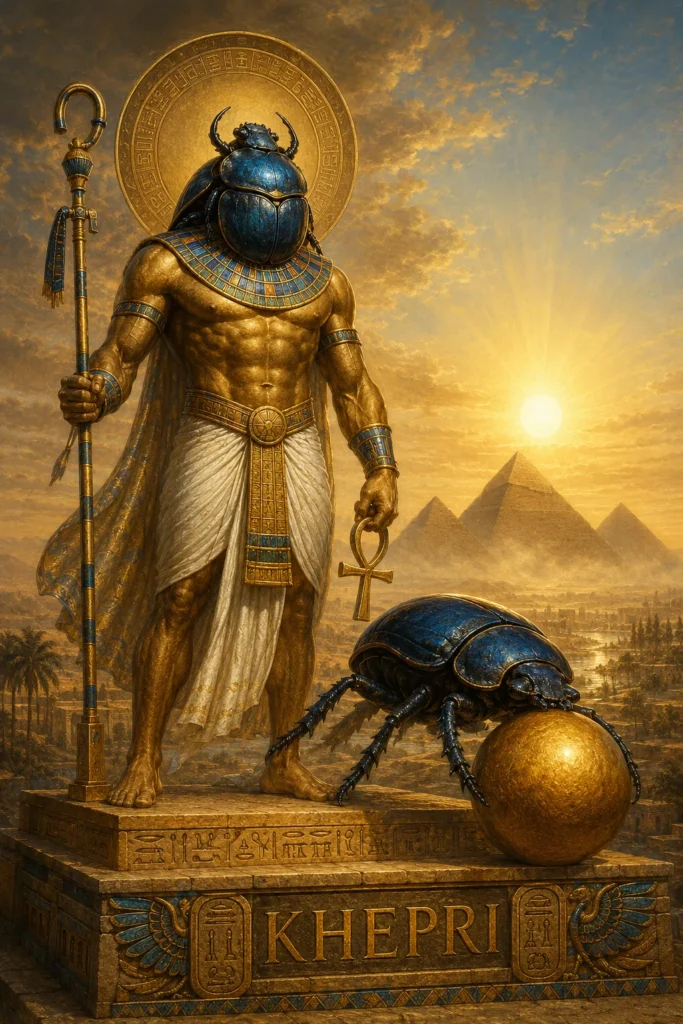
Khepri is depicted as a complete scarab or as a man with a scarab’s head. In the solar barque he sometimes appears with raised arms or rolling the sun disc before him. At Karnak, beside the Sacred Lake, stands a granite scarab of Amenhotep III about 1.9 metres long.
Khepri had no independent main temple; his cult was integrated into the sun temples, for example in Heliopolis, at Abu Gurob and in the mortuary temples of the pharaohs. He was invoked at dawn, when the sun priests “awakened” the statues of the gods. In the Late Period dried scarabs were presented as votive offerings.
His sacred animal is the scarab, the dung beetle Scarabaeus sacer, which rolls a ball of dung as Khepri rolls the sun disc across the sky. Scarab amulets carry protective formulas; the heart scarab with Spell 30B of the Book of the Dead was meant to protect the heart before the judgement of the dead.
With Re as midday sun and Atum as evening sun, Khepri forms the triple form of the sun’s course, three aspects of the same cosmic entity. With Atum he is identified in many constellations. His self-utterance of the name as an act of creation is regarded as structurally related to the Greek logos.
Myth and Genealogy
Khepri is a god without a clear genealogy. Unlike the Olympian gods of Greece, whose family tree is recounted in meticulous detail, Khepri belongs to the category of self-existing, unbegotten gods.
In the Pyramid Texts (Spell 587) he is called the one “who came into being by his own power,” who has neither father nor mother.
This unusual genealogical position links him to Atum, with whom he is identified in many theological constellations. The earliest evidence shows Khepri already in the Old Kingdom, and his significance grows continuously in the Middle and New Kingdoms.
In Heliopolitan theology, Khepri is a manifestation of Atum-Ra, that is, the same god in his morning form of appearance. Egyptian theology understood the relationship of the three sun gods (Khepri, Ra, Atum) not as kinship in the genealogical sense, but as three aspects of the same cosmic being.
In Egyptian kingship, Khepri appears especially in the coronation theologies as the protective god of royal birth; his name is moreover used in numerous royal birth names, such as Men-kheper-Ra (Thutmose III), Neb-kheper-Ra (Tutankhamun), Aa-kheper-Ra (Thutmose II), in which the element “kheper” carries a central theological meaning.
One particular mythic narrative is the nightly solar voyage. After Atum, as the aged sun, descends into the underworld in the evening, he traverses the twelve hours of the night in the solar barque.
In the twelfth hour of the night, shortly before morning, the aged Atum transforms into the youthful Khepri, who breaks forth from the shell of the scarab and is reborn as the rising morning sun.
This transformation is described in detail in the “Books of Gates” and in the “Book of That Which Is in the Underworld” (Amduat) and forms the theological heart of Egyptian solar theology.
In the later tradition, numerous family connections are attributed to Khepri, depending on the local theology. In some texts his consort is the “Mehet-Weret” cow, the personification of the primeval waters in their celestial aspect.
No children of his own are recorded; the creation of humankind is attributed in Heliopolitan theology to Atum, not to Khepri. Khepri is thus less a family god than a cosmic function that gains an independent dignity in Egyptian religion.
Symbols, Iconography and Attributes
Khepri is depicted in two ways: on the one hand as a complete scarab, on the other as a man with a scarab head.
The latter depiction is one of the strangest in all of Egyptian pictorial art, because it takes an insect as a substitute for the head, which looks anatomically unusual; yet the theological clarity achieved with the scarab-headed depiction gained a firm standing in the Egyptian pictorial tradition.
On the temple walls of the New Kingdom and the Late Period, Khepri is regularly depicted in the human, scarab-headed form within the assemblies of the gods.
His sacred animal is the scarab, the dung beetle of the species Scarabaeus sacer.
The Egyptians observed that the beetle forms a ball of dung, rolls it before itself and buries it in a cavity in which it lays its eggs; the young beetles seem to emerge of their own accord from the buried ball.
This behavior became a cosmic analogy: just as the scarab rolls the ball before itself, so Khepri rolls the solar disk across the sky; just as the young beetles seem to break forth from the ball, so all living beings arise from the creative principle of becoming.
Aelian (De natura animalium X, 15) combined these observations with astonishment at Egyptian religiosity.
Scarab amulets are among the most common finds of Egyptian archaeology. Countless examples survive from all epochs, from the Middle Kingdom to the Roman period, in sizes ranging from a few millimeters to several centimeters.
On the flat underside they bear inscriptions: royal names, formulas of the gods, protective spells, magical signs. They were worn as amulets, used as seals, placed within the mummy wrappings and given to graves as offerings.
The famous “heart scarab,” a larger scarab placed on the breast of the deceased, bore Spell 30B of the Book of the Dead, which was meant to protect the heart at the judgment of the dead. The example of the heart scarab shows the close connection between Khepri symbolism and ideas of the afterlife.
At Karnak stands the famous “scarab of Amenhotep III,” a granite scarab about 1.9 meters long, set up by the “Sacred Lake.” It is the largest surviving scarab sculpture in Egyptian art and is regarded as a model example of Khepri’s theological dignity.
The reliefs of the mortuary temples often show Khepri in the solar barque, sometimes with raised arms, sometimes rolling the solar disk before himself.
In the ceiling depictions of the Ramesside royal tombs in the Valley of the Kings, the nightly solar voyage is visualized with particular attention to detail; there Khepri appears as the youthful scarab who emerges in the last hour of the night from the transformation of Atum.
Cult and Veneration
Khepri had no independent main temple in the sense of the great temple complexes for Amun, Ra or Ptah.
His cult was integrated into the general solar temples, above all in the great temple of Heliopolis, in the sun sanctuaries of the pyramid fields (Abu Ghurab with the sun temple of Nyuserre, Fifth Dynasty) and in the mortuary temples of the pharaohs.
The ritual invocation of Khepri took place at dawn, when the sun priests “awakened” the statues of the gods and began the daily offerings. The solar ritual of Karnak, of which numerous papyri survive (especially the Berlin Papyrus 3055), begins with an invocation of Khepri as the scarab of the eastern horizon.
Khepri held a special position in the so-called “scarab cult” of the Late Period. At Heliopolis, Karnak and on numerous other temple grounds, scarabs were offered.
Cemeteries for mummified scarabs are known neither at Saqqara nor at Tuna el-Gebel, where cats, ibises and baboons were buried. However, the scarabs offered were not living animals kept in the temple, but dried beetle bodies offered as amulets or votive gifts.
In the daily solar ritual of the temple, Khepri hymns were sung that celebrated the morning emergence of the sun from the nocturnal primeval waters.
A particularly impressive hymn is the “Hymn to the Rising Sun God,” preserved in Papyrus Boulaq 17 (Thebes, 18th Dynasty), in which Khepri is invoked as “the one who came into being from himself” and “before whom nothing was.” The theological depth of these hymns shows that Khepri was not merely a god of natural phenomena, but the bearer of a high-ranking cosmological conception.
In the royal burial, Khepri played a role of his own. On the sarcophagus lids and in the royal tombs of the Valley of the Kings, Khepri is omnipresent as a symbol of resurrection.
The heart-scarab ritual (Book of the Dead, Spell 30B) connected the deceased with Khepri: “My heart is my mother, my heart is my mother, my heart is my becoming on earth”; the verse plays on the meaning of “kheper” (to become) and places the heart of the dead under Khepri’s protection.
In the Pyramid Texts and Coffin Texts, Khepri frequently appears in spells that address the ascent of the deceased to the sky and his transformation into a star form.
Important Sanctuaries and Temples
Since Khepri had no main temples of his own, his veneration is bound to cult sites that were consecrated to other principal gods. At Heliopolis, Khepri played an important role in the Atum-Ra temple, yet an independent Khepri shrine is not attested.
In the great sun temple of Nyuserre at Abu Ghurab (5th Dynasty), the theological program is oriented toward the solar cycle with particular attention to Khepri; the sanctuary lies in ruins today, yet the architecture can be reconstructed: a large platform with an obelisk-like Benben stone at its center, before which stood an alabaster altar with the offering altars for the solar voyage.
At Karnak, Khepri is prominent in several places. The granite scarab of Amenhotep III by the Sacred Lake, already mentioned, is the most famous Khepri sculpture of all. On the walls of the hypostyle hall and in the side chapels, Khepri is regularly depicted in the theological pictorial programs.
At Luxor and in the mortuary temples of the western Theban necropolis (Ramesseum, Medinet Habu, temple of Seti I), Khepri has a firm place in the solar picture series.
In the Valley of the Kings, the royal tombs are decorated with the “Amduat” and with the “Books of Gates,” in which Khepri appears centrally.
Particularly impressive is the tomb of Seti I (KV 17), in which the nightly solar voyage is depicted with all its phases of transformation; in the twelfth hour of the night, Khepri appears as the youthful scarab who pushes the solar disk up toward the morning horizon.
Similar pictorial programs are found in the tombs of Ramesses II, Ramesses IV and Seti II.
Scarab temples in the strict sense did not exist, but Khepri cult niches are attested in numerous smaller sanctuaries.
At Bubastis (Tell Basta) in the Delta there was a Khepri chapel beside the Bastet temple; at Mendes (Tell el-Rub’a) a Khepri veneration linked with the sacred ram of Mendes; at Edfu a Khepri series in the main program of the temple walls.
In the Hibis temple of the Kharga oasis, the theological pictorial script shows Khepri as part of the cosmic assembly of the gods. In the Ptolemaic-Roman Late Period, the Khepri cult continued to be cultivated in the temple of Esna and in the smaller temples of Tod and Hermonthis.
Mythic Narratives
The central Khepri narrative is the daily solar voyage. In the evening the old sun Atum descends into the nocturnal underworld. During the twelve hours of the night the solar barque traverses the twelve gates or chambers of the underworld; there it encounters Apophis, the serpent of chaos, who is defeated each day.
In the twelfth hour of the night, shortly before morning, the old sun is bathed in the primeval waters of Nun, from which a transformation into the youthful Khepri proceeds. From this “rebirth” the sun enters the morning sky as a new young god.
In the Pyramid Texts and Coffin Texts, the deceased king or the deceased person is identified with Khepri. The dead one passes through the twelve hours of the night parallel to the sun and is reborn together with it in the morning.
This identification is one of the oldest models of resurrection theology and shapes the Egyptian conception of the afterlife into the Late Period. The scarab amulet given to the deceased on the breast was the material guarantee of this identification.
A further narrative connects Khepri with self-generation. In a theological reflection treated in detail in the Hibis temple and in the Esna hymns, Khepri declares: “I am the one who came into being from himself.
I was in the primeval waters, I arose out of myself, I spoke my name, and through this name I came into being.” This statement is significant in the history of religion, because it expresses the idea of creative speech (the “word”) in a form that is structurally related to the Greek concept of the Logos.
The self-pronouncement of the divine name as an act of creation is one of the intellectual high points of Egyptian theology.
In the myth of the Eye of the Sun, Khepri is also assigned a secondary role. The Eye of Ra (or Atum) had withdrawn into the Nubian desert; Thoth was sent to bring it back.
On its return the Eye found that it had been replaced by a new eye, and grew angry; through a theological fusion it was placed as the uraeus serpent on the forehead of the sun god.
In this episode Khepri is the morning aspect of the sun god, who protects the Eye and accomplishes the daily journey with it.
Relationships within the Pantheon
Khepri is connected with Ra and Atum through the concept of solar transformation. These three are not three different gods, but three aspects of the same sun at the different times of day. Khepri is the rising morning sun, Ra the midday sun on high, Atum the setting evening sun.
This “solar triad” is unique in its clarity within the history of religion; it makes the cosmic function of the sun’s course the chief theological matter and places the multiplicity of aspects above the unity of the sun god.
With Atum there is a particularly close relationship, because both share the concept of self-production. Khepri is, as it were, the youthful Atum, who is reborn from the nocturnal primeval waters.
This doubling is explicitly treated in the theological hymns; Khepri and Atum stand at the beginning and at the end of the sun’s course, and both are linked with one another through the concept of “kheper” (becoming).
With the kings of Egyptian kingship, Khepri has a special relationship. The royal name is frequently provided with the element “kheper,” which makes the king the bearer of the cosmic principle of becoming.
At the coronation, the new pharaoh is connected with Khepri; at his death he enters the solar cycle and is joined with Khepri for the morning rebirth.
With Thoth, the god of writing and of knowledge, Khepri has a theological connection through the concept of creative speech; Thoth is the one who “speaks” the names of the gods, Khepri the one who comes into being through “speaking his name.”
Reception
In Greco-Roman antiquity, Khepri was regarded as the Egyptian sun god par excellence; the identification with Helios and Apollo was common.
Plutarch (“De Iside et Osiride” 10, 73 and 74) treats Khepri at length and gives a theological interpretation of the scarab symbol: the scarab is said to have only the male sex, for which reason it is an emblem of self-birth.
This reading was widespread in ancient natural history and shaped the symbolism of scarab amulets in late antiquity. Egyptian scarabs were traded widely across the Mediterranean region; in Phoenician, Etruscan and Greek graves they are attested as imported goods.
In the Hermetic writings of late antiquity, Khepri is treated under the name “Kheper” as an aspect of cosmic consciousness. The magical papyri (Papyri Graecae Magicae) contain numerous invocations of Khepri, which were mostly used for purposes of protection and healing.
The scarab symbol was not adopted into Christian-Coptic symbolism, but it remained present in ancient natural history (Pliny, Aelian) as a remarkable animal peculiarity.
The modern rediscovery of Khepri begins with Champollion’s publications on the solar hymns.
In the nineteenth century, Heinrich Brugsch and Adolf Erman treated solar theology; in the twentieth century, Erik Hornung (“Conceptions of God,” “Das Buch der Anbetung des Re”), Jan Assmann (“Sonnenhymnen in thebanischen Gräbern,” “Re und Amun”) and James P. Allen (“Genesis in Egypt”) systematically presented the theological depth of Egyptian solar religion and thereby also of Khepri.
In modern esotericism and popular culture, Khepri symbolism is present in jewelry and in the general “Egyptian” aesthetic; the scarab amulet has become a standard element of esoteric symbolism, often without the theological depth of the original Khepri concept being taken into account.
Religious-Studies Classification
Khepri belongs to the “gods of becoming,” who embody a cosmic process of transformation. In the history of religion his position is remarkable: while most creator gods accomplish creation in a single initial act, Khepri represents the ongoing creation that renews itself each day.
This idea of a “continuous creation” (creatio continua) is a topos of its own in the history of religion, found in the Vedic idea of Ṛta, in the Greek doctrine of Physis and (with a different accent) in the Christian theology of sustaining creation.
In the comparative religious context, the scarab symbolism is unique. The animal, which in many cultures was held in low regard as a dung beetle, gains a cosmic dignity in Egypt through the observation of its behavior: the rolling of the ball, the apparent self-generation of the young beetles.
This attention to a supposedly lowly creature, to which the Egyptians ascribed a theologically high-ranking meaning, is the expression of a religious gaze that can see the sacred in all cosmic phenomena.
Jan Assmann, in “Ägypten,” described this peculiarity of Egyptian religion as “cosmotheistic”: the sacred is visible in the world itself and in its natural phenomena.
Erik Hornung, in “Conceptions of God,” identified the “identification” of the deceased with Khepri as one of the central models of Egyptian resurrection theology. This reading prepares the way for the Christian idea of resurrection, without a direct influence having to be assumed; the structural kinship is nonetheless recognizable.
James P. Allen, in “Genesis in Egypt,” presented the theological connection of Khepri and Atum as a model of an Egyptian “creation eschatology,” in which the beginning and the end of the sun’s course correspond to one another.
Sources
Pyramid Texts, especially Spell 587 and 600. Coffin Texts and Book of the Dead, especially Spell 17 and 30B (heart scarab). “Amduat” and “Books of Gates” from the royal tombs in the Valley of the Kings, edition by Hornung. Solar hymns, especially Papyrus Boulaq 17 (Thebes, 18th Dynasty), edition by Adolf Erman.
Plutarch, “De Iside et Osiride” 10, 73 and 74. Aelian, “De natura animalium” X, 15. Henri Frankfort, “Kingship and the Gods,” Chicago 1948. Erik Hornung, “Der Eine und die Vielen,” Darmstadt 1971. Erik Hornung, “Das Buch der Anbetung des Re im Westen,” Geneva 1975. Jan Assmann, “Sonnenhymnen in thebanischen Gräbern,” Mainz 1983. James P. Allen, “Genesis in Egypt.
The Philosophy of Ancient Egyptian Creation Accounts,” New Haven 1988.