Gilgamesh, King of Uruk and Epic Hero
By Ralf Ittermann · last reviewed on
Gilgamesh is the king of Uruk and, as an epic hero, the central figure of humanity’s oldest great epic preserved in cuneiform. Gilgamesh is probably the most famous literary hero of the ancient Mesopotamian tradition.
As the legendary king of Uruk, he reigns for around 126 years according to the royal lists and subsequently becomes a semi-divine figure whose quest for immortality is the main theme of the epic named after him.
The Epic of Gilgamesh in its canonical standard version of 12 tablets is among the earliest surviving works of world literature and addresses central questions of human existence.
Profile: Gilgamesh
Gilgamesh: the most important aspects at a glance. The following fields summarise origin, function, appearance, veneration, symbols and parallels.
Gilgamesh probably goes back to a king of Uruk in the early 3rd millennium BCE and appears in the king lists as the fifth king of the First Dynasty of Uruk. His mother is the goddess Ninsun, his father the deified Lugalbanda. The epic arose from Sumerian songs and survives in a standard version of twelve tablets.
As the semi-divine king of Uruk, Gilgamesh seeks immortality after the death of his friend Enkidu and fails the trials. After his death he was invoked as a demigod and judge of the underworld, who welcomes the dead and shows them the way. His spirit was regarded as powerful in divination practices.
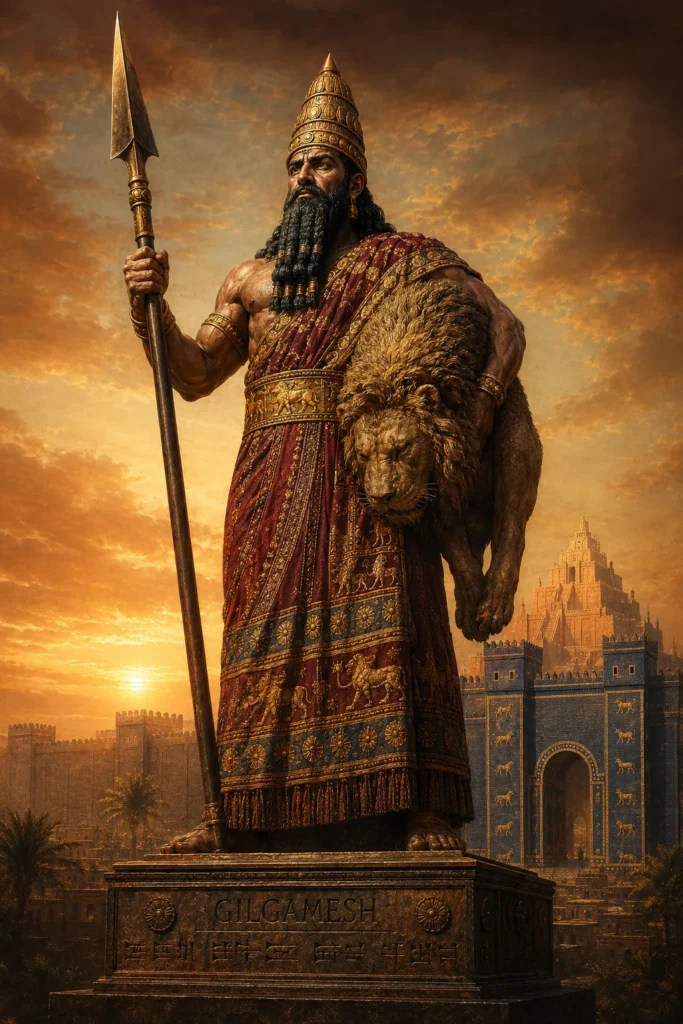
Gilgamesh is depicted as a tall hero with beard and curly hair, with a mace, often with a double head, and a bow. On Neo-Assyrian reliefs he sometimes carries a lion under his arm. Other images show him as master of animals between two rearing lions.
Gilgamesh was venerated in cult: inscriptions attest offerings for his spirit in the month of mourning for the dead. One sanctuary was the Eturkalama in Uruk, which was dedicated to him and his ancestors. In Nippur and Babylon, too, he was called upon in incantation texts and lamentation liturgies.
His attributes are mace and bow, and his animal is the lion. Enkidu, his companion, is a distinct pictorial type with long hair, a garment of fur and the features of a wild animal. A plant that is meant to turn back old age is lost to him because a snake steals it. The walls of Uruk are regarded as his lasting fame.
The flood account on Tablet XI has been read as a parallel to the biblical story of the Flood. Whether there is a historical dependence or a common origin is still debated today. The motif of the heroic pair of friends recurs in Greek and Persian narratives.
Myth and Origin
Gilgamesh can probably be traced historically to a king of Uruk in the Early Dynastic period of the early 3rd millennium BCE. His name appears in the Sumerian king lists as the fifth king of the first dynasty of Uruk, among a series of rulers who partly carry a semi-divine character.
Already in the Old Sumerian tradition he was conceived as half divine, because his mother Ninsun, a minor goddess, was connected with Lugalbanda, a likewise deified ruler.
The Old Sumerian narratives about Gilgamesh are not a single unified novel, but a series of individual songs. These include “Gilgamesh and Aga”, “Gilgamesh and Huwawa”, “Gilgamesh and the Bull of Heaven”, “The Death of Gilgamesh” and “Gilgamesh, Enkidu and the Netherworld”.
In the Old Babylonian period, around 1800 BCE, these songs were combined into a first connected composition, now in the Akkadian language. In the Middle Babylonian period, around 1200 BCE, the later standard version of twelve tablets emerged, which is attributed to the priest Sin-leqi-unninni.
The epic first follows the unbound king Gilgamesh, who torments his subjects with arrogant demands. The gods create Enkidu, a wild man equal to him in strength. The two become friends and set out together to defeat the guardian of the Cedar Forest, Humbaba.
After this victory Gilgamesh insults the goddess Ishtar, who as punishment sends the Bull of Heaven against the city. The two heroes kill the bull, whereupon the gods cause Enkidu to fall ill as a guilt offering. His death plunges Gilgamesh into a deep life crisis and drives him onto a quest for immortality.
Gilgamesh travels to Utnapishtim, the survivor of the great flood, who tells him the story of the flood and sets him tests, at which he fails. On the return journey he finds a plant said to reverse old age, but it is stolen by a snake.
Gilgamesh returns to Uruk and proudly contemplates the walls of his city: that is his lasting fame. This closing composition is regarded as one of the most moving final formulations of ancient literature.
Symbols and Attributes
Gilgamesh is depicted in visual art as a tall hero with a beard and curly hair. His most important attributes are the war mace, often with a double head, and the bow. On Neo-Assyrian reliefs he sometimes appears with a lion under his arm, a depiction that symbolically conveys his superior physical strength.
One iconographic tradition depicts him as a hero between two rearing lions, a position that in the ancient Mesopotamian visual program characterizes the “Master of Animals”.
Several heroic figures and gods of the pantheon share this position. Reliefs from the palace of Sargon II in Khorsabad show him in this position, which underscores the cross-cultural resonance of his figure.
His companion Enkidu is a distinct iconographic type, often depicted with long hair, a fur garment and wild-animal features. The two heroes together form an ancient Mesopotamian pair motif, which later recurs in comparable form in Greek and Persian narratives.
The motif of the close heroic pair of friends was taken up by Friedrich Schiller and many other modern authors.
Cult and Veneration
Unlike many heroes of the ancient world, Gilgamesh was actually venerated in cult. Inscriptions from the Old Sumerian and Old Babylonian periods attest sacrifices made to his spirit in the month of mourning for the dead.
He was invoked above all as a deity of divination and judgment in the netherworld, where he was to greet the dead and show them the way.
An important sanctuary was the Eturkalama in Uruk, which was dedicated to him and his ancestors. In Nippur and Babylon too his names were invoked in incantation texts and lament liturgies.
His spirit was considered especially powerful in divination practices, because as a hero he had entered the netherworld twice: once to retrieve Enkidu, once after his own death.
In the Neo-Assyrian period his literary reputation remained unbroken, yet the cultic aspect waned. Ashurbanipal, the great librarian-king, had the Epic of Gilgamesh kept in several copies in his library.
A large number of the surviving tablets come from this royal collection in Nineveh. In Hattusha too, the capital of the Hittites, a Hittite translation was produced, which shows the international spread of the material.
In the Late Babylonian and Seleucid periods the literary tradition faded. Yet even in Jewish-Aramaic and Syriac sources traces of the Gilgamesh material appear, often reinterpreted onto other heroes. The direct tradition ended only with the complete burial of Mesopotamian written culture in the 1st century CE.
Important Myths
The main work is the Epic of Gilgamesh in the standard version of twelve tablets. Tablets I to II describe the young, domineering Gilgamesh and the creation of Enkidu by the goddess Aruru.
The encounter of the two heroes, their fight and their subsequent friendship are remarkable in religious-historical terms, because they transform the classic conflict between city and steppe into a bond of love.
Tablets III to V describe the journey to the Cedar Forest and the fight against Humbaba, the guardian of the forest.
This episode is remarkable in religious-historical terms, because it connects cosmic geography with concrete timber trade. The extraction of cedar wood in Lebanon was a real economic activity of Mesopotamian kings, and the epic legitimizes it mythically.
Tablets VI to VIII contain the episode with Ishtar, the killing of the Bull of Heaven and the death of Enkidu. Here the religious-historical themes are at their densest.
Gilgamesh’s refusal to take Ishtar as his wife, and his enumeration of the goddess’s earlier lovers, are a rare polemic against a powerful deity. The reaction of the gods, to let Enkidu die, gives the narrative a theological depth.
Tablets IX to XI are devoted to Gilgamesh’s path of despair. He travels through the tunnels of the sun god, crosses the waters of death, reaches Utnapishtim and hears the flood narrative.
Tablet XI, with its detailed flood account, is especially important in religious-historical terms, because it was read as a parallel to the biblical flood story and in the 19th century deeply influenced the discussion about the literary prehistory of the Pentateuch.
Tablet XII, a later addition, describes Gilgamesh’s lament for Enkidu and the return of Enkidu’s spirit from the netherworld. This part is actually a translation of the Sumerian song “Gilgamesh, Enkidu and the Netherworld” and is not fitted into the narrative scheme of the standard version, which is why scholarship regards it as an appendix.
Relationships within the Pantheon
As a historical figure Gilgamesh is not part of the pantheon in the narrower sense, yet posthumously he was venerated as a demigod and judge of the netherworld.
His mother Ninsun, a goddess of wisdom and animal husbandry, belongs to the pantheon of Uruk. His father Lugalbanda was a deified predecessor on the throne of Uruk.
His companion Enkidu is not conceived as a deity, but as a wild creation figure who, after his death, passes into the realm of Ereshkigal.
With Inanna (Ishtar), the city goddess of Uruk, Gilgamesh stands in a conflictual relationship. With Shamash, the sun god and god of justice, by contrast, he stands in a protective relationship, because Shamash assists him in the combat tasks.
The encounter at the end of the world connects him with Utnapishtim and his wife, and a philosophical instruction about human existence connects him with Siduri, the tavern keeper at the waters of death. These encounters develop a rich theological landscape in which Gilgamesh increasingly becomes a teacher of the reader.
Gilgamesh’s relationship with his mother Ninsun is of central importance. Ninsun, whose name means “Lady of the Wild Cows”, is a goddess of the city of Uruk and is depicted as the hero’s adviser and interpreter of dreams.
In Tablet I she interprets the dreams of Gilgamesh, in which Enkidu appears as the future friend. This function of the divine mother is an archaic element that also plays a role in other heroic epics of Mesopotamia, for example in Lugalbanda and Etana.
His father Lugalbanda is himself a heroic figure, to whom two separate Sumerian narratives are devoted. The theogonic line Gilgamesh, Lugalbanda, Ninsun connects the city of Uruk with a divine-royal genealogy spanning three generations.
This genealogy was set down in the Sumerian King List and gave the city of Uruk a theological dignity that went beyond mere city history.
Reception and Influence
The Epic of Gilgamesh was deciphered in 1872 by George Smith at the British Museum, which triggered the scholarly sensation of the flood tablet. Since then it has been translated into dozens of languages and published in many editions.
Rainer Maria Rilke called it “one of the greatest works of human literature”, and Carl Gustav Jung interpreted it in an archetypal sense as the journey of the conscious self to the depths of the soul.
In modern literature the Gilgamesh motif has been taken up many times, for example by Hans Henny Jahnn, Stephan Grundy, Robert Silverberg and Joan London.
The composer Bohuslav Martinu wrote “The Epic of Gilgamesh”, a cantata for soloists, choir and orchestra, which premiered in Basel in 1958. In comics, films and games the hero appears in many adaptations, often with great liberties toward the ancient material.
In the history of religions the epic plays a central role in the comparative study of hero, death and flood. The parallels to the biblical Genesis have been a standard topic of theological and religious-studies textbooks since its discovery. The question of historical dependence or common origin is debated to this day.
In modern religious history the Epic of Gilgamesh has fundamentally changed the discussion about the origin of the biblical flood. Hermann Gunkel formulated in “Genesis” (1901) the thesis that the Mesopotamian tradition shapes the biblical narrative linguistically and in its motifs.
This thesis was adopted by Claus Westermann in his great Genesis commentary. The exact form of the transmission, whether directly through the Babylonian captivity or through oral traditions in the Near East, remains debated.
In modern literature Gilgamesh has become a cipher for the search for meaning after the loss of a friend.
Joan London’s “Gilgamesh” (2001) and Robert Silverberg’s novel “Gilgamesh the King” (1984) are the most important literary adaptations. In film, Andrei Tarkovsky’s “Stalker” (1979) is shaped by Gilgamesh motifs.
Religious-Studies Classification
Andrew George, in his critical edition “The Babylonian Gilgamesh Epic”, reconstructed the manuscript tradition and analyzed the epic in its ancient Near Eastern context. His work is regarded as the standard reference and has decisively shaped the scholarly understanding of the material. Stefan Maul has analyzed the magical–ritual aspects of the epic in several studies.
Thorkild Jacobsen sees in the Gilgamesh material an ancient Mesopotamian form of reflection on death and dying. In his view the epic is not primarily a heroic novel, but a theological engagement with finitude.
Jean Bottéro emphasizes the social function of the text, which was copied in the schoolrooms of apprentice scribes and thereby became part of the educational foundation of the ancient Mesopotamian elite.
Stephanie Dalley and Wilfred Lambert have produced translations and commentaries that made the work accessible to a broader public. Walther Sallaberger reconstructed the Old Sumerian precursors.
Scholarship today regards the Epic of Gilgamesh as one of the most important self-testimonies of ancient Mesopotamian high culture and as a key text for the question of how an early high culture reflected on mortality, friendship and fame.
Standard Version and Sin-leqi-unninni
The literarily best-known form of the Epic of Gilgamesh is the so-called standard version, an Akkadian composition comprising twelve tablets, compiled around 1200 BCE under the name “Sha naqba imuru”, “He who saw everything”.
The ancient tradition attributes the redaction to a learned Babylonian named Sin-leqi-unninni, an exorcist and scribe who probably worked in the Middle Babylonian period (12th century BCE).
His name appears in scribal lists from Nineveh as “the one who compiled the tablets”. Andrew George, in his monumental edition “The Babylonian Gilgamesh Epic” (Oxford 2003), meticulously reconstructed the textual history and collated the sources from Nineveh, Sultantepe, Babylon, Uruk and Mesopotamia.
The standard version is divided into twelve tablets. Tablets I to II treat the creation of Enkidu and his encounter with Gilgamesh. Tablets III to V describe the journey to the Cedar Forest and the fight with Humbaba. Tablet VI reports the encounter with Ishtar and the killing of the Bull of Heaven.
Tablet VII contains Enkidu’s death and Gilgamesh’s grief. Tablets VIII to XI report Gilgamesh’s quest for immortality, with the encounter with Utnapishtim, the Mesopotamian Noah, and the flood narrative. Tablet XII is a Sumerian addendum that reproduces, as an appendix, an excerpt from “Gilgamesh, Enkidu and the Netherworld”.
The flood narrative in Tablet XI is one of the most famous episodes in world literature. Utnapishtim tells Gilgamesh how Enki warned him of the great flood that the god Enlil imposed upon humanity. Utnapishtim built an ark into which he saved his family, all living creatures and knowledge.
After seven days of the flood the ark landed on Mount Nisir, and Utnapishtim was made immortal by the gods. The narrative was first published in 1872 by George Smith at the British Museum and triggered a scholarly and theological sensation, because it pointed to a possible Mesopotamian model for the biblical flood narrative.
Old Babylonian Versions and Bilgames Texts
Before the standard version, several Old Babylonian versions from the 18th century BCE existed, among them the Pennsylvania Tablet and the Yale Tablet, both of which were copied by academy pupils as a writing exercise.
These Old Babylonian versions are in part more terse and liturgically more flexible than the standard version and contain variations that suggest a fortunate ending of the Gilgamesh-Enkidu relationship. The Pennsylvania Tablet begins with the dreamlike prediction of Enkidu by Gilgamesh’s mother Ninsun, a scene that is reproduced in abbreviated form in the standard version.
Before the Old Babylonian versions there is a Sumerian tradition in which Gilgamesh appears under the name Bilgames in five independent narratives.
These Bilgames texts are: “Bilgames and Aga”, the depiction of a siege of Uruk by the royal neighbor Aga; “Bilgames and Huwawa”, the precursor of the Humbaba episode; “Bilgames and the Bull of Heaven”; “Bilgames, Enkidu and the Netherworld”; and “The Death of Bilgames”.
These five Sumerian texts are older than the Akkadian tradition and reach back to the time of the Third Dynasty of Ur (21st century BCE). A complete edition with English translation was presented by Andrew George in “The Epic of Gilgamesh” (Penguin Classics, 1999).
A particularly important source is “The Death of Bilgames”, a text that describes the death of the hero and his burial. Gilgamesh is installed in the netherworld as a judge, a function that later also comes into play in the incantation texts.
This dual position as hero of the past and judge of the dead is a construction typical of Mesopotamian heroic figures. Aage Westenholz and Antoine Cavigneaux have analyzed the significance of this text for Mesopotamian eschatology in several essays.
History of Research and Lines of Influence
The discovery of the Epic of Gilgamesh began in 1853 with the excavations of Hormuzd Rassam in the library of Ashurbanipal at Nineveh. The clay tablets were brought to the British Museum and deciphered there by George Smith.
His lecture “The Chaldean Account of the Deluge” before the Society of Biblical Archaeology on 3 December 1872 was co-financed by the Daily Telegraph and is regarded as the beginning of modern Assyriology.
Smith thereupon traveled to Nineveh and in 1873 found further fragments that completed the work. His edition “The Chaldean Account of Genesis” (1876) made the epic accessible to the broad public.
The modern editions largely follow Andrew George 2003, with supplementary finds from Sultantepe (published by Oliver R. Gurney and Jacob J. Finkelstein in 1957), from Ugarit (published by Daniel Arnaud in 2007) and from Hattusha (Bogazkoy, in Hittite and Hurrian translation).
These supra-regional finds prove that in the 2nd millennium the epic circulated in several languages and in numerous cultures of the Near East, from the Levant to Anatolia.
The history of influence is broad. In biblical scholarship the discussion about parallels between Gilgamesh and the Hebrew Bible has been a perennial topic since George Smith. Frank Moore Cross, John Day and Othmar Keel have identified traces of the Gilgamesh material in the flood narrative, in Job and in the Psalms.
In modern literature, Rainer Maria Rilke (in letters), Jorge Luis Borges (in stories) and Philip Roth (in “The Counterlife”) have received the epic. The German translation by Albert Schott and Wolfram von Soden (Reclam 1958) established the work in the German-speaking world.
Sources and Further Reading
Ancient sources: Sumerian Gilgamesh songs (“Gilgamesh and Huwawa”, “Gilgamesh and the Bull of Heaven”, “The Death of Gilgamesh”), Old Babylonian fragments, Epic of Gilgamesh standard version in 12 tablets, Hittite translation from Hattusha, Nineveh tablets from the library of Ashurbanipal.
Research literature: Andrew George, “The Babylonian Gilgamesh Epic”, Oxford 2003. Stephanie Dalley, “Myths from Mesopotamia”, Oxford 1989. Wilfred Lambert, “Babylonian Creation Myths”, Winona Lake 2013. Thorkild Jacobsen, “The Treasures of Darkness”, New Haven 1976. Jean Bottéro, “Mesopotamia: Writing, Reasoning, and the Gods”, Chicago 1992. Stefan Maul, “Die Wahrsagekunst im Alten Orient”, Munich 2013. Walther Sallaberger, “Der kultische Kalender der Ur III-Zeit”, Berlin 1993.