Buddha Gautama, founder of Buddhism
By Ralf Ittermann · last reviewed on
As a historical person, Siddhartha Gautama is the founder of Buddhism. In religious studies, a distinction must be drawn between the biographically tangible teaching figure and the later mytho-religious reshaping.
While key points of his activity can be located in northeastern India of the 5th century before the common era, his life story in the canonical texts is already strongly hagiographically formed. Current scholarship therefore follows a twofold reading that treats historical plausibility and religious attribution of meaning separately.

Profile: Buddha
Buddha: the most important aspects at a glance. The following fields summarise origin, function, appearance, veneration, symbols and parallels.
Siddhartha Gautama is regarded as the historical founder of Buddhism. He taught in northeastern India in the 5th century BCE and was born in the tribal territory of the Shakyas at Lumbini. Scholarship tends toward a death date between 410 and 380 BCE, but the dating remains relative.
The Buddha taught the Four Noble Truths: existence is marked by suffering, suffering has its cause in craving, its cessation is possible, and the Eightfold Path leads to it. The teaching is directed toward practical liberation; he calls himself a “physician.”
The earliest Buddhist art, for instance at Sanchi and Bharhut, knows no depiction in human form. Only the school of Gandhara in the 1st to 3rd centuries CE, influenced by Hellenistic sculpture, developed it. Later texts list thirty-two major marks such as the ushnisha, urna and elongated earlobes.
After the Parinirvana, ashes and bone remains were divided among eight kingdoms and interred in stupas. Ashoka is said to have distributed the relics in the 3rd century BCE among 84,000 new structures; the number is symbolic. The Sangha comprises monks, nuns and male and female lay followers.
In early art, empty thrones, footprints, the wheel of the teaching (dharmacakra), the Bodhi tree and the stupa stand for the teacher. Hand gestures (mudra) encode teaching situations: touching the earth (bhumisparsha), fearlessness (abhaya), teaching (dharmacakra) and meditation (dhyana).
An inscription at Nigali Sagar names an earlier Buddha called Konagamana. In the Mahayana, the doctrine of the three bodies (trikaya) appears alongside the historical Buddha; in the Lotus Sutra, Shakyamuni is only one manifestation of a being enlightened immeasurable ages ago. Gods such as Indra (Sakka) and Brahma acknowledge him as teacher.
Historical person and dating
For a long time the so-called “long chronology” with the key dates 563 to 483 before the common era was regarded as standard.
From the 1980s onward, Heinz Bechert critically reweighted the sources in several volumes (“Die Datierung des historischen Buddha”, Göttingen 1991 to 1997) and strengthened the evidence for a “short chronology” with life dates around 480 to 400 before the common era.
International scholarship has since tended toward a date of death between 410 and 380 before the common era. Hans Wolfgang Schumann (“Der historische Buddha”, Cologne 1982) had previously still defended the longer dates.
This discussion is not closed, but it has shown methodologically that the dating depends on the chronology of the Maurya kings, in particular Ashoka, and is therefore relative and not absolutely secured.
The biographical core is taken to be: Siddhartha was born in the tribal territory of the Shakya in Lumbini on the southern edge of the Himalaya; his father Suddhodana was an aristocrat or elected tribal chief, not a hereditary royal dignity in the later sense. Lumbini lies in present-day Nepal near the Indian border.
The identification of the place goes back to the Ashoka pillar of Lumbini, erected in the 3rd century before the common era, which designates the birthplace by name. Klaus-Josef Notz (“Buddhismus”, Stuttgart 2002) assesses this inscription as the earliest archaeological testimony that links the Buddha to a concrete place.
The life story in the Pali Canon
The most detailed canonical source on the end of his life is the Mahaparinibbana Sutta (Digha Nikaya 16). It describes the final months, the journey from Rajagriha to Kushinagara and the dying between two sala trees.
The text is regarded as compositionally complex; it combines a travel chronicle with discourses and a description of the funeral rites.
Other texts such as the Ariyapariyesana Sutta (Majjhima Nikaya 26) report in the first person on the search for insight, the departure from the parental home and the break with the ascetic teachers Alara Kalama and Uddaka Ramaputta.
The Lalitavistara, a Sanskrit text from the 3rd to 4th century of the common era, expands these accounts into an embellished hagiography with cosmic miracles.
The famous “four encounters”, in which the young Siddhartha sees an old man, a sick man, a dead man and a wandering ascetic, are not attested in this closed form in the oldest layer of the canon.
They condense a theological motif that interprets the confrontation with transience as the trigger of the renunciation. Edward Conze (“Der Buddhismus”, Stuttgart 1953) pointed out that this is a narrative composition that takes up older narrative patterns from pre-Buddhist ascetic literature.
Teaching and the Four Noble Truths
The sermon at Sarnath, the Dhammacakkappavattana Sutta (Samyutta Nikaya 56.11), formulates the four “Noble Truths”: existence is marked by suffering (dukkha), suffering has a cause in craving (tanha), the cessation of suffering is possible (nirodha), there is a path leading there, the eightfold path (atthangika-magga).
The eight limbs are right view, right resolve, right speech, right action, right livelihood, right effort, right mindfulness and right concentration. This articulation is attested several times in the canon and is regarded as the oldest systematic core of the teaching that can be plausibly attributed to the historical Buddha.
Volker Zotz (“Geschichte der buddhistischen Philosophie”, Reinbek 1996) places the Four Truths within the ancient Indian diagnostics of medicine: symptom, cause, curability, therapy.
This medical background is made explicit several times in the Pali canon, for instance when the Buddha refers to himself as a “physician”. The teaching is thus not conceived speculatively, but directed toward practical liberation.
Sangha and teaching activity
After the enlightenment at Bodh Gaya, a teaching activity of 45 years began, concentrated on the region of Magadha, Kosala and Videha. The oldest monastic communities arose in Sarnath, Rajagriha (Veluvana grove) and Shravasti (Jetavana grove). The latter is said to have been donated to the order by the merchant Anathapindika.
The Sangha was divided into four groups: monks (bhikkhu), nuns (bhikkhuni), and male and female lay followers. The admission of women, mediated by Ananda and the foster mother Mahapajapati, is transmitted in the Cullavagga (Vinaya-Pitaka). Scholarship sees in this a step unusual for the religious history of ancient India, though its historical reliability is disputed.
Symbols, iconography and relics
The earliest Buddhist art, for example the reliefs of Sanchi and Bharhut (2nd to 1st century before the common era), knows no anthropomorphic representation of the Buddha.
The teacher is symbolised by empty thrones, footprints, the wheel of the teaching (dharmacakra), the Bodhi tree and the stupa. Only the Gandhara school in the 1st to 3rd century of the common era, influenced by Hellenistic sculpture, developed the human-form iconography.
The thirty-two “principal marks” (mahapurusalaksana) of the later texts, among them the ushnisha (cranial protuberance), the urna (forehead hair), elongated earlobes and lotus imprints on the soles of the feet, formalise the representation.
The hand gestures (mudra) encode teaching situations: the touching of the earth (bhumisparsha), the gesture of fearlessness (abhaya), that of the teaching (dharmacakra) and that of meditative absorption (dhyana).
After the Parinirvana, the ashes and bone remains were divided among eight kingdoms and interred in stupas. Ashoka is said to have reopened these stupas in the 3rd century before the common era and distributed the relics among 84,000 new structures.
This number is symbolic, but the archaeological evidence points to a considerable expansion of the stupa cult under the Maurya.
Influence and religious reshaping
In Mahayana Buddhism, which arises from the 1st century before the common era, alongside the historical Buddha there appears a “three-body” doctrine (trikaya): the transformation body (nirmanakaya), in which Siddhartha appeared as a historical person, the enjoyment body (sambhogakaya) and the dharma body (dharmakaya) as timeless truth.
In the Saddharmapundarika sutra (Lotus sutra, ca. 1st century of the common era), Shakyamuni is only one manifestation of a being enlightened immeasurable ages ago. Donald Lopez (“The Story of Buddhism”, San Francisco 2001) traces this shift as a generalisation in religious history in which the individual person becomes a cosmic function.
Robert Buswell and Donald Lopez (“Princeton Dictionary of Buddhism”, Princeton 2014) show that historical-critical Buddha scholarship and religious Buddha veneration in modern Asian Buddhism run largely in parallel. Western academic dating debates such as Bechert’s have so far found little resonance in the traditional monasteries of Sri Lanka, Thailand or Tibet.
In religious studies this tension is itself an object of research; it leads to the question of how biographical reality and religious meaning stand in relation to one another in the process of transmission.
Reception in Europe
European knowledge of the Buddha begins with translations from Pali and Sanskrit in the 19th century. Eugène Burnouf laid the foundation with “Introduction à l’histoire du buddhisme indien” (Paris 1844). Hermann Oldenberg combined philology and religious history with “Buddha. Sein Leben, seine Lehre, seine Gemeinde” (Berlin 1881).
Schopenhauer received Buddhist motifs at second hand and thus exerted an influence far beyond academic Indology. In the 20th century the Theravada monk Nyanatiloka (Anton Gueth) shaped the German-language teaching of the Buddha through systematic Pali translations. This line continues to have effect right up to the present academic and meditation-practice engagement.
Sources and further reading
Primary sources: Mahaparinibbana Sutta (Digha Nikaya 16); Ariyapariyesana Sutta (Majjhima Nikaya 26); Dhammacakkappavattana Sutta (Samyutta Nikaya 56.11); Vinaya-Pitaka, Cullavagga; Lalitavistara; Saddharmapundarika sutra (Lotus sutra).
Secondary literature: Heinz Bechert (ed.), “Die Datierung des historischen Buddha”, 3 volumes, Göttingen 1991 to 1997; Hans Wolfgang Schumann, “Der historische Buddha”, Cologne 1982; Klaus-Josef Notz, “Buddhismus”, Stuttgart 2002; Volker Zotz, “Geschichte der buddhistischen Philosophie”, Reinbek 1996; Edward Conze, “Der Buddhismus”, Stuttgart 1953; Donald Lopez, “The Story of Buddhism”, San Francisco 2001; Robert Buswell and Donald Lopez, “Princeton Dictionary of Buddhism”, Princeton 2014; Hermann Oldenberg, “Buddha. Sein Leben, seine Lehre, seine Gemeinde”, Berlin 1881.
Early monastic community and the formation of schools
The Buddha’s teaching activity already led during his lifetime to the formation of a relatively heterogeneous community. Already within the first generation after the Parinirvana, differing interpretive practices emerged, which at the so-called second council of Vaishali (about 100 years after the Parinirvana) led to a first schism.
The Theravadins (“teaching of the elders”) and the Mahasanghikas (“great community”) separated; the points of contention concerned ten disciplinary questions, among them the handling of money and the interpretation of the Vinaya rules.
From the Mahasanghikas the precursors of the Mahayana emerged over several centuries, while the Theravada line consolidated above all in Sri Lanka.
In several essays Heinz Bechert has shown that this early schism methodologically touches on the most important dating problem of early Buddhist history, for it provides a relative reference point for the life dates of the Buddha.
The Ashoka pillars as historical markers
The inscriptions of the Maurya emperor Ashoka (reigned about 268 to 232 before the common era) are the oldest undisputed historical testimonies of Buddhist history.
They name the Buddha explicitly, describe pilgrimages to his birthplace and teaching sites, and document the imperial support of the Sangha. The pillar of Lumbini (Rummindei inscription, 250 before the common era) marks the birthplace.
A further inscription at Nigali Sagar refers to an earlier Buddha named Konagamana, which shows that Ashoka was already interested in a series of Buddhas into which Shakyamuni is embedded.
These inscriptions are methodologically central because they securely attest the existence of an organised Buddhist community and a Buddha geography in the 3rd century before the common era. The existence of the person of the Buddha before this date is thereby also secured, although without the exact lifespan being fixed by it.
The Buddha's teaching on the gods
A question often underestimated in modern scholarship concerns the Buddha’s attitude toward the gods (deva) of the Vedic tradition. The Pali canon does not present the gods as non-existent; rather, they are placed within a hierarchically structured cosmos in which they too are subject to rebirth and thus to suffering.
Indra (in Pali Sakka), Brahma, the lower deities and the beings of the higher worlds appear several times in the canon as interlocutors of the Buddha.
They are not superior to him but acknowledge him as their teacher. This relationship is peculiar from a phenomenology-of-religion perspective; Buddhism is neither atheistic nor theistic in the usual sense.
Klaus-Josef Notz described this constellation in “Buddhismus” as an “atheistic religion with a world of gods”. The gods have functions, but they are not ultimate points of reference.
Vinaya and monastic order
The disciplinary rules (Vinaya), which order the daily life of monks and nuns, are traced back to the Buddha himself. In fact the Vinaya-Pitaka is a collection that grew in layers, whose oldest core reaches back to the Buddha’s period of teaching.
The 227 Patimokkha rules for monks (311 for nuns) regulate clothing, food intake, living situation, sexual abstinence and the relationship to the laity.
They are recited twice monthly in the Uposatha assembly, which ensures a continuous awareness of discipline. This practice is continuously attested since the 3rd century before the common era and thus represents one of the oldest religious forms of discipline in the world.
The first councils and the codification of the teaching
Immediately after the Parinirvana, according to tradition, the first Buddhist council took place in Rajagriha, convened by Mahakassapa. Ananda recited the discourses (Sutta-Pitaka), Upali the disciplinary rules (Vinaya-Pitaka).
This tradition is transmitted in the Cullavagga. Étienne Lamotte (“Histoire du bouddhisme indien”, Louvain 1958) assesses the council tradition as a subsequent legitimising narrative that nevertheless contains a historically plausible core: the safeguarding of the orally transmitted teaching through standardised recitations.
The second council at Vaishali (about 380 before the common era) dealt with ten contested disciplinary points. The third council at Pataliputra under Ashoka (about 250 before the common era) is regarded in the Theravada tradition as the conclusion of the canonisation of the Tipitaka.
The Mahasanghika line does not know this third assembly in this form, which attests to school-specific historiography already in the early phase.
The final written fixing of the Pali Canon took place only in Sri Lanka under King Vattagamani Abhaya in the 1st century before the common era. At the fourth council at Aluvihara the texts were written down for the first time on palm leaves.
This caesura is significant in religious history; it marks the transition from a purely memorial culture to a written culture. Until then, specialised groups of monks (bhanaka) had transmitted individual groups of texts from memory.
The Buddha in comparison with contemporary teachers
The Buddha lived and worked in a religiously plural phase, described in the Pali canon as the time of the “six other teachers”.
Among them were Mahavira, the founder of Jainism, Makkhali Gosala (Ajivika), Purana Kassapa, Pakudha Kaccayana, Ajita Kesakambali and Sanjaya Belatthiputta. The Samannaphala Sutta (Digha Nikaya 2) gives a comparative account of their teachings.
Scholarship has evaluated these sources in order to reconstruct the intellectual-historical profile of India’s Axial Age. In his “Vom Ursprung und Ziel der Geschichte” (1949), Karl Jaspers assigned this constellation to the global Axial Age, in which new philosophical movements arose simultaneously in China, India, Iran and Greece.
The closeness to Mahavira is especially striking. Both taught in the same region, both recruited followers from the Kshatriya aristocracy, both criticised the Vedic sacrificial cult. Padmanabh Jaini (“The Jaina Path of Purification”, Berkeley 1979) has systematically worked out the commonalities and differences.
While the Jainas advocated a strict asceticism and a quasi-material doctrine of karma, the Buddha formulated a “middle way” between sensual pleasure and self-mortification and replaced the substantial doctrine of the soul with the anatta principle.
The twelve principal motifs of the Buddha hagiography
The later hagiography condensed the life of the Buddha into twelve normative principal events, which are codified as the “twelve deeds” (mdzad pa bcu gnyis), especially in the Tibetan tradition.
They comprise the descent from the Tushita heaven, the conception, the birth, the skills of youth, marriage and wealth, the renunciation, the asceticism, the victory over Mara, the attainment of enlightenment, the teaching activity and the Parinirvana.
This standardisation took place in the Mahayana and Vajrayana only after the 7th century of the common era. The Lalitavistara provides the most detailed model.
Steven Collins (“Selfless Persons”, Cambridge 1982) has shown that this codification fulfils a function in the sociology of religion: it creates a meditative visualisation grid that can be reproduced in liturgy and monastic instruction.
The Buddha as teacher of gods and humans
In the Pali canon the Buddha bears the title “satthadevamanussanam”, “teacher of gods and humans”. This title reflects the cosmological position of the enlightened one within the Indian model of six realms (gods, demigods, humans, animals, hungry ghosts, hell beings). Indra (Sakka), Brahma Sahampati and lower deities are also regarded as pupils of the Buddha.
This hierarchisation does not serve as polemic against the Vedic heaven of gods, but as their incorporation into the Buddhist scheme. Lambert Schmithausen (“Buddhism and Nature”, Tokyo 1991) points to the “inclusivism” strategy that was typical of early Indian religious competition.
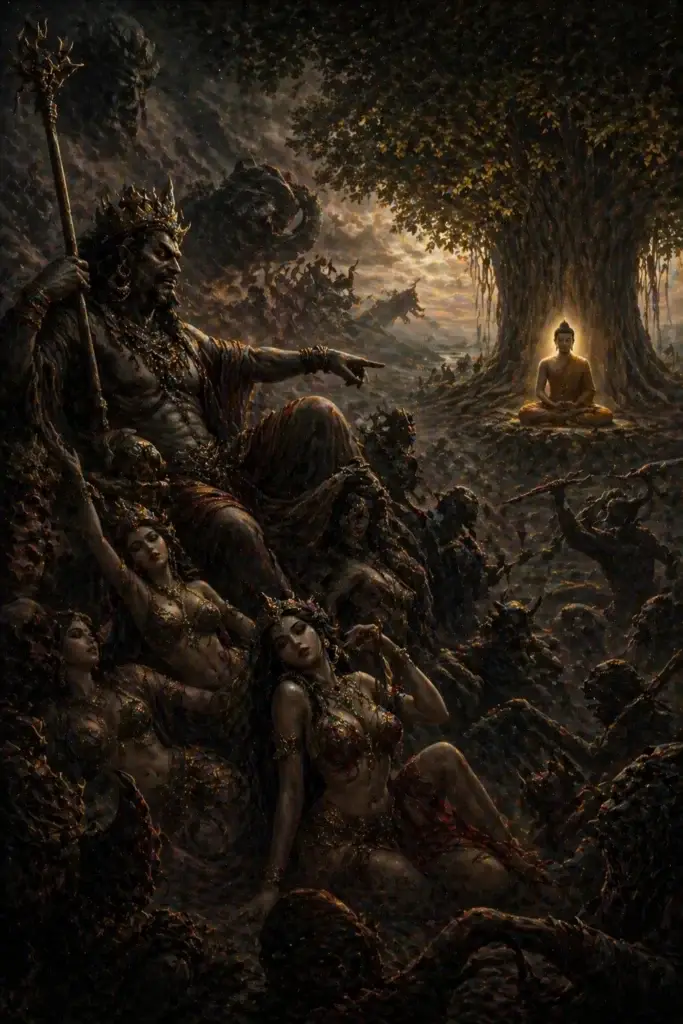
Mara too, the tempting antagonist beneath the Bodhi tree, is read not as an ontologically evil being but as a psychic-cosmic personification of entanglement in becoming.
The Buddha's death and the Cunda question
The Mahaparinibbana Sutta reports that before his death the Buddha took a meal at the home of the smith Cunda, which is designated “sukara-maddava”.
The translation is disputed: “tender pork” (Rhys Davids), “mushrooms that pigs dig up” (Walpola Rahula), “young bamboo shoots”. According to the sutta, the Buddha subsequently fell severely ill with bloody dysentery (lohita-pakkhandika); a bacterial food poisoning or a mesenteric infarction are regarded as modern hypotheses, but there is no scholarly consensus.
The Buddha publicly defended Cunda by saying that the alms meal preceding an enlightenment and the meal before the Parinirvana were two supreme merits.
This gesture has found broad attention in scholarship because it symbolically shifts the responsibility for the teacher’s death and relieves the question of guilt. In several essays Hellmuth Hecker has worked out the medical and phenomenology-of-religion aspect of Cunda.
Frequently asked questions
When did the historical Buddha live? Older scholarship dated him to 563 to 483 before the common era.
The investigations of Heinz Bechert have shown that the “short chronology” with life dates around 480 to 400 before the common era fits the source situation better. International scholarship today tends toward a date of death between 410 and 380 before the common era.
Where was the Buddha born? In Lumbini in present-day southern Nepal. The place is identified by name through an Ashoka pillar from the 3rd century before the common era.
What is the difference between the historical Buddha and the Buddha in the Mahayana? In Theravada Buddhism, Shakyamuni is the historical teacher of this world age. In the Mahayana he is one of many manifestations of a cosmically understood Buddha principle. Both conceptions exist in parallel and are discussed separately in the study of religion.
What language did the Buddha speak? Most probably an Old Indo-Aryan vernacular, presumably closely related to present-day Magadhi. The Pali in which the oldest canon is transmitted is a literarily smoothed form that is not identical to Magadhi but is related to it.