Jarilo, Slavic god of spring
By Ralf Ittermann · last reviewed on
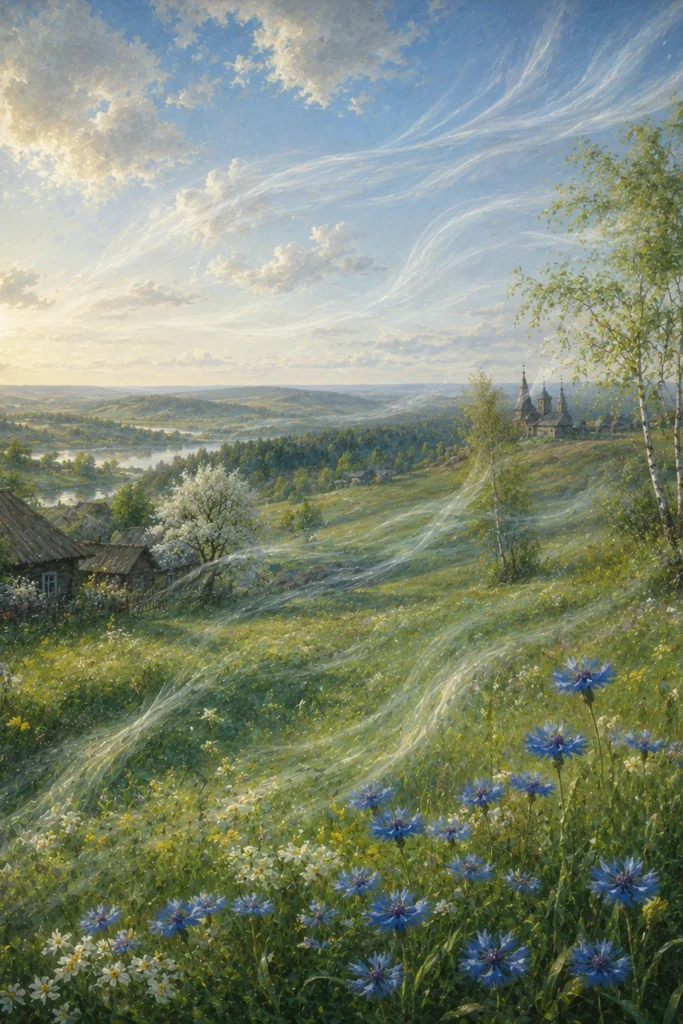
Jarilo is a Slavic god of spring and fertility whose festival opened the warmer, growth-rich season. Jarilo (also Jaryło, Jarila, South Slavic Juraj/Jurij) is, within the Slavic pantheon, a god of spring, of fertility and of reawakening vegetation.
He belongs to the deities of the “dying and rising” vegetation type and is connected with the annual cycle of death and resurrection of nature.
Unlike the gods of Vladimir’s group of six, Jarilo is not attested by name in any direct medieval source; his existence is reconstructed from the well-documented East and South Slavic folk tradition of the Jarilo customs.
Scholarship assesses him more cautiously than, say, Perun or Veles, but regards his function as a vegetation god as historically probable.

Profile: Jarilo
Jarilo: the most important aspects at a glance. The following fields summarise origin, function, appearance, veneration, symbols and parallels.
Jarilo comes from the folk tradition of the eastern and southern Slavs and is not named in any medieval source; his figure is reconstructed from customs. The name derives from Proto-Slavic “jarъ” (“spring, year, ardent”). The cult of Saint George is regarded as a possible Christian overlay of an older cult of Jarilo.
Jarilo is god of spring, fertility and reawakening vegetation, a “dying and rising” god. In spring he adorns the earth with blossoms and grain, marries Mara (Morena), is killed or buried at midsummer and returns the following spring.
The iconography is a reconstruction from folk tradition and Romantic art: a young man, often barefoot in a white shirt, sometimes with a wreath of ears of grain or flowers, riding a white horse, with a bundle of ears of grain or a skull in his hand. There are no medieval images.
On “Jarilin den” spring begins. In Serbia and Croatia a young lad in a wreath of grain rides through the village on a white horse. The burial of Jarilo (Pochorony Jarila) is celebrated in Belarus and western Russia around Midsummer (June 24); a straw effigy is buried or burned.
The white horse, ears of grain, a wreath of flowers or grain, and the skull as a sign of cyclical return belong to the image of Jarilo. The straw effigy or wooden figure in the burial bears a male phallus, which underlines the fertility-magic character of the practice.
Parallels exist with Adonis, Tammuz/Dumuzi, Osiris, Freyr and the Indian vegetation complex around Krishna; James George Frazer placed Jarilo in the complex of the “dying gods.” In folk religion he merges with Saint George (Jurij), and the West Slavic burning of Marzanna is regarded as a related custom.
Name and etymology
The name “Jarilo” derives from the Proto-Slavic “jarъ” (“spring, year, ardent”), with links to Russian “jaryj” (“fierce, passionate, bright as spring”), Czech “jarní” (“springlike”) and Serbian “jar” (“spring field, summer grain”).
This etymology clearly assigns Jarilo to the sphere of spring and vegetation. The suffix “-ilo” is a common Slavic formative element for male personal names and figures.
A connection with the Ukrainian-Russian “Jurij” (Saint George, the Slavic form of the name George) has prompted a lengthy discussion in scholarship.
Roman Jakobson and other linguists have proposed that in many regions the Slavic cult of George is a Christian overpainting of a pre-Christian Jarilo cult, because the date of Saint George (23 April, Julian) coincides with the Jarilo spring customs.
This thesis is plausible in terms of the history of religion, but hard to prove in detail.
Function and myth
The following mytheme can be reconstructed from folk tradition: Jarilo appears in spring, adorns the earth with blossoms and grain, marries Mara (or Morena, the winter goddess), is killed or ritually buried at high summer, and returns the following spring.
Vladimir Toporov and Vyacheslav Ivanov reconstructed this narrative in their structuralist works as a variant of the Indo-European “dying and rising god”.
In the South Slavic “Jarilo plays” the death of the god is ritually re-enacted: a straw figure or a young lad embodying Jarilo is carried through the village, then “killed” (by burning, sinking in the river or burial) and mourned.
These rituals are documented in Serbia, Bulgaria, Belarus, Ukraine and parts of Russia up to the early 20th century. James George Frazer treated them at length in “The Golden Bough” (1890 to 1915) and placed them within his complex of “dying gods”.
Veneration, customs and rituals
The “Jarilin den” (“Jarilo’s day”, usually in early May or on 23 April according to the Orthodox-Julian feast of Saint George) marks the beginning of spring.
In the Serbian and Croatian tradition, a young lad wearing a wreath of grain and a white garment rides through the village on a white horse; he is accompanied by young girls who sing songs.
In the Ukrainian tradition it is a young woman in men’s clothing who walks through the fields with a straw figure of “Jarilo”.
The “Jarilo burial” (“Pochorony Jarila”) is celebrated in Belarus and western Russia around Midsummer (24 June): a straw figure or wooden figure bearing a male phallus is buried or burned amid tears.
In this way the death of the vegetative force is symbolically enacted. In some regions the coffin is accompanied by love songs and obscene allusions, which underscores the fertility-magic character of the practice.
Sergei Tokarev (“Religioznye verovaniya vostochnoslavyanskikh narodov”, 1957) and Vladimir Propp (“Russkie agrarnye prazdniki”, 1963) documented these customs in detail and pointed out their parallels to the Adonis-Tammuz complex and to the West Slavic “burning of Marzanna”.
Iconography
Unlike most gods, no medieval images exist for Jarilo.
His iconography is a reconstruction drawn from folk tradition and the Romantic art of the 19th century: a young man, often barefoot and in a white shirt, sometimes with a wreath of grain ears or flowers, riding a white horse, holding a bundle of grain ears or a skull (as a symbol of cyclical return) in his hand.
This depiction is a condensation of the South Slavic festival customs and is not secured by historical sources.
Classification in the history of religion
Jarilo belongs to the widespread type of the “dying and rising vegetation god”. Structural parallels emerge with Adonis (Greece, with Phoenician-Syrian roots), Tammuz/Dumuzi (Mesopotamia), Osiris (Egypt), Freyr (Germanic) and the Indian vegetation complex around Krishna.
James Frazer and Mircea Eliade described this type as a universal structural motif; more recent religious studies are more cautious here and stress the cultural specificity of each individual tradition.
Within the Slavic pantheon, Jarilo stands in a structural relationship to Mara (Morena), the winter goddess and goddess of death, to whom he is ritually wedded, and to Veles, the god of the underworld and of the herds, into whose realm he passes after his death.
Boris Rybakov sketched a highly elaborate Jarilo theology in “Yazychestvo Drevney Rusi” (1987); this is today regarded as speculatively overloaded, though its essential features are largely taken up by more recent scholarship (Jiří Dynda).
Afterlife in folklore
Even after Christianization, Jarilo customs remained alive in South Slavic and East Slavic folk religion. The fusion with Saint George (Jurij, Jaroslav) is a classic example of syncretistic overpainting: Saint George’s fight with the dragon was, in many Slavic regions, linked with spring and vegetation themes.
At the “Jurjev den” in Serbia the saint is venerated as protector of the herds and of spring forces, which clearly points to pre-Christian layers.
In the Russian, Ukrainian and Belarusian folk tradition, Jarilo customs survived into the 20th century, often integrated into the “Rusalka” and “Kupala” festivals.
It was the Soviet era that systematically suppressed many of these customs; in recent decades they have experienced a revival, partly as folkloric cultivation and partly within the framework of the Rodnovery movement.
History of research
Scholarly engagement with Jarilo began in the 19th century with Romantic folkloristics (Pavel Chubinski, Aleksandr Afanasyev, Vuk Karadžić). These collections are rich, but uncritical in their evaluation. The critical turn was effected by Aleksander Brückner, who doubted the existence of Jarilo as an independent god.
Boris Rybakov and Aleksander Gieysztor rehabilitated Jarilo once more as a major god; Henryk Łowmiański and present-day scholarship follow a middle position: Jarilo is well attested as a ritual figure of folk religion, but his status as a major god of an official pantheon of the early Slavs remains uncertain.
Sources
Direct medieval sources for Jarilo are lacking. The reconstruction rests on: Russian, Ukrainian, Belarusian and South Slavic folk songs and accounts of customs from the 18th to the 20th century, collected by Aleksandr Afanasyev, Pavel Chubinski, Vuk Karadžić, Sergei Tokarev and Vladimir Propp; Serbian and Croatian ethnographic reports of the 19th and early 20th century.
Aleksandr Afanasyev, “Poeticheskiye vozzreniya slavyan na prirodu”, 3 volumes, Moscow 1865 to 1869. Vuk Stefanović Karadžić, “Srpski rječnik”, Vienna 1818 (lemma “Jurij”). Sergei Tokarev, “Religioznye verovaniya vostochnoslavyanskikh narodov”, Moscow 1957. Vladimir Propp, “Russkie agrarnye prazdniki”, Leningrad 1963. James George Frazer, “The Golden Bough”, 12 volumes, London 1890 to 1915.
Aleksander Brückner, “Mitologia słowiańska”, Krakow 1918. Aleksander Gieysztor, “Mitologia Słowian”, Warsaw 1982. Boris Rybakov, “Yazychestvo Drevney Rusi”, Moscow 1987 (with reservations).
Vladimir Toporov and Vyacheslav Ivanov, “Issledovaniya v oblasti slavyanskikh drevnostey”, Moscow 1974. Henryk Łowmiański, “Religia Słowian i jej upadek”, Warsaw 1979. Roman Jakobson, “Slavic Gods and Demons“, in: Selected Writings VII, Berlin 1985. Jiří Dynda, “Slovanské pohanství ve středověkých latinských pramenech”, Prague 2017.
The ethnographic source situation
Scholarly engagement with Jarilo rests above all on the ethnographic collections of the 18th and 19th centuries. In his monumental series of works “Poeticheskiye vozzreniya slavyan na prirodu” (3 volumes, 1865 to 1869), Aleksandr Afanasyev collected hundreds of Russian and Ukrainian folk tales, songs and accounts of customs in which Jarilo appears directly or indirectly.
Vuk Stefanović Karadžić (1787 to 1864) collected the Serbian evidence in parallel; his “Srpski rječnik” (Vienna 1818) and his song book contain detailed descriptions of the Jarilo plays in Serbia and Bosnia.
In Belarus and in the Ukrainian Carpathians, Pavel Chubinski (“Trudy etnografichesko-statisticheskoi ekspeditsii”, 1872 to 1877) and his research team collected numerous pieces of evidence that consolidate the picture of the dying and rising vegetation god.
In “Religioznye verovaniya vostochnoslavyanskikh narodov” (1957), Sergei Tokarev systematized this material and placed it on a scholarly footing; his work remains to this day the standard work of East Slavic religious ethnography.
Frazer and the "dying god"
In his monumental work “The Golden Bough” (12 volumes, London 1890 to 1915), James George Frazer placed the Jarilo tradition within the worldwide complex of “dying and rising gods”.
In his comparative religious-studies construction, Jarilo, Adonis, Tammuz, Attis, Dionysus and Osiris stand as representatives of the same structural type: young male vegetation deities who die and rise again each year, thereby embodying the cycle of nature.
Frazer’s construction was very influential in the 19th and early 20th century, but holds a difficult position in more recent religious studies. Mary Beard and Jonathan Z. Smith have shown that Frazer’s “dying gods” are often structured very differently and that the apparent commonality represents a constructed deep category.
This criticism has also reached Jarilo research: Vladimir Propp, Mircea Eliade and newer authors such as Jiří Dynda have sought to replace the Frazerian reading with a culturally and historically differentiated description.
Jarilo, Mara and the contest of the seasons
In folk traditions, Jarilo regularly appears in connection with Mara (also Morena, Marzanna, Marena), the goddess of winter and death.
The relationship is ambivalent: in some narratives the two marry in spring and Jarilo begets with Mara the vegetation of the coming season; in others Mara is his murderer, who kills him at high summer and takes him to the underworld.
In spring, in turn, Mara is “burned” or “drowned”, a practice well attested in West and East Slavic lands: the Marzanna figure is carried through the village at the end of winter and disposed of in the river or in the fire.
In their structuralist comparative mythology, Vladimir Toporov and Vyacheslav Ivanov reconstructed this complex relationship as the central myth of the Slavic vegetation year.
Their book “Issledovaniya v oblasti slavyanskikh drevnostey” (1974) offers the most extensive theoretical treatment of this complex, but is not tenable in all its details on account of its extreme structuralist method.
Saint George as a Christian overpainting
Roman Jakobson and others have advanced the thesis that in the Slavic world the Christian cult of Saint George (Jurij, Slavic Jurij or Juraj) frequently took the place of an older Jarilo cult.
Arguments for this are the temporal coincidence of Saint George’s day (23 April in the Julian calendar, that is, early May in the Gregorian) with the Jarilo festivals, the rural and vegetative symbolism of Saint George (patron of farmers, herdsmen and horses) and the fact that in many Slavic languages “Jurij”/”Juraj” and “Jarilo” sound alike.
This substitution hypothesis is plausible in terms of the history of religion, but hard to prove in detail. Henryk Łowmiański cautiously accepted it in 1979, Aleksander Gieysztor was more reserved.
More recent scholarship sees in the George-Jarilo connection a popular syncretism that does not necessarily go back to a deliberate “relabeling” by the church, but to a natural fusion of the calendar of saints with pre-Christian custom.
Straw figures and vegetation burnings
The burning or drowning of a straw figure embodying a male vegetation god is unusually well documented in the East and South Slavic folk tradition. The Belarusians, Ukrainians, Russians, Serbs, Bulgarians and Croats each have their own variants of this practice.
In Belarus the straw figure “Pochorony Jarila” (burial of Jarilo) is explicitly connected with the god’s name; in Ukraine the custom is often merged with the Kupala festivals on the day of John the Baptist (24 June), which in turn shows the link between the vegetation cult and the summer solstice cult.
A special variant is the “Kostroma” burial in the central Russian tradition: a straw figure named Kostroma is carried through the village, mourned and burned or drowned.
In some sources Kostroma is the “sister” of Jarilo, in others an independent figure. In “Nechistaja, nevedomaja i krestnaja sila” (1903), Sergei Maksimov documented the regional diversity of these customs in detail.
Indo-European comparative perspective
On the Indo-European comparative level, Jarilo belongs to the complex of young male vegetation deities that reaches from India to Scandinavia.
In the Germanic pantheon he corresponds structurally to Freyr (god of vegetation and fertility), in Greek mythology to Adonis (the dying youth loved by Aphrodite) and Dionysus (god of vegetation and wine), in the Phrygian-Mesopotamian tradition to Attis and Tammuz, in Egyptian religion to Osiris (the dying and rising god of vegetation and of the underworld).
More recent religious studies stress that these structural parallels do not necessarily go back to a genetic kinship. The “dying class of gods” can also be explained from universal experiences of the vegetation cycle, without one having to assume a direct historical connection.
In “Russkie agrarnye prazdniki” (1963), Vladimir Propp explained the Slavic vegetation myth in this way, more anthropologically than mythologically.
Jarilo in modern perception
In Ukrainian and Russian literature of the 19th and 20th centuries, Jarilo is a recurring figure.
Aleksander Ostrovsky integrated him prominently in his spring fairy-tale play “Snegurochka” (“The Snow Maiden”, 1873); Nikolai Rimsky-Korsakov recomposed this drama as an opera in 1881, in which Jarilo appears at the end as a god of the sun and of spring. This artistic treatment firmly anchored Jarilo in Russian high culture.
In the contemporary Rodnovery movement and in Slavic Neopaganism in general, Jarilo is one of the central principal deities. His festival is celebrated at the beginning of spring (often on 23 April, Saint George’s day, or at the equinox) and observed with vegetation rites, fires and communal meals.
This revival is, in terms of the history of religion, a new construction, but it ties in directly with the folk-religious tradition of customs that was still alive in the Slavic peasant communities in the 19th century.