Kanaloa: Hawaiian High God of the Ocean, the Underworld and Healing
By Ralf Ittermann · last reviewed on
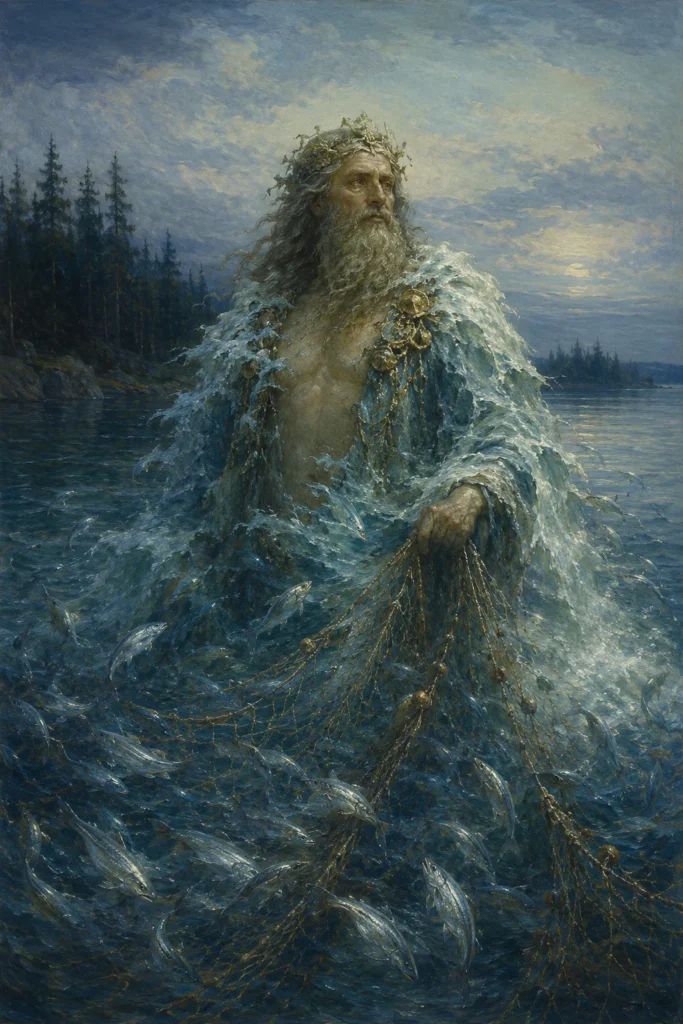
Kanaloa is, in Hawaiian religion, one of the four high gods (Ku, Lono, Kane, Kanaloa) and is regarded as the atua of the ocean, the underworld and healing.
He is a close parallel figure to the Maori god Tangaroa. This account describes his specifically Hawaiian form, his position within the pantheon and his cultural influence down to the present day.

Profile: Kanaloa
Kanaloa: the most important aspects at a glance. The following fields summarise origin, function, appearance, veneration, symbols and parallels.
Kanaloa is among the four high gods of Hawai’i (Ku, Lono, Kane, Kanaloa), who were systematically venerated in official temple liturgies. His name corresponds etymologically to Tangaroa, Tagaloa and Tangaloa. The change from t to k is a typical feature of Hawaiian.
Kanaloa is regarded as Atua of the ocean, of the underworld and of healing. He often appears as companion of Kane on creation journeys, on which both create springs of water, plant awa and establish ritual places. Beckwith sees in him the necessary other pole alongside the creative Kane.
Kanaloa is often depicted as a tall, calm god. In the layout of a heiau, particular stones or posts connected with sea rituals may be assigned to him. Stories in which he appears as a hero are rare; he acts primarily through ritual presence.
Kanaloa was venerated in certain, often coastal heiau. Fishermen invoked him before setting out, and whoever went to sea brought offerings on a shore and spoke pule. At the festival Makahiki, which was primarily dedicated to Lono, he also had a role.
His symbols are the octopus (he’e), certain fish and the deep water. To these are added stones and posts in heiau. In healing rituals the plant awa (kava) occurs; some Kahuna La’au Lapa’au invoked Kanaloa as the source of their healing knowledge.
Within Polynesia Kanaloa corresponds to Tangaroa, Ta’aroa, Tagaloa and Tangaloa, but is embedded more institutionally and ritually than the Maori Tangaroa. In comparative religion he is connected with Poseidon, Neptune, Varuna and Njörd.
Classification within the Hawaiian pantheon
Kanaloa belongs to the four high gods of Hawai’i, who were systematically venerated in official temple liturgies. The other three are Ku (war, comparable to Tu Matauenga), Lono (peace and fertility, see Lono), Kane (creation and light, comparable to Tane).
Valeri (Kingship and Sacrifice, 1985) analysed this fourfold structure systematically. From a religious-studies perspective it becomes clear that the Hawaiian system was more strongly institutionalised than the Maori system: there were fixed temples (Heiau), fixed priests (Kahuna), fixed rites and a strong connection between religion and royal house.
Even though Kanaloa belongs to the four institutionally venerated high gods of Hawai’i, the underlying theology, comparable to the Maori tradition, remains without a closed system of doctrine.
There is no fixed doctrine; whatever reality the atua possess, they prove in performance: in the Karakia, in the gatherings on the Marae, in the Whakapapa recitations.
This practice-based theology is valued by religious studies as a contribution to the field in its own right; Mary Ann Boord and Edward Tregear set it out systematically in their religious-ethnographic studies of Polynesia.
The study of Polynesian atua such as Kanaloa runs into a fundamental difficulty: many sources originate from the colonial 19th century and are coloured by the perspective of missionaries and ethnologists.
More recent research therefore pursues an ongoing decolonisation of these holdings by placing Polynesian voices at the centre and subjecting Western categories to critical examination.
If one compares Polynesian religion with other indigenous religions of Oceania, Australia and Southeast Asia, a twofold characteristic emerges: in its basic motifs it remains remarkably constant, yet at the same time it adapts locally.
The fact that Kanaloa, as a pan-Polynesian figure, presents himself differently from region to region is one example of this. This tension between universality and locality forms an important object of study in Pacific religious ethnology.
Name and Etymology
The name Kanaloa corresponds etymologically to Tangaroa (Maori, Tahiti), Tagaloa (Samoa), Tangaloa (Tonga). The phonetic shift from t to k is a typical feature of Hawaiian. The proto-Polynesian root is *Ta(n)galoa, whose exact meaning has not been securely reconstructed.
In Hawai’i, Kanaloa is not as frequently depicted as the main god of a narrative as Kane or Ku. He often appears as Kane’s companion on creation wanderings. This position as a “co-creator” is a specific feature of the Hawaiian form.
The fact that a god appears under numerous epithets points, in terms of language history, to an oral tradition that has branched out richly from region to region. With Kanaloa, whose name changes across the Polynesian languages, this can be observed well.
The linguistic depth of the Maori and Hawaiian theonyms is recorded in the lexicographical works of Bruce Biggs and Ross Clark, research that is at the same time fundamental for grasping the kinship of the Polynesian languages.
Epithets are often more than decorative adornment. They encode particular ritual functions and are fixed in the Karakia formulas. The Tohunga, the ritual experts, knew precisely which epithet was to be invoked in which situation. This precisely regulated liturgical practice is studied by Charles Royal and Pou Temara.
What original meaning belongs to the epithets is often disputed; with Kanaloa, whose proto-Polynesian root itself is not securely reconstructed, this is especially true. In many cases, competing etymological proposals stand side by side without secured sources allowing a decision. Modern religious studies values this diversity as a richness, not as a deficiency.
Description and Iconography
In the Hawaiian tradition, Kanaloa is often depicted as a tall, calm god. His symbols are: the octopus (he’e), certain fish, the deep water. In Heiau complexes, particular stones or posts connected with sea rituals may be assigned to him.
Beckwith describes that there are fewer narrative accounts comparable to those of Pele or Kane in which Kanaloa appears as a hero. Instead, he acts primarily through ritual presence. This “quiet” mode of action is interesting from a religious-studies perspective.
The carving art of the Maori and Hawaiians has undergone an impressive renaissance over the past five decades. Artists such as Cliff Whiting, Robyn Kahukiwa, Wright Bowman and Sam Ka’ai cultivated both traditional forms and modern adaptations.
The atua, among them Kanaloa, emerge in their works in many ways; their iconographic presence thus extends into contemporary art.
Polynesian art cannot be separated from its cosmological meaning. A spiral (koru), an ornament, a line: each of these elements carries religious-phenomenological meaning, including in the posts and stones that may be assigned to Kanaloa. Roger Neich, Damian Skinner and other art historians have systematically unlocked these layers of meaning.
The iconographic tradition is supplemented by a rich poetic tradition (mele, waiata) in which the divine is manifested through language and sound. From a religious-studies perspective, this practice corresponds to the concept of the “verbal icon”.
Kanaloa and Kane
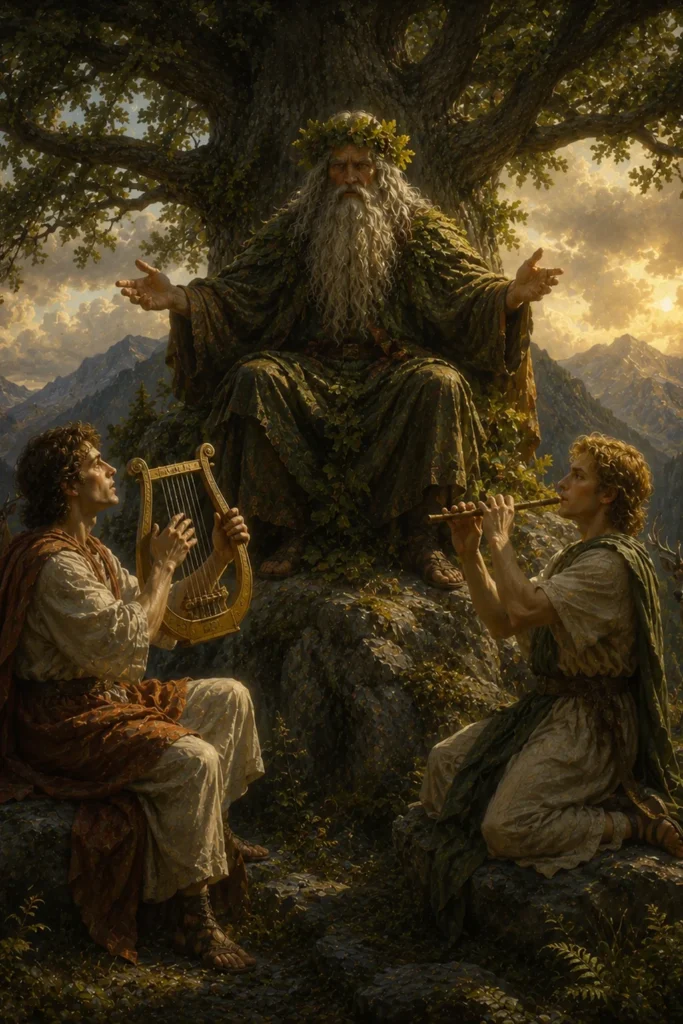
An important narrative tells how Kanaloa and Kane wander together across the islands. They travel, create water sources, introduce Awa (Kava), establish ritual places.
Kane is the initiating, creative god; Kanaloa is his companion, who often represents the darker or more problematic side. In some versions they try to drink Awa but find no water; Kane strikes the ground with his staff, and a spring wells up.
From a religious-studies perspective, this narrative is a classic creation myth with two gods who complement one another. It recalls Mesopotamian and West Semitic dual-god structures. Beckwith emphasises that Kanaloa is not the “evil one” here (unlike in some post-missionary reinterpretations), but the necessary other pole.
The narratives in which Kanaloa appears at Kane’s side are likewise not, from a religious-studies perspective, to be read as a self-contained narrative. They form a web of narratives that explain one another and are accented differently in the individual tribal traditions.
This rhizomatic, network-like structure makes research methodologically demanding, yet at the same time opens up hermeneutic depth. Versions of a story that differ from one another are not regarded as “false” or “corrupted”, but as regional forms of equal standing.
The narratives surrounding Kanaloa and Kane are not merely remembered but actively passed on: in Karakia, in the speeches on the Marae and in teaching. They are thus living practice and not a static archive. The language programmes for Te Reo Maori and Olelo Hawai’i have considerably strengthened this vitality over the last thirty years.
Kanaloa and the Underworld
In some traditions, Kanaloa is connected with the underworld (Po). This connection was often misunderstood by Christian missionaries from the 19th century onward, and Kanaloa was reinterpreted as the “Hawaiian Satan”. This reinterpretation is distorting in terms of religious history and is today rejected by Hawaiian scholars.
In the original context, Kanaloa’s relation to the underworld is not morally negative but cosmological: he stands for the depth, the night, the oceanic unconscious. The Po is not “hell” but primordial ground. Mary Kawena Pukui and Lilikala Kame’eleihiwa open up the correct reading.
The fact that Kanaloa is assigned both to the deep water and to the underworld fits into a basic feature of the religion of the Maori and Hawaiians: rite and everyday activity interlock.
While other religious systems sharply separate the sacred from the profane, here the references to the atua pervade the whole of life. This religiosity, anchored in the lifeworld itself, is the object of religious-phenomenological studies by Mason Durie, Charles Royal, Lilikala Kame’eleihiwa and other Polynesian scholars of the present generation.
How closely ritual practice and everyday life are connected is also shown by language: terms such as mana, tapu, aroha or hauora belong today to the general English of Aotearoa and are also used in non-religious contexts. That Maori theology has thus inscribed itself into linguistic usage documents its deep cultural impact.
Cult and Rituals
Kanaloa was venerated in particular Heiau, often near the coast. Fishermen invoked him before setting out, similar to the way Maori fishermen invoked Tangaroa. Kanaloa was also present in healing rituals: some Kahuna La’au Lapa’au invoked Kanaloa as the source of their healing knowledge.
Within the framework of the Makahiki festival, which was primarily dedicated to Lono, Kanaloa likewise had a role. Valeri describes the system of calendrical assignments of the gods.
Polynesian religion remains alive above all at Marae and Heiau, those places that are at once gathering and cult site; the Hawaiian Heiau in particular could assign Kanaloa his own stones and posts. Every Marae and every Heiau has its own Whakapapa, its own traditions and its own atua references.
A Marae visit begins with the Powhiri, the ritual in which the Tangata Whenua solemnly receive their guests. It is not ceremonial folklore but lived religious practice, which counts among the best-documented Polynesian greeting rituals in religious studies.
In the 20th and 21st centuries, cult practice has shifted noticeably. Whereas the Tohunga formerly carried the rite, this task today often lies with the Kaumatua, the elders, and with the Marae committees.
From the perspective of the sociology of religion, this shift is of interest; Manuka Henare and Mason Durie discuss it in their works.
Traditions of Protection
In the Hawaiian tradition, Kanaloa is invoked as a protecting god in sea voyages, in illness and in healing contexts. Those who went to sea brought offerings on a coast, spoke Pule and had certain rites performed by a Kahuna. This practice is today partly alive again within the framework of the Hawaiian renaissance.
Healing rituals in the Kanaloa sphere know plants such as Awa, whose use in ritual contexts is documented (Pukui). Here too it applies that the effect is not “magical” in the Western pharmacological sense, but integrated in the ritual-religious sense.
On the theme of protection, a religious-studies distinction must be made: Western thought proceeds from the effective amulet, the Polynesian from the cultivated relationship. Protection here does not rest on a magical-causal effect but is constituted relationally and ritually.
Whoever stands in relationship with an atua such as Kanaloa and maintains this relationship is considered “protected”, not because an object exerts power, but because an existing relation is cosmologically binding. In the anthropology of religion, this is treated under the heading of “relational ontology”.
The practice of protection is also a field on which tradition and modernity meet. Smartphone applications with Karakia, online guides to protective rituals and virtual Marae visits show that Polynesian religion takes up new media for its practice. This modernisation is not to be interpreted as a flattening, but as an adaptable further development.
Parallels in Other Cultures
Within Polynesia, Kanaloa corresponds to Tangaroa, Ta’aroa, Tagaloa, Tangaloa. In comparative religion he can be linked with Poseidon (Greek), Neptune (Roman), Varuna (Vedic), Njörd (Norse). The specific feature of Kanaloa is his position as a high god of equal standing alongside Kane and his connection with the underworld.
Compared with Tangaroa of the Maori tradition, Kanaloa is more institutionalised and more ritually embedded. This difference is explained by the different social structure of Hawai’i.
Universal structures of religious experience were studied systematically by Joseph Campbell and Mircea Eliade. As fundamental as their works are, they must nonetheless be rethought for the concrete Polynesian contexts, without lapsing into a pan-globalising simplification. More recent Polynesian research places great value on this context-sensitive interpretation.
Global indigenous-studies research systematically works out the parallels between Polynesian and other indigenous religions. With Decolonizing Methodologies (1999), Linda Tuhiwai Smith set methodological standards whose impact reaches internationally.
Reception Today
Kanaloa is less visible in the Hawaiian renaissance than Pele or Hi’iaka, but present nonetheless. Movements to revive the Heiau, the Kahuna tradition and the traditional healing art refer to Kanaloa. Hawaiian voyaging initiatives such as the Polynesian Voyaging Society (Hokule’a) integrate references to Kanaloa into their Pule before voyages.
In academic research, Lilikala Kame’eleihiwa and Marie Alohalani Brown have critically deconstructed the Christian-missionary distortion of Kanaloa. This opens up a more appropriate reading in terms of religious history.
In the international debate, Polynesian religion is increasingly recognised as an independent religious system and no longer devalued as mere “mythology” or “folklore“.
That terms such as mana, tapu, mauri and whakapapa have been taken up into the technical vocabulary of religious studies documents this recognition. Their use, however, requires a contextual sensitivity that is not to be had without preconditions.
The incorporation of Polynesian religions into popular culture, through Disney productions, tourism and esoteric literature, is the object of critical debate. Where does an appropriate mediation occur, and where is it flattened or distorted? These questions are discussed emphatically and publicly in Aotearoa and Hawai’i.
Research and Sources
Important contributions on Kanaloa come from Martha Beckwith, Mary Kawena Pukui, Valerio Valeri, Lilikala Kame’eleihiwa and Marie Alohalani Brown. Beckwith’s Hawaiian Mythology remains fundamental; Valeri’s Kingship and Sacrifice offers the structural analysis.
A deeper classification within the Polynesian family of religions shows the close kinship of Kanaloa with Tangaroa and the specifically Hawaiian form. Both gods share a common proto-Polynesian root.
Several institutions today carry the dialogue between the Polynesian-internal knowledge traditions and academic research: the Royal Society of New Zealand, Te Aparangi, the Maori Studies Department of Auckland University, the University of Hawai’i at Manoa and the Te Punga Tipu foundation.
Their institutional framework ensures that Polynesian research does not merely take place about Polynesia but is also conducted from Polynesia.
The connection to global religious studies is established by studies that use Polynesian theology as an example case of a non-Western religiosity. This comparative work is methodologically demanding, yet it opens up new perspectives on how religion can be understood as a cultural phenomenon.
The Separation from Kāne in Hawaiian Genealogy
In the Hawaiian creation traditions, Kāne and Kanaloa frequently appear as a pair who act together before a rupture occurs.
The versions gathered by Martha Beckwith in Hawaiian Mythology (1940) describe how the two gods wander across the islands and open springs with their digging sticks wherever they want to drink ʻawa. These spring-opening episodes bind Kanaloa closely to concrete water sources whose names the tradition has preserved.
The rupture is justified differently in several strands of tradition. One version makes Kanaloa the leader of a first generation of gods who rebel against Kāne and are banished into the depths, which was reinterpreted by missionary-influenced collectors of the 19th century into a Lucifer parallel.
From a religious-studies perspective, this reading must be treated with caution, since it transfers Christian narrative patterns onto Hawaiian material.
Other versions know no fall but a division of labour: Kāne rules over fresh water and the fertile land, Kanaloa over the sea and its creatures.
The paired invocation in the prayers of the kahuna argues that the older layer understood the two gods as complementary rather than hostile. The reference to Tāne in the New Zealand tradition shows that the name Kāne is pan-Polynesian in distribution, while Kanaloa corresponds to the Polynesian Tangaroa.
The Hawaiian peculiarity lies in the fact that Kanaloa here recedes behind Kāne, while Tangaroa elsewhere occupies a more central position. The genealogical chants documented by Abraham Fornander and later Kenneth Emory preserve several layers of this tension side by side, without any one of them being identifiable as the original.
The State of the Sources between Chant, Missionary Report and Modern Edition
Unlike the classical mythologies of the Mediterranean region, there is for Kanaloa no contemporary written source from pre-colonial times.
The Hawaiian tradition was oral until the 19th century, carried by genealogical and cosmogonic chants such as the Kumulipo, which was first written down in 1889 under King Kalākaua and edited and translated in 1951 by Martha Beckwith.
In this creation chant, Kanaloa does not appear as a main figure, which shows how differently the individual lines of tradition weighted their gods.
The earliest European notes come from missionaries such as William Ellis, whose Polynesian Researches (1829) mentions Kanaloa, but filtered through their own theological grid.
Sheldon Dibble and later Abraham Fornander, a Swedish immigrant and judge, collected more systematically from the 1860s onward; Fornander’s collection of material was published posthumously as the Fornander Collection of Hawaiian Antiquities and Folk-Lore (1916 to 1920) by the Bishop Museum.
A source genre of its own is formed by the Hawaiian-language newspapers of the 19th and early 20th centuries, in which Hawaiian authors such as Samuel Kamakau and Joseph Poepoe published traditions.
These texts are today regarded as especially valuable because they present the tradition from within, and they have been digitised and newly made accessible since the 1990s through projects such as ʻIke Kūʻokoʻa. For every statement about Kanaloa it therefore holds that it depends on a particular layer of tradition.
Whoever describes him as a pure sea god, as a fallen rebel or as a healing god beside Kāne is in each case quoting a different source, and the research of recent decades, for instance with Valerio Valeri and John Charlot, has above all worked out the polyphony of this tradition.
Kanaloa as Healer and Patron of the Octopus Fishers
Besides the cosmogonic role, Kanaloa has a concrete profile in Hawaiian everyday religion as the protecting god of particular activities. In the prayers of the kahuna lapaʻau, the healing specialists, he is invoked together with Kāne when healing herbs are gathered and prepared.
The spring-opening episodes of the wandering narrative provide the mythical background for this: where Kanaloa let water flow, the plants thrive from which medicine is obtained. This connection explains why his name appears so frequently in healing formulas, even though he recedes in the great creation chant.
Closely linked with the sea is his function as patron of octopus and squid fishing.
The Hawaiian term heʻe denotes the octopus, and Kanaloa is in some traditions conceived in this form himself or symbolised by it. Fishers who went out for heʻe directed prayers to him, and certain bait forms and fishing techniques were considered to stand under his protection.
This animal association connects Kanaloa with the wider Polynesian conception of Tangaroa as lord of all sea creatures.
Striking is the breadth of his responsibilities: fresh-water springs, healing plants, the open sea and its animals. From a religious-studies perspective, this argues against the older colonial narrowing of Kanaloa to a single aspect. Rather, a god emerges whose sphere of action was thought across the boundary of land and sea, precisely because he shared the wandering across the islands with Kāne. The modern Hawaiian renaissance has again more strongly emphasised this healing, caring side of Kanaloa and has thereby set an older understanding against the missionary-shaped image of the rebel.
Literature (Selection)
- Martha Beckwith: Hawaiian Mythology (1940)
- Mary Kawena Pukui: Nana I Ke Kumu (1972)
- Valerio Valeri: Kingship and Sacrifice (1985)
- Lilikala Kame’eleihiwa: Native Land and Foreign Desires (1992)
- Marie Alohalani Brown: Facing the Spears of Change (2016)
- David Malo: Hawaiian Antiquities (1898)
As a Hawaiian high god, Kanaloa stands beside Kane, Ku and Lono at the head of the pantheon; the transmitted myth connects him with the ocean, the underworld and healing knowledge.
Related key terms: Kanaloa Hawaii sea god Tangaroa-related four high gods Heiau Kane.
iWell Guard and Traditions of Protection
iWell Guard ties in with the cultural-historical tradition of portable protective objects, in the tradition of Polynesia / Maori and many other cultures worldwide. 41 layers, solid gold, platinum, silver, made in Germany. 30-day right of return.
Personal experiences may vary. Not a medical device. No healing promise.