Medea, Colchian sorceress and tragic heroine
By Ralf Ittermann · last reviewed on
Medea is one of the most layered figures in Greek mythology. She is a sorceress, a princess from distant Colchis on the Black Sea, a priestess of Hecate, the beloved and later the rejected of Jason, and a mother who kills her own children.
Her story combines myth, magic, and tragedy. Unlike divine figures such as Aphrodite or Eros, Medea is mortal, yet her magical competence and her closeness to Hecate place her in a position between humanity and superhuman power.
Origins and Mythological Framework
According to the Argonautica of Apollonius of Rhodes (3rd century BCE), Medea is the daughter of Aeëtes, king of Colchis, and granddaughter of the sun god Helios. Her aunt is Circe, the sorceress of the Odyssey. This kinship positions Medea within a lineage of magically gifted women at the margins of the Greek world.
Colchis lies on the eastern shore of the Black Sea, in a region the Greeks perceived as exotic and charged with magic. The association between Colchian origin and sorcery appears early in literature: Hesiod (Theogony 956) already mentions Medea as daughter of Aeëtes.
The Argonaut Myth and Aid to Jason
The central mythological context is the voyage of the Argonauts. Jason comes to Colchis to obtain the Golden Fleece. King Aeëtes sets impossible tasks: taming fire-breathing bulls, ploughing a furrow of dragon’s teeth, overcoming the warriors that spring from them, and retrieving the fleece from the grove of Ares.
Medea, having fallen in love with Jason (in Apollonius through the intervention of Eros), aids him with ointments and spells.
After the theft of the fleece she flees with the Argonauts, and during the pursuit she kills her brother Absyrtus, scattering his dismembered limbs into the sea to delay their father, who must stop to collect the pieces.
The murder of her brother is the first sign of her ambivalent position: she is Jason’s helper and at the same time the agent of a grave act of violence.
Euripides and the Corinthian Tragedy
The most celebrated treatment of the material is Euripides’ tragedy Medea (431 BCE). In Corinth, where the couple has settled after long wandering, Jason intends to repudiate Medea and marry the princess Glauce. Medea plans her revenge: she sends Glauce a poisoned robe that burns the bride and her father Creon to death.
She then kills her own two sons by Jason, to inflict on him the greatest possible pain. The tragedy ends with Medea’s escape on a dragon-drawn chariot sent by Helios.
Euripides’ Medea has left a lasting mark on European literature and theatre: she is the paradigmatic tragic heroine whose passionate love and absolute revenge are inseparably bound together.
Magical Competence and Connection to Hecate
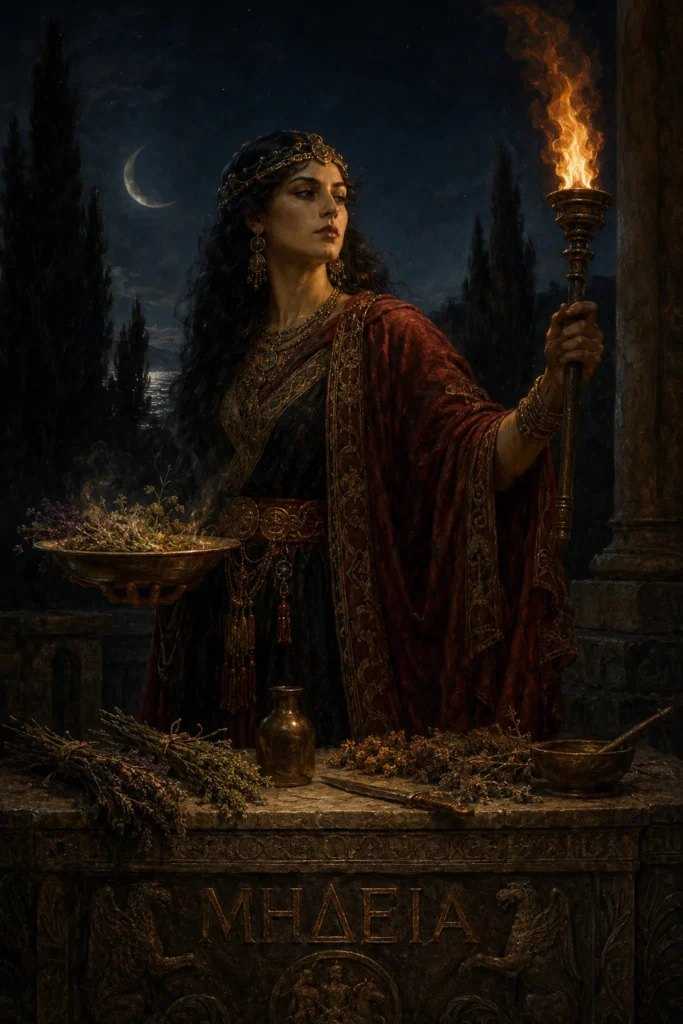
Medea’s magical practice is described in detail in the ancient sources. Apollonius and later Ovid (Metamorphoses 7) enumerate ointments made from rare herbs, spells spoken by moonlight, invocations of chthonic powers, and journeys by dragon-drawn chariot.
Hecate, goddess of crossroads and of magic, is Medea’s patron goddess: in Euripides’ play Medea confirms her oath by Hecate. This Hecate affinity places Medea within the tradition of the Greek Pharmakeutria, the herbalist and sorceress, who had a real social role in ancient popular religion and are attested archaeologically through curse tablets (defixiones).
Ovid’s Metamorphoses and Roman Reception
Ovid devotes a long book of the Metamorphoses to Medea, describing her magical operations in detail: the death of Pelias at the hands of his daughters, deceived by Medea, and the rejuvenation of Aeson, Jason’s father, through an herbal juice. Seneca’s tragedy Medea (1st century CE) sharpens the Euripidean model and turns Medea into an almost demonic figure of vengeful fury.
In the Roman pictorial tradition she appears on sarcophagus reliefs and wall paintings, often with inscriptions emphasising her Colchian origin. The reception continues through the Middle Ages (Boccaccio, Christine de Pizan) into the early modern period, where Medea becomes a key figure in discourses on female power and magic.
Modern Readings and Classification in Religious Studies
In modern scholarship Medea is discussed from several angles. Walter Burkert emphasised the Hecate connection and the pharmacological profile in Griechische Religion (1977). Feminist readings (Christa Wolf’s Medea. A Modern Retelling, 1996) interpret the tragedy as the story of a foreign woman who fails in Corinthian male society.
From a history-of-religions perspective, Medea is interesting as an example of the Greek processing of Colchian (Caucasian) magical traditions, in which real conceptions of sorcery are mythically transformed. The connection to Hecate makes her a bridge between the mythological heroine and cultic practice.
Related Topics: Hecate | Aphrodite | Eros
Medea as a Model Figure of Female Power
In the 20th century Medea becomes a key figure in feminist mythological readings. Christa Wolf’s novel Medea. Voices (1996) interprets the child-murderess as a healer defamed by Corinthian male society, whose true story has been obscured behind the tragic version.
In the dance-theatre tradition of Pina Bausch and in numerous modern stage productions, Medea appears as a woman whose magical competence, foreign origin, and emotional intensity are simultaneously the source of her fascination and her rejection. This reading is literarily productive, but cannot be straightforwardly argued against Euripides on historical-mythological grounds.
Magical Practice and Connection to Hecate
The connection between Medea and Hecate is dense in the ancient sources. Apollonius of Rhodes has Medea invoke Hecate as her patron goddess; Ovid follows this lead.
In the late antique Greek-Egyptian magical tradition (PGM), Hecate invocations appear that display structures familiar from the literary Medea tradition: nocturnal rites, preparation of potions, invocations with herbs from the Caucasus or Thessaly.
This practice does not simply mirror the myths; rather the influence runs the other way: the literary Medea acts as a stimulus for late antique Hecate magic.
Medea as a Cultural Cipher
The figure of Medea functions in Western culture as a cipher for several converging themes: female power in a patriarchal context, the foreign as a source of knowledge and threat, the entanglement of Eros and violence, and the tragedy of absolute love.
In the visual arts, from Eugene Delacroix’s Medea (1838) to Anselm Kiefer’s material works, she returns repeatedly as a pictorial subject.
In film, Pier Paolo Pasolini created an iconic adaptation in 1969 with Maria Callas, in which Medea travels back from Corinth to Colchis, a reversal that inverts the relationship between centre and periphery.
This cultural history of reception is significant for the history of religions: Medea stands for a form of the sacred that the official Greek pantheon could not integrate, the sorceress as a boundary figure between mortality and divinity, between knowledge and fear.
Sources
- Apollonius Rhodius: Argonautica, ed. Glei/Natzel-Glei, WBG (Darmstadt) 1996.
- Euripides: Medea, ed. Donald J. Mastronarde, Cambridge UP 2002.
- Sarah Iles Johnston: Hekate Soteira, Scholars Press (Atlanta) 1990.
- Hans Dieter Betz (ed.): The Greek Magical Papyri in Translation, Chicago UP 1986.
- Christa Wolf: Medea. Voices, Luchterhand 1996.
Medea in the Argonaut Myth
Medea first appears in the Greek tradition in connection with the voyage of the Argonauts. She is the daughter of King Aeëtes of Colchis, a land at the eastern edge of the Greek world-view, and granddaughter of the sun god Helios.
When Jason arrives in Colchis with the Argonauts to obtain the Golden Fleece, Medea falls in love with him.
The most detailed ancient account of this phase is provided by the epic Argonautica of Apollonius of Rhodes from the third century BCE.
Medea helps Jason to pass the impossible tasks set by her father: she gives him an ointment that makes him invulnerable to fire and iron, enabling him to tame fire-breathing bulls and defeat the warriors that grow from dragon’s teeth.
Finally she uses her magical arts to lull to sleep the dragon that guards the fleece.
The flight from Colchis is accompanied by a gruesome episode. According to the common tradition, Medea kills her own brother Absyrtus and scatters his limbs across the sea to stop their pursuing father, who must pause to collect the pieces. Other versions soften or alter this act.
Already at this early stage the dual nature of Medea is apparent, a duality that marks her entire tradition. She is Jason’s helper and rescuer, yet at the same time capable of extreme violence.
Scholarship emphasises that Medea is conceived as a woman from a distant land associated with sorcery, which made her simultaneously fascinating and threatening in the Greek imagination. Related figures of the magical arts include Circe, Medea’s aunt.
The Tragedy of Euripides and the Killing of the Children
The most influential portrayal of the figure of Medea comes from the eponymous tragedy by Euripides, performed in Athens in 431 BCE.
The play opens when Jason and Medea have long since fled Colchis and are living in exile in Corinth. Jason repudiates Medea in order to marry the daughter of King Creon and thereby secure a more advantageous position for himself.
Euripides depicts Medea’s response as calculated revenge. She sends the princess a poisoned robe and a poisoned diadem, which kill the girl and the hastening Creon.
Medea then resolves to kill her own children, whom she has had with Jason, in order to strike him in the most painful way possible. The play ends with Medea escaping on the dragon-drawn chariot sent by Helios, while Jason is left behind broken.
Scholars have long debated whether the deliberate killing of the children by the mother was an invention of Euripides.
Before Euripides there were apparently versions in which the children were killed by the Corinthians or died accidentally. Euripides appears to have attributed the act to the mother herself, thereby creating the psychological force of the play.
Famous is the long monologue in which Medea wavers between maternal love and the will for revenge. This monologue is among the most analysed texts in ancient tragedy. Euripides makes Medea neither a pure monster nor a pure heroine.
He shows a woman who, in a situation of legal defencelessness as a foreigner and a rejected wife, is driven to an act she herself recognises as terrible. This ambivalence has kept the play effective across the centuries.
Medea between Sorceress, Healer, and Goddess
Medea is difficult to pin down to a single category in the ancient tradition. She appears as a sorceress who works with herbs, ointments, and incantations, as a princess and granddaughter of Helios, and in some traditions even as an immortal, divine figure.
Her connection to the magical arts is close. Ancient sources link her to the goddess Hecate, the patron of magic. Medea’s arts encompass both harm and rejuvenation.
In a well-known episode described at length by Ovid in the Metamorphoses, among others, Medea rejuvenates the aged Aeson, Jason’s father, by replacing his blood with a juice prepared from herbs.
She uses the same art for deception when she persuades the daughters of Pelias to dismember their father in the false hope of thereby rejuvenating him.
In some local traditions, particularly in Corinth, Medea had cultic significance. There were accounts there according to which her children were venerated as heroes, possibly in connection with a ritual.
Some scholars have suggested that behind the literary figure of Medea stands an older, divinely conceived figure, perhaps a protective deity or a healing goddess. This hypothesis is speculative, however, and remains contested in scholarship.
The range from healer to killer, from princess to goddess, makes Medea one of the most complex figures in Greek mythology. Any classification from the perspective of religious studies must acknowledge this complexity rather than reducing her to a single type.
The Legacy of Medea from Rome to the Modern Age
The history of Medea’s reception extends without interruption from Antiquity to the present. In Rome the philosopher and tragedian Seneca wrote his own Medea, which pushed the figure even further toward revenge and unbridled passion than Euripides had done. Seneca’s version exerted a considerable influence on the early modern European theatrical tradition.
In the visual arts of Antiquity, Medea was a popular motif, appearing on vase paintings and Roman wall paintings that frequently depict her at the moment before the killing of the children, caught between sword and hesitating hand. A famous Pompeian wall painting portrays precisely this inner conflict.
In the modern period Medea remained central to the theatre. Pierre Corneille wrote a Medee in the 17th century; Franz Grillparzer produced a widely regarded German-language treatment in the 19th century with the trilogy The Golden Fleece, emphasising Medea’s foreignness and her failure in Greek society.
In the 20th century Christa Wolf’s novel Medea. Voices offered a reinterpretation that absolves Medea of guilt for the killing of the children and portrays her as a victim of political intrigue.
Opera and film also took up the material, including the opera by Luigi Cherubini and the film by Pier Paolo Pasolini.
Scholarship explains this enduring presence by noting that Medea embodies fundamental conflicts: between woman and male society, between foreigner and native, between love and revenge. Each era has emphasised different aspects of these tensions and interpreted her accordingly.
As a mythical figure, Medea combines Colchian healing knowledge, Hecate veneration, and tragic fate; in the Greek tradition she stands between priestess, sorceress, and princess.