Ate, Goddess of the Greek Tradition
By Ralf Ittermann · last reviewed on
Goddess of delusion, ruin and fatal decisions. Ate is a dark force in Greek mythology, not evil but ruinous. She sends madness and misjudgement into the hearts of heroes and kings. Her steps are quiet, her influence treacherous. She walks upon the earth and leads people into catastrophe by darkening their judgement.
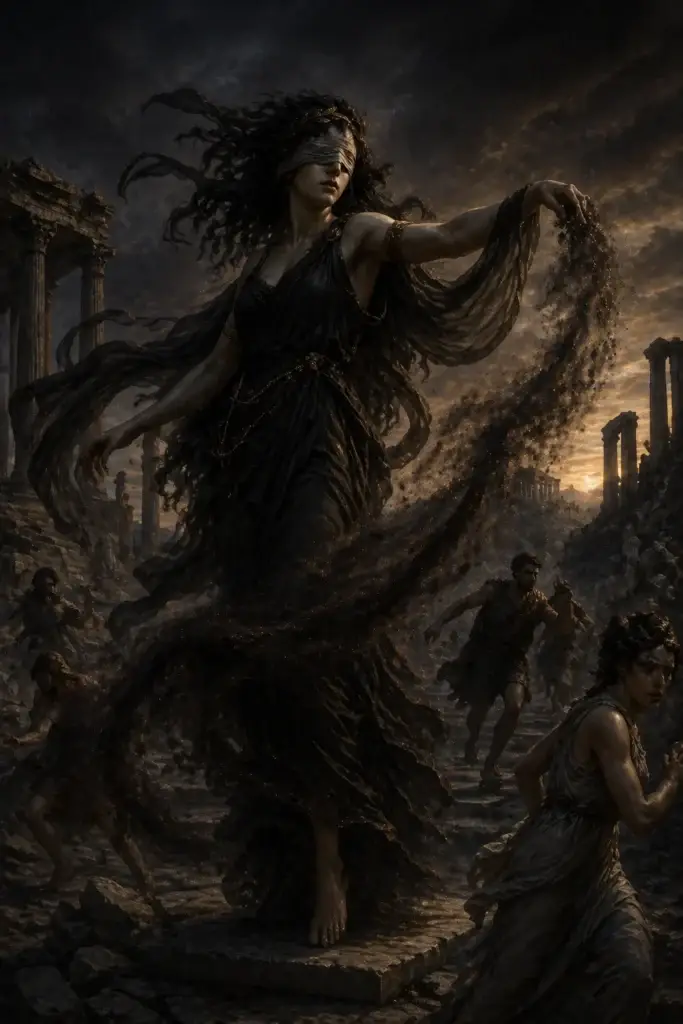
Ate
Ate in Homer’s Iliad: Goddess of Delusion and Ruin
Homer’s Iliad 9.502-512 contains the classic depiction: Phoenix speaks there about Ate, the goddess of delusion and bad counsel, and about the Litai. Ate represents the inability to foresee consequences and the temptation of wrong decisions.
In 19.85-138 she is described in detail: Agamemnon relates that Ate herself deceived Zeus and was therefore banished from Olympus. She is a goddess who runs lightly across the earth and destroys entire peoples by entering the minds of mortals and blinding them.
For Homer this goddess is a cosmological force, not morally judged but presented as a reality of human susceptibility to error. She embodies the tragic fate of the mistake, especially in war, where a flawed command costs thousands of lives.
Brief Profile: Ate
Type: Personification
Tradition: Greek mythology
Class: Demon/Goddess
Role: Delusion, error, madness
Sources: Hesiod Theogony 230, 232, Homer, Apollodorus, Plato
Sphere of effect: Mind, judgement, moral confusion
Main conflict: Divine will vs. human reason
Context
Period of the Texts
Hesiod’s Theogony, around 700 BC, is the oldest source (Ate as daughter of Eris). Homer’s Iliad IX, 500, 512 expands the characterisation. Greek tragedy of the 5th century BC (Sophocles, Aeschylus) uses Ate as a dramaturgical force. Later: Plato, Plutarch, the Stoics (Ate as inner darkening).
Area of Distribution
Ate belongs to the shared body of Greek myth and is not tied to a specific sanctuary or region. She is attested chiefly in epic and tragic poetry, from Homer and Hesiod to Aeschylus, texts that circulated throughout the Greek-speaking Mediterranean world. No dedicated cult site for Ate is confirmed, though local tradition in Ilion associated a hill with her fall from Olympus.
State of the Sources
Primary sources:
Hesiod, Theogony 230, 232
Homer, Iliad IX, 500, 512
Sophocles, Antigone 614 to 625
Aeschylus, Agamemnon
Secondary sources: Burkert, Griechische Religion 1977; Bremmer, Greek Religion 1994; Ziegler/Sontheimer (eds.), Der kleine Pauly; Graf, Greek Mythology 1993
Name and Variants
Ate is rarely depicted pictorially, since her force is invisible. She is described as swift-footed, often with madness in her gaze, and sometimes as a female daimon with a dark radiance. Her symbols are confusion, the false word, the fateful decision.
According to Homer she is hurled down by Zeus from Olympus to the earth, where the Litai (prayers for forgiveness) run behind her to repair the damage. Her presence is a change of atmosphere, a darkening of judgement.
Characteristics
Ate is not actively worshipped but feared and resisted. She is invoked in prayers for protection against delusion. She is a force that must be recognised; Sophocles and other tragedians are masters at showing Ate’s influence on heroes.
She sends atê (delusion, folly) that leads to ruin. In tragedy she is often the hidden force behind a hero’s downfall. Her veneration consists rather in rituals of aversion: sacrifices to appease the Litai, prayers for clarity.
Appearance and Symbolism
Ate is rarely depicted pictorially; Greek art developed no fixed image of her. She is described as a goddess who darted swiftly across the earth and Olympus without returning. Homer described her as a tender-footed goddess who walks over the heads of men; she deceives and seduces. She sometimes wore wings to underline her fleeting nature.
Unlike personified malice, she was rather human delusion itself made visible. Her attributes were confusion, deceit and the darkening of reason. She stood in close relation to Nemesis (retribution), who often followed her; whoever was seduced by Ate had to endure the punishment of Nemesis.
Ate in Hesiod and the Aeschylean Interpretation
Hesiod’s Theogony names Ate as a daughter of Eris. She is not as dominantly personalised as Zeus’s Ate in Homer, but her effect is present: she sows discord and ruin.
Aeschylus uses Ate in his tragedies as a motivating concept; the Agamemnon, for instance, is permeated by Ate: the king is deluded by pride (hubris), through which he defiles the temple and curses his family.
Aeschylus makes Ate the link between guilt and punishment, not as an external power but as an internal moral clouding. This shapes Greek tragedy as a whole: Ate is not fate in the sense of mere inevitability, but delusion that prepares guilt and makes ruin possible.
Profile: Ate
In Greek mythology, Ate is the personification of delusion, who leads gods and humans alike into rash deeds. Homer calls her a daughter of Zeus; in Hesiod she appears as a daughter of Eris, the goddess of strife. Her field of action is the moment of decision, when judgment and a sense of proportion fail.
Genealogy: In Homer daughter of Zeus, in Hesiod daughter of Eris. Ate exists as an autonomous cosmic force, older than conscious decision. She acts upon the mind before insight sets in.
Function: Ate causes delusion (ἄτη), a cognitive and moral darkening. An unintended cosmic force, not evil in the active sense. It affects primarily rulers and kings, whose wrong decisions trigger collective catastrophes. In tragedy: a curse spanning generations.
Greek art never developed a fixed visual representation of Ate; she remains above all a figure of poetry. Homer describes her as light-footed: she does not touch the ground but strides over the heads of men and confuses their minds. The Iliad also relates that Zeus, after the deception at the birth of Heracles, seized her by the hair and hurled her from Olympus to the earth; since then she has been at work among mortals.
Mythical effect: Homer’s Iliad: Ate deludes Zeus at the birth of Heracles, so that he swears an unholy oath in favour of Eurystheus. Aeschylus’s Agamemnon: the Ate of Clytemnestra and Agamemnon = the family curse of the House of Atreus. Examples: Phaethon (the horses of the sun), Pentheus (Bacchae), Ajax (madness). Sphere: war, blood, mourning, catastrophes.
As protective powers against Ate, the Iliad names the Litai, the personified prayers, who as daughters of Zeus follow behind delusion and soften its consequences. Whoever honors the Litai and asks forgiveness can, according to Homer, limit the damage done by Ate; whoever turns them away draws fresh misfortune upon himself. No physical amulet against Ate is recorded in the ancient sources; the protection lies in conduct: prudence, moderation, and timely atonement.
Related personifications in other cultures: The Greek Ate as the embodiment of delusion has a distinct position in Hellenic thought, yet can be compared functionally with similar concepts of other traditions.
In Mesopotamia the Akkadian Namtar appears as personified doom; in the Hebrew tradition the Book of Proverbs (Mishlei) knows the hardening of the heart as divine punishment (cf. the hardening of Pharaoh, Ex 7-14).
In the Roman adaptation, Discordia appears as a sister concept to the personifications near the Erinyes; Furor in Virgil (Aeneid I, 294) dramatises a comparable blind driving force. In the Indian sphere of thought, Moha (delusion, confusion), as one of the three root evils of Buddhism, corresponds to this complex.
Ate, however, is not merely a personification but an acting power; her expulsion by Zeus (Hom. Il. XIX, 91-133) marks a mythical rupture between the divine sphere and human error.
Aversion in Everyday Life
Rituals and Aversion
Antiquity: primarily philosophical and literary. The Stoics recommended self-control and insight. Sanctuaries of Metis carried out rituals for divine insight. Sacrifices to Zeus and Themis were regarded as protection against family curses.
Conjurations and Invocations
Few direct conjurations, since Ate was no independent deity. In tragedy: prayers to Athena or Metis. Stoic philosophers taught an inner conjuration through reason and virtue.
Amulets and Protective Symbols
An owl amulet (the Athena symbol) was regarded as protection against delusion. Roman households: protection against misjudgement within the family (Minerva amulets).
Ate, Parallels in Other Cultures
Gods and daimons of ruin and delusion exist everywhere: the Erinyes (Greece, vengeance), Hecate (confusion and crossroads), Lilith (Hebrew, seduction into error). Ate’s function resembles the Sanskrit concepts of avidya (ignorance) or maya (illusion).
She shares with Eris (strife) and Nemesis (retribution) the role of guardian of cosmic balance, not to punish but to chastise hubris. Ate’s difference from other forces of ruin lies in her subtlety: she darkens the mind, not the mind itself.
Ate and Cosmic Justice in Euripides and Later Authors
Euripides uses Ate as a concept to deepen the irony of human tragedy. In The Bacchae, for instance, Pentheus is driven to his ruin by Ate as blindness toward the truth of Dionysus. This is not the punishment of an external god but the result of his own inability to see.
Plato and the later philosophers integrated Ate into theoretical ethics: she is the absence of phronesis (practical wisdom), the incomplete understanding that poisons decisions.
In this reading Ate becomes an inner psychological state rather than a goddess, a concept carried forward by modern psychology. Mythologically she remains a power to be taken seriously; theologically a description of human susceptibility to error.
Ate in Homer and the Fall from Olympus
The earliest detailed depiction of Ate is found in the Iliad. There she appears not merely as an abstract term for delusion but as an acting figure.
In the nineteenth book, Agamemnon, in order to explain his quarrel with Achilles, tells a story in which Ate is responsible for his delusion. He says it was not he who was to blame, but Zeus, fate and Ate who walks in darkness and confused his mind.
Famous in this context is the episode of Ate’s own fall. Homer relates that Zeus himself was once deceived by Ate, concerning the birth of Heracles, and that he thereupon seized her by the hair in anger and hurled her down from Olympus among men, swearing that she might never return to the heavens.
Since then, the text says, Ate walks upon the heads of men and works ruin among mortals.
This narrative is significant for the history of religion because it describes delusion as a power that could overcome even Zeus, but that is now permanently banished into the world of men. Ate is no longer a power of Olympus but an earthly plague.
Homer portrays Ate as delicate-footed, for she does not touch the ground but strides over the heads of men and brings them harm.
In the Iliad she is contrasted with the Litai, the prayers or pleas of repentance, which limp lamely and wrinkled behind her and try to make good the harm Ate has caused.
This image links delusion with the question of guilt, repentance and atonement, and makes Ate one of the most striking allegorical figures of the Homeric epic.
Ate in Hesiod's Lineage of Harmful Powers
A different classification of Ate is offered by Hesiod’s Theogony, the great work on the origin of the gods and the order of the world. Hesiod places Ate within a genealogy that makes clear to which sphere he assigns her. There Ate appears as a child of Eris, the goddess of strife and discord.
This descent is programmatic. According to Hesiod, Eris brings forth a whole series of dark powers, among them toil, forgetfulness, hunger, pains, battles, murders, quarrels, false words and finally Ate, delusion, as well as the Oath that punishes the perjured.
Ate thus stands within a family that covers the entire field of social ruin, from discord through lies to violence.
By making Ate the daughter of Eris, Hesiod gives an interpretation of her nature. Delusion is therefore no chance mishap but springs from strife. Where discord rules, there delusion grows, and from delusion follow further evils. This genealogy is Hesiod’s method of translating abstract connections into relationships of kinship.
It is noteworthy that Homer and Hesiod locate Ate differently: Homer binds her to Zeus and Olympus and tells of her fall, while Hesiod places her in the lineage of the plagues produced by Eris. The two depictions do not fundamentally contradict each other; they illuminate different aspects.
Delusion is a power that once stood close to the gods, yet by its nature belongs to the realm of strife and human self-destruction. This duality shaped the ancient understanding of Ate well into later literature.
Delusion, Guilt and Punishment in Attic Tragedy
In the Attic tragedy of the fifth century before our era, Ate becomes a central interpretive concept for the downfall of people and houses. In Aeschylus in particular, the idea of delusion runs through his entire work.
In the Oresteia and in the Theban plays, Ate appears as a power that is passed down from generation to generation and drags whole lineages into the abyss.
Characteristic of the tragic understanding is the close connection of Ate with two further terms, hubris, immoderate arrogance, and nemesis or tisis, the balancing punishment.
Tragedy often traces a chain at whose beginning stands prosperity, which leads to satiety; satiety gives birth to arrogance, arrogance draws delusion after it, and delusion leads to the fateful deed and thus to ruin. In this scheme Ate is the link that translates the inner state of a person into outward doom.
Important here is the problem of guilt. Delusion comes from outside, often described as sent by a deity, and yet the deluded person acts and bears the consequences. Tragedy deliberately sustains this tension: the human being is victim and perpetrator at once. Ate is the concept on which this twofold view is fixed.
In Sophocles and Euripides too, delusion remains a key motif, for instance where a hero ignores the warning signs and rushes into his ruin.
Tragedy has thus made the Homeric figure into a profound concept of human existence, one that is still examined in detail by classical philologists and scholars of religion, for example in the studies on the Greek understanding of guilt.