Yama Buddhism, god of the Buddhist tradition
By Ralf Ittermann · last reviewed on
Yama Buddhism is a god of the Buddhist tradition.
The Buddhist god of death and judge of souls after death.
In Buddhism, Yama acts as a karmic judge and administrator of the hell worlds.
Yama Buddhism
Type: Major Buddhist deity (Mahayana, Vajrayana), judge of the dead and keeper of the Dharma
Pantheon: Buddhism (all schools), adopted from the Hindu Yama
Function: judge of the dead, keeper of the lawfulness of karma, in the Tibetan tradition a wrathful deity
Main attributes: book of the dead, mirror of karma, sword (Khadga), noose (Pasha), black buffalo
Main places of cult: Tibetan Gelug monasteries (Cham dance), Japan (Enma-O), Vietnam (Yamaraja)
Various forms: Yama-Dharmaraja (Tibet), Enma-O (Japan), Yeomra (Korea), Yanluo (China)
Classification
Yama is carried with Buddhism from India into all Buddhist countries (Vedic precursor in the Rigveda, from 1200 BC onward). In the Pali tradition (Theravada) he is the chief examiner in the court of the dead (e.g. in the Devaduta-Sutta).
In Mahayana he has his own Sutra corpus. In Tibet, since the 8th century AD, he has been central as Yama-Dharmaraja in the wrathful-deity pantheons of the Vajrayana tradition. Main period of flourishing: in Tibetan Gelug monasteries to this day, with dramatic Cham dance performances.
Main places of cult: Tibetan Gelug monasteries (Drepung, Sera, Gandän, Tashilhunpo, with the Yama-Dharmaraja Cham dances), Japan as Enma-O (in every temple of the dead), Vietnam as Diem Vương. In Theravada countries (Thailand, Myanmar, Sri Lanka) as a cosmic background presence. In China as Yanluo (separate page).
Central sources: Devaduta-Sutta (Pali), Yama Sutra (Chinese), the Tibetan Bardo Thodol (the “Tibetan Book of the Dead”, classical source of the Yama-Dharmaraja theology), tantric texts on the Yama-Dharmaraja sadhana.
Secondary literature: Lopez, The Tibetan Book of the Dead. A Biography; Linrothe, Ruthless Compassion. Wrathful Deities in Early Indo-Tibetan Esoteric Buddhist Art; Williams, Mahayana Buddhism.
Name
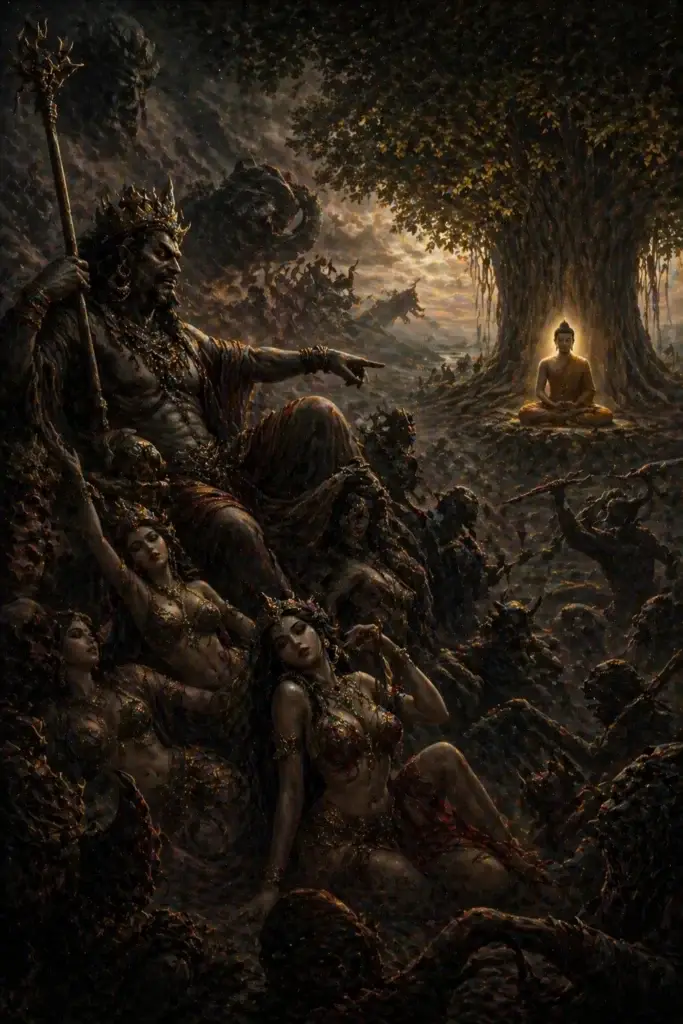
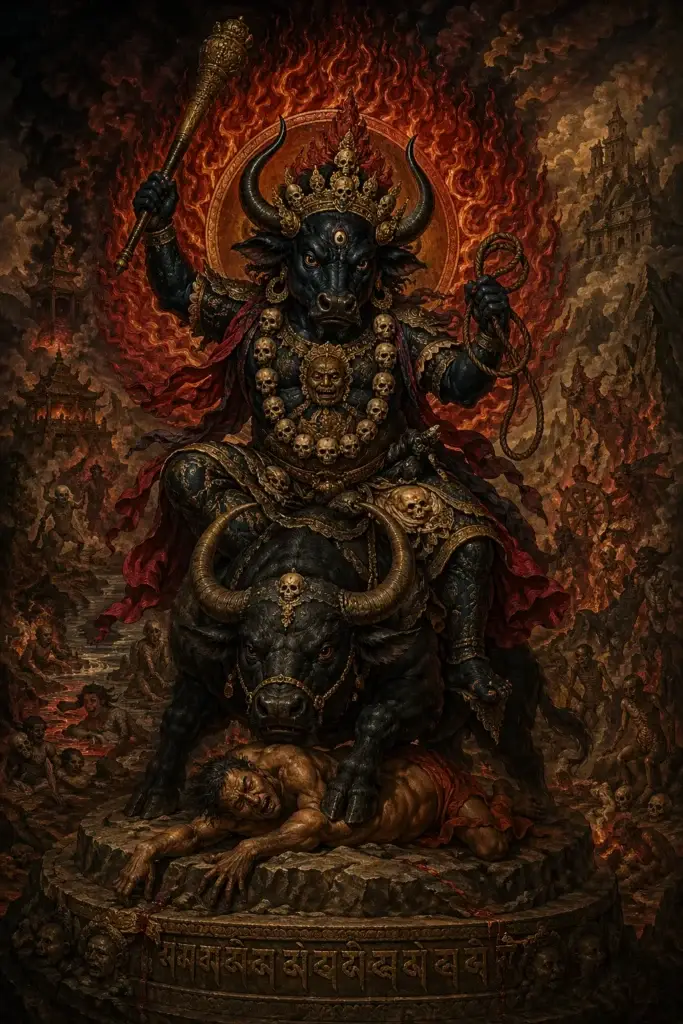
The Buddhist Yama is often depicted with a bull head, massive horns, a terrifying face, and black or dark blue skin. Sometimes he has two or four arms. He carries a Damaru (hand drum) and a lasso made of a rope of souls.
Demons and Yaksha dance around him. Fire surrounds him; blood drips from his mouth. In Tibetan artwork he often sits in a cave or in his palace in Naraka.
Characteristics
Yama in Buddhist teaching is not punishment but a mirror. The Yama judge is automatic: every action (Karma) will have its consequence. In tantric practices Yama is not implored for mercy but visualized as a teacher of impermanence.
The rites of death in Tibetan Buddhism address Yama directly, with the request to open a favourable Bardo path for the soul. Practitioners learn to meet Yama without fear.
Profile: Yama Buddhism
The most important aspects of Yama (Buddhism) at a glance. The following fields summarize origin, function, appearance, worship, symbols and cultural parallels.
Yama is adopted in Buddhism from the Hindu Yama (the first man to die in the Vedic tradition), keeps the function of judge of the dead, but is reinterpreted in Buddhist terms: not an arbitrary judge, but a mirroring mediator of karma.
In the Tibetan Bardo-Thodol system he appears to the deceased in the bardo state between death and rebirth; his mirror shows the dead person their own karma, without Yama himself passing judgement. The punishment results from one’s own karmic reaction. In wrathful form as Yama-Dharmaraja: protector of the Dharma against all threats.
Judge of the dead in the bardo state. Keeper of the lawfulness of karma. In the tantric Vajrayana tradition a protective yidam (meditation deity) against all inner and outer threats, especially against the fear of death.
Patron of the practice of self-examination (the honest seeing of one’s own deeds). In Tibetan Cham dances a ritual reminder of mortality.
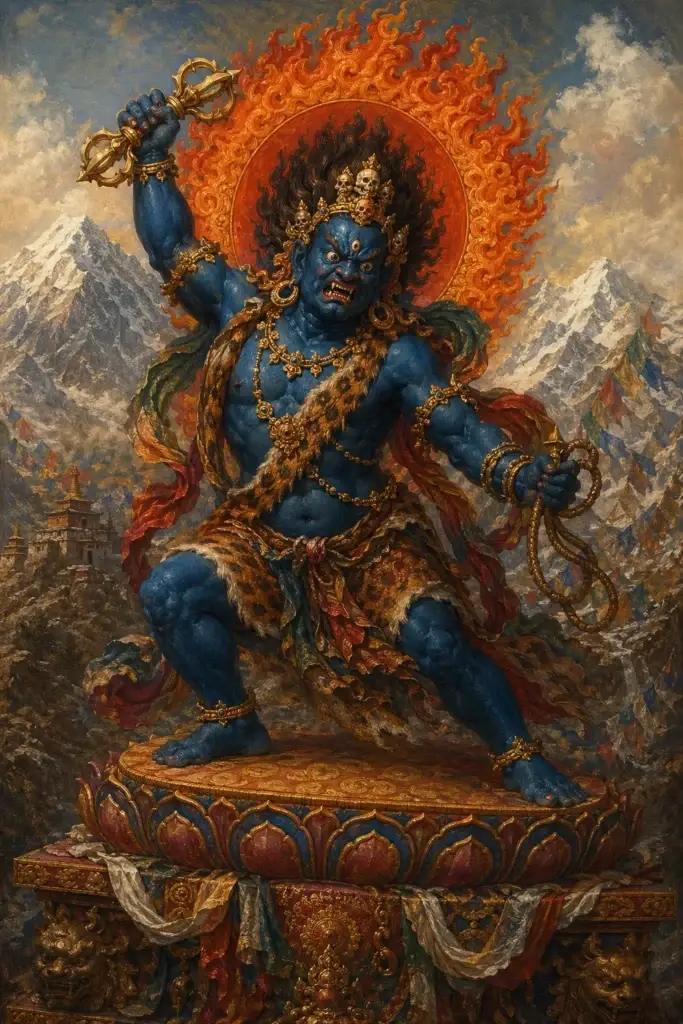
In most Asian traditions anthropomorphic, as a stern official with a book of the dead and a writing stylus. In the Tibetan Vajrayana tradition as Yama-Dharmaraja: a dark blue or black wrathful figure with a buffalo head, three eyes, flaming hair and a flaming aureole.
Bone ornaments, a tiger-skin loincloth. In his hands a skull cup (Kapala), a Khatvanga (skull staff), a noose (Pasha), a sword. He rides a black buffalo that tramples a human underfoot. He is accompanied by his sister Yami.
Sphere of effect: In the Tibetan Bardo Thodol, Yama is expected to appear in the bardo state, and the dying are prepared for the encounter with him. In Tibetan Cham dances there is a ritual confrontation with the judge of the dead (with dramatic masks).
In tantric practice he is meditated upon as a protective yidam. In Theravada and Mahayana rites of the dead he serves as a background mediator of karma. In Japan he is central as Enma-O in every Buddhist cemetery.
Book of the dead, mirror of karma (Karma-Darpana), sword (Khadga), noose (Pasha), black buffalo (mount), Khatvanga (skull staff), Kapala (skull cup), buffalo head (in the Tibetan wrathful form), third eye, flaming hair. Sacred plants: none specific. Sacred direction: south (in the Indian tradition).
Yama (Hinduism, root), Yamaraja (Hinduism / Buddhism), Yama-Dharmaraja (Tibet, wrathful Vajrayana form), Enma-O (Japan), Yeomra (Korea), Yanluo (China, fifth of the Ten Kings of Hell), Hades (Greece), Anubis/Osiris (Egypt, guide and judge), Hel (Germanic), Mictlantecuhtli (Aztec).
Yama is one of the most widely distributed concepts of a god in the world (from India across all of Asia to Japan).
Practical defence
Rituals for defence
Buddhist Yama defence ritual: recitation of Dharani texts and bodhisattva invocations in times of danger (the dying process, near-death experiences). Goma fire rituals (Tibetan fire offerings) are directed against Yama’s punishment.
The chanting traditions use mantras of the compassionate gods to soften Yama’s verdicts. Chinese Buddhist folk practice: paper notes at the Jade Emperor temple, to appease the judge Yama.
Conjurations and invocations
Jizō mantras (the bodhisattva of hell) and Avalokiteshvara invocations are regarded as a defence against Yama’s punishment. The Sutra of Great Compassion (Karuna Sutra) is recited. Tibetan: the Yamantaka visualization in the Guhyasamaja Tantra, the aggressive defeat of Yama by the “demon-subduer Yamantaka”. Sanskrit original text: “Om jñana-jyoti dharma dhara Yamantaka hum phat”.
Amulets and protective symbols
Jizō statues as protective symbols in Chinese and Japanese temples. A Buddhist bracelet (Mala) with 108 beads, ritually connected with the appeasement of the guardians of hell. Archaeological evidence: Buddhist stone steles from the 7th century in China/Korea that contrast the judge Yama with bodhisattva rescuers.
Yama Buddhism, parallels in other cultures
Yama between Vedic heritage and Buddhist reinterpretation
The Buddhist figure of Yama did not arise independently, but emerged from an older Indian deity. In Vedic India, in the hymns of the Rigveda, Yama is the first human to die, and thus the king of the dead who has found the way into the afterlife.
He rules over a bright realm in which the deceased ancestors gather, and is rather a friendly receiver of the dead than a punishing judge.
Buddhism adopted Yama, but changed his function considerably. In Buddhist cosmology, Yama becomes the lord of the underworld and the judge who decides on the rebirth of the deceased, in particular on who enters the hell realms.
This shift from receiver of the blessed to judge of the guilty is connected with the central Buddhist teaching of karma: the fate after death follows from one’s deeds, and Yama becomes the instance that represents this connection.
religious studies offers the insight that Yama, in the strict Buddhist understanding, does not judge of his own accord. The texts repeatedly emphasize that karma itself determines rebirth and that Yama rather holds the deceased’s own deeds before their eyes.
A well-known parable from the Devaduta Sutta of the Pali Canon has Yama show the deceased the divine messengers, old age, sickness and death, and ask whether they had not noticed these warnings.
Yama in Tibetan Buddhism and the Wheel of Life
In Tibetan Buddhism, Yama attained a particularly pronounced iconographic and ritual significance. Here he usually appears as Shinje, in a terrifying form, with a bull head, a wreath of flames and the attributes of a judge of the dead, often standing on a bull.
Especially well known is his depiction on the so-called Wheel of Life, the Bhavachakra. In this widely distributed pictorial composition, which adorns the entrance area in many monasteries, a large, teeth-baring being holds the wheel of the six realms of existence in its claws and teeth.
This clutching being is usually interpreted as Yama, as the embodiment of impermanence and of death, to which all conditioned forms of existence are subject. The image expresses the teaching that every realm of rebirth, including the heavens, is subject to death and thus to Yama’s grip.
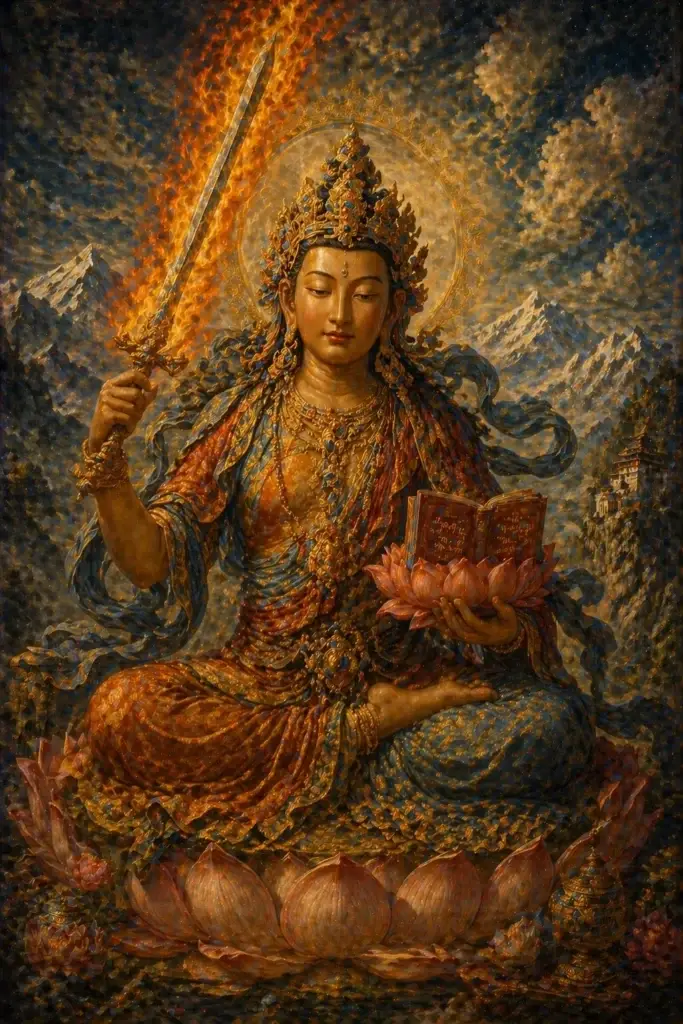
Alongside this, the Tibetan tradition knows the meditative figure of Yamantaka, whose name means the subduer of Yama or the ender of death. Yamantaka is regarded as a wrathful manifestation of the bodhisattva Manjushri and embodies the wisdom that overcomes death itself.
In this constellation, Yama’s ambivalent position becomes clear: he is lord of death and at the same time a power that can be overcome in awakening. Scholarship sees in the rich Tibetan Yama iconography a fusion of Indian models with local Tibetan ideas of mountain and death deities.
Yama in East Asia: From the Indian god to the hell judge Enma
With the spread of Buddhism to China, Korea and Japan, Yama too travelled and was there deeply embedded in local notions of the afterlife.
In China the Indian figure merged with ideas of a bureaucratically organized underworld and became Yanluo Wang, King Yanluo, one of ten Kings of Hell, each of whom leads a court of the underworld.
These Ten Kings of the Underworld examine the deceased in successive instances, and the dead person passes through them one after another before a decision is made about their next existence.
Within this, Yanluo Wang usually takes the position of the fifth king. The whole system mirrors the experience of the earthly hierarchy of officials, with registers, verdicts and measures of punishment.
In Japan this figure was adopted as Enma or Enma-ō, in Korea as Yeomra. Enma is a well-known figure in Japanese folk religion, often depicted with a reddened face, a judicial headdress and a writing tablet or mirror in which the deeds of the deceased become visible.
Religious studies emphasizes that the East Asian formations go far beyond the Indian model and that Yama there became a fixed component of popular notions of the afterlife, which combine Buddhist, Daoist and folk-religious elements.
The transformation from the Vedic figure of light through the Indian Buddhist judge to the East Asian hell bureaucrat is a textbook example of religious cultural transfer.
Further links
Literature (selection)
Further standard works in the literature index.